Custom Hats for Fundraisers and Charity Events: Design Ideas That Sell
Create custom hats that generate maximum fundraising revenue. Covers design strategies for charity events, pricing for profit, cause-related messaging, golf tournament hats, walk/run merchandise, and donor appreciation headwear.
Marcus Chen
E-Commerce Growth & Merchandising Lead at RareCustom. MBA from Wharton, former Shopify strategist. Marcus has helped 200+ merchants launch custom merchandise lines and specializes in business strategy, bulk ordering, and fundraising programs.
Custom hats are one of the highest-margin merchandise items for fundraisers and charity events. Unlike printed custom t-shirts that typically sell for $15-$25, custom hats command $20-$35 retail pricing because consumers perceive embroidered headwear as a premium product worth more than screen-printed apparel. With production costs of $8-$14 per unit, a well-designed fundraiser hat generates $10-$20 profit per sale — multiplied across an event with 200-500 attendees, that is $2,000-$10,000 in fundraising revenue from a single merchandise category.
This guide covers fundraiser hat design strategies that maximize both aesthetic appeal and sales velocity, pricing frameworks that balance affordability with profit margin, cause-related messaging techniques, and event-specific approaches for golf tournaments, walks/runs, galas, and community festivals. Every design recommendation is grounded in what actually sells at events — not just what looks good on a screen.
Design Strategies That Maximize Sales
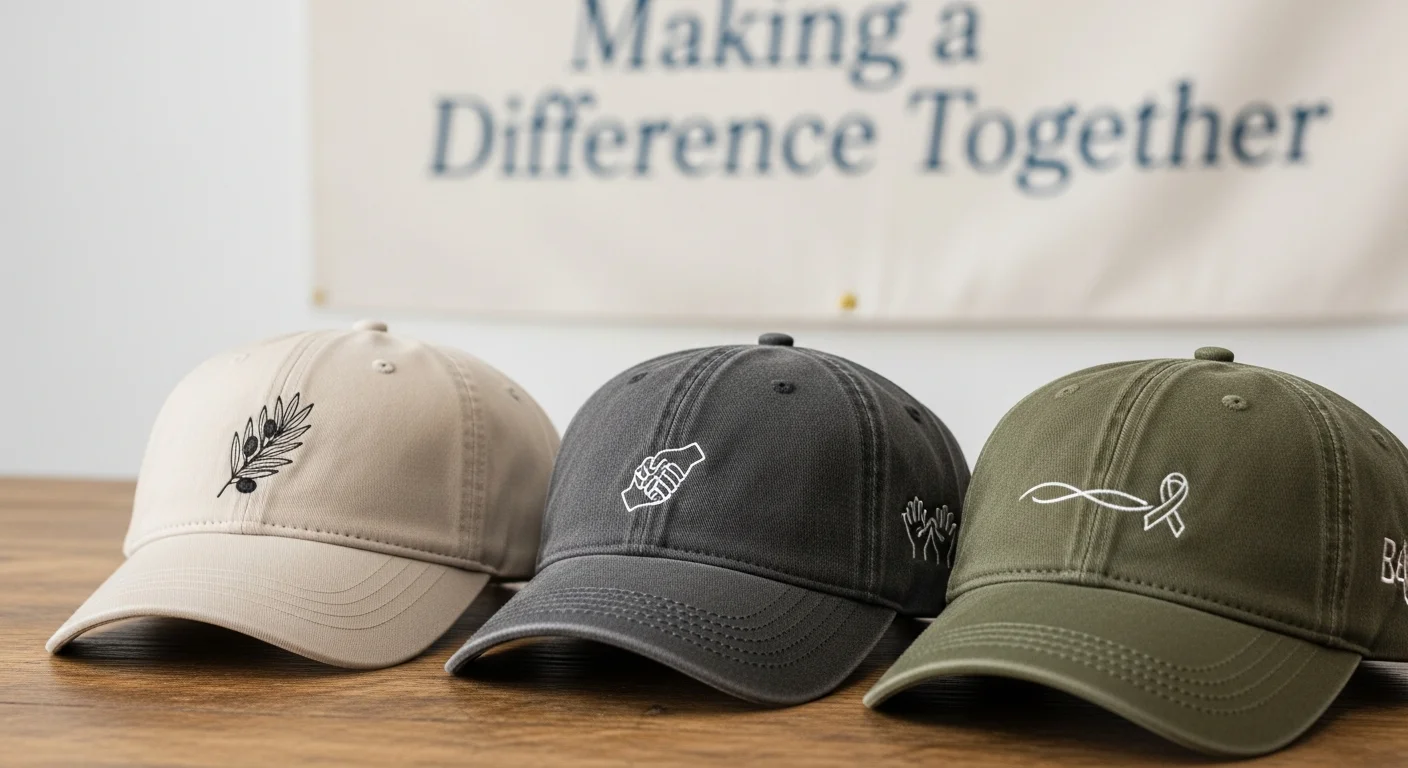
The most successful fundraiser hats balance cause messaging with everyday wearability. Hats that are overtly promotional (large text reading "5K Walk for Cancer Research 2026") generate initial sales at the event but are rarely worn afterward. Hats that are primarily fashion-forward with subtle cause integration (a clean logo with small cause awareness ribbon embroidery) become everyday accessories that continue promoting the cause for years — and sell better at the event because buyers envision wearing them beyond the single day.
Apply the 90/10 design rule: 90% of the hat's visual appeal should come from attractive design elements (well-chosen colors, clean typography, appealing graphics), and 10% should communicate the specific cause or event. The event name, date, and cause messaging can appear on the side panel, back panel, interior tag, or underbrim — secondary locations that provide context without dominating the aesthetic.
Color selection drives sales volume more than any other design factor. Neutral and earth-toned hats (navy, charcoal, olive, tan, black) outsell bright and neon colors by 3:1 at fundraising events because neutral colors match more outfits and appeal to wider demographics. Reserve cause-specific colors (pink for breast cancer, purple for Alzheimer's, teal for ovarian cancer) for embroidery thread or patch accents rather than the hat body color — this maintains the everyday wearability while incorporating the cause color symbolically.

Pricing for Maximum Fundraising Revenue
The optimal fundraiser hat price point balances impulse-buy affordability with meaningful profit margin. Research and event sales data consistently show that $20-$25 is the sweet spot for fundraiser hats — low enough for most attendees to purchase without deliberation, high enough to generate meaningful per-unit profit.
Structure the pricing with a tiered approach: a standard hat option at $20-$25 and a premium hat option at $30-$35. The standard hat uses a mid-range blank with flat embroidery, while the premium hat uses a better blank with 3D puff embroidery or a leather patch. This tiering increases average transaction value by 20-30% because some buyers will upgrade to the premium option, while the accessible standard option ensures no potential buyer is priced out.
Calculate the target production cost by working backward from the desired profit margin. For a hat selling at $25 with a 50% margin target, the maximum production cost is $12.50 per hat — achievable with a mid-range blank ($5-$6) and standard flat embroidery ($4-$5) plus shipping and packaging ($1-$2). At higher volumes (100+), the production cost drops to $8-$10 per hat, increasing the margin to 60-70%. Every dollar saved on production cost goes directly to the cause.
Golf Tournament Hats
Golf tournaments are the single largest fundraiser hat category, with an average of 100-200 custom hats per event. The golf audience expects quality headwear and is willing to pay premium prices ($25-$35 per hat) for well-designed tournament caps. Golf hat design conventions include:
Hat style: Performance caps or structured baseball caps in white, navy, or khaki. Performance fabrics with moisture-wicking and UV protection are expected at golf events. The Richardson 258 (performance) and Imperial 5054 (structured cotton) are popular choices for golf tournament headwear.
Design approach: Tournament logo centered on the front with flat embroidery. Sponsor logos on the side panels (left and right) — sponsors often pay $500-$2,000 for logo placement on tournament hats, which can offset or fully cover production costs. The event name, date, and course name on the back panel. Keep the design clean and refined to match the golf aesthetic.
Many golf tournaments include a custom hat in the player registration package (bundled into the entry fee), guaranteeing 100% distribution and eliminating sales effort. The hat cost is built into the registration fee, and the perceived value of a quality hat increases registration appeal. Additional hats can be sold to spectators and volunteers at the event. For coordinated golf merchandise, pair tournament hats with custom hats for the driving range and practice rounds.
Walk, Run, and Athletic Event Hats
Charity walks, 5K runs, and athletic fundraisers benefit from performance caps that serve a practical purpose during the event — sun protection, moisture management, and visibility. Participants who receive or purchase a hat for the event are more likely to wear it during the activity, creating a sea of branded headwear in event photographs that generates powerful social media content.
Design walk/run hats with high visibility elements: bright embroidery thread on neutral hats, reflective accents for early-morning events, and clear event identification from a distance. Include the cause messaging prominently — unlike golf tournaments where subtlety is preferred, athletic charity events celebrate visible cause advocacy. Text like "Walk to End Hunger 2026" or "Run for Research" displayed boldly on the front communicates participant pride and generates awareness from every observer along the route.
For large-scale athletic events (500+ participants), DTF transfers offer the most cost-effective decoration method at $3-$5 per hat, enabling full-color event branding at scale. The lower durability of DTF compared to embroidery is acceptable for event merchandise that serves primarily as a participation memento rather than a long-term fashion accessory. For smaller events where quality matters more, embroidered performance caps at $10-$14 per unit deliver a premium keepsake.
Donor and Sponsor Appreciation Hats
Custom hats serve as effective donor appreciation gifts at premium giving levels ($100-$500+ donors). A quality embroidered hat with the organization's logo and a "Founding Donor" or "2026 Sponsor" designation costs $10-$15 per unit but delivers perceived value of $25-$35, making it one of the most cost-efficient donor thank-you gifts available.
For corporate sponsors, create co-branded hats featuring both the charity logo and the sponsor's logo — this gives sponsors a tangible return on their sponsorship investment (branded merchandise for their team) while deepening their connection to the cause. Co-branded hats require careful design balance: the cause logo should occupy the primary front position with the sponsor logo on the side panel, maintaining the charitable focus while honoring the sponsorship.
Exclusive hat designs available only to donors at specific giving levels create a scarcity-driven incentive that can increase donation amounts. A "Gold Level Donor" leather patch hat available only to $250+ donors, or a limited-edition colorway exclusive to founding sponsors, adds collectible value that motivates higher giving. The marginal cost difference between a standard and premium donor hat ($3-$5) is trivial compared to the increased donation revenue it can generate.
Getting Started with Fundraiser Hats
Fundraiser and charity event hats combine brand building with direct revenue generation, making them one of the most valuable merchandise investments for nonprofits and event organizers. Start by exploring the full range of custom hat styles and decoration options, then use the free online design tool to preview event-specific designs before committing to production. For large event orders with complex logistics, the support team can help coordinate timelines, sizing, and multi-location decoration to ensure every hat arrives event-ready.
Frequently Asked Questions
What is the best profit margin for fundraiser hats?
Target a 50-70% profit margin for fundraiser hats. At a $25 selling price, aim for $8-$12 production cost, yielding $13-$17 profit per unit. Higher volumes (100+) reduce production costs to the lower end of that range, increasing margins. For premium hats sold at $30-$35, the absolute profit per unit increases even with higher production costs, making them worth offering alongside standard options.
Should fundraiser hats include the event date?
Including the event date is a design tradeoff. It creates a commemorative keepsake specific to the event but limits the hat's appeal as an everyday fashion accessory. The recommended approach is to place the date in a secondary location (side panel, back, or interior tag) rather than as part of the primary front design. This preserves everyday wearability while still marking the hat as an event memento for those who look closely.
How many fundraiser hats should be ordered for an event?
Order 40-60% of the expected attendee count for events where hats are sold separately (not included in registration). This accounts for the typical merchandise purchase rate at charitable events. For events where hats are included in registration packages, order the exact registrant count plus 10-15% for staff, volunteers, and last-minute additions. Pre-selling hats through online order forms before the event reduces inventory risk and provides more accurate quantity targets.
Share this article
Written by
Marcus Chen
E-Commerce Growth & Merchandising Lead at RareCustom. MBA from Wharton, former Shopify strategist. Marcus has helped 200+ merchants launch custom merchandise lines and specializes in business strategy, bulk ordering, and fundraising programs.