Custom Socks for Fundraising & Nonprofits: A Complete Revenue Guide
Launch a profitable sock fundraiser for your school, nonprofit, or sports booster club. Includes profit margin calculations, design tips for cause-driven messaging, and proven sales strategies.
Marcus Chen
E-Commerce Growth & Merchandising Lead at RareCustom. MBA from Wharton, former Shopify strategist. Marcus has helped 200+ merchants launch custom merchandise lines and specializes in business strategy, bulk ordering, and fundraising programs.
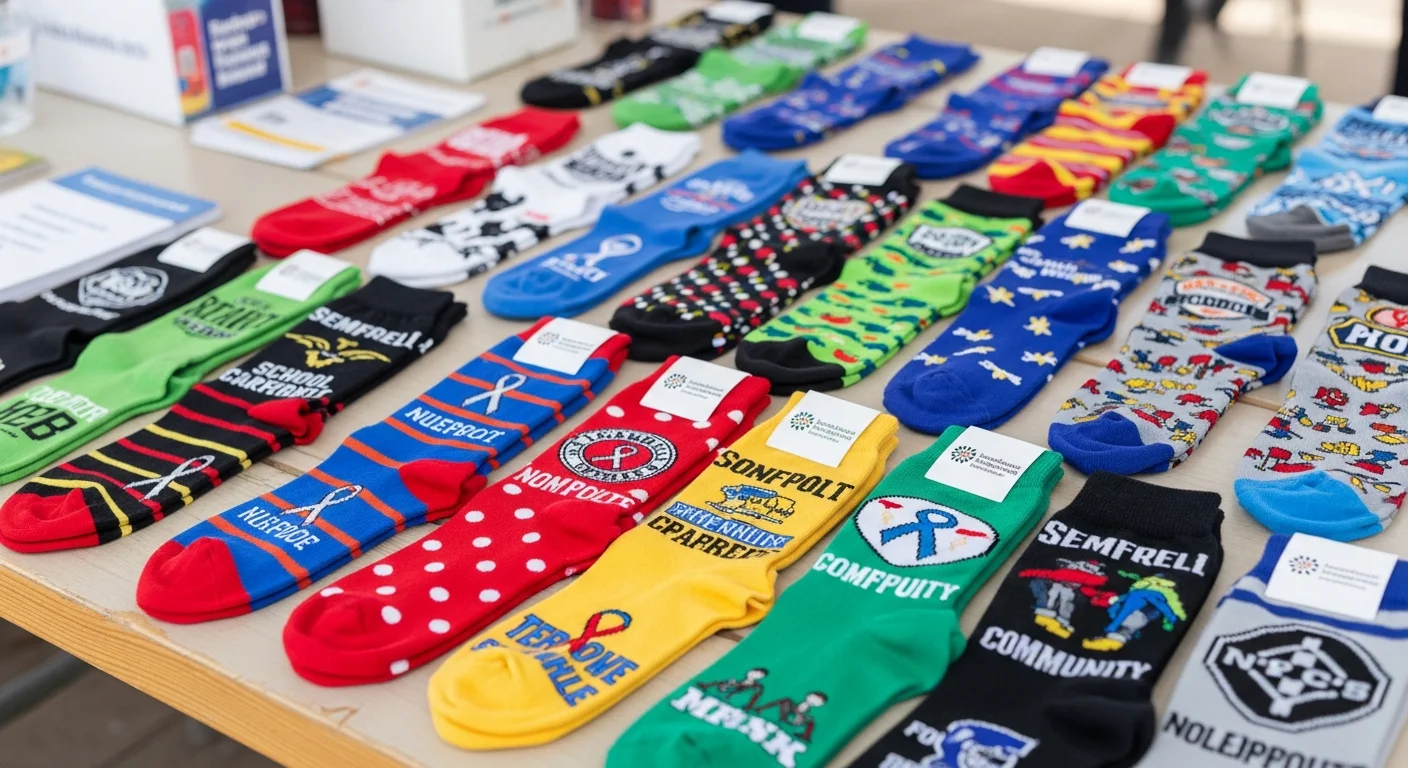
Fundraising is the lifeblood of schools, nonprofits, booster clubs, and community organizations — yet traditional fundraisers like bake sales, car washes, and wrapping paper drives are losing steam. Donors want something tangible, useful, and emotionally connected to the cause. Custom fundraising socks solve all three problems. They are a product people actually want to buy, they serve as a walking billboard for the cause, and they generate profit margins of 50% to 70% — significantly higher than most fundraising products.
The sock fundraiser model has been adopted by thousands of organizations across the country, from elementary school PTAs raising money for playground equipment to national nonprofits funding cancer research. What makes socks particularly effective is their universal appeal: everyone wears socks, sizing is simple, and the price point ($10.00 to $20.00 retail) falls in the impulse-buy range that does not require committee approval or spouse consultation. This guide walks through every step of planning, executing, and scaling a custom sock fundraiser.
Why Socks for Fundraising: High Margin and Universal Appeal
The economics of sock fundraising are compelling. A standard knit-in custom sock costs $4.00 to $6.00 per pair at quantities of 200 to 500 pairs. Retail pricing for fundraising socks typically falls between $12.00 and $20.00 per pair, yielding a gross margin of 60% to 70%. Compare that to common fundraising alternatives: cookie dough (35-40% margin), wrapping paper (40-50% margin), and magazine subscriptions (30-40% margin). Socks deliver more profit per unit while offering a product that supporters actually want.
Beyond margins, socks have logistical advantages. They are lightweight, non-perishable, and easy to ship or distribute at events. There are no refrigeration requirements, no expiration dates, and no messy cleanup. A single volunteer can carry 100 pairs of socks in a backpack, whereas 100 pizzas or cookie dough tubs require vehicles and cold storage.
Calculating Profit Margins
Understanding the math behind a sock fundraiser helps you set realistic goals and pricing. Here is a worked example for a school PTA ordering 300 pairs of custom crew socks:

Production cost: 300 pairs of knit-in crew socks at $5.25 per pair = $1,575.00. This includes two-color design, standard packaging with belly bands, and domestic shipping to the school. For a full breakdown of how sock pricing works at different quantities, see the sock pricing guide.
Retail price: $15.00 per pair. This price point feels fair to buyers and positions the socks as a quality product rather than a charity obligation. Some organizations sell at $12.00 for volume or $18.00 to $20.00 for premium designs with more colors or gift packaging.
Gross revenue: 300 pairs at $15.00 = $4,500.00. Net profit: $4,500.00 minus $1,575.00 = $2,925.00. That is a 65% margin. If you sell through an online store, deduct 3-5% for payment processing fees, bringing net profit to approximately $2,700.00 to $2,780.00.
Break-even point: You need to sell 105 pairs at $15.00 to cover the production cost of $1,575.00. Everything beyond 105 pairs is pure profit. With 300 pairs, you have a comfortable buffer — even if you only sell 80% of inventory, you still net $2,025.00.
Design Tips for Cause-Driven Messaging
Fundraising socks need to serve two purposes: represent the cause and look good enough that people want to wear them. Avoid cramming too much text onto the sock — instead, focus on a strong visual element (mascot, ribbon, icon) paired with minimal text (organization name, year, or hashtag). The cause should be recognizable at a glance.
Color choice is critical for cause-driven socks. Pink for breast cancer awareness, yellow for childhood cancer, teal for ovarian cancer, and puzzle pieces for autism awareness are all established visual shorthand. Using these recognized color codes instantly communicates the cause without needing explanatory text. Pair the cause color with a complementary neutral (black, white, or gray) for a wearable design that works with everyday outfits.
School spirit socks follow different design principles. Use the school mascot prominently on the leg panel, school colors as the primary palette, and the school name or abbreviation on the cuff. Avoid generic designs — the more specific the sock feels to the school community, the higher the emotional buy-in and the stronger the sales. For youth-specific design considerations, reference the kids and school spirit socks guide.
School Spirit Sock Drives
Schools are the single largest market for sock fundraisers. Elementary schools, middle schools, and high schools all run sock drives for class trips, playground upgrades, arts programs, sports equipment, and graduation events. The typical school sock drive follows a three-week campaign cycle: one week of pre-sale announcements, one week of active selling, and one week for order fulfillment and distribution.
Successful school sock drives leverage existing communication channels — the school newsletter, parent Facebook groups, class messaging apps, and morning announcements. Student involvement drives sales: when kids are excited about the socks and show them to friends, peer-to-peer selling kicks in naturally. Some schools gamify the fundraiser with class competitions, offering prizes (like extra recess or a pizza party) to the class that sells the most pairs.
For large school districts ordering across multiple schools, bulk ordering can drop per-pair costs by 15-25%, increasing profit margins further. A district-wide sock drive with 1,000 to 2,000 pairs often achieves per-pair costs of $3.80 to $4.50.
Sports Booster Club Campaigns
Booster clubs fund everything from new uniforms to travel expenses, and custom team socks are a natural fundraising product because they double as fan gear. Design socks that match the team's colors and include the team name, mascot, and season year. Sell them at games, tournaments, and through the school's online store.
The key to a successful booster club sock campaign is selling at events where school spirit is already high. Football Friday nights, basketball tournament weekends, and rivalry game days generate the emotional energy that drives impulse purchases. Set up a table near the entrance with a clean display, accept cash and digital payments, and price socks at $12.00 to $15.00 per pair. Bundles work well too — offer three pairs for $30.00 to increase average order value.
Awareness Ribbon and Cause-Branded Socks
Nonprofits focused on health awareness, social justice, and environmental causes use custom socks as both fundraising tools and awareness builders. The sock becomes a conversation starter — when someone asks about the unique socks, the wearer explains the cause, creating an organic outreach moment that paid advertising cannot replicate.

Design awareness socks with the cause ribbon prominently featured on the leg panel, the organization's name or logo on the cuff, and a website URL or hashtag on the sole. For maximum impact, time the fundraiser to coincide with the cause's designated awareness month — October for breast cancer, April for autism, September for childhood cancer. Seasonal alignment creates urgency and taps into existing media coverage.
Nonprofits selling awareness socks through their website should invest in professional product photography and compelling product descriptions. Consider bundling socks with other merchandise like custom nonprofit t-shirts for a higher average order value. A sock-and-shirt bundle at $30.00 to $35.00 generates more revenue per transaction than either item sold individually.
Online vs In-Person Sales Strategies
In-person sales work best at events with an existing audience — school open houses, sporting events, community festivals, charity galas, and church gatherings. The advantage of in-person sales is immediate gratification: buyers walk away with socks in hand. Display socks on a tabletop rack or in a branded basket, accept payment via a mobile card reader, and have volunteers wearing the socks to serve as walking advertisements. At in-person events, conversion rates typically run 15-25% of attendees, meaning a 500-person event can generate 75 to 125 pair sales in a single evening.
Online sales expand reach beyond the immediate community. Set up a simple online store using platforms like Shopify, Square, or a dedicated fundraising platform. Include high-quality photos, a clear description of the cause and how proceeds will be used, and easy social sharing buttons. Online sales work especially well for alumni networks, out-of-town supporters, and corporate matching gift programs. Create a dedicated landing page with a progress bar showing how close the campaign is to its fundraising goal — this social proof element has been shown to increase conversion rates by 12-18% compared to pages without progress indicators.
The most effective fundraisers combine both channels. Launch with an in-person event to generate buzz and initial sales, then extend the campaign online for two to four additional weeks to capture supporters who could not attend in person. Track sales by channel to optimize future campaigns. Email marketing to your supporter list drives the highest conversion rates online, with open rates of 25-35% and click-through rates of 5-8% being typical for cause-driven merchandise emails. Social media posts featuring photos of people wearing the socks generate three to five times more engagement than product-only images. Encourage supporters to share photos with a campaign-specific hashtag and tag the organization. Bundling socks with complementary fundraising merchandise like custom nonprofit t-shirts can increase average order values by 40-60% when offered as a discounted package.
Success Metrics and Reorder Triggers
Measure your sock fundraiser against three key metrics: sell-through rate (percentage of inventory sold), total net profit, and cost per dollar raised (total expenses divided by net profit). A healthy sell-through rate is 75% or higher within the campaign period. If you exceed 85% sell-through, you likely underordered and should increase quantities by 20-30% for the next campaign.
Plan to reorder when you have sold through 70% of inventory and demand remains strong. Reorders from the same manufacturer are faster and cheaper because the design files, yarn colors, and production settings are already on file. Most manufacturers can fulfill reorders in two to three weeks versus four to six weeks for initial orders.
Frequently Asked Questions
How many pairs of fundraising socks should you order for a school?
A general rule is to order one pair per student enrolled, plus 20% for staff, parents, and siblings. A 500-student school would order 600 pairs. For a more conservative approach, start with 50% of enrollment and reorder if demand exceeds expectations — the tradeoff is slightly higher per-pair cost on the smaller initial order.
What is the best retail price for fundraising socks?
$12.00 to $15.00 per pair is the sweet spot for most school and nonprofit sock fundraisers. This price feels affordable to supporters while generating strong margins. Premium designs with more colors or gift packaging can justify $18.00 to $20.00. Avoid pricing below $10.00 — it undervalues the product and reduces profit potential.
Can you run a sock fundraiser entirely online?
Yes. Many organizations run online-only sock fundraisers using pre-order models. Collect orders and payment through an online store, then place one bulk order with the manufacturer. This eliminates the risk of unsold inventory since you only produce what is already sold. The tradeoff is that you lose the impulse-buy sales that happen at in-person events.
How do you handle leftover inventory from a sock fundraiser?
Leftover socks can be sold at future events, offered as add-ons to other fundraisers, donated to the organization's constituents, or held for the following year's campaign if the design is not date-specific. Many schools sell remaining inventory through their front office or school store at a slight discount to clear stock before the next fundraiser.
Share this article
Written by
Marcus Chen
E-Commerce Growth & Merchandising Lead at RareCustom. MBA from Wharton, former Shopify strategist. Marcus has helped 200+ merchants launch custom merchandise lines and specializes in business strategy, bulk ordering, and fundraising programs.