Custom Socks for Kids, Youth Teams & School Spirit Programs
Design custom socks for kids, youth sports teams, and school spirit programs. Covers youth sizing from toddler to teen, mascot integration, grip soles for safety, fundraising strategies, and back-to-school ordering timelines.
Marcus Chen
E-Commerce Growth & Merchandising Lead at RareCustom. MBA from Wharton, former Shopify strategist. Marcus has helped 200+ merchants launch custom merchandise lines and specializes in business strategy, bulk ordering, and fundraising programs.
Custom socks for kids and youth programs represent one of the fastest-growing segments in the personalized apparel market. Schools, youth sports leagues, and parent-teacher organizations are discovering that custom socks offer a unique combination of affordability, wearability, and spirit-building power that other apparel items struggle to match. A pair of custom socks costs a fraction of a custom jersey or hoodie, fits easily into any dress code, and gets worn far more frequently than a spirit t-shirt that sits in a drawer after homecoming week.
From toddler grip socks for a daycare graduation to varsity-style crew socks for a high school basketball program, the design approach, material requirements, and sizing considerations change dramatically across age groups. This guide covers everything needed to plan, design, and order custom socks for young wearers — from age-appropriate design strategies to the critical safety features that parents expect.
Youth Sizing: Toddler Through Teen
Youth sock sizing does not follow the same system as adult sizing, and getting it wrong results in socks that bunch at the ankle or slip off entirely during play. Four size categories cover the full range from toddlers to teenagers:
Toddler (2T–4T, shoe size 5–8): These tiny socks measure approximately 4–5 inches in foot length. The cuff must be snug enough to stay up on a small calf without leaving marks. Non-slip grip soles are strongly recommended for this age group since toddlers frequently walk on smooth floors. Minimum order quantities for toddler sizes are often higher (72+ pairs) because the specialized knitting machine setup differs from standard youth production runs.
Youth Small (shoe size 9–12): This covers most elementary-age children from kindergarten through second grade. Foot length ranges from 5.5 to 7 inches. At this age, sock durability becomes critical — kids are running, jumping, and playing aggressively. Reinforced heel and toe construction prevents holes from developing within the first few wears.
Youth Medium (shoe size 12–3): The upper elementary and middle school range. Foot length measures 7 to 8.5 inches. This is the age where design preferences start to diverge between bold, playful graphics and more subtle, "cool" aesthetics. Offering two design options — one bolder, one simpler — can increase adoption rates in school spirit programs.
Youth Large (shoe size 3–6): This bridges the gap between youth and adult sizing, covering most middle school and early high school students. Foot length ranges from 8.5 to 10 inches. Many custom sock manufacturers can produce this size on adult machines, which reduces minimum order quantities and per-unit cost compared to smaller youth sizes.
For detailed measurement guidance across all age groups, the custom sock sizing guide provides printable measurement templates that parents can use at home.
School Mascot and Color Integration
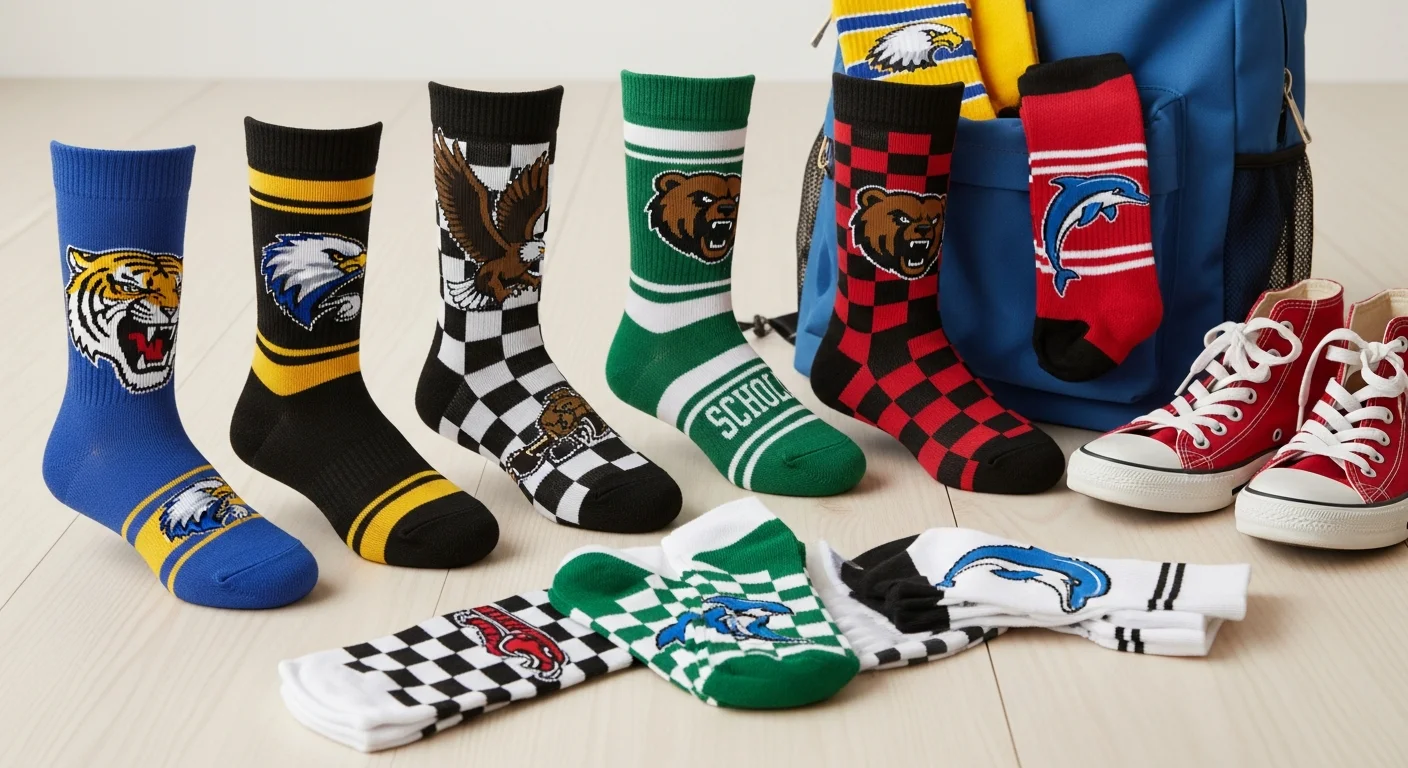
The most popular school spirit socks feature the school mascot prominently on the calf or ankle area. Knit-in construction handles mascot designs well, reproducing bold shapes and team colors with excellent durability through hundreds of wash cycles. The key to a great mascot sock is simplifying the mascot artwork to work at sock scale — fine details that look sharp on a gymnasium wall banner will blur into an indistinct blob on a 3-inch sock panel.

Reduce the mascot to its most recognizable silhouette and use no more than four colors. A bulldog mascot, for example, works better as a bold profile view with two body colors and one accent than as a detailed front-facing illustration with shading and gradients. The school's primary and secondary colors should dominate the sock body, with the mascot serving as the focal point on the outer calf.
Schools that coordinate sock designs with other spirit wear — including custom spirit t-shirts and youth team jerseys — create a cohesive visual identity that strengthens school pride across every event, from pep rallies to away games.
Sports Team Sock Programs
Youth sports leagues are increasingly requiring matching team socks as part of the official uniform, moving beyond the days when parents scrambled to find "close enough" solid-color socks at retail stores. Custom team socks ensure every player matches perfectly and create an opportunity for league or sponsor branding.
For sports applications, material choice matters significantly. Youth athletic performance socks need moisture-wicking polyester or nylon construction with cushioned footbeds and arch support. Cotton socks absorb sweat and create blisters during extended play — a problem magnified for kids who may not recognize discomfort until damage is done. A performance blend of 60% nylon, 25% polyester, 10% cotton, and 5% spandex provides the right balance of durability, comfort, and moisture management for young athletes.
Sock height varies by sport. Soccer requires knee-high socks that accommodate shin guards. Basketball teams typically wear crew-length socks. Baseball and softball teams often choose stirrup-style socks or solid crew socks in team colors. Cross-country and track teams prefer low-cut or quarter-length socks for minimal weight.
Fundraising Through Spirit Sock Sales
Custom socks have become one of the most effective fundraising products for schools and youth organizations because they combine low cost, high perceived value, and universal appeal. A pair of custom spirit socks costs $4–7 per pair at wholesale quantities of 100+ and sells for $12–18 at retail, generating $6–12 profit per pair. For a school selling 300 pairs during a spirit week campaign, that translates to $1,800–$3,600 in fundraising revenue from a single product.
The fundraising advantage of socks over other spirit items is repeat purchasing. Parents who buy one pair for a child often return for siblings, gifts for grandparents, and replacement pairs as kids outgrow them. Schools that run sock fundraisers twice per year (fall and spring) report 40–60% higher cumulative revenue compared to once-annual campaigns. For a complete fundraising playbook including pricing strategies and campaign timelines, see the custom socks fundraising guide.
Durability Requirements for Kids
Children are significantly harder on socks than adults. Running on playground surfaces, playing sports in cleats, and general rough-and-tumble activity means youth socks must withstand more mechanical stress than comparable adult products. The most critical durability feature is reinforced heel and toe construction — double-layered knitting in the high-wear zones that extends sock life by 50–80% compared to single-layer construction.
Material composition directly impacts durability. Youth socks should contain a minimum of 25% nylon for abrasion resistance, compared to the 15–20% nylon found in standard adult casual socks. Higher nylon content adds approximately $0.30–0.50 per pair in material cost but dramatically reduces replacement frequency, making it a worthwhile investment for parents and programs alike.
Colorfastness is another youth-specific concern. Kids frequently ignore washing instructions (or their parents do), leading to socks being washed in hot water with bleach-containing detergents. Specify colorfast dyes and recommend cold-water washing on the care label to maintain design vibrancy through rough laundry treatment.
Safety Features: Grip Soles for Younger Children
For children under age six, grip soles transform custom socks from a potential slip hazard into a safety feature. Silicone or rubberized grip dots applied to the sole of the sock provide traction on hardwood, tile, and laminate floors — the surfaces where sock-related falls most commonly occur. Daycare centers, preschools, and indoor play facilities increasingly require grip-sole socks for liability and safety reasons.

Grip application adds $0.75–1.50 per pair to the production cost depending on coverage area. Full-sole coverage provides maximum traction, while partial grip (heel and ball of foot only) reduces cost while still addressing the highest-risk zones. The grip material should be PVC-free, non-toxic, and tested to ASTM F2913 slip resistance standards for children's products. Custom grip patterns — such as the school logo repeated in grip dots — add a premium branding touch that parents notice and appreciate.
Design Appeal for Different Age Groups
A design that thrills a first-grader will embarrass a high school freshman. Age-appropriate design is essential for adoption rates across school spirit programs spanning multiple grade levels.
Elementary (ages 5–10): Bright, bold colors and oversized mascot graphics perform best. Kids in this age group want their socks to be fun and noticeable. Full-color sublimation or knit-in designs with the mascot taking up the entire calf panel generate the most excitement. Popular extras include glow-in-the-dark yarn and neon accent colors.
Middle school (ages 11–13): Design sophistication increases. Students prefer more subtle team logos, tonal color schemes (navy on navy, for example), and smaller branding elements. Athletic sock silhouettes — crew length with ribbed cuffs — outperform novelty styles. Peer approval matters enormously at this age, so aligning designs with current athletic fashion trends increases voluntary wear.
High school (ages 14–18): Varsity aesthetics dominate. Clean typography, minimalist logo placement, and premium materials signal quality. High school students respond well to limited-edition colorways and player-specific customization options. Coordinating sock designs with the official athletic program identity — matching fonts, color codes, and logo placement used on team jerseys — elevates the perceived value significantly.
Back-to-School Timing Strategy
Timing is the single biggest factor in whether a school spirit sock program succeeds or misses its window. The back-to-school period (late August through September) generates the highest demand and willingness to purchase. To hit this window, orders must be placed by July 15 at the latest to allow for standard 4–6 week production timelines.
The ideal timeline works backward from the first day of school: finalize designs by June 1, approve samples by June 15, submit the bulk order by July 1, and receive delivery by August 10–15. This provides a one-to-two-week buffer for shipping delays and allows distribution before or during the first week of school when spirit and enthusiasm are highest.
Schools that miss the back-to-school window can target the next peak period: homecoming (typically October). Holiday gift season (November–December) provides a third opportunity. Planning all three campaigns at once allows bulk pricing across combined quantities, reducing per-pair cost by 10–20% compared to three separate smaller orders.
Frequently Asked Questions
What is the minimum order quantity for youth-sized custom socks?
Minimum order quantities for youth socks typically range from 48 to 100 pairs depending on the manufacturer and sock size. Toddler sizes may require higher minimums (72+) due to specialized machine setup. Some print-on-demand services offer no-minimum options, but per-pair costs are significantly higher ($10–15/pair versus $4–7/pair for bulk).
Are grip-sole socks safe for all ages?
Grip soles are recommended for children under six and beneficial for anyone walking on smooth indoor surfaces. The silicone or rubberized grip material should be PVC-free and non-toxic. For older children and teens wearing socks inside athletic shoes, grip soles are unnecessary and may add unwanted bulk inside the shoe.
Can the same design work for both elementary and high school students?
A single design rarely appeals equally to both age groups. The most successful K–12 spirit sock programs offer two to three design variations using the same school colors and mascot but adapted for different age preferences — bold and playful for elementary, subtle and athletic for high school. This adds minimal cost since the base colors and materials remain the same.
Share this article
Written by
Marcus Chen
E-Commerce Growth & Merchandising Lead at RareCustom. MBA from Wharton, former Shopify strategist. Marcus has helped 200+ merchants launch custom merchandise lines and specializes in business strategy, bulk ordering, and fundraising programs.