How to Order Custom Socks in Bulk: The Complete Checklist
Follow this step-by-step checklist to order custom socks in bulk for teams, events, corporate gifts, or resale. Covers MOQs, sampling, timelines, shipping, and quality control.
Natalie Voss
Founder & CEO of RareCustom. MBA from Stanford with 8 years in e-commerce operations. Natalie's logistics expertise ensures bulk sock orders are managed efficiently from order to delivery.
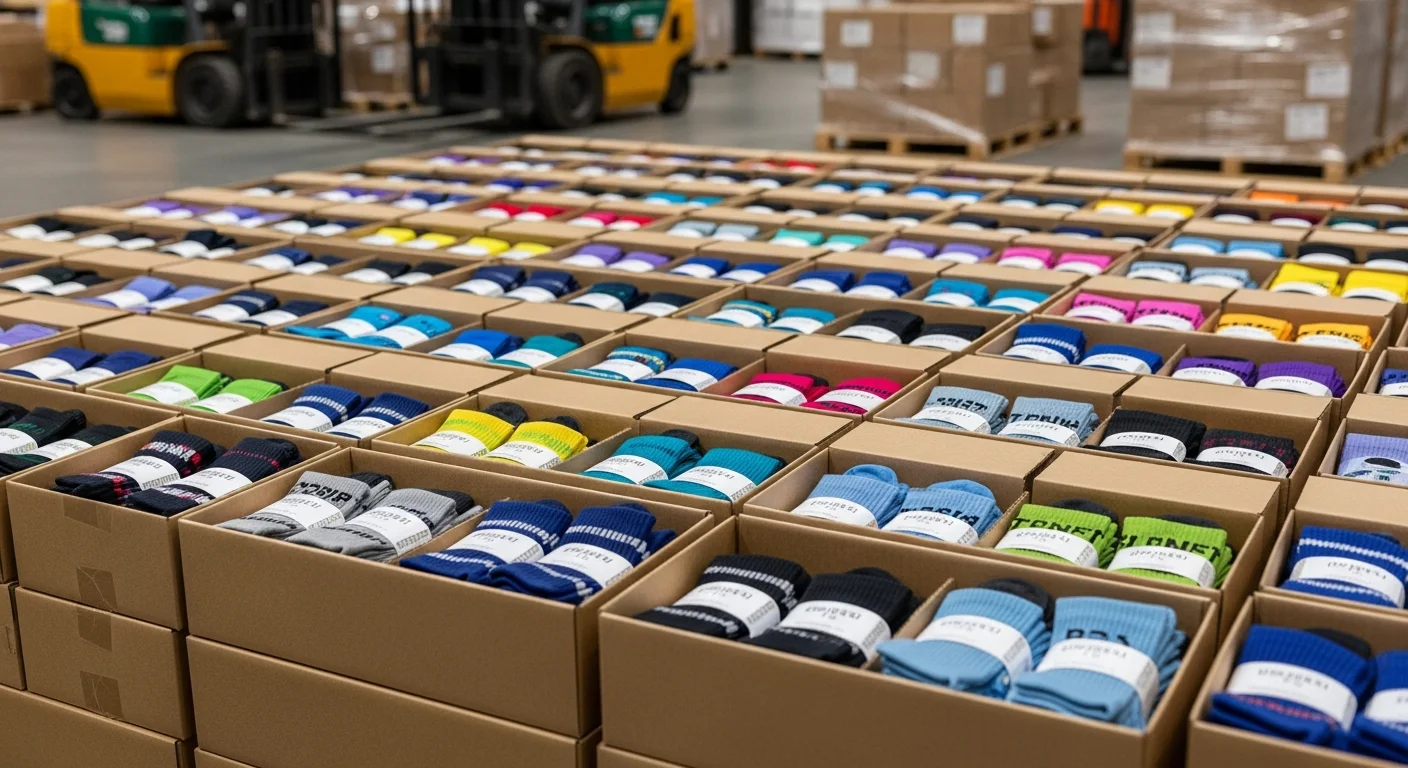
Ordering custom socks in bulk sounds straightforward — pick a design, choose a quantity, and hit submit. In practice, bulk sock orders involve far more moving parts than most buyers expect. From collecting accurate size distributions across a 200-person roster to navigating minimum order quantities that vary by printing method, the details matter. Missing even one step can result in delayed delivery, mismatched colors, or an entire shipment that does not meet quality standards.
This checklist distills the entire bulk ordering process into a linear, repeatable workflow. Whether the order is for a youth sports league, a corporate holiday gift program, a nonprofit fundraiser, or a retail resale line, every phase is covered. Teams that have ordered custom jerseys in bulk will recognize many parallels, but socks introduce unique considerations around sizing curves, knitting tolerances, and packaging formats that deserve their own guide.
When to Order Bulk: Events, Teams, Corporate, and Resale
Bulk sock orders generally fall into four categories, each with distinct timelines and requirements. Event orders — races, conferences, festivals — typically need 100 to 500 identical pairs delivered to a single address by a hard deadline. Team orders involve 20 to 60 pairs with multiple sizes and sometimes individualized details like player names or numbers. Corporate orders range from 50 to 2,000 pairs with branded packaging and multi-address shipping to offices or remote employees. Resale orders require 200+ pairs with hang tags, poly bags, and UPC barcodes for retail distribution.
Identifying the order type early shapes every downstream decision. Event orders prioritize speed and uniformity. Team orders need careful roster management. Corporate orders demand polished presentation with custom packaging. Resale orders must factor in wholesale margin targets and retail-ready packaging that adds $0.75 to $2.00 per pair. Clarifying the use case before contacting a supplier prevents scope creep and ensures accurate quoting.
MOQ Comparison by Printing Method
The minimum order quantity depends entirely on the printing method selected. Sublimation printing typically requires a minimum of 50 pairs because the process uses pre-printed fabric that is then cut and sewn, making small runs inefficient. Knit-in (jacquard) construction carries the highest minimums at 100 to 200 pairs per design because the sock knitting machines must be programmed with custom patterns, and setup costs are amortized across larger runs. DTG (direct-to-garment) printing has the lowest barrier at just 1 pair, but per-unit costs are significantly higher — typically $18 to $25 per pair compared to $6 to $10 for sublimation at volume.

For buyers ordering 50 to 99 pairs, sublimation offers the best balance of cost and quality. At 100+ pairs, knit-in construction becomes viable and produces the most premium feel since the design is literally woven into the sock fiber. At 200+ pairs, knit-in pricing drops to $5 to $8 per pair, making it competitive with sublimation while delivering superior texture and durability. For orders under 25 pairs, DTG remains the only practical option despite higher per-unit costs.
Size Collection and Roster Management
Socks are less forgiving than t-shirts when it comes to fit. A sock that is too small compresses the toes and creates blisters, while an oversized sock bunches inside the shoe and causes hot spots. Most custom sock providers offer three to four size ranges: Small (Youth/Women 4-7), Medium (Women 7-10 / Men 5-8), Large (Men 8-12), and XL (Men 12-15). A standard adult order typically follows a distribution of roughly 10% Small, 30% Medium, 45% Large, and 15% XL.
For team orders, collect individual sizes through a digital form rather than guessing. Spreadsheet templates that include columns for name, size, and any personalization simplify the process. The custom sock sizing guide provides detailed measurement instructions and a printable size chart that team managers can distribute. Lock in the size breakdown at least two weeks before the production deadline to avoid last-minute changes that delay the entire order.
Design File Requirements and Proofing
Sock designs require specific file formats depending on the production method. Sublimation needs a flat template file (typically provided by the supplier) at 300 DPI in CMYK color mode. The template wraps around the sock so designers must account for seam placement, heel curvature, and toe closure. Knit-in designs require vector artwork or a pixel grid file where each pixel represents one stitch — typically 80 to 120 stitches wide by 200 to 300 stitches tall depending on sock length.
Always request a digital proof before approving production. A digital proof shows the design rendered on a 3D sock mockup, highlighting how colors translate, where the design wraps around the heel, and whether text remains readable at the final scale. Most suppliers provide one round of digital proofing at no charge, with additional revisions costing $10 to $25 each. Compare the proof carefully against the original design file, paying close attention to color accuracy, text legibility, and alignment across the cuff, leg, heel, and toe sections.
Sampling Before Production
For orders exceeding 100 pairs or orders destined for retail resale, investing in a physical sample is strongly recommended. Sample pairs cost between $25 and $50 depending on the method and supplier, with turnaround of 5 to 10 business days. The sample reveals details that digital proofs cannot — fabric texture, cushioning density, elastic grip, color vibrancy on the actual material, and how the design looks when the sock is worn and stretched over a foot.
Evaluate the sample on three criteria: visual accuracy (does the printed design match the approved proof?), construction quality (are the seams smooth, is the elastic firm, does the toe closure lie flat?), and comfort (does the sock fit well, wick moisture, and stay in place during movement?). If the sample fails any criterion, provide specific feedback and request a revised sample before greenlighting production. The $25 to $50 sample cost is trivial compared to the risk of producing 500 pairs with a color mismatch or uncomfortable fit.
Production Timelines: Standard vs Rush
Standard production for custom socks runs 3 to 4 weeks from design approval to shipment. This includes 2 to 3 days for prepress setup, 7 to 14 days for knitting or printing, 3 to 5 days for quality inspection and packaging, and 3 to 5 days for domestic shipping. Knit-in orders tend toward the longer end because machine programming adds lead time.

Rush production compresses the timeline to 7 to 10 business days but carries a surcharge of approximately 30% above standard pricing. Rush orders jump the production queue, which means overtime labor and expedited material sourcing. Not all suppliers offer rush service for knit-in construction since the machine programming cannot be shortened significantly. Sublimation and DTG methods are more amenable to rush timelines. For event-driven orders with immovable deadlines, build in a one-week buffer beyond the quoted delivery date to account for unexpected delays in customs, weather, or carrier logistics.
Shipping, Warehousing, and Multi-Address Delivery
Bulk sock shipments are lightweight relative to apparel like custom hoodies or jerseys, so shipping costs are proportionally lower. A box of 100 pairs of crew socks weighs approximately 15 to 20 pounds and ships via ground for $15 to $30 domestically. Free shipping thresholds typically kick in at 100+ pairs or $500+ order value.
Corporate orders frequently require multi-address shipping — sending individual pairs or small bundles to remote employees or regional offices. This service adds $2 to $5 per address for pick-and-pack labor plus individual shipping costs. Some suppliers offer warehousing where the full production run ships to a central facility and individual packages are dispatched on a schedule. This is ideal for onboarding kits where new hires receive socks as they join throughout the quarter. For nonprofit fundraising campaigns, consider drop-shipping directly to donors to eliminate the need for local inventory management.
Quality Control Checkpoints
Establish quality control checkpoints at three stages: pre-production (sample approval), mid-production (spot-check photos from the factory floor), and post-production (inspection of the finished shipment). A reliable supplier will send mid-production photos showing the first 10 to 20 pairs off the line so any color drift or construction issues can be caught before the full run completes.
Upon receiving the shipment, inspect at least 10% of the total quantity. Check for consistent color across pairs, secure elastic at the cuff, smooth toe seams, correct sizing labels, and accurate packaging. Document any defects with photos and report them to the supplier within 48 hours. Reputable suppliers offer reprints or partial refunds for defect rates exceeding 2% to 3% of the total order. For orders tied to athletic team performance, also test a sample pair during practice to verify cushioning, grip, and moisture management under real conditions.
Frequently Asked Questions
What is the lowest minimum order for custom socks?
DTG (direct-to-garment) printing allows orders as low as 1 pair, though per-unit costs are high at $18 to $25. Sublimation starts at 50 pairs with better pricing. Knit-in construction typically requires 100 to 200 pairs minimum. For the best price per pair, orders of 250+ pairs offer the steepest volume discounts.
How far in advance should bulk sock orders be placed?
Allow 5 to 6 weeks from initial design submission to delivery for standard production. Rush orders can arrive in 7 to 10 business days at a 30% premium. For events with fixed dates, submit the order at least 8 weeks early to allow time for sampling and revisions without resorting to rush fees.
Can individual names or numbers be added to bulk sock orders?
Yes, but personalization depends on the printing method. Sublimation and DTG support individual customization since each pair is printed separately. Knit-in construction is less flexible because each unique design requires separate machine programming. Personalized knit-in socks are possible but add $2 to $5 per pair in setup costs.
Share this article
Written by
Natalie Voss
Founder & CEO of RareCustom. MBA from Stanford with 8 years in e-commerce operations. Natalie's logistics expertise ensures bulk sock orders are managed efficiently from order to delivery.