Custom Hat Trends 2026: Leather Patches, Tonal Embroidery, and Eco Materials
Explore the biggest custom hat trends for 2026 — leather patch dominance, tonal and tone-on-tone embroidery, sustainable materials, vintage washed finishes, mixed-media decoration, and the rise of performance lifestyle hats.
Camille Dupont
Creative Director at RareCustom. BFA from RISD with 9+ years in graphic design. Camille tracks emerging headwear trends and translates them into actionable design guidance.
The custom hat industry evolves rapidly, with trend cycles driven by fashion influencers, brand innovations, material technology, and shifting consumer values. 2026 has already established several dominant trends that are reshaping how brands, teams, and individuals approach custom headwear. From the continued rise of leather patches to the sophistication of tonal embroidery to the mainstreaming of sustainable materials, these trends reflect a broader shift toward premium quality, understated aesthetics, and environmental consciousness in the custom merchandise space.
This guide analyzes the six most impactful custom hat trends of 2026, with practical guidance for incorporating each trend into custom hat programs. Whether designing for a brand launch, team uniforms, corporate merchandise, or a personal fashion line, understanding these trends helps create headwear that feels current, relevant, and desirable to today's consumers.
Trend 1: Leather Patch Dominance
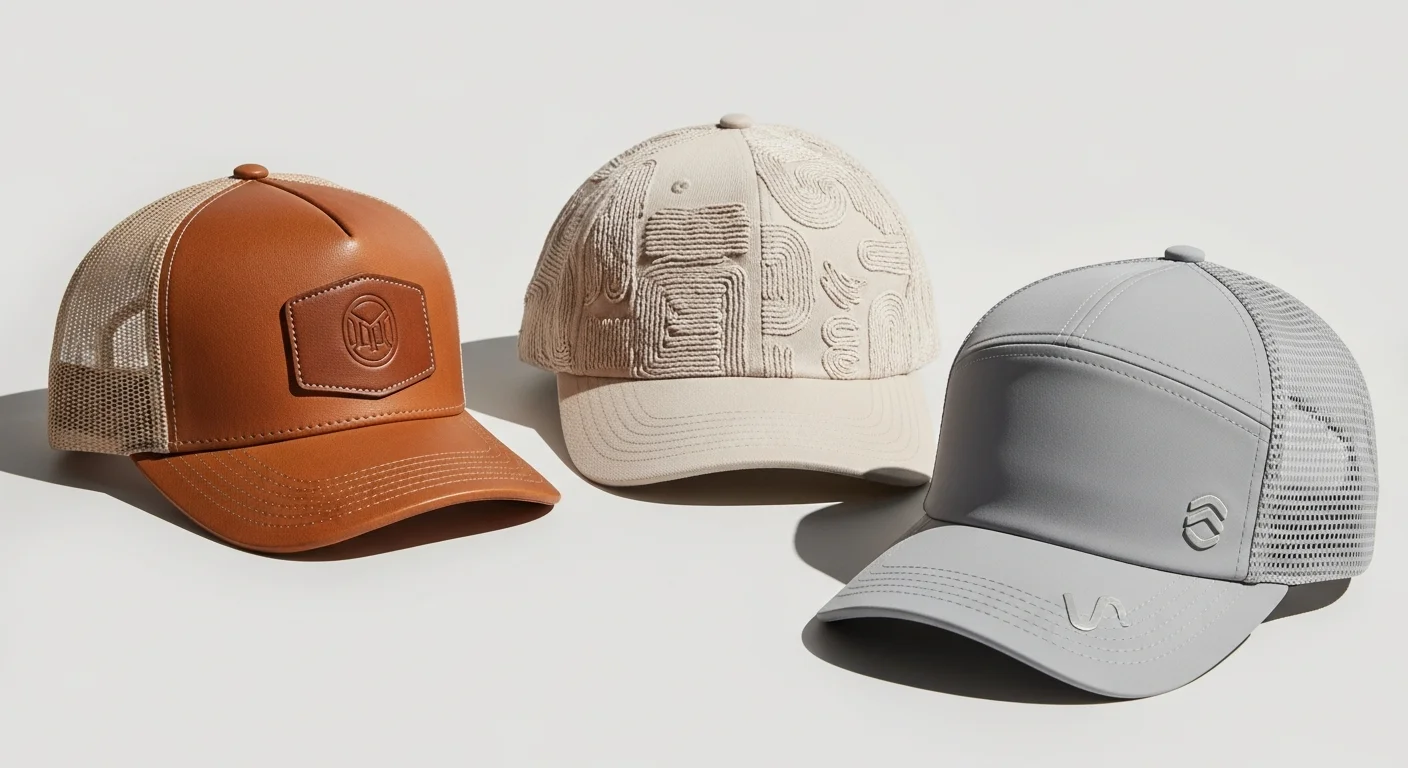
Leather patches have moved from a niche decoration option to the fastest-growing segment of the custom hat market, with demand increasing 45% from 2024 to 2026 according to industry order data. The appeal is multi-dimensional: leather communicates craftsmanship, authenticity, and premium quality through its natural material properties. A leather patch on a trucker hat or dad hat signals an outdoor lifestyle, artisan sensibility, and brand confidence that embroidery alone cannot achieve.
The three leather decoration techniques — debossing, laser engraving, and heat branding — each create a distinct aesthetic. Debossing (pressing the design into the leather) produces the most subtle, premium result, popular with upscale brands and corporate programs. Laser engraving offers the highest detail capability, reproducing fine text and intricate logos with precision. Heat branding creates a rustic, handmade appearance that resonates with ranch, farm, and outdoor adventure brands.
Faux leather (vegan leather) patches have reached quality parity with genuine leather for most visual applications, making the leather patch trend accessible to brands with sustainability commitments or vegan values. Faux leather costs 40-50% less than genuine leather while offering identical visual impact and superior weather resistance. The choice between genuine and faux is now primarily a brand-values decision rather than a quality tradeoff.
Leather patches pair best with earth-toned hat blanks — olive, tan, brown, charcoal, and forest green — in trucker, dad hat, and five-panel styles. The natural material-on-natural-color combination creates a cohesive aesthetic that dominates outdoor, food and beverage, and lifestyle brand headwear in 2026.

Trend 2: Tonal and Tone-on-Tone Embroidery
Tonal embroidery — using thread that is one or two shades lighter or darker than the hat fabric — has become the defining aesthetic of premium headwear in 2026. The technique creates a subtle, textured design that must be seen up close to fully appreciate, replacing the high-contrast, maximum-visibility approach that dominated custom hats for decades. Tonal embroidery signals design sophistication and brand confidence — the willingness to let quality speak rather than relying on visual loudness.
Popular tonal combinations: white thread on cream or off-white hat, dark navy thread on mid-navy hat, charcoal thread on black hat, sage thread on olive hat, and dark tan thread on khaki hat. The key principle is same hue, different value — the thread and hat share the same color family but differ in lightness or darkness by just enough to create visible texture without high contrast.
Tonal embroidery works best with bold, simple designs — monograms, single words, geometric logos, and thick letter marks — because the subtle contrast requires strong forms to be readable. Fine details and thin lines disappear in tonal embroidery because the low contrast makes them indistinguishable from the hat surface. For brands considering tonal embroidery, review the fonts and colors guide for specific font recommendations that work well with low-contrast stitching.
Trend 3: Sustainable and Recycled Materials
Sustainability has transitioned from a premium niche to a mainstream expectation in the custom hat market. In 2026, recycled polyester (rPET) hat blanks have achieved price parity or near-parity with virgin polyester at major manufacturers, removing the cost barrier that previously limited eco-friendly hat adoption. Organic cotton, hemp blends, and cork accents have also entered the mainstream product catalogs of companies like Richardson, Pacific Headwear, and Econscious.
The sustainability trend extends beyond materials to production processes and packaging. Brands increasingly request minimal packaging (no individual poly bags), recycled cardboard shipping materials, and carbon-neutral shipping options. Manufacturers who offer sustainability certifications (GOTS, GRS, OEKO-TEX) see 25-30% higher order volumes from sustainability-conscious brands. For a comprehensive overview of sustainable options, read the eco-friendly custom hats guide.
The marketing value of sustainable custom hats extends beyond the environmental benefit — brands that use recycled or organic hat blanks can communicate their sustainability commitments through interior labels, hang tags, and packaging inserts that tell the material story. "This hat is made from 5 recycled plastic bottles" is a compelling narrative that adds perceived value and generates social media sharing.
Trend 4: Vintage Washed and Distressed Finishes
Vintage-wash finishes — enzymatic or garment-dye treatments that create a sun-faded, broken-in appearance from day one — have become a dominant aesthetic for casual and lifestyle hats. The appeal is a hat that looks like it has been worn and loved for years, with softened colors, relaxed fabric hand-feel, and subtle tonal variation across the surface. This aesthetic resonates particularly with millennial and Gen-Z consumers who value authenticity and lived-in style over pristine newness.
Vintage washes work best on cotton twill dad hats where the unstructured construction and the soft, faded fabric create a cohesive relaxed aesthetic. The wash process softens the fabric, which makes these hats exceptionally comfortable for all-day wear — contributing to their popularity as everyday fashion accessories rather than occasional promotional items.
Embroidery on pre-washed hats presents technical considerations. If the hat is embroidered before washing, the thread colors may shift slightly during the wash process. If embroidered after washing, the softened fabric requires lighter stitch density to prevent puckering. Most manufacturers prefer to embroider after washing for better stitch quality, using pre-shrunk thread that will not distort during the wearer's future washes.
Trend 5: Mixed-Media Decoration
Combining multiple decoration methods on a single hat has evolved from a premium novelty into a mainstream design approach in 2026. 3D puff embroidery on the front with a flat-embroidered tagline on the side, or a leather patch on the front with embroidered text on the back — these multi-media combinations create rich, tactile products that justify premium pricing and generate social media attention.
The most popular 2026 combinations: Leather patch + flat embroidery (the artisan standard — leather brand mark on front, embroidered URL or tagline on side), 3D puff + flat embroidery (the sports standard — puffed team name on front, flat player details on side/back), and woven patch + embroidery (the fashion standard — detailed woven logo on front, minimal embroidered accent on side).
Mixed-media hats cost $3-$8 more per unit than single-method hats due to the additional setup, handling, and production steps. The cost premium is justified by the higher perceived value — mixed-media hats retail for $5-$15 more than single-method equivalents, improving profit margins for merchandise programs.
Trend 6: Performance Lifestyle Crossover
The boundary between athletic performance hats and casual lifestyle hats has blurred significantly in 2026. Performance fabrics (moisture-wicking polyester, UPF-rated nylon, laser-cut ventilation) previously confined to sports and outdoor categories are now appearing in everyday fashion hats. Consumers want the comfort and functionality of performance materials in hats they wear to brunch, the office, and social events — not just the gym or the trail.
This crossover has created a new category of performance lifestyle caps that pair athletic fabrics with fashion-forward designs — tonal embroidery on a moisture-wicking cap, a leather patch on a UPF-rated performance hat, or a minimalist logo on a laser-ventilated structured cap. These hybrid products appeal to active professionals who move between workouts, workdays, and weekends without changing hats.
Explore all current hat styles and decoration trends on the custom hats product page, and preview trending designs using the free online design tool.
Frequently Asked Questions
Which 2026 hat trend has the best ROI for brands?
Leather patches offer the strongest ROI for most brands because they add high perceived value ($5-$10 in consumer perception) at a modest cost premium ($2-$4 per hat over standard embroidery). The leather aesthetic photographs well for social media, appeals across demographics, and creates a tactile, premium experience that encourages long-term hat retention and wear — maximizing brand impression value over the hat's lifespan.
Is tonal embroidery appropriate for all brands?
Tonal embroidery works best for brands that prioritize design sophistication over maximum visibility — fashion labels, premium food and beverage brands, tech companies, and luxury lifestyle brands. Brands that require high recognition distance (sports teams, event merchandise, trade show giveaways) should stick with high-contrast embroidery because tonal designs are not legible beyond 5-8 feet. The choice depends on whether the goal is close-up appreciation or distance-level brand recognition.
Can existing hat designs be updated with 2026 trends?
Yes. Most trend updates can be applied to existing designs without starting from scratch. Switching from flat embroidery to a leather patch requires a new patch die but uses the same logo artwork. Changing from high-contrast to tonal embroidery requires only a thread color change. Adding a vintage wash to an existing hat style is a post-production treatment. These modifications typically cost $1-$4 per hat in incremental cost over the existing design.
Share this article
Written by
Camille Dupont
Creative Director at RareCustom. BFA from RISD with 9+ years in graphic design. Camille tracks emerging headwear trends and translates them into actionable design guidance.