Custom Hats for Festivals, Concerts, and Outdoor Events: A 500-Piece Case Study
Learn how a regional music festival used 500 custom hats across five designs to generate $8,200 in merchandise revenue. Covers event hat design, vendor logistics, pricing strategy, and post-event analysis.
Natalie Voss
Founder & CEO of RareCustom. Natalie's event merchandise experience helps festival organizers create hat programs that maximize revenue and attendee satisfaction.
The Pine Valley Music Festival — a two-day outdoor event in Colorado attracting 3,500 attendees — launched a custom hat merchandise program in 2025 that generated $8,200 in net revenue from 500 hats across five designs. The program exceeded projected merchandise revenue by 40% and established custom hats as the festival's top-selling merchandise category, surpassing custom t-shirts for the first time in the event's five-year history. This case study breaks down the design strategy, production decisions, pricing approach, on-site sales logistics, and post-event analysis — providing a replicable framework for any festival, concert, or outdoor event seeking to maximize merchandise revenue through custom headwear.
The key insight from Pine Valley's program: hats outsold t-shirts because they solve a practical problem (sun protection at an outdoor event) while simultaneously serving as premium merchandise that attendees perceive as more valuable than printed apparel. The combination of utility and perceived premium quality creates a purchasing dynamic unique to headwear at outdoor events.
The Five-Design Strategy
Instead of producing one hat design at 500 units, Pine Valley created five distinct designs at 100 units each. This strategy was based on the principle that variety drives urgency — when attendees see multiple designs, the fear of their preferred design selling out motivates faster purchasing decisions. Each design targeted a different aesthetic preference and price point:
Design 1: Trucker hat with leather patch ($28). The premium offering. Earth-toned trucker hat with a laser-engraved genuine leather patch featuring the festival's mountain logo. This design targeted the outdoor-lifestyle demographic and sold out first (all 100 units by mid-day Saturday). Production cost: $14 per hat.
Design 2: Dad hat with vintage wash ($25). The fashion offering. Pre-washed, relaxed cotton dad hat with small front embroidery of the festival name in a script font. Targeted the millennial and Gen-Z demographic seeking a lived-in, Instagram-ready aesthetic. Sold 92 units. Production cost: $11 per hat.
Design 3: Performance cap with flat embroidery ($22). The practical offering. Moisture-wicking polyester cap with the festival logo embroidered in white on a navy body. Targeted active attendees who wanted functional sun protection with event branding. Sold 88 units. Production cost: $9 per hat.
Design 4: Snapback with 3D puff ($25). The bold offering. Structured flat-brim snapback with 3D puff embroidery of the festival name in block letters. Targeted younger attendees and streetwear enthusiasts. Sold 85 units. Production cost: $12 per hat.
Design 5: Bucket hat with DTF print ($20). The fun offering. Cotton bucket hat with a colorful, full-wrap DTF print of the festival's illustrated poster artwork. The lowest-priced option, targeting impulse buyers and families. Sold 78 units. Production cost: $8 per hat.

Production Timeline and Logistics
The production process began 14 weeks before the festival with design finalization. The festival's creative team submitted vector artwork for all five designs to the manufacturer, which provided digital mockups within 3 business days. After one round of color revisions (adjusting the leather patch color tone and the performance cap embroidery thread), physical samples of all five designs were produced and delivered within 10 business days.
Sample review revealed two adjustments: the dad hat embroidery was slightly too large for the unstructured crown (reduced from 3.5" to 3" wide to prevent puckering), and the bucket hat DTF print needed higher opacity on the white base layer to prevent the hat fabric color from showing through. Both corrections were implemented in the production proof stage at no additional cost.
Full production of 500 hats (100 per design) took 15 business days from proof approval to shipment. Shipping (ground freight to the venue) took 5 business days. Total timeline from first design submission to venue delivery: 10 weeks, with 4 weeks of buffer before the festival. The buffer time proved valuable when the venue requested an earlier delivery date to accommodate setup logistics.
Pricing Strategy and Revenue Analysis
The tiered pricing strategy ($20-$28) was based on perceived value hierarchy rather than pure cost-plus markup. The leather patch trucker hat ($28) had a 50% margin, while the bucket hat ($20) had a 60% margin — the cheaper hat was actually more profitable on a percentage basis, but the premium hat generated more absolute profit per unit ($14 vs. $12).
| Design | Units Sold | Price | Revenue | Cost/Unit | Total Cost | Profit |
|---|---|---|---|---|---|---|
| Leather Patch Trucker | 100 | $28 | $2,800 | $14 | $1,400 | $1,400 |
| Vintage Wash Dad Hat | 92 | $25 | $2,300 | $11 | $1,012 | $1,288 |
| Performance Cap | 88 | $22 | $1,936 | $9 | $792 | $1,144 |
| 3D Puff Snapback | 85 | $25 | $2,125 | $12 | $1,020 | $1,105 |
| DTF Bucket Hat | 78 | $20 | $1,560 | $8 | $624 | $936 |
| Total | 443 | $10,721 | $4,848 | $5,873 |
Total revenue: $10,721. Total production cost (500 hats): $5,300 (including 57 unsold units). Net merchandise profit: $5,421. Adding setup fees, shipping, and display materials ($480 total), the net program profit was $4,941 — a 93% return on the total $5,780 investment. The 57 unsold hats (11.4% of production) were sold through the festival's online store post-event, generating an additional $1,259 in revenue that brought total net profit to approximately $6,200.
On-Site Sales Setup and Staffing
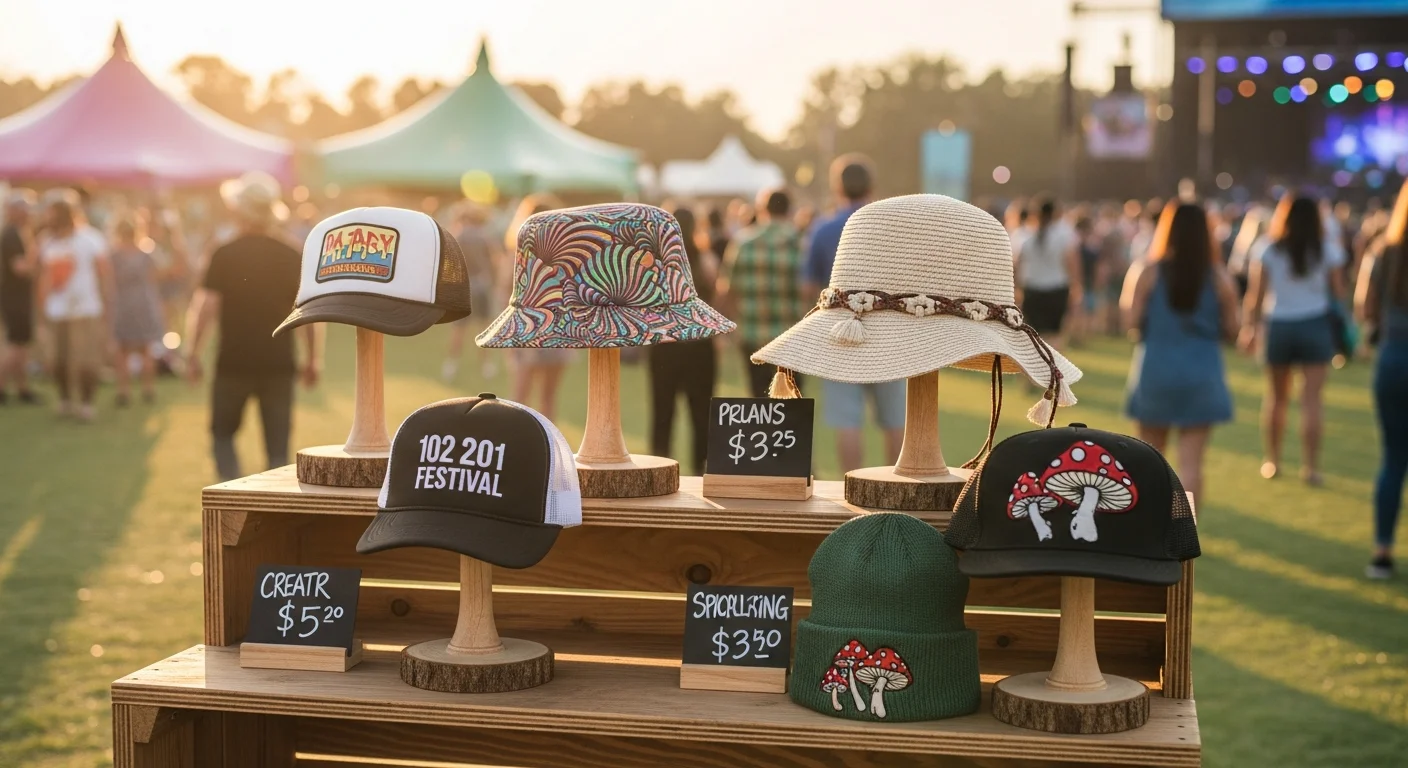
The merchandise booth used a tiered display rack showing all five hat designs at eye level, with pricing clearly visible on small acrylic cards. Each design had a size-mirror available for try-on — allowing attendees to see how the hat looked on them significantly increased conversion rates. The display was positioned at the main entrance and at the secondary beer garden entrance, maximizing foot traffic exposure.
Staffing consisted of two volunteers per shift (6-hour shifts, two shifts per day). Volunteers wore the leather patch trucker hat (the premium design) as a walking advertisement. Payment processing used a mobile POS system (Square) that accepted card, tap-to-pay, and Apple/Google Pay — cash-only setups at festivals lose 30-40% of potential sales because many attendees do not carry cash.
The busiest sales period was Saturday 11am-3pm, when attendees arriving in morning sun immediately recognized the practical need for a hat. The festival organizers placed the merchandise booth in a high-traffic, sun-exposed area rather than under a shade tent — counterintuitively, positioning the booth in the sun increased sales because it amplified the practical need the hats were solving.
Lessons Learned and Recommendations
Lesson 1: Variety outsells volume. Five designs at 100 each outsold the previous year's single design at 300 units, generating 65% more total revenue despite the higher per-unit production cost of managing five separate production runs.
Lesson 2: Practical utility drives event hat sales. Sun protection was cited by 72% of hat buyers as a purchase factor — the hat's functional value at an outdoor event created a buying motivation that pure merchandise branding alone could not achieve.
Lesson 3: Premium pricing works at events. The $28 leather patch design sold out fastest, disproving the assumption that lower prices drive higher volume. Event attendees are in a spending mindset and will pay premium prices for merchandise they perceive as high quality and limited availability.
Lesson 4: Post-event online sales recover unsold inventory. Promoting remaining inventory through social media and email to attendees within 48 hours of the event captured purchase intent from people who considered buying at the event but did not. The urgency of "limited remaining stock" converted these on-the-fence buyers into customers.
For event merchandise planning, explore the full range of custom hat styles and use the free online design tool to prototype event-specific designs before committing to production orders.
Frequently Asked Questions
How many hat designs should a festival offer?
Three to five designs is the optimal range for most festivals. Fewer than three limits attendee choice and reduces urgency. More than five creates decision paralysis and complicates production logistics. Each design should target a distinct audience segment (premium/casual/budget or fashion/practical/fun) to maximize total addressable market within the attendee population.
What percentage of festival attendees typically buy hats?
At outdoor festivals with sun exposure, 10-15% of attendees purchase hats when pricing is in the $20-$28 range. Indoor events see lower rates of 5-8%. These rates increase with better merchandise booth visibility, cashless payment options, and variety of designs. Pine Valley's 12.6% conversion rate (443 buyers from 3,500 attendees) aligns with industry benchmarks for well-merchandised outdoor events.
Should event hats be sold or included in ticket price?
Selling hats separately (rather than including in ticket price) maximizes per-unit revenue because voluntary buyers accept higher price points for merchandise they choose to purchase. Including a hat in the ticket price works well for premium VIP packages where the hat is part of an elevated experience bundle. Most festivals use the separate-sale model for general merchandise and the bundle model for VIP upgrades.
Share this article
Written by
Natalie Voss
Founder & CEO of RareCustom. Natalie's event merchandise experience helps festival organizers create hat programs that maximize revenue and attendee satisfaction.