How to Start a Custom Sock Business in 2026: Print-on-Demand & Beyond
Launch a custom sock business in 2026 with this comprehensive guide. Compare print-on-demand vs wholesale models, evaluate suppliers like Printful and Printify, set pricing strategy, and project first-year revenue from side hustle to full brand.
Natalie Voss
Founder & CEO of RareCustom. MBA from Stanford with 8 years in e-commerce operations. Natalie shares business strategy insights for aspiring custom sock entrepreneurs.
The custom sock industry sits at the intersection of two massive trends: the $54 billion global socks market and the explosive growth of personalized, on-demand consumer products. Socks are the most frequently purchased apparel item in the world — the average American buys 12 pairs per year — and customization adds a premium that transforms a $3 commodity into a $15–25 branded product. For entrepreneurs evaluating custom apparel opportunities, socks offer lower startup costs, simpler logistics, and higher margins than nearly any other product category.
This guide covers everything needed to launch a custom sock business in 2026, from choosing the right business model and evaluating suppliers to setting pricing, building a brand, and projecting realistic first-year revenue. Whether the goal is a side hustle generating an extra $1,000 per month or a full-time brand targeting six-figure annual revenue, the fundamentals outlined here provide a clear roadmap. Entrepreneurs interested in complementary product lines can also explore guides on launching a custom t-shirt business or a custom jersey business.
Market Opportunity: $54B Global Socks Market
The global socks market was valued at $54 billion in 2025 and is projected to grow at a 6.2% compound annual growth rate (CAGR) through 2030, reaching approximately $73 billion. Several factors drive this growth: increasing athleisure adoption, rising demand for specialty performance socks, the "sock as a fashion statement" trend popularized by social media, and the expanding custom/personalized segment fueled by print-on-demand technology.
Within this massive market, the custom and personalized socks segment is growing at nearly double the overall rate — approximately 11–14% annually. Consumers and businesses alike are shifting away from commodity socks toward branded, customized, and niche-specific options. Corporate branding programs, sports teams, wedding parties, fundraising organizations, and direct-to-consumer sock brands all contribute to this accelerating demand.
The competitive landscape remains relatively fragmented compared to custom t-shirts, where established players dominate. This fragmentation creates opportunity for new entrants to capture niche audiences without competing directly against incumbents with massive advertising budgets. A sock brand focused on a specific niche — nurses, trail runners, dog lovers, or eco-conscious consumers — can establish authority and build a loyal customer base faster than a generalist brand competing on price alone.
Business Model Options: POD, Wholesale, Hybrid
Three primary business models serve the custom sock market, each with distinct tradeoffs between upfront investment, per-unit margins, and operational complexity:

Print-on-Demand (POD): Zero inventory investment. Socks are manufactured and shipped one at a time as orders come in. The POD provider handles production, packaging, and shipping. Profit margins range from 25–40% depending on the supplier and retail price. The tradeoff is higher per-unit cost (since there are no volume discounts) and limited control over production quality, packaging, and shipping speed. POD is ideal for testing designs, validating a niche, and generating revenue with zero financial risk.
Wholesale/Bulk Manufacturing: Upfront inventory investment of $2,000–$10,000 for initial production runs of 200–1,000+ pairs. Per-unit costs drop dramatically — $3–6 per pair compared to $10–13 per pair with POD — enabling profit margins of 50–70%. The tradeoff is inventory risk (unsold stock ties up capital), warehousing costs, and the need to handle fulfillment (picking, packing, shipping) or pay a third-party logistics (3PL) provider. Wholesale is ideal for established brands with proven demand and consistent sales volume.
Hybrid Model: Start with POD to validate designs and build initial demand, then transition best-selling designs to wholesale production for higher margins. This approach minimizes upfront risk while providing a clear path to profitability. Most successful custom sock businesses follow this trajectory, using POD revenue to fund their first wholesale production run once a design consistently sells 50+ pairs per month.
Choosing a Niche: Athletic, Fashion, Corporate, Novelty
Niche selection is the single most important strategic decision for a new custom sock business. A clearly defined niche determines the target customer, design direction, price point, marketing channel, and competitive positioning. Four broad niche categories dominate the custom sock market:
Athletic/Performance: Targets sports teams, runners, cyclists, and fitness enthusiasts. Requires technical knowledge of performance sock construction and moisture-wicking materials. Higher per-unit cost but strong team/bulk order potential. Average retail price: $18–30/pair.
Fashion/Lifestyle: Targets trend-conscious consumers who treat socks as a style statement. Design-forward with bold patterns, artistic collaborations, and seasonal collections. Lower barrier to entry but more competitive. Average retail price: $14–22/pair.
Corporate/Branding: Targets businesses ordering custom logo socks for employee gifts, trade shows, and client appreciation. Higher order values (50–500+ pairs per order) with repeat purchasing potential. Requires sales outreach and B2B marketing capabilities. Average retail price: $8–15/pair (bulk pricing).
Novelty/Gift: Targets gift shoppers with humorous, personalized, and occasion-specific designs (pet face socks, holiday socks, inside-joke socks). Strong seasonal demand spikes (Christmas, Valentine's, Father's Day). Average retail price: $15–25/pair.
Setting Up a Print-on-Demand Storefront
A POD custom sock business can be operational within 48 hours using existing e-commerce platforms. Three primary storefront options serve different business strategies:
Shopify ($39/month + transaction fees): The most popular option for building a standalone branded store. Full control over branding, customer experience, and marketing. Integrates directly with sock POD suppliers through apps. Best for entrepreneurs building a long-term brand with its own identity and customer base.
Etsy ($0.20/listing + 6.5% transaction fee): The largest marketplace for handmade and custom products. Built-in traffic from 95+ million active buyers. Lower startup cost and faster time to first sale. Best for validating designs and generating initial revenue while building brand awareness. Limited branding control and higher competition from similar sellers.
Custom website (Squarespace, Wix, or WooCommerce): Lower monthly costs ($16–35/month) with moderate customization. Suitable for niche brands with specific design requirements not served by Shopify templates. Requires more technical setup for POD integrations.
Supplier Evaluation: Printful, Printify, Prodigi Sock Offerings
Choosing the right POD supplier directly affects product quality, profit margins, and customer satisfaction. Three major POD suppliers offer custom sock products with meaningful differences in pricing, quality, and fulfillment speed:
Printful offers crew socks at a base cost of $12.50 per pair with a suggested retail price of $25. Production time averages 3–5 business days with fulfillment from US and European facilities. Printful offers the highest print quality consistency and the most reliable shipping times, but also the highest per-unit cost. The all-over sublimation print covers the entire sock surface including the sole.
Printify connects to multiple print partners, offering crew socks at a base cost of $10.80 per pair with a suggested retail price of $22. Production time varies by print partner (2–7 business days). Lower cost per unit, but quality consistency varies across print partners. Printify Premium plan ($29.99/month) provides additional discounts of up to 20% on base costs.
Prodigi offers crew socks at a base cost of $11.20 per pair with a suggested retail price of $23. Production time averages 3–6 business days with global fulfillment. Prodigi's strength is international fulfillment with local production in 15+ countries, reducing shipping costs and delivery times for non-US customers.
Pricing Strategy and Margins
Successful custom sock pricing targets a 2.5–3x markup over the total cost per pair (product cost + shipping + packaging + platform fees). This markup range ensures sustainable profitability while remaining competitive with comparable brands in the market.

For a POD model using Printful at $12.50 base cost with $3.99 average shipping subsidy, the total cost per pair is approximately $12–13 (after factoring in platform transaction fees). A retail price of $24.99 yields a gross profit of approximately $12–13 per pair, or roughly a 48–52% gross margin. Higher retail prices ($29.99) are achievable for premium or niche designs with strong brand positioning.
For wholesale models with per-unit costs of $4–6, the same 2.5–3x markup yields retail prices of $12–18 per pair with gross margins of 55–70%. The higher margins compensate for the inventory risk, warehousing costs, and fulfillment labor that POD eliminates. For additional pricing strategy details, see the custom sock pricing guide.
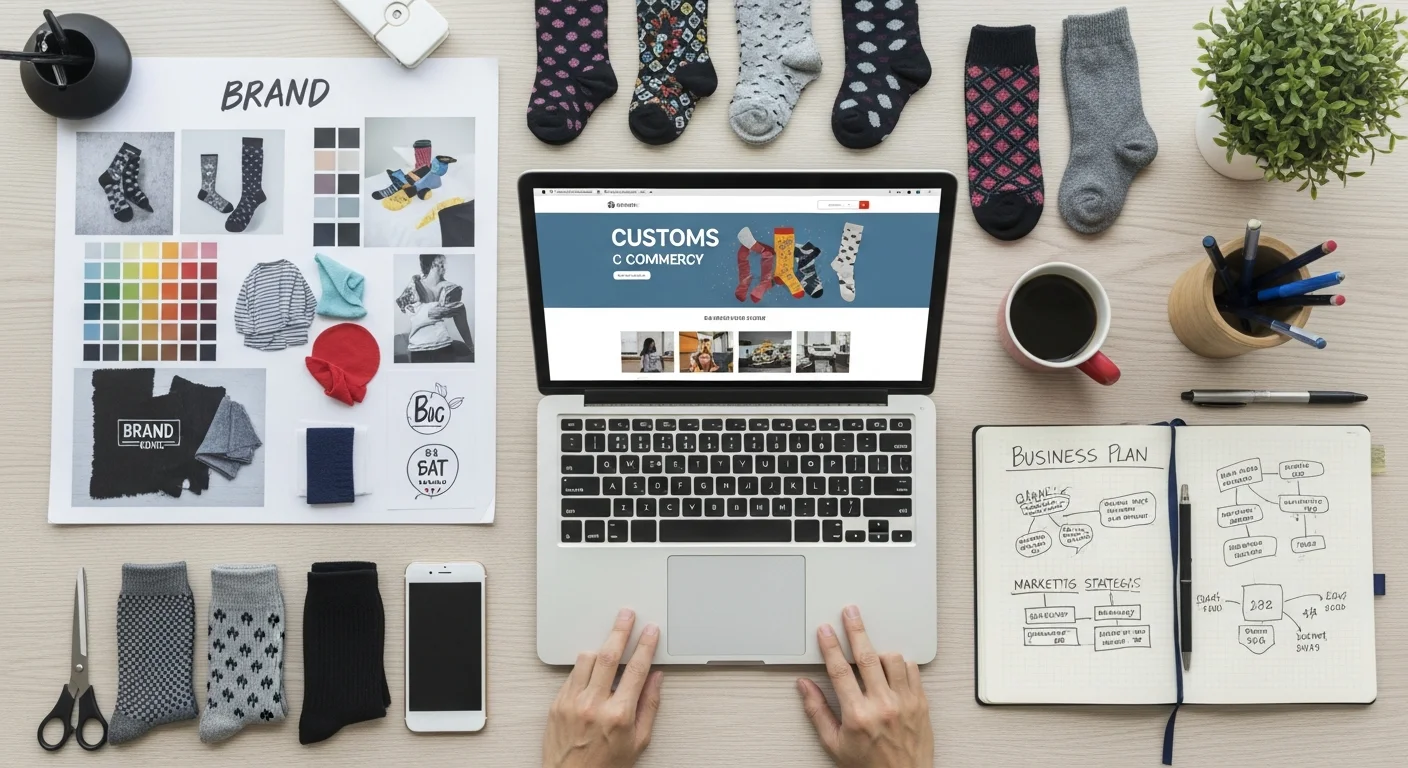
Branding, Packaging, and Unboxing Experience
In a crowded market, branding and packaging differentiate a forgettable commodity from a memorable brand experience. The unboxing moment — when a customer first opens the package — is the highest-engagement touchpoint in the entire customer journey and directly influences repeat purchase rates, social sharing, and word-of-mouth referrals.
Minimum viable branding includes a logo, consistent color palette, and branded packaging insert (thank-you card with social media handles and a discount code for the next purchase). The insert costs $0.10–0.25 per order and drives 8–15% repeat purchase rates when it includes a compelling offer. Premium branding adds custom tissue paper ($0.15–0.30/pair), branded belly bands ($0.30–0.75/pair), and custom mailer boxes ($1.50–3.00/pair). Brands committed to sustainability can explore eco-friendly packaging options using recycled materials and soy-based inks.
For POD businesses, branding options depend on the supplier. Printful offers branded pack-ins and custom packing slips. Printify and Prodigi offer more limited branding options through their print partners. A hybrid approach — adding branded packaging manually to POD-fulfilled orders — provides full branding control at the cost of handling each package personally.
Marketing Channels: Social Media, Etsy, Shopify
Three marketing channels consistently drive the highest return on investment for custom sock businesses:
Instagram remains the top visual marketing platform for custom socks. Sock flat-lay photography, on-foot styling content, and behind-the-scenes production videos generate the highest engagement rates. Instagram Shopping integration allows direct purchasing from posts and stories. Hashtag strategy targeting niche communities (#socksofinstagram, #dogsocks, #nurselife, #runnersocks) builds organic reach within target audiences.
TikTok drives explosive discovery for novelty and gift sock brands. Short-form videos showing the "reveal" moment — unwrapping a pair of custom face socks, for example — routinely generate hundreds of thousands of views. TikTok Shop integration enables in-video purchasing. The platform's algorithm favors entertaining, authentic content over polished production, making it accessible for bootstrapped sock businesses.
Pinterest delivers the highest average order value among social platforms for custom apparel. Pinterest users actively search for gift ideas, wedding accessories, and custom products, making it a high-intent discovery platform. Rich Pins with pricing and availability information drive direct traffic to product pages. Pinterest advertising costs 30–50% less per click than Instagram or Facebook for custom apparel keywords.
Scaling from Side Hustle to Full Brand
The transition from side hustle to full-time brand follows a predictable progression tied to monthly volume. At 1–50 pairs per month, the business operates as a side hustle with POD fulfillment and minimal time investment (5–10 hours/week). At 50–200 pairs per month, the business generates meaningful income ($650–2,600/month at $13 average profit) and justifies transitioning best-selling designs to wholesale for higher margins. At 200–500 pairs per month, the business requires dedicated time, potentially a part-time employee or virtual assistant, and professional-grade branding and marketing. At 500+ pairs per month, the business is a full-time operation generating $6,500+ per month in gross profit and should invest in wholesale relationships, custom packaging, and expanded product lines.
Key scaling milestones include: first consistent $1,000/month revenue (validates the niche), first wholesale order (proves demand justifies inventory), first repeat customer cohort (confirms product quality and brand loyalty), and first non-founder employee (enables growth beyond the founder's time capacity).
Financial Projections: Year One
Realistic first-year projections vary significantly based on the chosen business model, niche, and time investment. Two common scenarios illustrate the range:
Conservative (Side Hustle): Selling 100 pairs per month at an average profit of $13 per pair generates $1,300/month or $15,600 per year in gross profit. This scenario assumes POD fulfillment, part-time effort (10–15 hours/week), and modest marketing spend ($100–200/month on social media advertising). Startup costs total approximately $500–1,000 (Shopify subscription, initial ad spend, sample orders).
Aggressive (Full Commitment): Selling 500 pairs per month at an average profit of $13 per pair generates $6,500/month or $78,000 per year in gross profit. This scenario assumes a mix of POD and wholesale fulfillment, full-time effort (40+ hours/week), and significant marketing investment ($500–1,500/month). Startup costs total $5,000–15,000 (wholesale inventory, professional branding, website development, initial advertising).
Both scenarios assume a ramp-up period of 3–6 months before reaching the stated monthly volume. First-month revenue for most new sock businesses ranges from $200–800, growing 15–30% month-over-month as marketing efforts compound and repeat customers establish purchasing patterns. Break-even on initial startup costs typically occurs within 2–4 months for the side hustle model and 4–8 months for the full commitment model.
Frequently Asked Questions
How much money do you need to start a custom sock business?
A POD-based sock business can launch for under $500, covering a Shopify subscription ($39/month), domain name ($12/year), sample orders ($50–100), and initial advertising ($200–300). A wholesale-based business requires $2,000–$10,000 for initial inventory, plus $500–1,500 for branding and website setup. The POD model eliminates inventory risk entirely, making it the recommended starting point for first-time entrepreneurs.
What profit margin should a custom sock business target?
Target a gross profit margin of 45–55% for POD fulfillment and 55–70% for wholesale fulfillment. After deducting marketing costs (15–25% of revenue), platform fees (3–8%), and operating expenses (5–10%), net profit margins typically range from 15–30% for established sock businesses. New businesses should prioritize reaching consistent monthly volume before optimizing margins.
Is the custom sock market too saturated to enter in 2026?
The overall custom sock market is growing fast enough to absorb new entrants, but broad, undifferentiated approaches face strong competition. Success in 2026 requires niche focus — targeting a specific audience with designs, materials, and marketing that speak directly to their needs. A sock brand for veterinarians, CrossFit athletes, or elementary school teachers can build a loyal audience far more efficiently than a brand selling "cool socks" to everyone.
Share this article
Written by
Natalie Voss
Founder & CEO of RareCustom. MBA from Stanford with 8 years in e-commerce operations. Natalie shares business strategy insights for aspiring custom sock entrepreneurs.