How to Start a Custom Jersey Business in 2026: Print-on-Demand & Team Sales
Launch a custom jersey business using print-on-demand. Learn the B2B team sales model, seasonal ordering cycles, league partnerships, pricing strategy, and how to land your first contracts.
Natalie Voss
Founder & CEO of RareCustom. MBA from Stanford with 8 years in e-commerce operations. Natalie shares business strategy insights for aspiring custom jersey entrepreneurs.
The custom jersey market is projected to reach $13 billion globally by 2033, growing at 7-10% annually. That growth is fueled by expanding youth sports participation, the rise of esports, increasing corporate sports events, and a cultural shift toward team identity and personalization. Starting a custom jersey business in 2026 positions you in a growing market with strong, recurring demand.
Unlike starting a t-shirt business or a hoodie brand, which are primarily B2C (business-to-consumer), a jersey business is inherently B2B (business-to-business). Your customers are team managers, coaches, athletic directors, and league organizers who place bulk orders. This B2B model offers higher average order values, more predictable revenue, and stronger customer retention than one-off consumer sales.
The Custom Jersey Business Model
At its core, a custom jersey business connects design capability with production fulfillment. You offer teams a design service (creating their jersey layout), a production service (printing the jerseys through a POD partner or in-house equipment), and a logistics service (managing orders, sizing, and delivery). Your value proposition is making the jersey ordering experience easy and professional for busy team managers.
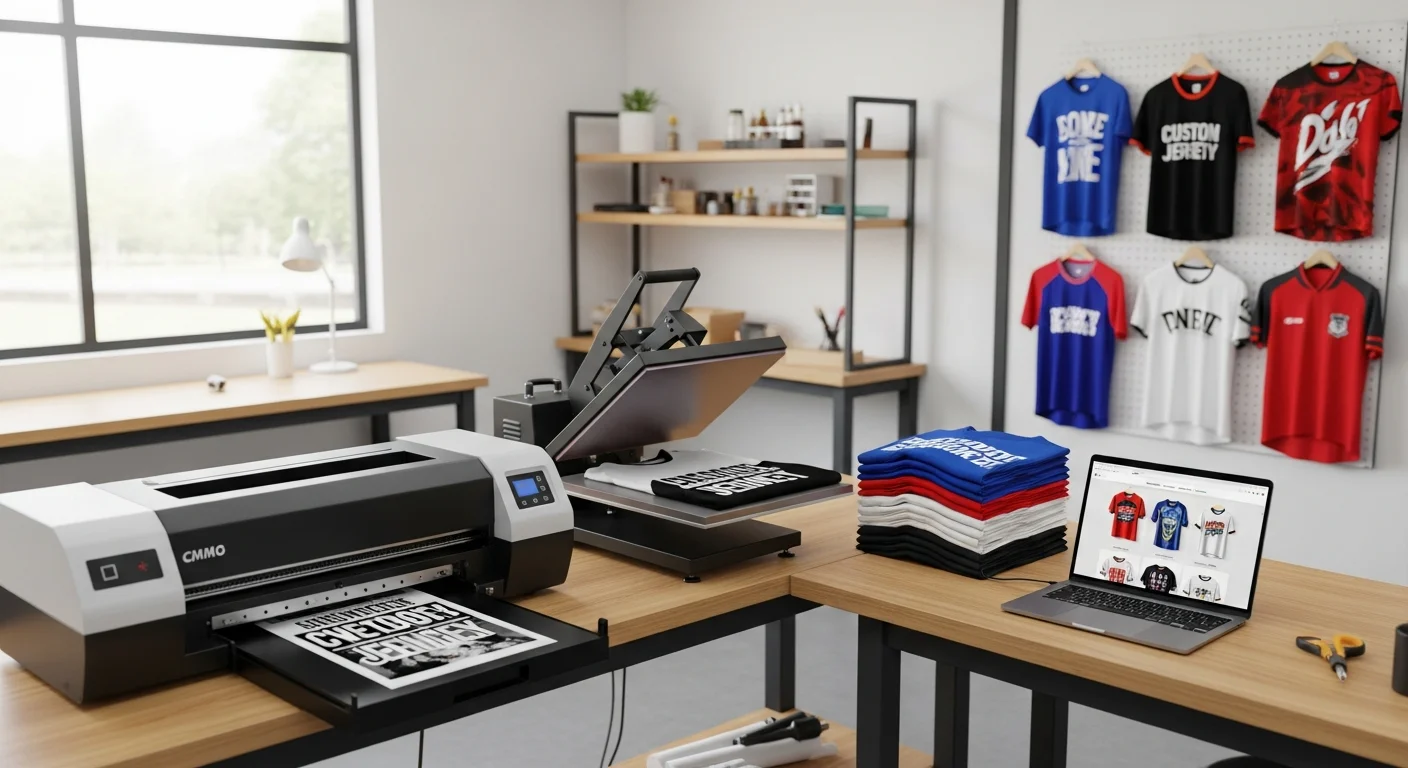
There are two primary approaches to production: print-on-demand (POD) and in-house production. POD requires minimal upfront investment — you design the jerseys and a partner like Printful, Printify, or a local sublimation shop handles printing and shipping. In-house production requires purchasing a sublimation printer, heat press, and blank jersey inventory, but offers higher margins and faster turnaround.

Identifying Your Target Market
Youth Sports Leagues
Youth leagues are the bread and butter of the custom jersey market. Youth basketball, soccer, baseball, and football leagues order hundreds of jerseys every season. Becoming the preferred jersey provider for a league gives you a captive, recurring customer base.
High School and College Athletics
School athletic departments order across multiple sports every year. Landing a school contract means consistent annual revenue with orders spanning basketball, football, baseball, soccer, volleyball, and more. Schools value reliability and quality consistency above all else.
Adult Recreational Leagues
Rec leagues for adults — softball, basketball, soccer, kickball — are growing rapidly. These teams often lack a go-to jersey provider and appreciate a business that makes the ordering process simple and fun.
Corporate and Event Markets
Companies ordering jerseys for sports days, charity events, and team building represent a premium market with larger budgets and less price sensitivity. Corporate clients also tend to reorder annually for recurring events.
Esports Teams
The esports market is growing at 20%+ annually and most teams at the amateur and semi-pro level do not have established jersey partnerships. Early entrants into this market can build strong relationships before competition intensifies. See our esports jersey guide for design specifics.
Getting Started with Print-on-Demand
Print-on-demand is the lowest-risk entry point for a new jersey business. You need no inventory, no equipment, and no upfront capital beyond basic business setup costs. Partner with a POD provider that offers sublimated jerseys, upload your designs, and fulfill orders as they come in.
The tradeoff is lower margins (POD providers take a significant cut) and longer production times (since you are relying on a third party). As your volume grows, transitioning to in-house production or a dedicated contract manufacturer becomes more profitable.
Pricing Strategy
Jersey pricing should cover your production cost plus design time plus a profit margin. A typical pricing structure for a new jersey business looks like this: production cost of $20-$30 per jersey (POD cost) plus a $10-$20 per unit margin, resulting in a retail price of $35-$55 per jersey. At 100 jerseys per month, that generates $1,000-$2,000 in monthly gross profit.
Offer volume discounts that incentivize larger orders. Teams ordering 24+ jerseys get a better per-unit price, which increases your total revenue while reducing per-unit overhead. For deeper pricing analysis, see our jersey pricing guide.

Landing Your First Customers
Your first customers will likely come from personal networks. Coach a team? Offer to design their jerseys. Know a league commissioner? Pitch a partnership. Volunteer at a youth sports organization? Demonstrate your service with a sample order. The custom jersey business is built on relationships and word-of-mouth referrals.
Create a portfolio website showcasing your best designs. Include mockups, testimonials from early customers, and a clear ordering process. Make it easy for team managers to request a quote and visualize their jerseys before committing.
Seasonal Planning
The jersey business follows sport-specific seasonal cycles. Basketball ordering peaks in October-November. Baseball peaks in February-March. Football peaks in June-July. Soccer spans year-round but peaks in August-September. Planning your marketing, inventory, and production capacity around these cycles ensures you can handle demand surges without compromising quality or turnaround times.
Scaling the Business
As volume increases, consider these scaling strategies: invest in a sublimation printer for in-house production (reducing per-unit cost and turnaround time), hire a designer to increase design capacity, pursue league-level partnerships that guarantee annual volume, and expand into related products (shorts, warm-ups, bags, team merchandise).
Frequently Asked Questions
Is selling custom jerseys profitable?
Yes. The B2B team model generates higher average order values ($400-$2,000 per order) than B2C apparel sales. With POD, margins run 20-40%. With in-house production, margins can reach 50-60%. The recurring nature of seasonal team orders creates predictable revenue.
How do I get contracts with local sports teams?
Start by networking with coaches, league commissioners, and athletic directors. Offer to design a sample jersey for a team you are connected to. Deliver excellent quality and service, then ask for referrals. League-level partnerships are the ultimate goal — becoming the preferred provider for an entire league guarantees annual volume.
What equipment do I need to start?
With print-on-demand, you need only a computer, design software (Adobe Illustrator, Canva, or similar), and a website. For in-house production, you need a wide-format sublimation printer ($3,000-$10,000), a heat press ($1,000-$3,000), blank jersey inventory, and cutting equipment.
How much does it cost to start a custom jersey business?
A POD-based jersey business can launch for under $500 (domain, website, design software). An in-house production setup requires $5,000-$15,000 for equipment and initial inventory. Most entrepreneurs start with POD and transition to in-house production as volume justifies the investment.
Share this article
Written by
Natalie Voss
Founder & CEO of RareCustom. MBA from Stanford with 8 years in e-commerce operations. Natalie shares business strategy insights for aspiring custom jersey entrepreneurs.