Custom Sock Sizing Guide: Finding the Perfect Fit for Every Foot
Master custom sock sizing with detailed charts for men, women, and youth. Covers measuring techniques, compression levels, material stretch factors, and team ordering size collection tips.
Terrence Okafor
Head of Production at RareCustom with 20+ years in commercial printing. Terrence's hands-on experience with sock construction and fit ensures every custom order fits perfectly.
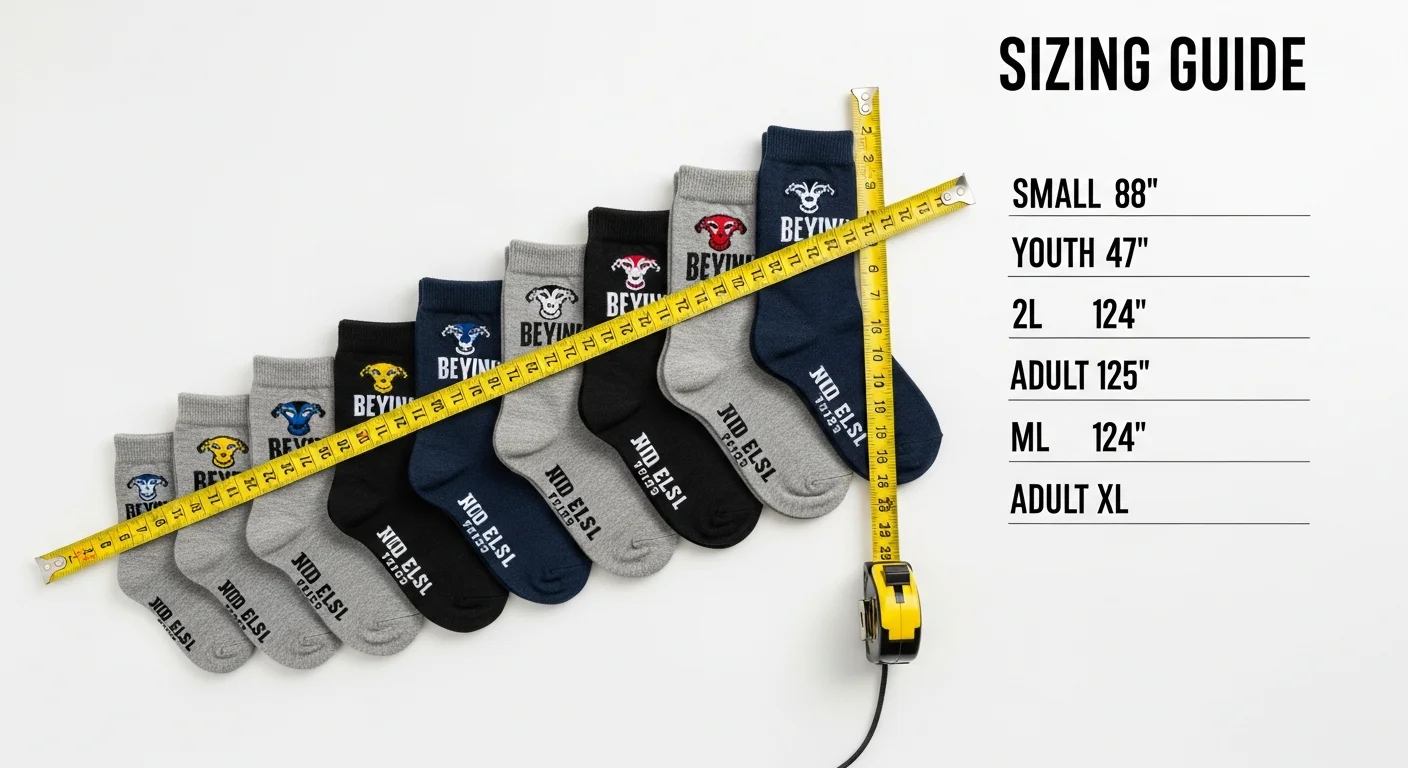
Getting the size right on custom socks is more critical than most people realize — even more so than sizing custom t-shirts because socks must conform to a three-dimensional foot shape rather than draping loosely over a torso. An ill-fitting sock bunches inside a shoe, slips below the heel during activity, creates blisters at friction points, or constricts circulation if too tight. Socks must conform precisely to the foot and leg to perform properly — and that means understanding how sock sizes translate from shoe sizes, how materials stretch, and how to collect accurate sizes from a group.
This guide provides complete sizing charts for men's, women's, and youth custom socks, explains measuring techniques, covers compression level sizing, and shares practical tips for team orders where you need to gather sizes from dozens or hundreds of people.
Standard Size Ranges: S, M, L, XL
Most custom sock manufacturers offer four to five size categories: Small (S), Medium (M), Large (L), and Extra-Large (XL), with some adding Extra-Small (XS) for youth. Each size corresponds to a range of shoe sizes and foot lengths. The exact correspondence varies slightly between manufacturers, but the ranges below are industry standard for U.S. sizing.
Understanding these ranges is essential because you must specify the quantity of each size in your order. A typical adult order follows a bell-curve distribution: approximately 10% Small, 35% Medium, 40% Large, and 15% Extra-Large. Adjusting these ratios based on your group demographics — for example, a men's basketball team skews toward Large and XL — avoids running out of popular sizes while having excess inventory in uncommon ones.
Men's, Women's, and Youth Size Charts
| Sock Size | Men's Shoe Size (US) | Women's Shoe Size (US) | Youth Shoe Size (US) | Foot Length (inches) | Foot Length (cm) |
|---|---|---|---|---|---|
| S | 4–6 | 5–7 | — | 8.5–9.5 | 21.6–24.1 |
| M | 6–9 | 7–10 | — | 9.5–10.5 | 24.1–26.7 |
| L | 9–12 | 10–13 | — | 10.5–11.5 | 26.7–29.2 |
| XL | 12–15 | — | — | 11.5–12.5 | 29.2–31.8 |
Youth sizing follows a separate scale: Youth S fits shoe sizes 9-12 (foot length 6.5-7.5 inches), Youth M fits shoe sizes 12-3 (foot length 7.5-8.5 inches), and Youth L fits shoe sizes 3-6 (foot length 8.5-9.5 inches). Youth socks have proportionally different heel depths, toe shapes, and cuff widths designed for growing feet — ordering adult Small socks for youth wearers results in misaligned heel pockets and oversized cuffs.
Note that men's and women's shoe sizes use different scales — a women's size 9 is approximately equivalent to a men's size 7.5, a full 1.5-size difference. When collecting sizes for a mixed-gender group, always specify whether the shoe sizes submitted are men's or women's to avoid mismatches that result in the wrong sock size being ordered. Some manufacturers simplify this by using unisex sock sizes based on foot length in inches or centimeters, which eliminates gender-based confusion entirely and is the recommended approach for large mixed-gender orders.

Measuring Foot Length and Calf Circumference
For standard crew and ankle socks, foot length is the primary measurement. Stand barefoot on a sheet of paper on a hard floor, mark the heel and the tip of the longest toe, and measure the distance in inches or centimeters. This maps directly to the size chart above. Always measure in the afternoon or evening when feet are at their largest — feet swell 3-5% throughout the day. If the measurement falls between two sizes, round up for standard socks and round down for compression socks.
For knee-high socks and compression socks, calf circumference becomes equally important. Measure the widest part of the calf with a flexible tape measure while standing. Standard knee-high sock calf ranges are: Small (12-14 inches / 30-36 cm), Medium (14-16 inches / 36-41 cm), Large (16-18 inches / 41-46 cm), and XL (18-20 inches / 46-51 cm). If the calf and foot measurements point to different sizes, prioritize the larger size.
How Material and Knit Affect Stretch
Different sock fabrics stretch differently, affecting how a given size fits. Polyester-spandex blends have the highest stretch recovery — they fit snugly and return to shape after every wash. Combed cotton blends stretch slightly less and may relax over time, so cotton socks should fit snugly out of the package. Merino wool has moderate stretch but less recovery than synthetics, meaning merino socks may loosen slightly before reaching a stable fit. For detailed fabric properties, consult the fabric guide.
Knit density also affects fit. A tightly knitted 200 GSM sock has less give than a loosely knitted 140 GSM sock of the same blend. When ordering from a new manufacturer, request a sample pair to verify fit before committing to a full production run.
Terry-loop construction (small loops of yarn lining the interior for cushioning) adds thickness and reduces interior volume. Socks with full terry cushioning effectively feel half a size smaller than flat-knit socks of the same labeled size. If your custom socks feature terry cushioning, recommend that wearers size up if they fall between sizes.

Compression Levels (mmHg)
Compression socks use graduated pressure — tightest at the ankle and progressively lighter toward the knee — to improve blood circulation, reduce swelling, and support muscle recovery. Compression is measured in millimeters of mercury (mmHg). Light compression (8-15 mmHg) provides gentle support for everyday wear and travel. Moderate compression (15-20 mmHg) is the most popular level for athletic recovery, long flights, and occupations involving extended standing. Firm compression (20-30 mmHg) is used for post-surgical recovery and chronic venous insufficiency treatment. Medical-grade compression (30-40 mmHg) is prescribed for severe edema, deep vein thrombosis prevention, and post-thrombotic syndrome — this level should only be used under medical supervision and requires a precise fit to avoid circulatory complications.
Compression sock sizing is more precise than standard sizing because the pressure profile must match leg dimensions exactly. In addition to foot length, compression socks require ankle circumference (narrowest point above the ankle bone), calf circumference (widest point), and sometimes calf length (ankle bone to back of knee). A compression sock that is too loose provides insufficient pressure; one that is too tight can restrict circulation. For style selection, knee-high is the standard length for compression applications.
Team Ordering Size Collection Tips
Collecting accurate sizes from a team or organization is one of the most logistically challenging parts of a custom sock order. Errors in size collection lead to costly exchanges, delayed distribution, and frustrated recipients. The following strategies are used by professional team managers and corporate event planners to minimize sizing issues and streamline the process.
Use a digital form with dropdown menus for shoe size and gender. Create a simple online form using Google Forms, Typeform, or your order platform's built-in tool. Use dropdown menus (not free-text fields) for shoe size and gender to prevent typos and ambiguous entries like "medium-ish" or "between 9 and 10." Include a note explaining that shoe size determines sock size automatically so respondents understand why the information is needed.
Set a hard deadline with automated reminders. Give your group two weeks to submit sizes, send a reminder at the one-week mark, and send a final reminder 48 hours before the deadline. After the deadline passes, order based on submitted sizes plus a 5-10% buffer distributed across medium and large sizes for late additions and last-minute roster changes. For comprehensive bulk ordering logistics including shipping timelines and quality control checklists, the wholesale ordering guide covers the full process from size collection through delivery.
Include a visual measurement guide in your form. Embed or link to a clear visual guide showing how to measure foot length (standing on paper, marking heel and toe, measuring the distance) and calf circumference for knee-high orders. People who have never measured their feet will guess inaccurately — research shows self-reported shoe sizes are incorrect approximately 30% of the time. Providing the actual measurement method with illustrations increases accuracy significantly and reduces exchange rates from the industry average of 12-15% down to 3-5%.
Common Sizing Mistakes
Ordering a single "one size fits all" size. Socks marketed as one-size stretch to fit a wide range but fit none of them properly. The heel pocket lands in the wrong position (too far forward for large feet, too far back for small feet), the toe seam falls short or extends past the toes creating uncomfortable bunching, and the cuff either cuts into the calf or slides down around the ankle. Always order in multiple sizes unless your group is very small and everyone wears the same shoe size.
Using men's shoe sizes for women's orders. A women's size 9 shoe is equivalent to a men's 7.5 — a full size and a half difference that translates to roughly one complete sock size. If a woman submits "size 9" without specifying gender and you order men's 9 socks (sock size Large), the correct sock size would have been Medium. Multiply this error across a group order and a significant portion of the socks will not fit. Always require gender specification or use a unisex foot-length-based sizing system that eliminates the ambiguity entirely.
Ignoring calf variance on knee-highs. Two people who wear the same shoe size can have very different calf diameters. For knee-high and compression socks, calf circumference can push someone into an entirely different size category than foot length alone would suggest. When calf and foot measurements point to different sizes, recommend the larger size — a slightly loose sock is far more comfortable than a constricting one.
Not ordering samples before production. Every manufacturer's sizing runs slightly differently due to variations in knitting machine calibration, yarn tension, and finishing processes. A "Large" from one supplier may fit like a "Medium" from another — the label says the same thing, but the actual dimensions differ by 5-10%. Before placing a large order (100+ pairs), request one or two sample pairs in different sizes to verify fit. This $15-30 investment can prevent hundreds of dollars in exchanges and reprints.
Frequently Asked Questions
What sock size should someone between two shoe sizes order?
Order the larger sock size. A slightly roomier sock is more comfortable than one that is too tight, and the spandex content (3-5%) keeps it snug enough to prevent slipping. For example, a men's size 9.5 shoe falls between Medium and Large — ordering Large ensures a comfortable fit with room for natural afternoon foot swelling.
Do custom socks shrink after washing?
Polyester and nylon socks do not shrink. Cotton socks can shrink 3-5% if washed in hot water or tumble-dried on high heat. Merino wool socks can shrink up to 8% if exposed to hot water and agitation, which causes felting. To prevent shrinkage, wash natural fiber socks in cold water (below 30°C / 86°F) and air dry flat or tumble dry on low. Quality blends are pre-shrunk during manufacturing.
How do you size compression socks for a team order?
Compression socks require ankle circumference and calf circumference in addition to shoe size. Provide each team member with a visual measurement guide and collect all three measurements via a digital form. Map measurements to the manufacturer's compression-specific size chart. Do not use standard sock sizes for compression orders — the fit must be precise for the compression to function correctly.
Share this article
Written by
Terrence Okafor
Head of Production at RareCustom with 20+ years in commercial printing. Terrence's hands-on experience with sock construction and fit ensures every custom order fits perfectly.