How to Start a Custom Hat Business: From Design to Revenue
Learn how to launch a custom hat business from scratch. Covers market research, brand development, sourcing manufacturers, pricing strategy, online sales channels, marketing approaches, and scaling from first sale to sustainable revenue.
Terrence Okafor
Head of Production at RareCustom with 20+ years in commercial printing. Terrence shares production expertise and industry knowledge for aspiring custom hat entrepreneurs.
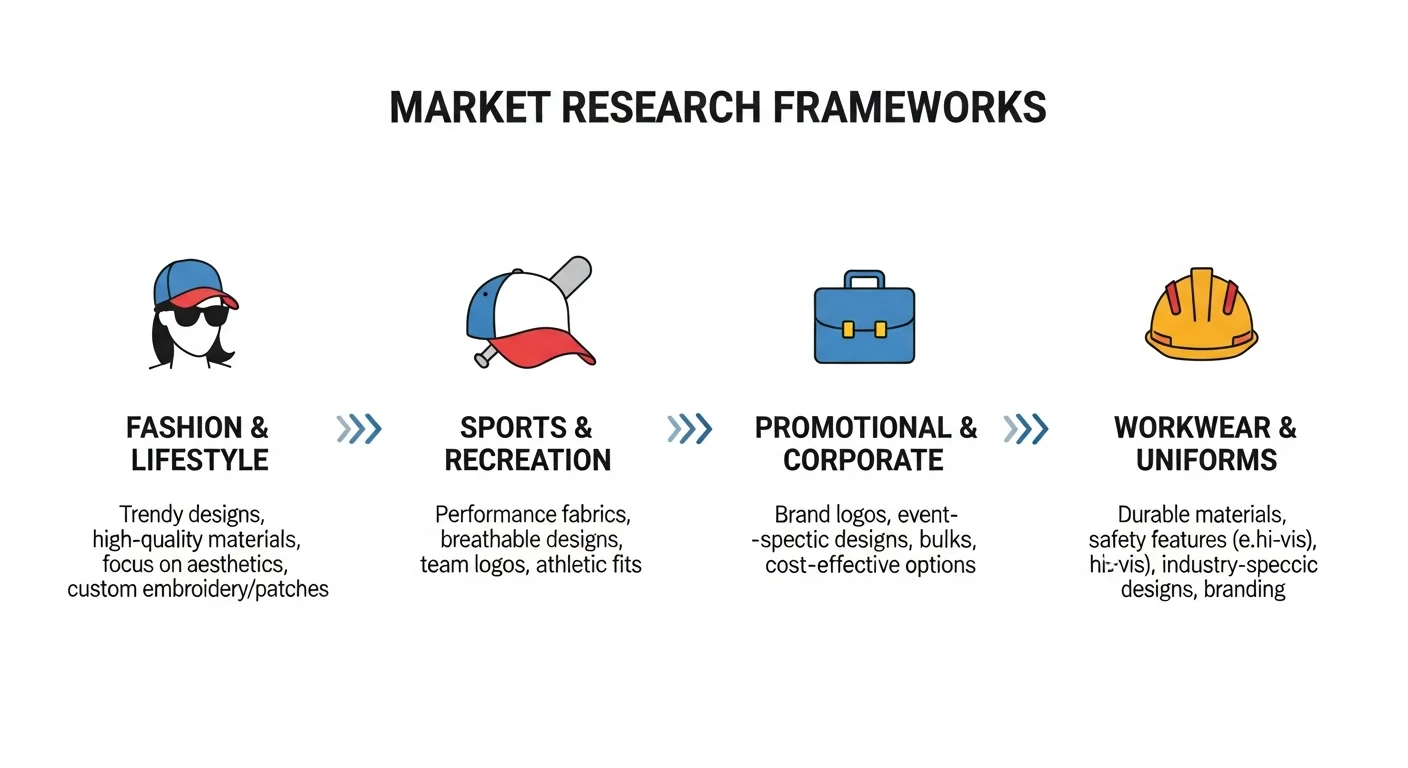
The custom hat industry represents one of the most accessible entry points for aspiring fashion and merchandise entrepreneurs. Unlike apparel brands that require extensive sizing, pattern development, and fit testing, custom hats have a relatively simple product structure (one-size-fits-most adjustable hats eliminate complex sizing matrices), lower minimum order quantities than most custom apparel (as few as 12-24 units), and strong consumer demand across multiple market segments — from fashion and streetwear to corporate branding to sports and events.
This guide covers the complete journey from concept to revenue: identifying a market niche, developing a brand identity, sourcing manufacturers, creating the first product line, setting pricing for profitability, choosing sales channels, marketing the brand, and scaling operations. The approach is grounded in practical steps that can be executed with a starting budget of $500-$2,000, making custom hat entrepreneurship accessible to first-time business owners.
Finding Your Niche: Market Research and Positioning
The custom hat market is large enough to support thousands of brands but competitive enough that undifferentiated products struggle to gain traction. Success requires identifying a specific niche — a defined audience with specific aesthetic preferences, values, or use cases that mass-market hat brands do not adequately serve.
Profitable custom hat niches include: Outdoor and adventure lifestyle (leather patches on trucker hats for hiking, camping, and fishing enthusiasts), local pride and community (city/neighborhood-themed hats for local markets), specific industries (construction, agriculture, food and beverage workers who want premium branded headwear), cause and values-driven (sustainability-focused hats for eco-conscious consumers), and fashion and streetwear (limited-edition drops targeting trend-conscious consumers).
Research the niche before committing: search social media hashtags related to the niche to gauge audience size and engagement, browse competitor products to identify gaps in style, quality, or messaging, and survey potential customers through Instagram polls or forums to validate that the concept has purchase intent. A niche is viable when at least 100-500 potential customers can be identified through social media and community channels.

Brand Development: Name, Logo, and Visual Identity
The brand identity — name, logo, color palette, and visual language — determines how the hat business is perceived before a single unit is sold. The brand should communicate the niche positioning clearly: an outdoor adventure hat brand needs a different name, logo style, and color palette than a streetwear-focused brand or a corporate merchandise provider.
Brand name: Choose a name that is memorable, easy to spell, available as a domain name and social media handle, and evocative of the brand's niche. Two-word names or invented compound words work well for hat brands because they are distinctive and trademark-friendly. Verify trademark availability through the USPTO database before finalizing.
Logo design: Create a logo that works at hat-embroidery scale from the beginning. Many new brands design a beautiful logo that looks great on websites and packaging but fails at the 4 × 2.5 inch embroidery size. Test the logo at embroidery scale during the design process — if it requires simplification for hat use, simplify the primary logo rather than creating a separate hat-specific version. A logo that works at hat scale will work at every other scale. Refer to the fonts and graphics guide for embroidery-optimized design principles.
Color palette: Select 2-3 primary hat blank colors and 1-2 thread colors that define the brand's visual identity. Consistent color use across all products creates recognizable brand cohesion. The initial palette should include at least one neutral (black, navy, charcoal, or white) and one distinctive brand color. Hat blank colors are limited to manufacturer-available options, so choose colors that are available from multiple suppliers to avoid vendor lock-in.
Sourcing: Manufacturers, Hat Blanks, and Decoration
For new hat brands starting with small quantities (12-100 units), contract decorators (companies that purchase hat blanks and apply embroidery, patches, or prints) are the most practical production partners. Contract decorators handle the full process — blank sourcing, decoration, quality control, and shipping — with low minimums and no requirement for the brand to purchase and warehouse blank hats.
Evaluate potential manufacturers on five criteria: minimum order quantity (lower is better for testing designs), decoration quality (request samples of their work), turnaround time (10-15 business days is standard), communication responsiveness (fast, clear communication prevents costly miscommunication), and pricing transparency (all costs itemized, no hidden fees). Request quotes from 3-5 manufacturers for the same design to compare pricing and service quality.
As the business scales beyond 200-500 units per quarter, consider direct blank purchasing from distributors (SanMar, Alphabroder, S&S Activewear) and partnering with a dedicated embroidery shop for decoration. This two-step approach reduces per-unit costs by 15-25% compared to full-service contract decorators, but requires the brand to manage inventory, blank quality control, and logistics coordination. For decoration method selection, reference the decoration methods comparison.
Pricing Strategy: Cost-Plus and Value-Based Approaches
Hat brand pricing should balance cost-based floor (the minimum price needed for profitability) with value-based ceiling (the maximum price the target market will pay based on perceived value). New brands often underprice their products, leaving money on the table and undermining the brand's premium positioning.
Cost calculation: Total per-unit cost = hat blank + decoration + packaging + shipping to customer + payment processing fees (typically 2.9% + $0.30). For a mid-range embroidered hat: $6 blank + $4 embroidery + $1.50 packaging + $3 shipping + $1 processing = $15.50 total cost. Minimum viable retail price at 50% margin: $31. Market-appropriate retail price: $28-$38 depending on niche and perceived value.
Value-based pricing considerations: Limited-edition releases command 20-40% premiums over standard products. Leather patch hats can be priced $5-$10 higher than embroidered hats because consumers perceive leather as a premium material. Collaborations with artists, influencers, or complementary brands add perceived value that supports higher price points. Bundle pricing (hat + t-shirt, or two hats at a discount) increases average order value while providing customer value.
For detailed pricing breakdowns across all decoration methods and volume tiers, review the custom hat pricing guide.
Sales Channels: Online and Local
Direct-to-consumer website (Shopify, WooCommerce, or similar) should be the primary sales channel for maximum control, margin, and customer data. A simple single-product page with high-quality photos, clear pricing, and straightforward checkout is sufficient to launch — do not delay launch waiting for a perfect website. Add products, content, and features iteratively as revenue grows.
Instagram and TikTok are the most effective social media channels for hat brands because headwear is inherently visual and wearable — user-generated content of customers wearing the hats creates organic marketing assets. Instagram Shopping and TikTok Shop enable direct purchasing within the platforms, reducing friction between discovery and purchase.
Local retail and pop-up events provide immediate feedback, customer interaction, and local brand building that online channels cannot match. Approach local boutiques, coffee shops, barber shops, and outdoor retailers about consignment or wholesale arrangements. Pop-up booths at farmers markets, art walks, and community events generate sales while building local brand awareness. In-person sales also allow customers to try hats on — significantly increasing conversion rates compared to online purchasing.
Scaling: From First Sale to Sustainable Revenue
The path from first sale to sustainable hat business follows a predictable progression. Phase 1 (0-100 hats): Test 2-3 designs in small quantities (24-36 per design), sell through personal network and local events, gather feedback on design preferences and pricing sensitivity. Phase 2 (100-500 hats): Expand to 4-6 designs based on Phase 1 data, launch online store, begin social media marketing, and establish 2-3 local retail partnerships. Phase 3 (500+ hats/quarter): Optimize production costs through volume, explore wholesale to regional retailers, develop seasonal collections, and consider limited-edition drops for brand heat.
The most important metric during early growth is sell-through rate — the percentage of produced inventory that sells within 90 days. A healthy sell-through rate for a new hat brand is 70-85%. Below 70% indicates overproduction or design-market mismatch. Above 85% indicates potential revenue left on the table from designs that sell out too quickly. Adjust production quantities based on sell-through data to minimize dead inventory while capturing maximum demand.
Explore production options and preview designs on the custom hats product page, and use the free online design tool to prototype brand designs before committing to production orders.
Frequently Asked Questions
How much money is needed to start a custom hat business?
A minimum viable custom hat business can launch with $500-$1,000 — enough for 24-36 hats across 1-2 designs at $12-$15 per hat, plus basic packaging and a simple website. To launch with more product variety and professional branding, budget $1,500-$3,000 for 72-100 hats across 3-4 designs, quality packaging, professional product photography, and a polished online store. The low startup cost is one of the most attractive aspects of custom hat entrepreneurship.
What is the most profitable custom hat style to sell?
Trucker hats with leather patches currently offer the strongest margin-to-demand ratio. Production cost runs $12-$16 per hat (mid-range blank + leather patch), and market-acceptable retail pricing ranges from $28-$38 — yielding 55-70% margins. Demand for leather patch hats has grown 45% year-over-year, and the artisan aesthetic generates strong social media engagement that drives organic marketing. Dad hats with minimal embroidery offer similar margins at a lower price point ($22-$30 retail), making them a strong complementary product.
Should a new hat brand use print-on-demand services?
Print-on-demand (POD) eliminates inventory risk but reduces margins by 40-60% compared to bulk ordering. POD works well for testing designs and gauging demand before committing to inventory — list 5-10 designs through a POD service, identify the top 2-3 sellers, then produce those designs in bulk at higher margins. Long-term, profitable hat brands transition from POD to inventory-based models as demand data becomes reliable enough to justify bulk production investments.
Share this article
Written by
Terrence Okafor
Head of Production at RareCustom with 20+ years in commercial printing. Terrence shares production expertise and industry knowledge for aspiring custom hat entrepreneurs.