Screen Printing vs DTG: Which Method Is Best for Your Custom T-Shirts?
Compare screen printing and DTG for custom t-shirts. Cost per shirt, durability, color options, and which method fits your order. Expert guide inside.
Terrence Okafor
Head of Production at RareCustom with 20+ years in commercial printing. SGIA certified and a regular speaker at printing industry conferences.
Choosing the right printing method is one of the most important decisions you will make when ordering custom t-shirts. The two dominant technologies, screen printing and direct-to-garment (DTG) printing, each deliver excellent results but excel in different situations. Understanding how they compare in cost, quality, durability, and turnaround time helps you make the smartest choice for your specific project.
This comprehensive guide breaks down every aspect of the screen printing vs DTG debate so you can order with confidence. Whether you are printing ten shirts for a bachelor party or five hundred for a corporate event, knowing which method fits your needs saves you money and ensures your finished product looks exactly the way you envisioned it.
Quick Summary: Screen Printing vs DTG at a Glance
Before diving into the details, here is a quick comparison table that summarizes the key differences between silk screen printing and direct-to-garment printing. Use this as a reference point as you read through the in-depth sections below.
| Factor | Screen Printing | DTG Printing |
|---|---|---|
| Best For | Bulk orders (50+ shirts), simple designs | Small batch orders, one-off prints, complex designs |
| Color Limit | 1 to 8 colors per design (each color = separate screen) | Unlimited colors, full CMYK color processing |
| Print Feel | Slightly raised ink layer on fabric | Soft-hand feel, ink absorbed into fibers |
| Durability | 100+ washes with proper care | 50+ washes with proper care |
| Setup Cost | Higher (screens must be created per color) | None (digital file printed directly) |
| Cost Per Unit (large orders) | Lower at volume | Higher at volume |
| Cost Per Unit (small orders) | Higher due to setup costs | Lower, no setup fees |
| Detail Level | Good for bold graphics, halftones possible | Excellent for photorealistic designs, gradients |
| Turnaround | Longer (screen setup required) | Faster (print on demand) |
| Eco-Friendly | Water-based inks available | Generally less waste, no screens to dispose |
The bottom line: if you need fifty or more shirts with a simple one-to-three color design, screen printing is typically the most cost-effective choice. For small batch orders with photorealistic or full-color designs, DTG printing delivers superior results without setup fees.
What Is Screen Printing?

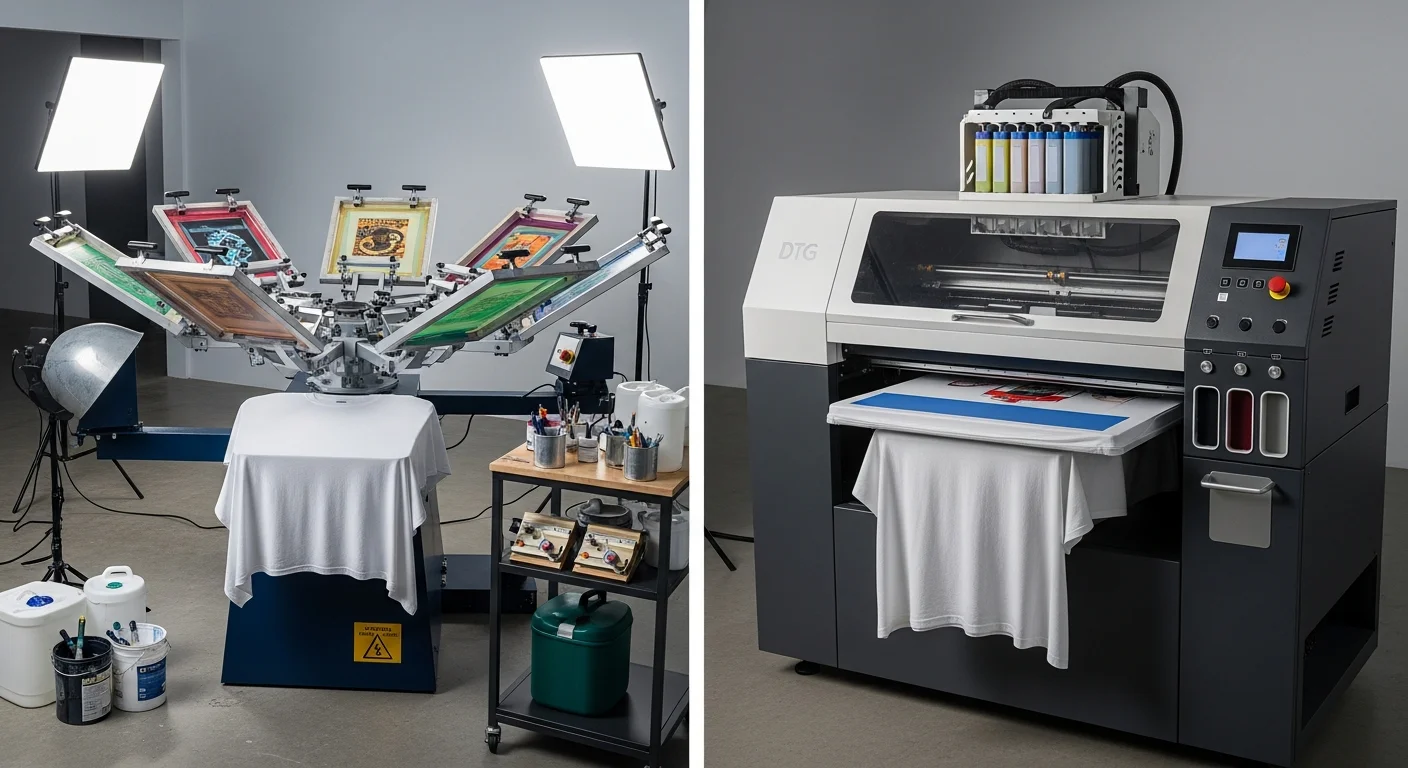
Screen printing, also known as silk screen printing, is one of the oldest and most widely used methods of custom apparel printing. The process involves creating a stencil, called a screen, for each color in your design. Ink is then pushed through the mesh screen onto the fabric using a squeegee, depositing a precise layer of color with each pass.
Each color in a screen-printed design requires its own separate screen, which is why simpler designs with fewer colors are more economical with this method. A one-color logo print, for example, requires only a single screen, while a six-color design requires six individual screens that must be precisely aligned during the printing process.
The inks used in screen printing come in two primary categories. Plastisol inks sit on top of the fabric and create a slightly raised, vibrant finish that is extremely durable and resistant to fading. Water-based inks absorb into the fabric fibers, producing a softer hand feel that is closer to what you experience with DTG printing. Water-based inks are also considered more eco-friendly because they contain fewer chemicals and produce less waste.
Screen printing has been the industry standard for decades because of its unmatched durability, vibrant color output, and cost efficiency at scale. The setup costs are front-loaded, meaning each screen has a fixed creation fee regardless of how many shirts you print. Once the screens are made, the per-unit cost drops dramatically as quantity increases, making it the preferred method for bulk orders.
What Is DTG (Direct-to-Garment) Printing?

Direct-to-garment printing is a digital printing technology that works similarly to a standard inkjet printer but is designed specifically for textiles. The garment is loaded onto a flat platen, and the printer applies water-based textile inks directly onto the fabric surface using CMYK color processing to reproduce any color in the spectrum.
Before printing, the garment typically undergoes a pre-treatment process where a special solution is applied to the fabric to help the ink bond properly. This step is especially important when printing on dark-colored fabrics, where a white underbase layer must be laid down first to ensure colors appear bright and accurate against the dark background.
Because DTG printing is entirely digital, there are no screens to create, no setup fees to absorb, and no minimum order quantities to meet. You can print a single shirt with a full-color, photorealistic design at the same per-unit cost as printing ten shirts. This makes digital printing the ideal choice for one-off prints, sample orders, and designs that feature gradients, photographs, or unlimited color variations.
The inks used in DTG printing are absorbed directly into the fabric fibers rather than sitting on top of them, which produces the coveted soft-hand feel that many customers prefer. The print becomes part of the fabric itself, meaning you cannot feel the design when you run your fingers across it. This characteristic makes DTG particularly appealing for fashion-forward designs and everyday wear.
Print Quality Comparison

When it comes to pure visual quality, both methods produce professional-grade results, but they excel in different areas. Screen printing delivers exceptional color vibrancy and saturation, especially with plastisol inks. Bold, solid-color designs with sharp edges look stunning in screen print because each color is applied as a dense, even layer.
DTG printing excels with full-color prints that include gradients, subtle color transitions, and photorealistic imagery. Because DTG uses CMYK color processing similar to a high-end photo printer, it can reproduce virtually any image with remarkable accuracy. Photographs, watercolor illustrations, and designs with dozens of colors are DTG's sweet spot.
For designs that use halftones, which are patterns of tiny dots that create the illusion of gradients in limited-color printing, screen printing can achieve impressive results. However, the process requires skilled technicians and careful calibration. DTG handles gradients natively without any special techniques, making it the simpler path to smooth color transitions.
The feel of the print also differs between the two methods. Screen printing with plastisol inks creates a slightly raised texture that you can feel on the fabric. Some customers love this tactile quality, while others prefer the smoother, softer finish of DTG. Water-based screen printing inks offer a middle ground, providing better color vibrancy than DTG while maintaining a relatively soft hand feel.
Durability and Wash Testing
Print durability is a critical factor, especially for shirts that will see regular wear and frequent washing. Screen printing holds the durability crown, with properly cured plastisol prints surviving one hundred or more wash cycles without significant fading or cracking. The thick ink layer bonds firmly to the fabric surface and resists the mechanical agitation of machine washing.
DTG prints are also impressively durable, typically maintaining their appearance through fifty or more washes when cared for properly. The key difference is that DTG inks are absorbed into the fibers rather than sitting on top, which means they are less susceptible to crack resistance issues but may experience gradual fade resistance reduction over time compared to screen printing.
Both methods benefit enormously from proper care. Washing inside out in cold water, avoiding bleach, and tumble drying on low heat extends the life of any printed garment significantly. For detailed care instructions, see our complete guide to caring for custom printed t-shirts.
For applications where maximum wash durability is essential, such as employee uniforms that will be laundered weekly for years, screen printing with plastisol inks is the safest bet. For personal wear, event shirts, or fashion pieces that receive moderate washing frequency, DTG printing provides more than adequate longevity.
Cost Breakdown by Order Size

Cost is often the deciding factor when choosing between screen printing and DTG. The economics of each method favor different order quantities, and understanding the cost per unit at various volumes helps you make the most budget-conscious decision.
For one to ten shirts, DTG printing is almost always more affordable because there are no setup costs. You pay a flat per-shirt price that includes the full-color print regardless of how many colors your design uses. Screen printing for this quantity range becomes expensive because the fixed cost of creating screens gets divided across very few shirts.
Between eleven and fifty shirts, you enter a break-even zone where the two methods may be comparable in price. A simple one-color screen print might be slightly cheaper at thirty shirts, while a complex multi-color DTG print could still be the better value. The specifics depend on the number of colors in your design and the complexity of the artwork.
Above fifty shirts, screen printing typically becomes the clear cost winner for designs with limited colors. Once the screens are created, each additional shirt adds only the cost of ink and labor, which drops the cost per unit significantly. A one-color screen print on a hundred shirts can cost as little as a few dollars per shirt, making it the preferred method for large bulk orders.
For a more detailed look at how pricing works across different quantities and methods, check out our custom t-shirt pricing explained guide.
Design Complexity: When to Choose Which
The complexity of your design is perhaps the clearest indicator of which printing method to choose. Simple designs with one to three solid colors are the bread and butter of screen printing. Logos, text-based designs, and graphic elements with clean edges look crisp and professional when screen printed, and the per-unit cost stays low because fewer screens are needed.
Complex designs with many colors, gradients, or photographic elements are where DTG shines. A design with thirty different colors would require thirty separate screens in traditional screen printing, making it prohibitively expensive. DTG handles the same design at no additional cost because it processes all colors simultaneously using CMYK digital printing technology.
Designs that include fine details, small text, or subtle textures tend to reproduce more faithfully with DTG printing. The digital precision of the inkjet process captures details that might be lost in the screen printing process, where each color layer has a slight margin of alignment tolerance. For a step-by-step guide on creating designs optimized for either method, visit our beginner's design guide.
If your design includes an all-over print that covers the entire garment from seam to seam, specialized techniques are required for both methods. Screen printing uses oversized screens and special equipment for all-over prints, while DTG printers with larger platens can accommodate extended print areas. Discuss all-over designs with your printer to determine which method produces the best result for your specific layout.
Turnaround Time and Production Speed
When you need shirts fast, production speed and turnaround time become critical factors in your decision. DTG printing offers inherently faster turnaround because there is no screen creation step. Your digital file goes directly to the printer, and production can begin almost immediately. This makes DTG the preferred choice for rush orders and tight deadlines.
Screen printing requires additional lead time for screen preparation. Each color in your design needs its own screen, which must be created, exposed, and inspected before printing begins. For a standard four-color design, screen setup can add one to two days to the production timeline. Once screens are ready, however, the actual printing process is remarkably fast because multiple shirts can be printed in rapid succession.
For very large orders of hundreds or thousands of shirts, screen printing's production speed at scale often outpaces DTG. Automatic screen printing presses can produce hundreds of shirts per hour, while DTG printers handle one garment at a time. The setup time becomes a smaller fraction of the total production window as order quantity increases.
At RareCustom, we optimize production speed by matching your order to the most efficient method. Small orders go through our DTG workflow for the fastest possible turnaround, while larger orders are routed to screen printing for maximum efficiency. Check our shipping page for current production and delivery estimates.
Fabric Compatibility
Not every fabric works equally well with both printing methods. Understanding how each technology interacts with different materials helps you choose the right combination of shirt style and print method for your project.
Cotton garments are the gold standard for both screen printing and DTG. Both methods produce their best results on one hundred percent cotton fabrics because the natural fibers absorb ink beautifully and provide a clean surface for printing. If you want the best possible print quality regardless of method, choose cotton.
Polyester and synthetic fabrics present different challenges for each method. Screen printing generally handles polyester better than DTG because plastisol inks bond effectively to synthetic fibers. DTG printing on polyester requires special inks and pre-treatment solutions because standard water-based DTG inks do not absorb into synthetic fibers the same way they do into cotton.
Blended fabrics like the popular fifty-fifty cotton-polyester blend work reasonably well with both methods but may show slightly different results. Screen printing on blends tends to produce a more consistent finish, while DTG on blends can occasionally appear slightly less saturated than on pure cotton. Tri-blend fabrics with cotton, polyester, and rayon offer a good balance of softness and printability for both methods.
Environmental and Sustainability Comparison
As sustainability becomes increasingly important to consumers and businesses alike, the environmental impact of your printing method is worth considering. Both screen printing and DTG have environmental pros and cons, and understanding them helps you make an informed choice that aligns with your values.
Traditional screen printing with plastisol inks uses petroleum-based chemicals and requires solvents for cleanup, which generates chemical waste. However, the industry has made significant strides with water-based inks that dramatically reduce chemical usage and waste. Eco-friendly printing using water-based inks on organic cotton produces a product with a substantially lower environmental footprint.
DTG printing is generally considered more eco-friendly by default because it produces minimal ink waste. The printer applies only the ink needed for each design with no excess runoff. There are no screens to dispose of, no chemicals for screen reclamation, and no large volumes of water used for cleaning. The pre-treatment process does involve chemicals, but in significantly smaller quantities than screen printing cleanup.
If environmental impact is a priority for your project, consider pairing either method with sustainable blank shirts. Organic cotton tees, recycled polyester blends, and ethically manufactured garments are available across multiple styles and can be combined with both printing technologies for a truly eco-conscious final product.
Which Method Should You Choose? (Decision Guide)

Still unsure which method is right for your project? Here is a simple decision framework based on the most common scenarios:
Choose screen printing if: You are ordering fifty or more shirts with a design that uses one to four colors, you need maximum print durability for frequent washing, you are printing on polyester or synthetic fabrics, or you want the most cost-effective price per unit at high volumes.
Choose DTG if: You are ordering fewer than fifty shirts, your design includes photographs, gradients, or more than six colors, you want a soft-hand feel with no raised ink texture, you need a fast turnaround with no setup delays, or you are placing a one-off or small batch order.
Choose either when: You are ordering cotton shirts with a moderately complex design in the twenty-to-fifty shirt range. In this sweet spot, both methods deliver excellent results, and the best choice depends on whether you prioritize durability (screen) or print softness and detail (DTG).
At RareCustom, we offer both screen printing and DTG printing because we believe in using the right tool for the job. When you design your custom t-shirts with us, our production team evaluates your design, quantity, and fabric choice to recommend the method that delivers the best combination of quality and value.
Get Your Custom T-Shirts Printed
Now that you understand the differences between screen printing and DTG, it is time to bring your design to life. Visit the RareCustom design tool to upload your artwork, add text, and preview your design on your chosen shirt style and color. Our system automatically recommends the optimal printing method based on your design complexity and order size.
Every order includes free shipping with no minimum quantity requirement. Whether you are ordering a single custom shirt for yourself or outfitting an entire organization, you get the same commitment to quality and the same free delivery. Learn more about our streamlined process on the how it works page.
Have questions about which printing method is best for your project? Our team is ready to help. Contact us for personalized recommendations based on your specific design, quantity, and timeline.
Related Articles
Share this article
Written by
Terrence Okafor
Head of Production at RareCustom with 20+ years in commercial printing. SGIA certified and a regular speaker at printing industry conferences.