Eco-Friendly & Sustainable Custom Phone Cases: Materials, Options & Impact
Explore sustainable custom phone case materials including biodegradable, recycled, and plant-based options. Learn about eco-friendly printing methods, certifications, and how to reduce the environmental impact of phone accessories.
Rohan Mehta
Head of Marketing at RareCustom. Rohan covers sustainability trends and helps businesses choose eco-friendly custom phone cases that align with their environmental commitments.
The global phone case industry produces an estimated 1.5 billion units annually, and the vast majority of those cases are made from petroleum-based plastics that will persist in landfills and oceans for centuries. As consumers and brands become increasingly aware of the environmental footprint of everyday accessories, demand for eco-friendly custom phone cases has surged — growing at more than 28 percent year over year since 2023 according to Allied Market Research. The shift toward sustainable phone accessories is not merely a trend; it reflects a fundamental change in how people think about the lifecycle of the products they carry every day.
This guide examines every facet of sustainable custom phone cases, from biodegradable phone case materials and recycled plastic phone case construction to plant-based alternatives, eco-friendly printing methods, and sustainable packaging options. Whether you are an individual seeking a greener phone case, a business building a carbon-neutral phone case product line, or a brand looking to align corporate gifts with environmental values, understanding the full landscape of eco-friendly options helps you make informed choices that reduce waste without sacrificing protection, design quality, or personalization.
The Environmental Cost of Traditional Phone Cases
To appreciate why sustainable phone cases matter, consider the scale of the problem. An estimated 1.5 billion phone cases are manufactured globally each year, and the average smartphone owner replaces their case every eight to twelve months. That means roughly 1.2 billion phone cases are discarded annually — the vast majority made from non-biodegradable materials including TPU (thermoplastic polyurethane), polycarbonate, and silicone, all of which are derived from fossil fuels and take 500 to 1,000 years to decompose in landfill conditions.
The environmental impact extends beyond disposal. Manufacturing a single conventional polycarbonate phone case requires approximately 3.5 kilograms of CO2 equivalent emissions when accounting for raw material extraction, polymer processing, injection molding, printing, and shipping. Multiplied across 1.5 billion units, the phone case industry generates over 5 million metric tons of CO2 annually — roughly equivalent to the annual emissions of a small European country. Traditional phone case materials like TPU and polycarbonate are derived from petroleum and natural gas, linking their production directly to fossil fuel extraction and the associated environmental degradation. Even silicone, often perceived as a more natural material, is synthesized from silica and methyl chloride through energy-intensive processes.
The packaging surrounding phone cases compounds the problem. Traditional retail packaging includes a rigid plastic shell, cardboard insert, printed paper card, and sometimes an additional outer box — generating an average of 45 grams of packaging waste per case. For an industry producing 1.5 billion units annually, that packaging waste alone totals approximately 67,500 metric tons per year. These numbers make a compelling case for rethinking every aspect of phone case production, from material selection through end-of-life disposal.

Biodegradable Phone Case Materials
A biodegradable phone case is designed to break down through natural biological processes within a defined timeframe, typically six months to five years depending on the material and composting conditions. Unlike conventional plastics that fragment into microplastics over centuries, truly biodegradable materials decompose into water, carbon dioxide, and biomass that can be safely absorbed by the environment.
The most common biodegradable phone case material is PLA (polylactic acid), a bioplastic derived from fermented plant starches — typically corn, sugarcane, or cassava. A PLA bioplastic case offers rigidity and surface quality comparable to polycarbonate while being industrially compostable within 90 to 180 days at temperatures above 58 degrees Celsius. PLA cases accept UV printing well, producing vibrant custom designs with excellent adhesion and durability during their useful life. The limitation of PLA is that it requires industrial composting facilities rather than backyard composting, and it is not as impact-resistant as traditional polycarbonate or TPU.
PBAT (polybutylene adipate terephthalate) is another biodegradable polymer used in flexible phone case construction. A compostable phone case made from PBAT offers flexibility similar to TPU with the advantage of being certified compostable under both industrial and home composting conditions. PBAT cases break down within 12 to 24 months in a standard home compost pile, making them more accessible for consumers who do not have access to industrial composting facilities. The trade-off is that PBAT cases are slightly softer and less scratch-resistant than conventional TPU, though advancements in PBAT blending with natural fiber reinforcements are closing this gap rapidly.
Recycled Material Phone Cases
A recycled plastic phone case uses post-consumer or post-industrial recycled materials as the primary feedstock, diverting plastic waste from landfills and oceans and reducing the demand for virgin petroleum-based materials. Recycled material phone cases have gained enormous traction since 2023, with major brands and boutique producers alike incorporating recycled content into their product lines.
Post-consumer recycled (PCR) polycarbonate is the most popular recycled material for rigid phone cases. PCR polycarbonate is sourced from discarded electronic housings, water bottles, and automotive components, which are cleaned, shredded, melted, and re-pelletized into virgin-quality engineering plastic. Cases made from 100 percent PCR polycarbonate are virtually indistinguishable from virgin polycarbonate in terms of clarity, rigidity, impact resistance, and print compatibility. The recycling process reduces CO2 emissions by approximately 40 percent compared to producing virgin polycarbonate from raw petrochemical feedstock.
Ocean-bound plastic phone cases represent a specialized category within recycled materials. These cases are manufactured from plastic waste collected within 50 kilometers of coastlines and waterways before it enters the ocean. Organizations such as Plastic Bank and Parley for the Oceans operate collection networks in coastal communities, channeling recovered plastic into manufacturing supply chains. A phone case made from ocean-bound recycled plastic typically contains 60 to 85 percent recycled content, with the remainder being virgin material needed for structural integrity and consistent color. While premium-priced compared to standard recycled options, ocean-bound plastic cases carry a powerful sustainability narrative that resonates with environmentally conscious consumers and corporate branding programs.

Plant-Based and Natural Material Options
Beyond biodegradable bioplastics and recycled synthetics, a growing category of phone cases uses plant-based and natural materials as primary construction components. These natural material phone cases offer unique textures, colors, and sustainability stories that differentiate them from conventional options.
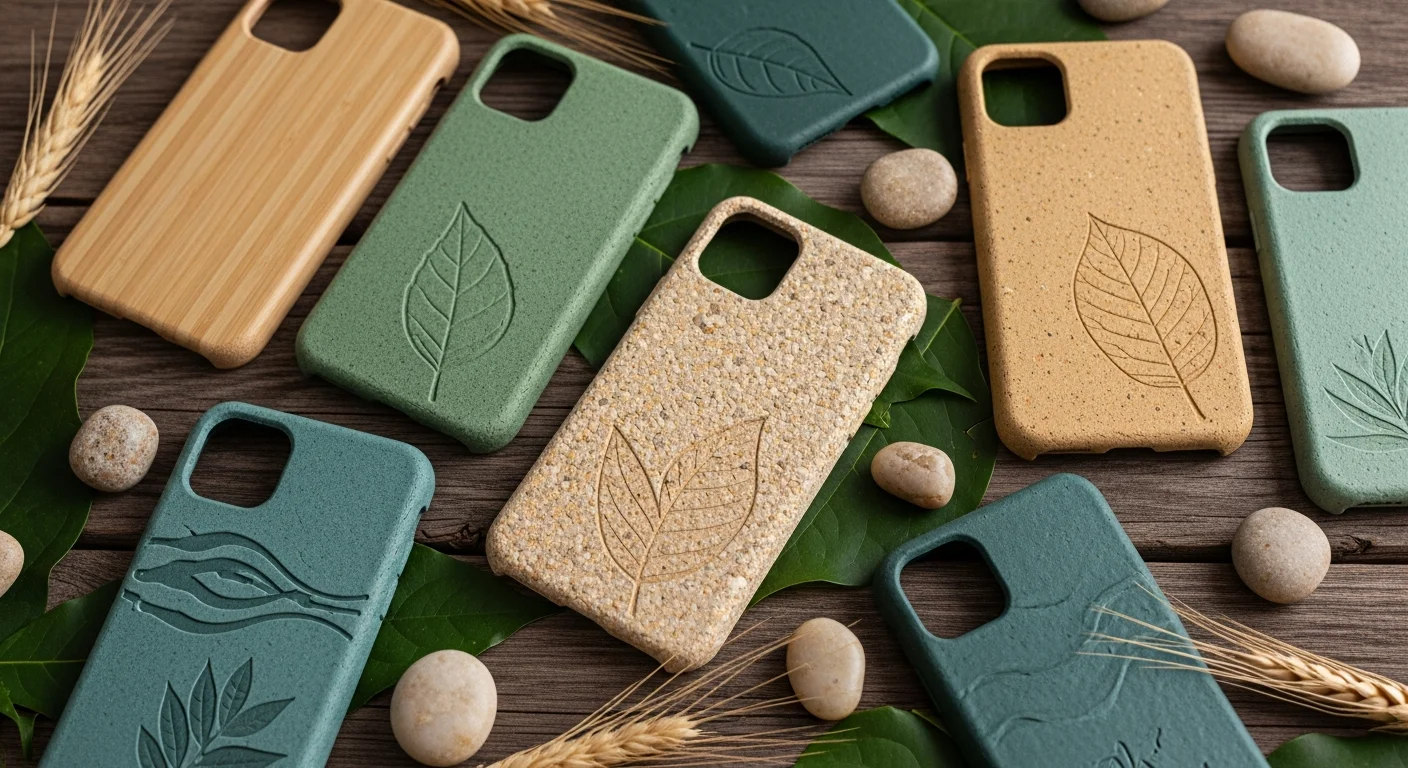
A wheat straw phone case is made from a composite of wheat straw fiber — an agricultural byproduct that would otherwise be burned or plowed under — blended with a small percentage of polypropylene as a binding agent. The resulting material is lightweight, durable, and has a distinctive natural speckled appearance. Wheat straw cases typically contain 40 to 60 percent agricultural waste by weight, significantly reducing petroleum content. They are not fully biodegradable due to the polypropylene binder, but they represent a substantial reduction in fossil fuel dependency compared to 100 percent plastic cases.
Bamboo fiber phone cases combine rapidly renewable bamboo with bioplastic binders to create rigid, attractive cases with a warm natural tone. Bamboo grows up to three feet per day, requires no pesticides or irrigation, and sequesters carbon at rates four to five times higher than equivalent stands of hardwood trees. Bamboo fiber cases are partially biodegradable — the bamboo component decomposes within two to three years, while the bioplastic binder may take longer depending on composting conditions.
Cork phone cases use harvested cork bark — a renewable material sourced from cork oak trees that regenerate their bark every nine years without harming the tree. Cork offers natural shock absorption, water resistance, and a distinctive warm texture that ages beautifully. Vegan leather phone case alternatives made from cork, pineapple leaf fiber (Pinatex), or mushroom mycelium (Mylo) are also emerging as premium eco-friendly options for folio and wallet-style cases, offering the aesthetic of leather without animal products or the environmental cost of cattle farming.
Eco-Friendly Printing Methods for Custom Phone Cases
Sustainable phone case production extends beyond materials to encompass the printing and decoration methods used to apply custom designs. Traditional printing processes can involve volatile organic compound (VOC) emissions, heavy metal pigments, and solvent-based inks that create hazardous waste. UV-based eco printing and other green decoration technologies offer alternatives that dramatically reduce the environmental impact of customization.
UV LED printing is currently the most eco-friendly method for custom phone case decoration. Unlike conventional UV mercury-vapor systems, UV LED curing units consume 70 to 80 percent less energy, generate no ozone emissions, contain no mercury, and produce no VOCs during the curing process. The UV-curable inks used in modern phone case printing are formulated without heavy metals, and because they cure instantly upon UV exposure, there is zero evaporative waste — every drop of ink applied becomes part of the finished print. For a deeper comparison of printing technologies, see our guide on UV printing versus sublimation versus DTF for phone cases.
Water-based sublimation inks represent another eco-friendly printing option. Unlike solvent-based sublimation inks that release VOCs during the heat transfer process, water-based formulations use water as the primary carrier, dramatically reducing airborne emissions. The sublimation process itself is inherently efficient — ink is transferred from paper to the polymer-coated case surface with minimal waste, as unused ink on the transfer paper can be recycled or composted in some cases. Soy-based and algae-based ink formulations are also entering the market, offering fully renewable ink systems derived from agricultural and aquaculture feedstocks rather than petroleum.

Sustainable Packaging for Phone Cases
Sustainable packaging completes the circular economy phone case approach by eliminating single-use plastics and minimizing waste throughout the shipping and retail presentation chain. The most common sustainable packaging options include recycled cardboard boxes, kraft paper sleeves, compostable plant-based cellophane wraps, and reusable cloth pouches.
Recycled and FSC-certified cardboard boxes use post-consumer paper fiber and sustainably managed forest pulp, reducing deforestation impact while maintaining structural protection during shipping. Soy-based printing inks for packaging graphics eliminate petroleum-based ink waste. Compostable plant-based cellophane wraps made from wood cellulose (NatureFlex and similar brands) provide the transparent product visibility of plastic cling film while decomposing in home compost within 8 to 12 weeks. Seed paper packaging — paper embedded with wildflower or herb seeds that can be planted after unpacking — transforms packaging waste into a garden, creating a memorable brand experience while eliminating waste entirely.
The most minimalist sustainable packaging approach uses no individual packaging at all. For bulk corporate orders and event distribution, cases can be shipped in a single recycled cardboard box with recycled paper padding, eliminating per-unit packaging entirely. This zero-waste distribution model works well for corporate gifting programs where cases are distributed directly to recipients rather than displayed on retail shelves.
Certifications and Environmental Standards
Navigating eco-friendly claims requires understanding the certifications and standards that validate sustainability promises. Without third-party verification, terms like "eco-friendly," "green," and "sustainable" have no legally binding definition and can be used in greenwashing — misleading marketing that overstates environmental benefits.
The most relevant certifications for eco-friendly phone cases include TUV Austria OK Compost (verifies industrial or home compostability), ASTM D6400 (American standard for compostability of plastics), EN 13432 (European standard for packaging compostability), Global Recycled Standard (GRS, verifies recycled content percentage), FSC certification (for paper and wood-based packaging), and ISO 14001 (environmental management system certification for manufacturers). A carbon-neutral phone case claim should be backed by verified carbon offset purchases or lifecycle carbon accounting certified by organizations like the Carbon Trust or Climate Neutral.
| Certification | What It Verifies | Applies To | Credibility Level |
|---|---|---|---|
| TUV OK Compost | Industrial/home compostability | Case material | Very High |
| ASTM D6400 | Compostability in municipal facilities | Case material | Very High |
| EN 13432 | Industrial compostability (EU) | Case + packaging | Very High |
| GRS (Global Recycled Standard) | Recycled content percentage | Recycled cases | High |
| FSC Certified | Sustainable forestry practices | Packaging | High |
| Carbon Neutral Certified | Net-zero carbon emissions | Full product lifecycle | High |
| ISO 14001 | Environmental management system | Manufacturer | Medium-High |
When evaluating eco-friendly phone case suppliers, ask for specific certification documentation rather than accepting general sustainability claims. Legitimate suppliers are proud to share their certifications and will provide copies of testing reports, certification numbers, and audit results upon request. If a supplier cannot produce certification documentation for their sustainability claims, treat those claims with appropriate skepticism.
Eco-Friendly Custom Phone Cases for Corporate and Brand Use
Sustainability-focused custom phone cases offer compelling advantages for corporate gifting, brand merchandise, and promotional programs. Research from Cone Communications found that 87 percent of consumers would purchase a product because a company advocated for an issue they cared about, and environmental sustainability consistently ranks among the top three issues across every demographic. A carbon-neutral phone case or recycled plastic phone case branded with a company logo communicates environmental values through a tangible, daily-use product that recipients carry everywhere.
For corporate sustainability reporting, eco-friendly phone case programs contribute measurable environmental metrics. A company ordering 1,000 recycled polycarbonate phone cases can report diverting approximately 45 kilograms of plastic waste from landfill, reducing CO2 emissions by roughly 1.4 metric tons compared to virgin material cases, and eliminating an estimated 45 kilograms of packaging waste through sustainable packaging choices. These metrics strengthen Environmental, Social, and Governance (ESG) reports, support B Corp certification applications, and demonstrate tangible commitment to corporate sustainability pledges.
The premium positioning of eco-friendly cases also benefits brand perception. Consumer research consistently shows that sustainably produced products command a 10 to 25 percent price premium and generate higher customer loyalty and social media engagement. A branded phone case made from ocean-bound recycled plastic tells a story that recipients share — creating organic word-of-mouth marketing that conventional promotional products rarely achieve. For businesses exploring the intersection of current design trends and sustainability, eco-conscious aesthetics are among the strongest movements in 2026 phone case design.

The Future of Sustainable Custom Phone Cases
The sustainable phone case industry is evolving rapidly, with several emerging technologies and approaches poised to make eco-friendly options even more accessible, affordable, and effective in the coming years. Understanding where the industry is heading helps consumers and businesses make forward-looking purchasing decisions.
Algae-based bioplastics represent one of the most promising material developments. Companies like Algix and Bloom are producing flexible foams and rigid plastics from harvested algae biomass — a process that actually removes CO2 from aquatic ecosystems while producing a viable manufacturing feedstock. Early algae-based phone case prototypes show promising mechanical properties, with the potential for cases that are fully compostable, carbon-negative in production, and cost-competitive with conventional plastics within the next three to five years.
Mycelium-based materials — grown from the root structures of mushrooms — are being developed for both rigid and flexible phone case applications. Mycelium composites can be grown into custom molds in just seven to fourteen days using agricultural waste as a growth substrate, resulting in a fully compostable material that requires minimal energy to produce. The resulting material is lightweight, shock-absorbent, and naturally fire-resistant. Several major consumer electronics brands have announced partnerships with mycelium material companies, suggesting that mushroom-based phone cases could reach mainstream availability by 2027 or 2028.
The circular economy phone case model — where cases are designed for return, recycling, and remanufacturing at end of life — is gaining traction through take-back programs. Brands like Pela Case and CASETiFY have pioneered phone case take-back and recycling programs where used cases are collected, ground into pellets, and remanufactured into new cases. This closed-loop approach eliminates end-of-life waste entirely and reduces the demand for new raw materials with each production cycle. As recycling infrastructure improves and consumer awareness grows, circular economy models are expected to become the industry standard rather than the exception. For related sustainability approaches in other custom product categories, see our guide on eco-friendly custom stickers.
Design Your Sustainable Custom Phone Case
Choosing an eco-friendly custom phone case is one of the simplest and most visible ways to reduce your personal or corporate environmental footprint. Whether you select a biodegradable PLA case, a recycled polycarbonate shell, or a wheat straw composite, you are diverting plastic waste from landfills, reducing fossil fuel consumption, and supporting the growing market for sustainable consumer products — all while carrying a phone case that looks and performs as well as conventional alternatives.
Ready to explore sustainable options? Use our design tool to create your custom phone case design and choose from our growing range of eco-friendly materials. Every sustainable case in our collection meets verified environmental standards, and our team can help you identify the best material and packaging combination for your specific project — whether it is a single personal case or a 500-unit corporate sustainability initiative. Browse our full collection of custom phone cases to see what is possible when design meets responsibility.
Related Articles
Share this article
Written by
Rohan Mehta
Head of Marketing at RareCustom. Rohan covers sustainability trends and helps businesses choose eco-friendly custom phone cases that align with their environmental commitments.