Sublimation vs Laser Engraving vs UV Printing for Custom Tumblers: Which Is Best?
Compare sublimation, laser engraving, and UV printing for custom tumblers — durability, cost, color range, material compatibility, and the best use cases for each decoration method.
Terrence Okafor
Head of Production at RareCustom with 20+ years in commercial printing. SGIA certified with mastery of sublimation, laser engraving, and UV printing for custom drinkware.
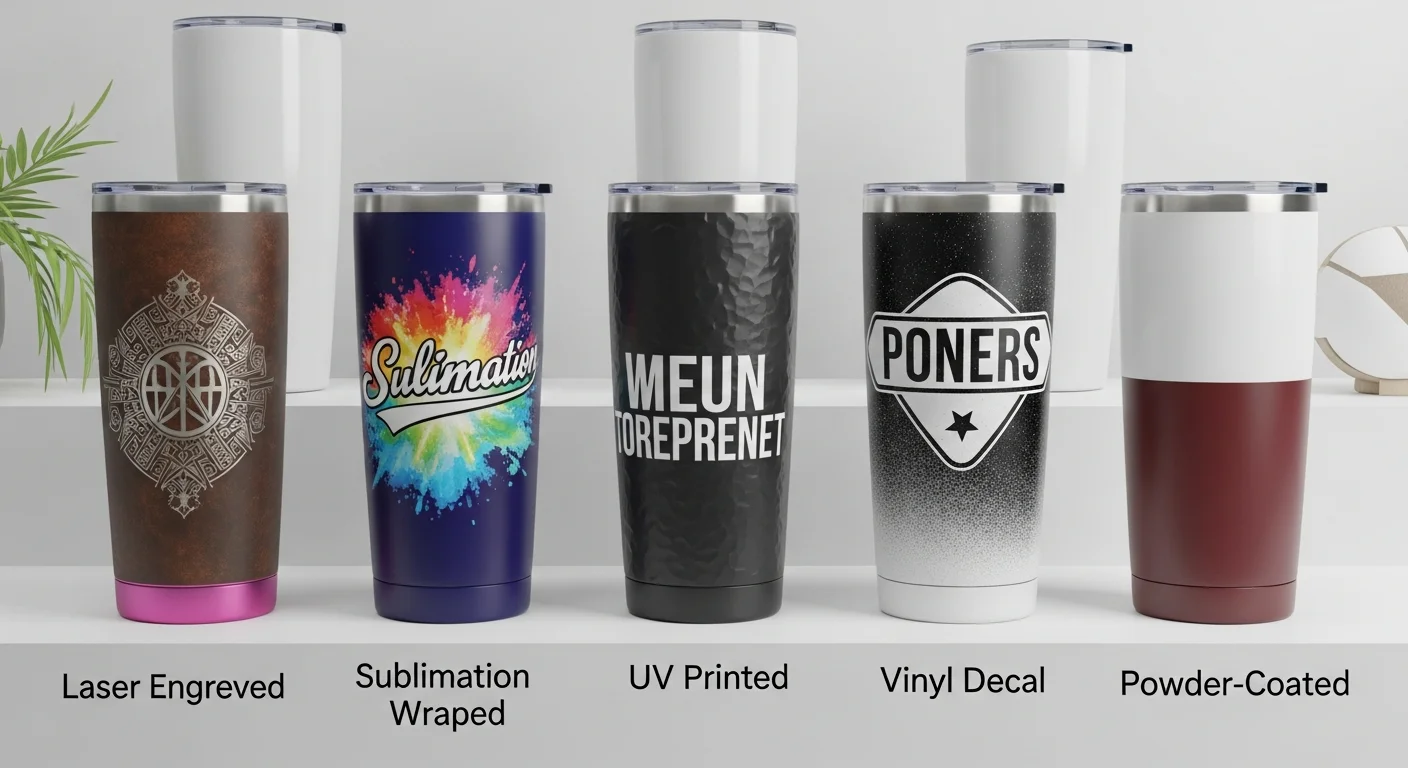
Choosing the right decoration method is arguably the most important decision in any custom tumbler project because it determines the look, feel, durability, and cost of the finished product. Three techniques dominate the custom tumbler production landscape — sublimation printing, laser engraving, and UV printing — and each excels in different scenarios. A photorealistic family portrait destined for a gift tumbler demands a different method than a minimalist corporate logo intended for 500 executive gifts, which in turn requires a different approach than a full-color event giveaway tumbler that needs to be produced quickly and affordably.
This guide breaks down exactly how each tumbler decoration method works, compares them side by side on durability, color range, cost, and material compatibility, and provides a clear decision framework so you can select the right method for your project with confidence. Whether you are ordering a single personalized tumbler or planning a bulk run of thousands, understanding the technical strengths and limitations of sublimation tumbler printing, laser engraved stainless steel tumblers, and UV direct-to-substrate printing will save you time, money, and potential disappointment. For a broader overview of the entire custom tumbler design process, start with the beginner's guide to custom tumblers.
How Sublimation Printing Works on Tumblers
Sublimation is a heat-transfer process that converts specialized dye sublimation ink from a solid state directly into a gas under high temperature and pressure. For tumblers, the process typically uses a heat press tumbler machine with a rotary attachment or a convection oven-style tumbler press. The printed transfer paper wraps tightly around the polymer-coated tumbler blank, and when heat is applied at 360–400 degrees Fahrenheit for 3 to 5 minutes, the sublimation ink transfer penetrates the polymer coating at a molecular level. The result is a permanent, full-color image that is literally infused into the surface — not sitting on top of it.
This molecular infusion means sublimation prints will not peel, crack, or flake under normal use. The colors are vibrant, gradients are smooth, and photographic detail is sharp enough to reproduce everything from pet portraits to intricate botanical illustrations. A dye sublimation wrap can cover the entire 360-degree surface of a tumbler, enabling full-wrap designs that have no beginning or end — a capability that sets sublimation apart from methods that print on one section at a time.
The primary limitation of sublimation is its material requirement. The process only works on surfaces with a sublimation coating — typically a white or light-colored polymer layer applied to the tumbler blank. This means sublimation is not compatible with dark-colored, uncoated, or bare metal tumblers. You cannot sublimate on a black tumbler unless it has been coated with a white sublimation-ready layer first, which is uncommon and adds cost. Most sublimation tumblers start as white sublimation blanks with a factory-applied polymer coating.

How Laser Engraving Works on Tumblers
Laser engraving uses a focused beam of light — typically from a CO2 laser or fiber laser — to physically remove material from the tumbler's surface. On a powder-coated stainless steel tumbler, the laser burns through the colored powder coating to reveal the bare stainless steel underneath, creating a striking metallic reveal effect. The result is a permanent etched design that literally cannot wear off because the decoration is not applied to the surface — it is carved into it. Fiber laser marking can also engrave directly onto uncoated stainless steel, producing a subtle color shift on the metal surface without removing material.
The engraving process uses a rotary attachment that spins the tumbler at a controlled speed while the laser traces the design. This produces extremely precise lines, making laser engraving the preferred method for fine text, detailed logos, and intricate monograms. The level of detail achievable rivals that of engraving on jewelry — lines as thin as 0.1 millimeters are possible on high-quality equipment. Each tumbler typically takes 2 to 8 minutes to engrave depending on design complexity and coverage area.
The trade-off for this permanence and precision is color limitation. Laser engraving on powder-coated tumblers produces only two tones — the coating color and the exposed metal color underneath. There is no option for full-color images, gradients, or photographs. This monochrome constraint makes laser engraving ideal for corporate branding, minimalist designs, and premium gifts where the sophisticated, understated aesthetic of the metallic reveal is the desired look.

How UV Printing Works on Tumblers
UV printing — also called UV direct-to-substrate printing — deposits digital ink directly onto the tumbler surface and instantly cures it with UV LED light. Unlike sublimation, which infuses ink into a coating, UV ink sits on top of the surface, creating a slightly raised, textured finish that you can actually feel with your fingernail. This tactile quality adds a premium dimension that many customers find appealing, particularly for designs with fine detail or embossed-style text.
The defining advantage of UV printing is its material versatility. Because the UV LED curing process bonds ink to virtually any surface, UV printing works on stainless steel, powder-coated metal, plastic, glass, ceramic, and even wood. It prints full color including white ink, which means vibrant designs on dark-colored, black, and metallic tumblers are not only possible but look stunning. A UV direct-to-substrate tumbler can reproduce photographs, brand-color logos with Pantone matching, gradients, and any other design complexity with the same ease.
Speed is another key advantage. UV printing typically completes each tumbler in 30 to 90 seconds — significantly faster than the 3-to-5-minute cycle for sublimation or the 2-to-8-minute cycle for laser engraving. This makes it the most efficient method for large-volume orders where turnaround time is critical. UV ink adhesion on properly prepared surfaces produces prints that are scratch-resistant, UV-resistant (ironically), and suitable for regular use. While not as molecularly bonded as sublimation or as permanent as laser engraving, UV prints hold up well under normal handling and washing conditions.
Durability and Longevity Comparison
Tumbler decoration durability varies significantly across the three methods, and understanding these differences is essential for choosing the right approach for each use case. Laser engraving is the most durable — because the design is physically carved into the tumbler's surface, it is literally impossible to wash off, scratch off, or fade. A laser engraved stainless steel tumbler will look exactly the same after 10 years and 5,000 washes as it did on day one. This permanence makes laser engraving the clear winner for products that need to survive demanding environments like outdoor work sites, commercial kitchens, and daily dishwasher use.
Sublimation ranks second in durability. Because the dye is infused into the polymer coating rather than applied on top, sublimation prints demonstrate excellent fade resistance and scratch resistance under normal use. Independent testing shows that sublimation prints maintain over 95 percent of their color vibrancy after 200 dishwasher cycles when washed on the top rack. Hand washing extends this further. The primary vulnerability is extreme abrasion — scouring pads or steel wool can damage the polymer coating itself, taking the print with it.
UV printing offers strong durability for everyday use but falls slightly behind the other two methods in extreme conditions. UV ink is scratch-resistant and UV-resistant, and modern UV inks maintain their adhesion through hundreds of wash cycles. However, because the ink sits on the surface rather than being infused into it (sublimation) or carved from it (laser), UV prints are more susceptible to chipping if the tumbler is dropped on a hard surface or struck by another object. For daily office use, UV-printed tumblers perform admirably and show minimal wear over years of regular use.

Color Range and Design Complexity
The color gamut comparison across the three methods reveals clear strengths for different design types. Sublimation offers the widest color gamut on compatible surfaces, reproducing millions of colors with smooth gradients, subtle tonal transitions, and photorealistic detail. A full-color tumbler printing project with photographs, watercolor artwork, or gradient designs will look best in sublimation. The only constraint is the surface color — sublimation produces the most accurate results on white or light backgrounds, as the translucent nature of the dye means dark substrates show through and shift colors.
UV printing matches sublimation in color range and adds the critical advantage of white ink capability. This means UV can produce vibrant, opaque designs on any surface color — black, navy, forest green, or brushed metal. UV also supports spot color tumbler production with accurate Pantone matching, making it the preferred method for corporate orders where brand color accuracy is non-negotiable. Gradient printing, photographic reproduction, and fine detail all perform well in UV, though the colors may appear slightly different from sublimation due to the ink sitting on the surface rather than being absorbed into it.
Laser engraving is monochrome only — the engraved area reveals the base metal (typically silver-toned stainless steel) against whatever color the powder coating provides. While this limits design complexity, the resulting contrast between the metallic engraved area and the colored coating produces a distinctly premium, sophisticated look that many customers prefer for corporate gifts and personal luxury items. The etched design also catches light in a way that printed designs cannot, adding a subtle dimensional quality.
Cost Comparison by Order Size
The per-unit decoration cost and setup cost comparison varies significantly depending on order volume, making the right economic choice dependent on how many tumblers you need. For single-unit or small orders (1–10 tumblers), UV printing typically offers the lowest per-unit cost because it has virtually no setup requirements — the design is printed directly from a digital file with no transfers, templates, or fixtures needed beyond the rotary printing attachment. Sublimation is slightly more expensive per unit at low volumes due to the cost of transfer paper and the longer production cycle, while laser engraving falls in the middle.
At medium volumes (10–100 tumblers), the per-unit cost for all three methods converges. Sublimation becomes more economical because the fixed costs (printing transfers, calibrating the heat press) are spread across more units. UV printing remains competitive, and laser engraving may actually become the most affordable option for simple logo designs because the per-tumbler processing time is fast for small engravings. At high volumes (100–500+ tumblers), sublimation and UV printing offer the best bulk vs one-off cost advantage because their production workflows can be parallelized — multiple tumblers can be processed in batch-style operations. Laser engraving, which must process each tumbler individually, scales less efficiently but maintains its advantage for simple, single-location designs.
When budgeting, remember to factor in the tumbler blank cost, which varies by material and coating. Polymer-coated white sublimation blanks are typically $4 to $8 per tumbler, powder-coated blanks for laser engraving range from $5 to $10, and uncoated or pre-coated blanks for UV printing fall in the $4 to $9 range depending on material and size. For a complete pricing analysis including blank costs, decoration costs, and volume discounts, see the custom tumbler pricing guide.

Material Compatibility Matrix
Not every decoration method works on every tumbler material, so understanding compatibility is essential before committing to a design approach. Stainless steel tumblers are the most versatile — they support all three decoration methods. Sublimation requires a polymer coating (applied at the factory), laser engraving works on both powder-coated and bare stainless surfaces, and UV printing adheres to coated, powder-coated, or bare metal. For a deep dive into stainless steel construction and quality grades, see the tumbler materials comparison guide.
Plastic tumblers are compatible with UV printing (primary method) and sublimation (on polymer-coated plastics such as coated acrylic). Laser engraving is generally not used on plastic because the laser melts the material rather than cleanly etching it, producing poor results. Glass tumblers support UV printing and sandblasting (a process similar in concept to laser engraving but using pressurized abrasive media). Sublimation does not work on standard glass because it lacks the polymer coating needed for ink absorption. Some specialty glass tumblers are coated for sublimation, but these are niche products.
When selecting a decoration method, always start with the material first. If you have already chosen a powder-coated stainless steel tumbler in matte black, your options are laser engraving (metallic reveal on black) or UV printing (full color on black). If you are using a white polymer-coated tumbler blank, sublimation will deliver the best color accuracy and the most seamless full-wrap coverage. Matching the method to the material ensures the best possible result.
Which Method Is Best for Your Project?
Use this decision framework to identify the best method for your specific needs. Choose sublimation if: you want full-color, photorealistic tumbler designs with seamless 360-degree wraps; your tumbler is white or light-colored with a polymer coating; you value the soft, flush feel of ink that is part of the surface rather than on top of it; or you are producing photo tumblers, artistic designs, or colorful pattern wraps.
Choose laser engraving if: you want the most durable, permanent decoration possible; your design is a logo, monogram, or text-based without the need for color; you want a premium, sophisticated metallic aesthetic; the tumblers will be used in harsh environments (outdoor, industrial, commercial kitchen); or you are creating executive gifts and corporate branding where understated elegance matters.
Choose UV printing if: you need full-color designs on dark or colored tumblers; you want the tactile, slightly raised texture of UV ink; production speed is a priority (30–90 seconds per tumbler); your substrate is plastic, glass, or another material that does not support sublimation; or you need accurate Pantone matching for brand-critical colors. Many projects benefit from considering two methods — for example, a corporate order might use laser engraving for executive-tier gifts and UV printing for wider staff distribution.
What RareCustom Uses (And Why)
RareCustom maintains multiple decoration capabilities specifically because no single method is best for every project. Sublimation is the primary method for full-color custom tumblers with photo wraps, illustrated designs, and pattern prints on white-coated blanks. Laser engraving is used for premium corporate gifts, monogrammed personal items, and any project where permanence and a metallic aesthetic are priorities. UV printing fills the gap for dark-colored tumblers, plastic drinkware, and rush orders where the fastest possible production time is needed.
Every tumbler order goes through a quality assurance process specific to the decoration method used. Sublimation prints are checked for color consistency against a calibrated reference, laser engravings are inspected for depth uniformity and clean edges, and UV prints are tested for adhesion strength and cure completeness. RareCustom also offers sample orders at standard pricing — there is no additional fee for ordering a single tumbler to verify the decoration quality before committing to a larger batch. Explore the full range of custom tumbler options or start building your design in the free online design tool.
Frequently Asked Questions
Can you sublimate on a black tumbler?
No — standard sublimation does not work on black or dark-colored tumblers because sublimation ink is translucent and requires a white or light-colored polymer-coated surface to produce accurate colors. For full-color designs on dark tumblers, UV printing with white ink is the recommended method, as it can lay down an opaque white base layer before printing the color design on top.
How long does laser engraving last on tumblers?
Laser engraving is permanent and lasts the entire lifetime of the tumbler. Because the design is physically etched into the stainless steel or through the powder coating, it cannot fade, peel, wash off, or wear away under any normal use conditions. Even aggressive dishwasher use, outdoor exposure, and daily handling will not affect the engraved design.
Is UV printing dishwasher safe?
Modern UV inks are formulated to withstand regular dishwasher use, though hand washing will maximize the print's longevity. UV prints on properly prepared surfaces maintain their appearance through hundreds of wash cycles. For the longest-lasting results, place UV-printed tumblers on the top rack and avoid using abrasive detergents or scouring pads.
Can you combine laser engraving with UV printing?
Yes — combining methods is a premium option that produces striking results. A common approach is to laser-engrave a logo or primary text and then use UV printing to add color accents, a secondary design, or brand-color fills within the engraved areas. This dual-method approach is popular for high-end corporate gifts and luxury promotional products where maximum visual impact justifies the additional production cost.
Related Articles
Share this article
Written by
Terrence Okafor
Head of Production at RareCustom with 20+ years in commercial printing. SGIA certified with mastery of sublimation, laser engraving, and UV printing for custom drinkware.