Common Custom Hat Ordering Mistakes and How to Avoid Them
Avoid the most common custom hat ordering mistakes that waste money and delay delivery. Covers artwork errors, sizing misjudgments, wrong hat style selection, color mismatches, and production timeline miscalculations.
Marcus Chen
E-Commerce Growth & Merchandising Lead at RareCustom. MBA from Wharton, former Shopify strategist. Marcus has helped 200+ merchants launch custom merchandise lines and specializes in business strategy, bulk ordering, and fundraising programs.
After processing thousands of custom hat orders, clear patterns emerge in the mistakes that first-time and even experienced buyers make. These mistakes result in hats that do not match expectations, orders that arrive late, budgets that exceed projections, and — in worst cases — entire production runs that must be redone at the buyer's expense. Every mistake in this guide has occurred repeatedly across the industry, and every one is preventable with the right knowledge applied before the order is placed.
This guide covers the ten most common custom hat ordering mistakes, explains why they happen, and provides specific preventive actions for each. Applying these lessons saves money, time, and the frustration of receiving custom hats that do not meet expectations.
Mistake 1: Submitting Low-Resolution or Raster Artwork
The most frequent artwork mistake is submitting a low-resolution JPEG, screenshot, or web graphic as the logo file for embroidery digitizing. Images downloaded from websites are typically 72-150 DPI — far below the 300 DPI minimum needed for clean digitizing. The result is embroidery with blurry edges, missing details, and colors that do not match the intended design.
Prevention: Always submit artwork as a vector file (AI, EPS, or SVG). Vector files contain mathematical paths rather than pixels, so they scale to any size without quality loss. If only a raster file is available, ensure it is at least 300 DPI at the final embroidery size (typically 4 × 2.5 inches for front-center placement). When in doubt, ask the manufacturer whether the submitted file quality is sufficient before approving the digitizing stage.
Mistake 2: Choosing the Wrong Hat Style for the Audience
Selecting a hat style based on personal preference rather than audience demographics leads to hats that recipients do not want to wear. A structured snapback cap ordered for a 50+ corporate team feels out of place. A dad hat ordered for a competitive youth baseball team looks too casual for the athletic context. The hat style must match the audience's expectations and the intended use case.
Prevention: Reference the hat style guide to match style to audience. When ordering for a diverse group, offer 2-3 style options if the budget allows. If a single style must be chosen, structured baseball caps are the safest universal choice — they are accepted across age groups, genders, and contexts more consistently than any other style.
Mistake 3: Designing Too Complex for the Canvas
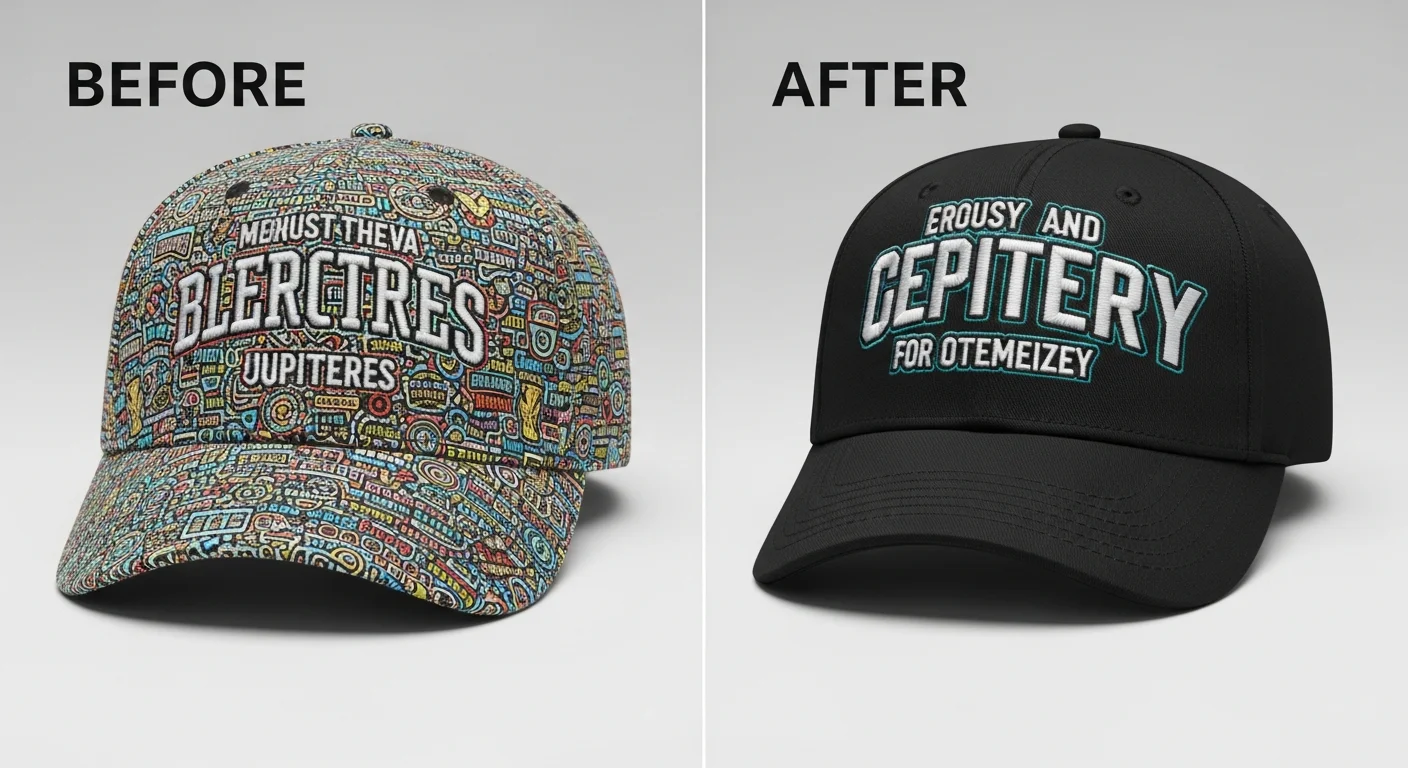
Designers accustomed to working on large canvases (posters, websites, t-shirts) often submit designs that are too detailed for the small hat embroidery space. A logo with 12 colors, fine text, thin outlines, and photographic elements that looks stunning on a computer screen becomes an illegible, expensive mess when embroidered at 4 inches wide.
Prevention: Create a hat-specific logo variation. Simplify the design to 3-4 colors maximum, remove text smaller than 0.25 inches, eliminate lines thinner than 1mm, and replace gradients with flat color fills. Test the design by printing it at actual embroidery size on paper — if any element is difficult to read at that size, it needs to be enlarged, simplified, or removed. The fonts and graphics guide provides specific recommendations.

Mistake 4: Ignoring the Front Seam
Six-panel caps have a vertical seam running between the two front panels. Centered designs straddle this seam, and poorly digitized designs can create a visible split or pucker at the seam line. This is especially problematic for symmetrical logos where even minor misalignment at the seam is immediately noticeable.
Prevention: Request that the manufacturer's digitizer specifically address seam crossing in the stitch file. Professional digitizers use specialized stitch patterns that lock across the seam, preventing separation. Alternatively, choose off-center placement (on a single front panel) to avoid the seam entirely, or use a five-panel hat style that eliminates the front seam altogether.
Mistake 5: Not Ordering a Physical Sample
Digital mockups show the design on the hat, but they cannot convey the tactile qualities that determine whether a hat looks and feels right in person — thread texture, color under natural lighting, fabric weight, hat fit, and construction quality. Approving a full production run based solely on digital mockups risks discovering issues only after hundreds of hats are produced and paid for.
Prevention: Always order a physical sample for orders over 50 units. The sample cost ($25-$50 plus 5-7 business days) is trivial compared to the cost of reprinting a full run. Evaluate the sample under different lighting conditions (indoor, outdoor, fluorescent), check the embroidery from multiple angles, and have multiple people try the hat for fit assessment.
Mistake 6: Underestimating Production Timeline
The most stressful ordering mistake is starting too late. Custom hat production takes 10-15 business days after proof approval, plus 3-7 days for shipping. Add 5-7 days for design and proof revisions, and the total timeline from first contact to delivery is typically 4-6 weeks minimum. Ordering 2 weeks before an event guarantees either a rush surcharge (20-30% premium) or a missed deadline.
Prevention: Start the ordering process 8-12 weeks before the delivery deadline. Build in buffer time for design revisions (at least one round), sample production (if applicable), and potential shipping delays. For event-critical orders, confirm the production timeline in writing with the manufacturer and include a penalty clause for late delivery if the order value justifies it. Check shipping timelines for current estimates.
Mistake 7: Color Mismatch Between Screen and Thread
Colors on a computer screen (RGB light) and colors in embroidery thread (physical dye) are produced by fundamentally different systems, and they frequently do not match. A vibrant blue on screen may appear darker, duller, or more purple in thread form. This mismatch leads to hats where the embroidered logo color does not match the brand guidelines, business cards, or website.
Prevention: Request a physical thread color swatch card from the manufacturer and compare it to brand color standards under natural lighting. For brand-critical applications, specify Pantone Matching System (PMS) colors — the manufacturer matches the thread to the PMS reference with high accuracy for a small setup fee ($15-$25 per color). Never rely on screen color alone for color-critical decisions.
Mistake 8: Ordering Wrong Quantities
Both over-ordering and under-ordering create problems. Over-ordering leaves unsold inventory that ties up budget. Under-ordering means some recipients do not receive hats, and rush reorders are expensive (20-30% surcharge) with 2-3 week delays. Sizing mistakes compound the quantity problem — ordering 100 hats in the wrong size split means some sizes run out while others remain.
Prevention: Use pre-orders or surveys to collect exact quantities before placing the production order. Add 10-15% buffer stock above confirmed quantities for measurement errors and last-minute additions. For events with unknown attendee counts, order adjustable-closure hats (which fit 90%+ of adults) and estimate 50-60% of expected attendance as the hat quantity. The bulk ordering checklist provides a complete quantity planning framework.
Mistake 9: Overlooking Decoration Location Costs
Each embroidery location (front, side, back) incurs its own per-hat decoration cost and one-time digitizing setup fee. Buyers who design a hat with front, left side, right side, and back embroidery without pricing each location separately receive a quote 2-3x higher than expected. The sticker shock sometimes forces last-minute design simplification that could have been avoided with upfront cost awareness.
Prevention: Request itemized quotes showing the cost per hat for each decoration location separately. Start with front-only embroidery and add secondary locations only if the budget allows. A well-executed single-location design often looks cleaner and more professional than a cluttered multi-location design that was added for perceived value without design intention. Reference the logo placement guide for strategic multi-location approaches.
Mistake 10: Skipping the Proof Approval Step
Rushing through or skipping the proof approval step — the digital mockup review before production begins — is the single most expensive mistake because it compounds all other errors. A wrong color, misaligned design, incorrect hat style, or typo caught at the proof stage costs nothing to fix. The same error caught after production costs the full production run value plus rush reorder charges.
Prevention: Treat proof approval as a formal milestone. Circulate the proof to all stakeholders with a specific deadline for feedback. Check every detail: logo positioning, text spelling, color specification, hat style and color, closure type, and embroidery locations. Approve in writing (email confirmation) only when every element is verified. Never approve a proof with known issues by saying "it is probably fine" — fix it before approving.
Frequently Asked Questions
What is the most costly custom hat ordering mistake?
Skipping the proof approval step is the most costly mistake because it allows all other errors (wrong colors, design issues, wrong hat style) to reach full production without correction. A 200-hat order with an uncaught error costs $2,000-$4,000 to redo. By contrast, catching and correcting the same error at the proof stage costs nothing — proof revisions are standard and included in the digitizing fee.
Can mistakes be fixed after production?
Some mistakes can be partially fixed: embroidered hats with minor color issues can sometimes be color-adjusted through additional thread overlay (at significant cost). Hats with wrong-size embroidery or incorrect placement cannot be fixed — embroidery is permanent and cannot be removed without visible damage to the hat fabric. The only solution for significant errors is reordering, which means the original hats become waste and the full cost is duplicated.
How can first-time buyers reduce ordering risk?
First-time buyers should: (1) start with a small test order of 12-24 hats before committing to large volumes, (2) order a physical sample before approving full production, (3) use adjustable-closure hats to eliminate sizing risk, (4) submit vector artwork to ensure digitizing quality, and (5) allow 8-12 weeks of lead time to avoid rush charges and timeline pressure. These five steps eliminate 90% of first-time ordering mistakes.
Share this article
Written by
Marcus Chen
E-Commerce Growth & Merchandising Lead at RareCustom. MBA from Wharton, former Shopify strategist. Marcus has helped 200+ merchants launch custom merchandise lines and specializes in business strategy, bulk ordering, and fundraising programs.