Custom Logo Socks for Business Branding: Startups to Enterprise
Turn your brand logo into wearable marketing with custom logo socks. Covers logo placement zones, Pantone color matching, printing methods for logos, and packaging options for corporate gifting.
Rohan Mehta
Head of Marketing at RareCustom. Former business journalist at Retail Dive. Rohan helps brands leverage custom logo socks as high-retention promotional merchandise.
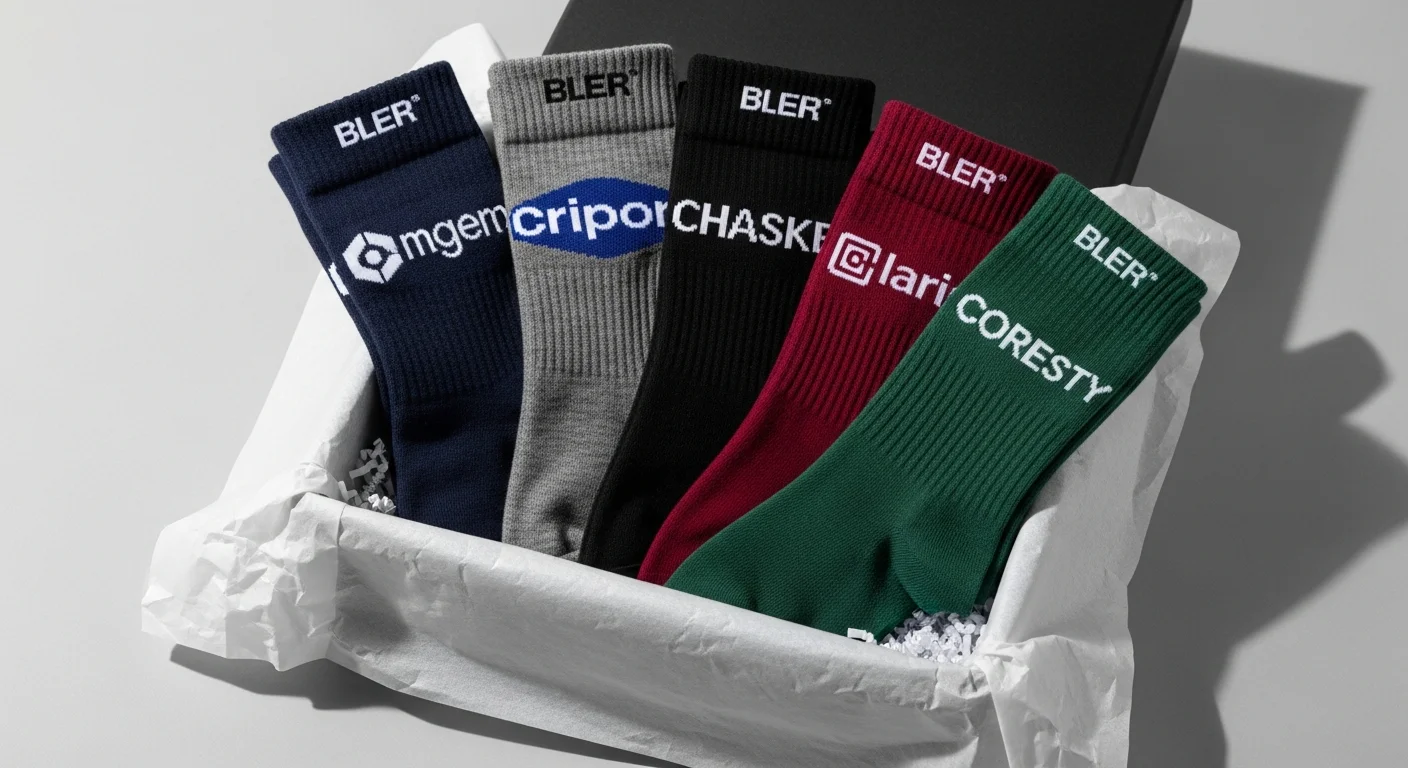
Branded merchandise has become a cornerstone of modern marketing, and custom logo socks are quietly outperforming nearly every other promotional item in the game. Unlike pens that run out of ink or tote bags that pile up in a closet, a well-designed pair of logo socks gets worn repeatedly — sometimes fifty or more times per year — putting your brand in front of people during commutes, at the gym, and around the office. For businesses ranging from scrappy startups to Fortune 500 enterprises, logo socks deliver an outsized return on a modest per-unit investment.
The appeal extends beyond simple impressions. A 2025 Advertising Specialty Institute study found that promotional apparel items are kept for an average of fourteen months, but socks specifically scored even higher in retention because recipients view them as genuinely useful rather than disposable. When you pair that retention with the relatively low cost of production — typically $4.50 to $12.00 per pair depending on method and quantity — the cost-per-impression math becomes extremely compelling. This guide covers every decision you need to make to turn your brand logo into a pair of socks that people actually want to wear.
Why Socks as Brand Merchandise
Promotional products live or die by one metric: do recipients keep and use them? Socks consistently rank among the top five most-retained branded items, alongside outerwear, USB drives, drinkware, and t-shirts. But socks have a unique advantage — they are replaced frequently. The average person buys six to eight pairs of socks per year, which means a free pair of high-quality branded socks fills a genuine wardrobe need rather than adding clutter.
From a marketing perspective, the wearability data is striking. A branded sock that gets worn once a week generates roughly fifty-two brand impressions per year. If that sock lasts two years (which quality custom socks absolutely do), you are looking at over one hundred impressions from a single unit that cost under ten dollars. Compare that to a single social media ad impression that costs $0.50 to $2.00 and disappears in a scroll. The math makes socks one of the highest-ROI physical marketing assets available.
Socks also carry an element of surprise and delight that other branded items lack. When someone opens a conference swag bag and finds a pair of well-made, cleverly designed socks instead of another pen or stress ball, it creates a memorable moment. That positive association transfers directly to your brand. Companies like Stance built entire businesses around the idea that socks can be exciting — your branded version taps into the same psychology.
Logo Placement Zones
Where you place your logo on a sock matters as much as the logo itself. Each zone offers different visibility, size constraints, and production considerations. Understanding these zones helps you choose the right placement for your branding goals.

Cuff (Top Band): The cuff is the folded area at the top of the sock, typically 1 to 2 inches tall. It is ideal for small text logos, wordmarks, or simple icons. Cuff logos are visible when pants ride up or when the wearer crosses their legs. For crew-length socks, the cuff is one of the most-seen zones. Knit-in logos work best here because the cuff experiences significant stretching when pulled on and off.
Leg Panel (Shaft): The leg panel is the flat area between the cuff and the heel, offering the largest canvas — roughly 3 by 4 inches on a crew sock. This is the prime real estate for detailed logos, mascots, or multi-color brand marks. Both knit-in and sublimation methods work well on the leg panel. If your logo has fine detail or more than six colors, sublimation on the leg panel delivers the sharpest reproduction.
Sole: The bottom of the foot is a hidden branding zone that creates a fun reveal moment. Sole logos appear when the wearer removes shoes at home, at a yoga class, or during a security check at the airport. Sole placement works best for short phrases, hashtags, or simple icons. Keep in mind that sole graphics experience the most friction and wear, so durability testing matters here.
Toe Box: The toe area is visible in open-toed shoes or sandals and works for small, simple marks. It is a less common placement but can be effective for brands targeting casual or beach-oriented markets. The curved shape of the toe limits logo complexity.
Color Matching to Brand Guidelines
Brand consistency demands exact color reproduction, and socks present unique color-matching challenges compared to printing on paper or flat fabric. Yarn-dyed colors in knit-in socks are matched using the Pantone Textile Cotton (TCX) system rather than the Pantone Coated (C) or Uncoated (U) systems used in print design. If your brand guidelines specify PMS 286 C (a common corporate blue), the textile equivalent will look slightly different due to the matte texture of yarn versus glossy paper.
Request a physical yarn dip or knit swatch from your manufacturer before approving a full production run. Digital mockups can approximate colors, but the only way to verify an exact match is to see the actual yarn against your brand's physical color standard. Most reputable sock manufacturers offer free color matching with a minimum order of 100 to 200 pairs.
For sublimation-printed socks, color matching follows the CMYK process, and results depend heavily on the base sock color. White or light-colored base socks produce the most accurate color reproduction. Printing on darker base colors requires an underbase layer, which can shift hues slightly. To learn more about how different sock printing methods handle color, review the detailed comparison in that guide.
Knit-In vs Sublimation for Logo Reproduction
The production method you choose determines how your logo looks, feels, and lasts on the finished sock. Knit-in construction weaves colored yarns directly into the sock fabric during manufacturing, creating a design that is literally part of the sock structure. Sublimation prints a full-color image onto the sock surface using heat-activated dyes.
Knit-in logos are best for simple, bold designs with fewer than six colors. The logo has a slightly textured, woven appearance that feels premium and handcrafted. Knit-in logos never crack, peel, or fade because the color is in the yarn itself. The tradeoff is reduced detail — fine gradients, photographic images, and very small text do not reproduce well in knit construction. Minimum orders for knit-in socks typically start at 100 to 200 pairs, with per-pair costs ranging from $5.00 to $9.00 depending on complexity.
Sublimation logos handle unlimited colors, photographic images, and fine detail with ease. The print covers the entire sock surface if desired, enabling all-over patterns and complex brand illustrations. Sublimation requires a polyester or polyester-blend sock and works best on white or light bases. Per-pair costs range from $6.00 to $12.00 for sublimation, with lower minimums (often 25 to 50 pairs). For a side-by-side breakdown of every method, see the pricing guide.
Packaging Options for Corporate Gifting
Presentation matters when branded socks serve as corporate gifts, client appreciation items, or trade show giveaways. The packaging is the first thing recipients see, and it sets the tone for the unboxing experience. Several packaging tiers accommodate different budgets and occasions.

Belly Bands: A printed paper band wraps around the folded sock pair, displaying your logo, tagline, and any relevant messaging. Belly bands cost $0.30 to $0.75 per pair and work well for bulk distribution at events. They keep socks tidy and provide a branding surface without adding bulk.
Hang Tags: A branded card attached with a string or clip, similar to retail sock packaging. Hang tags cost $0.25 to $0.50 each and give a retail-ready look. They work especially well if you are selling branded socks through a company store or pop-up shop.
Custom Gift Boxes: For premium gifting — such as executive holiday gifts, client onboarding packages, or investor relations — a rigid or folding gift box elevates the experience. Boxes range from $1.50 to $4.00 per unit depending on material and printing. Many companies pair socks with other branded items like custom t-shirts inside a single branded box to create a full gift set.
Branded Poly Bags: Clear or frosted poly bags with a printed header card offer a clean, professional look at $0.15 to $0.30 per unit. They protect socks during shipping and are the most cost-effective packaging option for large-volume mailings.
Case Examples by Company Size
Startup (50 employees): A fintech startup ordered 200 pairs of knit-in crew socks featuring their wordmark on the cuff and a subtle pattern on the leg panel using brand colors. Total cost including belly band packaging was $1,680 ($8.40 per pair). They distributed socks to employees, included them in investor pitch meeting gift bags, and handed out extras at their first conference booth. The socks became a talking point — attendees photographed them and shared on social media, generating organic brand impressions that the company estimated at 15,000 views.
Mid-Size Agency (300 employees): A creative agency ordered 1,000 pairs of sublimation-printed socks with a bold, colorful all-over pattern incorporating their logo and brand illustrations. Per-pair cost was $7.20 including custom gift boxes. They sent socks to clients as holiday gifts, used them in new employee welcome kits, and sold the remaining inventory through their online merch store at $18.00 per pair — recouping a portion of the production cost while turning branded merchandise into a revenue stream.
Enterprise (10,000+ employees): A global tech company ordered 25,000 pairs of knit-in socks across five colorways to distribute at their annual company-wide summit. Volume pricing brought the per-pair cost to $4.80 including poly bag packaging. They partnered with the sock manufacturer on a reorder program, refreshing designs quarterly to maintain excitement. For guidance on planning repeat orders and corporate gifting at scale, see the corporate gifting guide.
Reorder Strategy and Brand Consistency
Branded socks work best as an ongoing program rather than a one-time order. Seasonal designs keep the merchandise fresh — consider lighter ankle socks in summer and cushioned crew socks in winter. Maintain brand consistency across seasons by locking in your Pantone colors, logo placement, and packaging style, while rotating patterns and accent colors.
Establish a reorder schedule based on your distribution channels. If you hand out socks at quarterly trade shows, plan production eight to ten weeks in advance. If socks are part of your employee onboarding kit, set up a standing inventory of 200 to 500 pairs and reorder when stock drops below a one-month supply. Most manufacturers offer price locks and faster turnaround for repeat orders from established accounts.
Track the performance of your branded socks by including a QR code on the packaging that links to a landing page, social media handle, or survey. This gives you measurable data on engagement and helps justify the ongoing merchandise budget to stakeholders.
Frequently Asked Questions
What is the minimum order quantity for custom logo socks?
Minimums vary by production method. Knit-in socks typically require 100 to 200 pairs minimum. Sublimation-printed socks can start as low as 25 to 50 pairs. For very small runs under 25 pairs, DTG (direct-to-garment) printing on blank socks is an option, though per-unit costs are higher at $12.00 to $18.00 per pair.
How do you match sock colors to exact brand Pantone values?
For knit-in socks, manufacturers use the Pantone TCX (Textile Cotton) color system and can dye yarn to match your specified color. Request a physical yarn dip sample before production. For sublimation, provide CMYK or hex values and request a printed color proof on the actual sock material.
Can you put a logo on both sides of the sock?
Yes. Knit-in socks can feature a logo on the inner and outer leg panels, though the inner logo may be partially hidden depending on shoe style. Sublimation allows printing on every surface including the sole, heel, and toe. Most brands place the primary logo on the outer leg panel and a secondary mark on the cuff or sole.
How long do custom logo socks take to produce?
Knit-in socks require four to eight weeks for production, including yarn dyeing and knitting. Sublimation socks are faster at two to four weeks. Rush production is available from some manufacturers for an additional 15-25% surcharge. Always add one to two weeks for shipping and quality inspection.
Share this article
Written by
Rohan Mehta
Head of Marketing at RareCustom. Former business journalist at Retail Dive. Rohan helps brands leverage custom logo socks as high-retention promotional merchandise.