Sublimation vs. Knit-In vs. DTG: Custom Sock Printing Methods Compared
Compare the three major custom sock printing methods — sublimation, knit-in Jacquard, and DTG 360° digital — by durability, color range, cost, MOQ, and fabric compatibility.
Terrence Okafor
Head of Production at RareCustom with 20+ years in commercial printing. SGIA certified with expertise in sublimation, knit-in Jacquard, and DTG sock printing methods.
The printing method you choose for custom socks affects everything — design complexity, color vibrancy, fabric feel, durability after washing, minimum order quantity, and unit cost. Unlike custom jersey printing where sublimation dominates, the custom sock industry offers three genuinely competitive methods, each with distinct advantages depending on your design goals and order size. The same decision exists when ordering custom sweatshirts and other custom apparel, but sock production involves unique methods like knit-in Jacquard that do not apply to other garment categories.
This guide breaks down sublimation printing, knit-in Jacquard construction, and DTG (direct-to-garment) 360° digital printing for socks specifically. By the end, you will know exactly which method matches your design, budget, and timeline — whether you are ordering 25 pairs for a wedding party or 5,000 pairs for a retail product line.
How Sublimation Printing Works for Socks
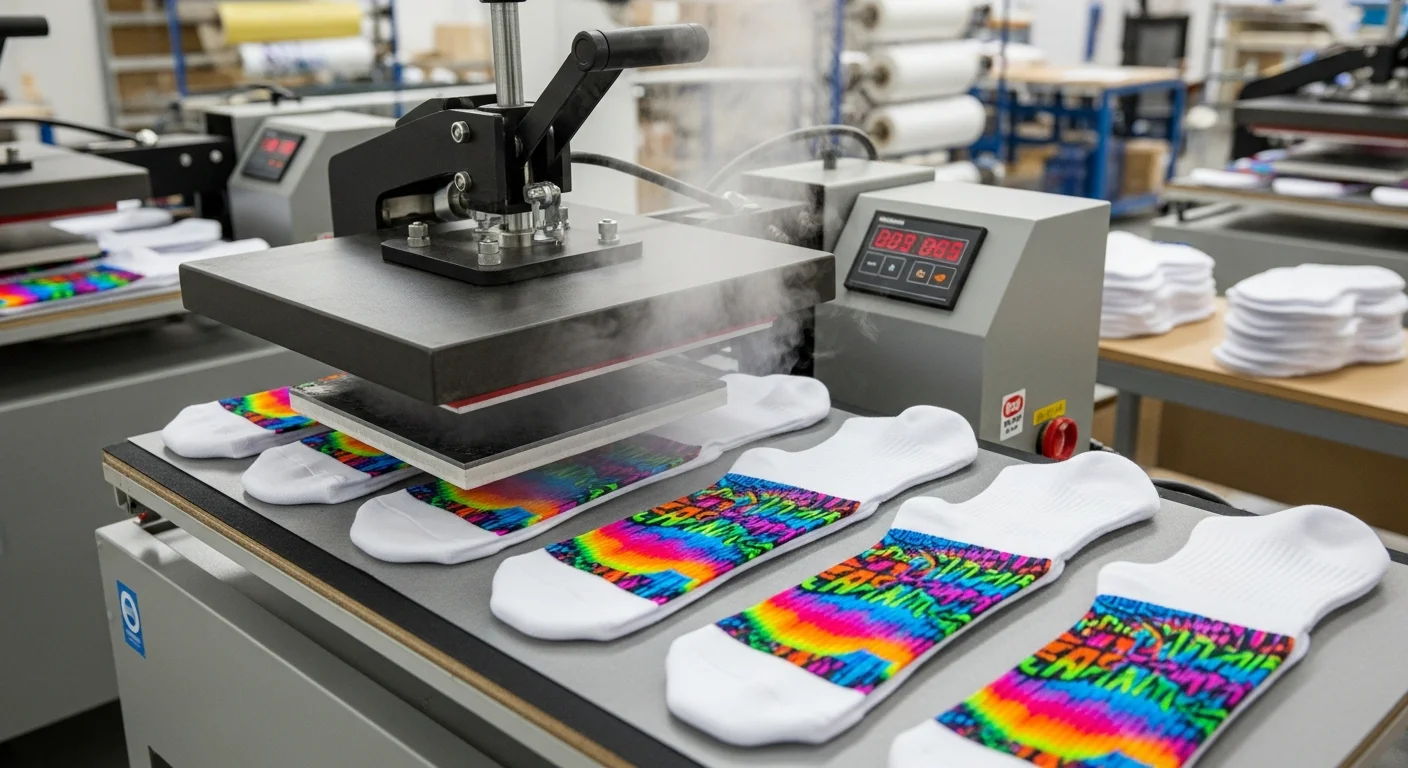
Sublimation uses heat (around 400°F / 204°C) and pressure to convert special dye inks from solid to gas, which then permanently bonds into the fibers of polyester fabric. The sock is first constructed from blank white polyester, then printed using a heat press that transfers the full-color design onto the finished sock. Because the dye becomes part of the fiber rather than sitting on top, sublimated socks retain their original softness, stretch, and breathability with zero texture difference between printed and unprinted areas.
Sublimation excels at photographic images, unlimited color gradients, and edge-to-edge coverage. A sublimated sock can display a full photographic image wrapping 360 degrees around the leg and foot with no color limitations and no added stiffness or weight. The ink will not crack, peel, or fade because it exists within the fiber structure itself. After 50+ wash cycles in a controlled testing environment, sublimated socks retain approximately 95% of their original color vibrancy — making them among the most durable custom print products available.
The primary limitation of sublimation is fabric compatibility. Sublimation only works on polyester or polyester-dominant blends (minimum 65% polyester content). It also requires a white or very light base color because sublimation dye is transparent — dark base colors show through the ink and distort the intended colors. Attempting to sublimate onto a navy blue sock, for example, will produce a dark, muddy version of the design rather than the vibrant original. Typical minimum order quantities for sublimation socks range from 50 to 100 pairs, with unit pricing between $8 and $15 per pair depending on volume, sock style, and manufacturer. At 500+ pairs, sublimation pricing can drop to $6-$8 per pair.

How Knit-In (Jacquard) Construction Works
Knit-in socks — also called Jacquard socks — are not printed at all. Instead, the design is literally woven into the sock during the knitting process using different colored yarns. A computerized circular knitting machine feeds multiple yarn colors simultaneously, switching between them stitch by stitch to create the pattern. Each sock is knitted as a single piece with the design built into the fabric structure from the very first stitch.
This method produces the most durable custom socks available. Because the design is part of the knit structure itself, it cannot wash out, crack, peel, or fade under any conditions — the design literally is the sock. Knit-in socks also offer the widest fabric flexibility — they can be produced in combed cotton, bamboo viscose, merino wool, nylon, polyester, or any custom blend, unlike sublimation which is restricted to polyester. The texture is slightly raised where colors change, giving knit-in designs a tactile quality and premium hand feel that printed socks cannot replicate. Many consumers perceive knit-in socks as higher quality than printed socks based on this tactile distinction alone.
The trade-off is design complexity. Most Jacquard knitting machines support eight to twelve colors per design, with no gradients, continuous tones, or photographic reproduction possible. Fine details smaller than approximately 2mm (about 3 stitches) are lost in the knitting process because each stitch is a discrete unit of color. Curved lines and diagonal edges appear slightly stepped or pixelated when viewed up close, though this effect becomes invisible at normal viewing distance. Minimum order quantities are higher — typically 100 to 200 pairs — because each design requires a new machine program, yarn threading, and calibration run. Unit pricing ranges from $5 to $12 per pair, making knit-in the most cost-effective method at high volumes. For a deeper look at yarn options and fiber properties, read the custom sock fabric guide.
How DTG 360° Digital Printing Works
DTG (direct-to-garment) sock printing uses modified inkjet technology to spray water-based textile inks directly onto a pre-constructed sock. The sock is stretched over a cylindrical mandrel form that rotates while print heads apply ink in a full 360-degree pass, covering the entire outer surface in a single printing cycle. After printing, the sock is heat-cured at 320-350°F for 60-90 seconds to bond the ink to the fibers permanently.
DTG works on cotton, cotton-blend, and polyester socks alike, making it the most versatile method in terms of fabric compatibility. It also works on dark-colored base socks because the printer can lay down a white ink underbase before applying colors on top — something sublimation cannot do. This opens up design possibilities like bright graphics on a black or navy sock that would be impossible with sublimation.
DTG offers the lowest minimum order quantities in the industry — some providers accept orders as small as one pair, making it ideal for samples, prototypes, personalized gifts, and small-batch promotional items. Color reproduction is excellent, supporting full-color photographic images and smooth gradients similar to sublimation. Setup costs are minimal because there are no screens, plates, or machine programming required — the design is simply loaded into the printer software and production begins immediately.
Durability is the primary weakness of DTG sock printing. Because the ink sits on the surface of the fibers rather than bonding into them (sublimation) or being woven in (knit-in), DTG prints fade more noticeably over time. After 30 wash cycles, DTG socks typically retain 70-80% of their original color vibrancy compared to 95%+ for sublimation and 100% for knit-in. The ink layer also adds a slight texture that can be felt when running a hand over the printed area, though modern water-based inks are significantly softer than older plastisol formulations. Unit pricing is higher at low volumes — $10 to $20 per pair for small orders — though it drops to $7 to $12 per pair at 100+ units.
Head-to-Head Comparison Table
| Feature | Sublimation | Knit-In (Jacquard) | DTG 360° |
|---|---|---|---|
| Colors Available | Unlimited | 8–12 per design | Unlimited |
| Gradients & Photos | Yes | No | Yes |
| Fabric Options | Polyester only (65%+ content) | Cotton, bamboo, merino, nylon, blends | Cotton, polyester, blends |
| Dark Base Colors | No (white/light only) | Yes (any base) | Yes (with white underbase) |
| Durability (50 washes) | 95%+ color retention | 100% (woven in) | 70–80% color retention |
| Minimum Order Qty | 50–100 pairs | 100–200 pairs | 1–25 pairs |
| Unit Cost (100 pairs) | $8–$12 | $5–$10 | $10–$15 |
| Production Time | 3–4 weeks | 4–6 weeks | 2–3 weeks |
| Texture / Hand Feel | Smooth (no ink layer) | Slightly textured at color changes | Slight ink layer on surface |
| Best For | Vivid all-over prints, photos | Classic logos, athletic team socks | Small batches, prototypes, dark socks |

When to Choose Each Method
Choose sublimation when your design features photographic imagery, complex gradients, or full 360-degree coverage with vivid, unlimited colors. It is the best option for promotional socks, retail product lines, event merchandise, and any design where visual impact is the top priority. Sublimation also works well for matching custom sock collections with coordinated designs across multiple styles because the same high-resolution artwork file can be adapted to crew, ankle, and knee-high templates without redesigning for color limitations.
Choose knit-in Jacquard when durability is paramount — athletic team socks that endure weekly washing for an entire season, corporate uniform socks worn daily for years, and retail products positioned as premium quality. Knit-in is also the only method that works with premium natural fibers like merino wool and bamboo, making it the go-to for comfort-focused brands and eco-conscious product lines. If your design uses clean geometric patterns, bold logos, classic stripe motifs, or argyle patterns with fewer than twelve colors, knit-in delivers a premium feel and unmatched longevity that printed methods cannot match.
Choose DTG 360° when you need small quantities with fast turnaround, the ability to print on dark-colored socks, or maximum fabric versatility. DTG is perfect for event giveaways with short lead times (two to three weeks), sample runs before committing to a large knit-in order, personalized one-off gifts (pet face socks, wedding date socks), and testing new designs before scaling up production. It is also the most accessible method for entrepreneurs testing sock designs with minimal financial risk.
Material Compatibility by Method
Material selection and printing method are tightly linked — choosing one constrains the other. Sublimation requires a minimum of 65% polyester content, with 100% polyester producing the most vibrant, color-accurate results. Knit-in works with virtually any yarn including combed cotton, ringspun cotton, bamboo viscose, merino wool, nylon, polyester, and custom blends, making it the most flexible method from a materials perspective. DTG performs best on cotton and cotton-blend socks (60%+ cotton content) and produces acceptable results on polyester, though sublimation is the superior choice when working exclusively with polyester fabrics.
If you are unsure which fabric to pair with your chosen method, the fabric guide provides detailed compatibility charts covering every major fiber type. For budget planning across methods and order volumes, the pricing guide breaks down cost per pair by method, volume tier, and sock style. When designing your first pair of custom socks, the beginner's design guide covers the full design workflow regardless of which printing method you select.
Frequently Asked Questions
Which custom sock printing method is most durable?
Knit-in Jacquard is the most durable method because the design is woven directly into the sock's fabric structure using colored yarns. It cannot fade, crack, or peel regardless of washing frequency or aggressiveness. Sublimation is a close second, retaining 95%+ color vibrancy after 50 wash cycles. DTG is the least durable option, with noticeable fading after 30 washes, though proper care (cold wash, air dry) extends its lifespan significantly.
Can you print photographs on custom socks?
Yes, but only with sublimation or DTG printing. Both methods support full-color photographic reproduction with unlimited colors and smooth tonal gradients. Popular photographic sock designs include pet faces, family photos, and landscape imagery. Knit-in Jacquard cannot reproduce photographs because it is limited to eight to twelve flat colors and cannot create smooth tonal transitions between colors.
What is the cheapest way to order custom socks in bulk?
Knit-in Jacquard offers the lowest per-unit cost at volumes above 200 pairs, typically $5 to $8 per pair for a standard crew sock. Sublimation becomes cost-competitive at 100+ pairs at $8 to $10 per pair. DTG is the most expensive per unit but has virtually no minimum order quantity, making it the cheapest total-cost option for orders under 25 pairs where the alternatives would require purchasing more than you need.
Do all three methods work on any sock fabric?
No. Sublimation requires polyester or high-polyester blends (65%+ polyester) and only works on white or light-colored socks. DTG works on both cotton and polyester but performs best on cotton blends with 60%+ cotton content. Knit-in Jacquard is the only method compatible with all fiber types including cotton, bamboo, merino wool, nylon, and synthetic blends, because the design is created during the knitting process itself rather than applied afterward.
Share this article
Written by
Terrence Okafor
Head of Production at RareCustom with 20+ years in commercial printing. SGIA certified with expertise in sublimation, knit-in Jacquard, and DTG sock printing methods.