Custom Poster Sizes: Complete Guide to Standard & Custom Dimensions
Everything you need to know about custom poster sizes — from standard dimensions like 18x24 and 24x36 to fully custom sizing. Learn which poster size works best for home decor, events, retail, and more.
Terrence Okafor
Head of Production at RareCustom. Terrence manages poster printing across all formats and sizes, ensuring dimensional accuracy and material quality for every custom poster order.
Choosing the right size is one of the most important decisions when ordering custom posters. A poster that is too small gets lost on a large wall, while one that is too large can overwhelm a tight space. Understanding standard poster dimensions and when to go custom helps you get the visual impact you are looking for — whether you are printing wall art for your living room, signage for a retail store, or presentation boards for a conference.
This guide covers every standard poster size, explains when custom dimensions make sense, and helps you match the right size to your specific project. If you are new to poster design, our step-by-step design guide walks you through the entire creation process from start to finish.
Standard Poster Sizes at a Glance
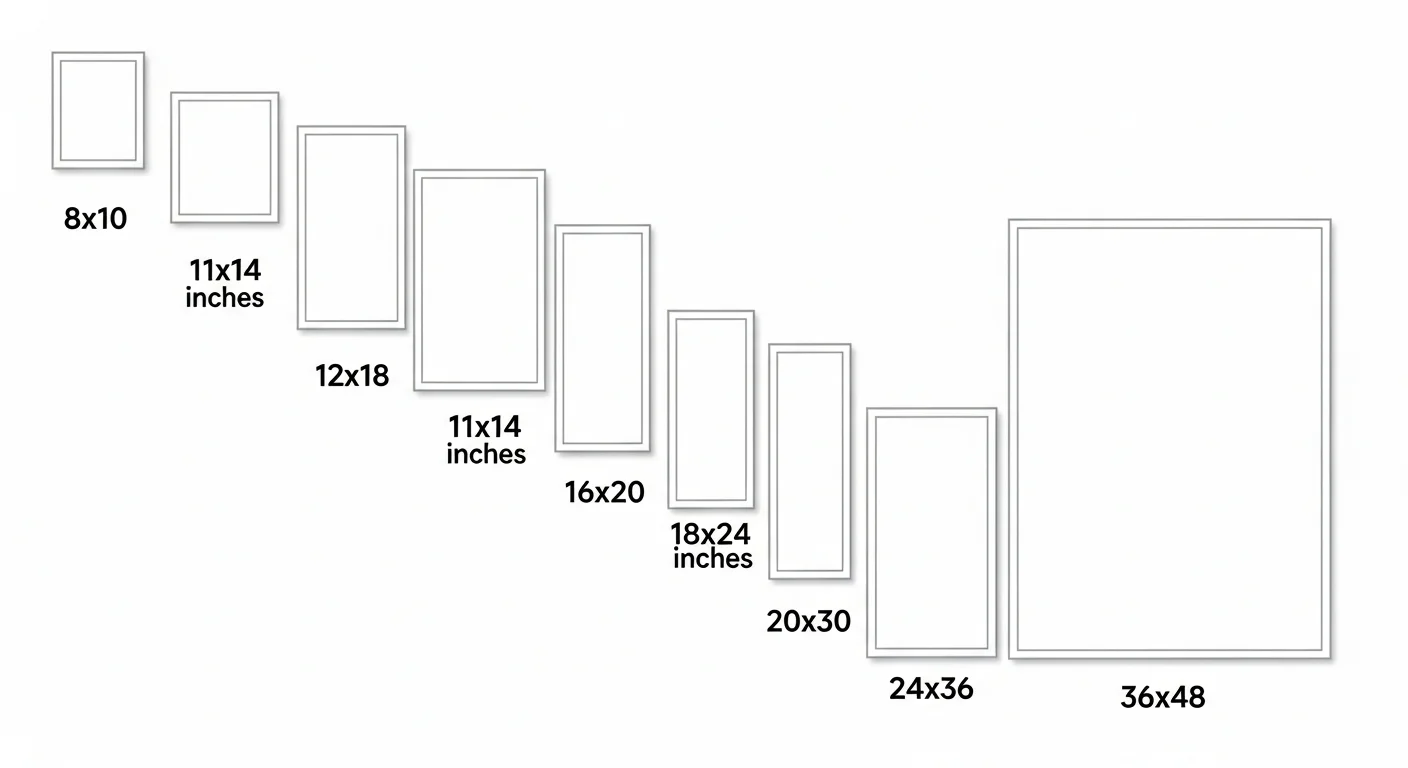
Standard poster sizes are based on common frame dimensions and print industry conventions. Using a standard size keeps costs lower because printers can use pre-cut paper stock and standard frame options are readily available. Here are the most widely used poster dimensions:
8" x 10" (Small) — A compact size ideal for desk displays, gift inserts, and small accent pieces. Popular for photo prints, mini art prints, and product inserts. Easy to frame with inexpensive off-the-shelf frames available everywhere.
11" x 17" (Tabloid) — The standard bulletin board and flyer size. Great for event announcements, classroom displays, and informational posters. Large enough to read from a few feet away but small enough to fit in standard mailing envelopes without rolling.
18" x 24" (Medium/Standard) — The most popular poster size for general use. Works well for home decor, dorm rooms, retail displays, and promotional graphics. Visible from across a room and fits standard poster frames widely available at retailers.
24" x 36" (Large) — The classic large poster size used for movie posters, concert posters, and gallery-quality wall art. Makes a strong visual statement and is large enough to serve as a focal point in most rooms. This is the most popular size for custom photo posters for home decor.

27" x 40" (Movie Poster) — The official one-sheet movie poster size used by theaters worldwide. Popular for film memorabilia, entertainment room decor, and professional theatrical displays. Slightly taller and narrower than 24x36.
36" x 48" (X-Large) — An oversized format for high-impact displays. Ideal for lobby graphics, retail window displays, trade show signage, and large wall art installations. Requires wall-mounting hardware or a floor easel for display.
When to Choose Custom Poster Sizes
Standard sizes work for most projects, but custom sizing unlocks possibilities that pre-set dimensions cannot match. Here are the most common scenarios where custom poster sizes make sense:
Filling a specific wall space: If you have a 32-inch-wide gap between two windows, a standard 24x36 would be too small and a 36x48 too large. A custom 32x40 poster fills the space perfectly. Measure your wall space first and order the exact dimensions you need.
Panoramic and ultra-wide formats: Landscape photography, cityscapes, and horizon shots look best in panoramic aspect ratios like 12x36, 16x48, or 20x60. These non-standard dimensions are not available as standard sizes but custom poster printing makes any aspect ratio possible.
Architectural and interior design projects: Interior designers and architects often need posters sized to specific wall panels, alcoves, or display spaces. Custom sizing ensures the artwork fits the architectural context precisely.
Scientific and research posters: Academic conference posters often require specific dimensions — commonly 36x48 or 42x56 — depending on the conference's display board sizes. Custom sizing ensures your research poster fits the allocated space. See our posters for education guide for more on academic formats.

Poster Size by Use Case
The right poster size depends on where it will be displayed and how viewers will interact with it. Here is a practical guide organized by common use cases:
Home decor and wall art: 18x24 for accent pieces, 24x36 for statement pieces, and custom sizes for gallery wall arrangements. For photo poster home decor, 24x36 is the most popular starting point because it is large enough to showcase photographic detail without dominating most rooms.
Business and retail signage: 18x24 for window displays and point-of-sale, 24x36 for in-store branding, and 36x48+ for storefront windows and lobby graphics. Business poster signage often benefits from larger sizes because viewers see them from greater distances.
Events and celebrations: 18x24 for table-top displays, 24x36 for welcome signs and photo boards, and custom sizes for backdrops and stage graphics. Event poster board signs on foam board are popular for weddings, birthdays, and corporate events.
Education and presentations: 24x36 for classroom posters, 36x48 for science fair tri-folds, and 42x56 for academic conference presentations. Larger educational posters should use fonts no smaller than 24pt for readability from across a classroom.
Resolution Requirements by Poster Size
Larger posters need higher-resolution source files to maintain print quality. The industry standard is 300 DPI (dots per inch) at the final print size. Here is what that translates to in pixel dimensions for common poster sizes:
8x10 at 300 DPI: 2,400 x 3,000 pixels (7.2 megapixels). Most smartphone cameras easily exceed this resolution.
18x24 at 300 DPI: 5,400 x 7,200 pixels (38.9 megapixels). Requires a high-resolution camera or graphic design file. Most DSLR and mirrorless cameras from the past 5 years produce files this large.
24x36 at 300 DPI: 7,200 x 10,800 pixels (77.8 megapixels). Very high resolution required. For photographs, consider medium format cameras or multi-shot composites. For graphics, vector-based designs (SVG, AI) scale to any size without quality loss.
36x48 at 300 DPI: 10,800 x 14,400 pixels (155.5 megapixels). At this size, 150-200 DPI is often acceptable because viewers see large posters from farther distances. Most professional photographers use 150 DPI for posters this large with excellent results.

A practical rule: for posters viewed from 3+ feet away, 150 DPI is sufficient. For posters viewed up close (desk prints, gallery art where viewers lean in), 300 DPI is recommended. Our online design tool automatically checks your image resolution and warns you if the file quality is too low for your selected poster size.
Poster Size and Material Considerations
Not all materials are available in all sizes. Here is a quick reference for material availability by size range:
Paper posters (matte, glossy, satin): Available in all standard sizes and custom sizes up to 60 inches wide. Paper is the most versatile and affordable option across all size ranges. Read our paper types and materials guide for help choosing the right paper finish.
Canvas posters: Available from 8x10 to 40x60. Gallery-wrapped canvas is most popular in 16x20, 24x36, and 30x40 sizes for home decor applications.
Metal posters: Available from 8x10 to 36x48. Metal works best in medium to large sizes where the brushed aluminum surface creates maximum visual impact.
Foam board posters: Available from 11x17 to 48x72. Foam board is the go-to choice for event signage and display boards where lightweight rigidity is essential.
Vinyl banners: Available up to 60 inches wide and virtually unlimited length. Vinyl is ideal for oversized outdoor displays. See our large format printing guide for more on oversized poster options.
How to Measure Your Wall Space for a Custom Poster
Before ordering a custom-sized poster, measure your intended display area precisely. Here is a quick method:
Use a tape measure to find the exact width and height of the available wall space. Subtract 2-4 inches from each dimension for visual breathing room — a poster should not fill its wall space edge to edge. For a 36-inch-wide wall space, a 32-inch-wide poster with 2 inches of margin on each side creates a balanced look.
If hanging above furniture (couch, desk, bed), the poster should be approximately two-thirds the width of the furniture piece. A 72-inch couch pairs well with a 48-inch-wide poster. The bottom edge of the poster should hang 6-12 inches above the top of the furniture.
For gallery wall arrangements with multiple posters, lay out your arrangement on the floor first using paper cut to your planned dimensions. This lets you visualize spacing and alignment before committing to sizes. Common gallery wall spacing is 2-3 inches between pieces.

File Setup Tips for Custom Size Posters
When creating a design file for a custom-sized poster, set up your document correctly from the start. In design software like Photoshop, Illustrator, or Canva, create a new document at the exact poster dimensions with a resolution of 300 DPI. Add 0.125 inches of bleed on all sides if your design extends to the edges (full-bleed printing).
For text and important design elements, keep them at least 0.5 inches from the trim edge to prevent accidental cropping. This safe zone ensures nothing critical is cut during the trimming process.
Save your final file as a high-quality PDF, TIFF, or PNG. Avoid JPEG compression for large poster files because compression artifacts become visible at large print sizes. If using our free online poster maker, the tool handles all file setup automatically — just upload your images, add text, and export.
Start Designing Your Custom Poster
Whether you choose a standard size or go fully custom, RareCustom poster printing delivers professional results on premium materials. No minimum orders, free shipping on orders over $75, and a 100% satisfaction guarantee. Use our free design tool to set your exact dimensions, upload your artwork, and preview your poster before ordering. For help choosing the right size, contact our team — we have printed over 100,000 custom posters and can recommend the perfect dimensions for your project.

Share this article
Written by
Terrence Okafor
Head of Production at RareCustom. Terrence manages poster printing across all formats and sizes, ensuring dimensional accuracy and material quality for every custom poster order.