Custom Shaped Keychains: Die-Cut, 3D & Novelty Designs Explained
Learn how custom shaped keychains are made including die-cut acrylic, custom metal molds, and 2D vs 3D PVC designs. Covers design file requirements, popular shapes, cost factors, and brand differentiation strategies.
Camille Dupont
Senior Designer at RareCustom. Camille guides customers through die-cut acrylic, custom metal mold, and 3D PVC keychain design with tips for achieving precise custom shapes.
Standard keychains come in predictable shapes — circles, rectangles, ovals, and dog tags. They serve their purpose, but they rarely stop someone in their tracks. Custom shaped keychains break that mold entirely. When your keychain takes the exact silhouette of your mascot, state outline, food item, or brand logo, it becomes instantly recognizable and dramatically more memorable than any standard-shape alternative. The unique contour of a shaped keychain catches the eye, sparks conversation, and communicates a level of creative investment that generic shapes simply cannot match.
Whether you are a business looking to differentiate your promotional products, a creator designing merchandise for your fan base, an event planner sourcing memorable favors, or simply someone who wants a truly one-of-a-kind everyday carry accessory, understanding how custom shaped keychains are manufactured, what materials support custom shapes, and how to prepare your design files will help you achieve the exact result you envision. This guide covers the three primary approaches to custom shaped keychains — die-cut acrylic, custom metal molds, and PVC/rubber molding — along with design requirements, popular shape categories, and the cost factors that influence pricing.
What Are Custom Shaped Keychains
A custom shaped keychain is any keychain whose physical outline follows a unique contour rather than conforming to a standard geometric shape. Instead of printing a dog illustration onto a rectangular keychain, for example, a custom shaped keychain would be cut or molded to the exact silhouette of the dog — ears, tail, and all. The shape itself becomes part of the design, adding a three-dimensional, sculptural quality that flat printing on a standard shape cannot achieve.
Custom shaped keychains are produced through three primary manufacturing methods, each tied to a specific material category. Die-cutting uses laser technology to cut flat sheet materials (primarily acrylic) into custom outlines. Metal molding uses die-casting to pour molten metal into a custom-shaped mold. PVC/rubber molding injects liquid PVC or silicone into a custom mold that defines both the shape and the surface detail. Each method has different capabilities, cost structures, and ideal use cases.
Die-Cut Acrylic Shapes
Die-cut acrylic is the most popular and accessible method for producing custom shaped keychains. The process is straightforward: your design file defines the outer contour, and a laser cutting machine follows that contour to cut each keychain from a sheet of acrylic. The laser produces clean, polished edges and can follow extremely intricate outlines — fine details like individual fingers on a character's hand, delicate antennae on an insect, or the complex coastline of a state outline are all achievable.
The advantages of die-cut acrylic are significant. First, there is no mold or tooling cost — the laser follows your digital file directly, which means custom shapes cost the same as standard shapes to produce. This makes die-cut acrylic the only custom shape method that is economically viable for small quantities, even single units. Second, design changes between production runs are free since there is no physical mold to modify. Third, the turnaround time is fast — most suppliers can cut and print acrylic keychains in five to seven business days.
The limitation of die-cut acrylic is that it produces flat, two-dimensional shapes. The keychain has uniform thickness (typically two to three millimeters) across its entire surface. If you need three-dimensional depth, texture, or varying thickness, you will need to explore metal or PVC molding. For detailed guidance on designing for acrylic, including file requirements and printing techniques, read our acrylic keychain design guide.

Custom Metal Mold Shapes
Custom shaped metal keychains are produced through die-casting — a process where molten zinc alloy (or occasionally brass or stainless steel) is injected into a custom-made steel mold under high pressure. The mold defines both the outer shape and any surface details — raised borders, recessed areas for enamel fill, text, textures, and dimensional elements. Once the metal cools and solidifies, the keychain is removed from the mold and finished with plating (nickel, gold, black nickel, antique brass, etc.) and optional enamel fill or laser engraving.
The quality of a die-cast metal keychain is immediately apparent. The weight, the crisp detail of the casting, and the premium plating finish create a product that feels substantial and valuable. Custom metal shapes are the preferred choice for collectible keychains, challenge coin-style keychains, corporate gifts, and any application where perceived value matters as much as visual design.
The primary consideration with custom metal molds is cost. Creating a new steel mold typically costs between fifty and two hundred dollars, depending on the complexity of the shape and the level of detail. This is a one-time investment — once the mold exists, it can be used for unlimited production runs without additional tooling charges. However, the mold cost means that custom metal shapes are most economical at quantities of two hundred units or more, where the per-unit mold amortization drops below one dollar. For smaller quantities, the mold cost represents a significant percentage of the total order cost.
Design changes to a metal mold are expensive (often requiring a completely new mold), so it is critical to finalize your design before approving mold production. Request a 3D rendering or CAD preview of the mold before committing. For a comprehensive comparison of decoration options available for metal keychains, explore our decoration methods guide.

PVC and Rubber: 2D and 3D Custom Shapes
PVC (polyvinyl chloride) and silicone rubber keychains offer the most versatile custom shaping capabilities of any keychain material. The manufacturing process involves injecting liquid PVC or silicone into a multi-part mold that defines the shape, surface texture, and color distribution of the finished keychain. Unlike acrylic (which is flat) or metal (which is rigid and heavy), PVC keychains are soft, flexible, lightweight, and can incorporate true three-dimensional depth.
2D PVC keychains: The design has a flat surface with raised borders separating colored sections, similar to a stained glass window or a comic book panel. Each color area is filled with a different color of PVC, creating a vibrant, multi-colored design. The keychain has a uniform thickness, but the surface detail creates the illusion of depth through the raised borders. 2D PVC keychains are the more affordable option and work well for logo reproductions, character illustrations, and graphic designs with defined color blocks.
3D PVC keychains: The design has genuine three-dimensional depth — elements protrude from the surface at varying heights, creating sculptural detail that you can see and feel. A 3D PVC keychain of a cartoon character, for example, would have a raised nose, recessed eyes, and layered clothing details that give the figure real dimension. 3D PVC keychains require more complex molds (and correspondingly higher mold costs) but produce a dramatic, tactile product that stands out from flat alternatives.
PVC keychains are waterproof, flexible, and virtually indestructible under normal use conditions. They resist fading, scratching, and cracking, making them one of the most durable keychain options available. The soft, rubbery texture also gives them a friendly, approachable feel that hard materials like metal and acrylic lack. These qualities make PVC keychains popular for children's products, outdoor brands, food and beverage companies, and any brand with a playful or casual identity.

Design File Requirements for Custom Shapes
Preparing your artwork correctly for custom shaped keychains is critical because your design file defines both the visual appearance and the physical outline of the finished product. Requirements vary by material:
Die-cut acrylic: Submit a PNG file with a transparent background at 300 DPI minimum. The outer edge of your non-transparent artwork defines the laser cut line. Include a two to three millimeter bleed around the outer edge and keep all critical design elements at least two millimeters inside the cut boundary. Vector files (AI, SVG, or EPS) are also accepted and preferred for designs with clean, geometric edges.
Custom metal molds: Submit a vector file (AI, EPS, or PDF) with clearly defined areas for each element — die lines, recessed enamel fill areas, raised metal surfaces, and engraving zones. Include Pantone color references for each enamel fill color. The manufacturer will create a technical drawing from your file for mold production approval.
PVC/rubber molds: Submit a vector file with each color clearly separated into its own layer or clearly labeled. Specify Pantone colors for each PVC fill area. For 3D designs, include a side-view or cross-section sketch showing the intended depth of each element. Some manufacturers request a 3D rendering if the design is complex.
Regardless of material, always check your design at actual print size before submitting. Details that look clear on a large screen may become illegible at the one and a half to two and a half inch scale of most keychains. Use our design tool to preview your shaped keychain at actual size and test readability.
Popular Custom Keychain Shapes
While the beauty of custom shaped keychains is that you can create literally any outline, certain shape categories consistently dominate the market due to their broad appeal and practical applications:
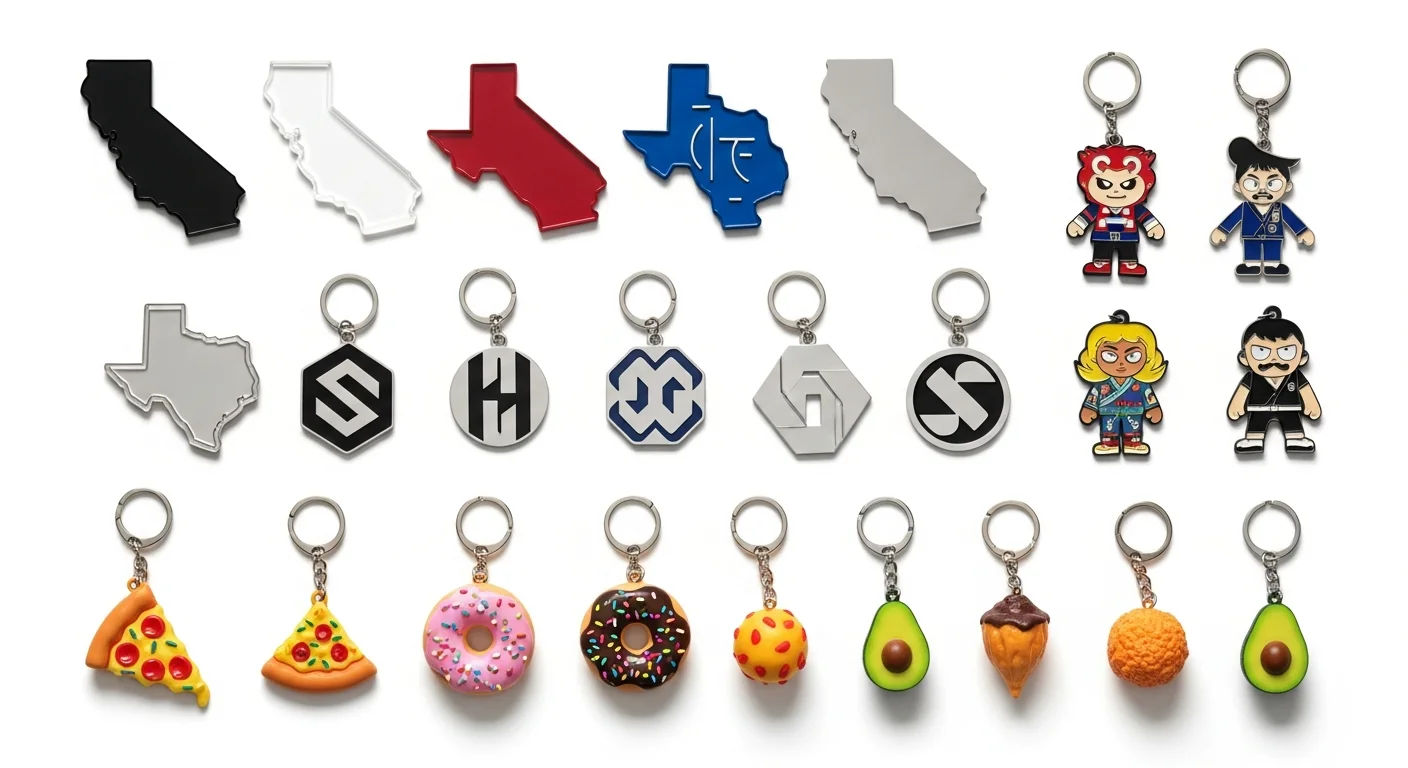
State and country outlines: Extremely popular for tourism, local business promotion, and hometown pride. State-shaped keychains are among the top-selling custom keychain designs on marketplace platforms. The geographic outline is instantly recognizable, and the interior provides space for a city name, landmark, or logo.
Logo silhouettes: Cutting the keychain to the shape of your brand logo creates an unmistakable brand identifier. The logo is not just printed on the keychain — it is the keychain. This approach works best for logos with distinctive, recognizable outlines. Abstract or overly detailed logos may not translate well to a small physical shape.
Mascot and character shapes: Schools, sports teams, and content creators use character-shaped keychains as merchandise and spirit items. The keychain becomes a miniature figurine of the mascot, creating an emotional connection with the recipient. Acrylic die-cutting handles detailed character shapes well, while PVC molding adds three-dimensional depth to character features.
Food and object shapes: Pizza slices, coffee cups, guitars, cameras, footballs, paw prints — functional and novelty shapes tied to specific interests, businesses, or hobbies. A pizza-shaped keychain from a local pizzeria or a guitar-shaped keychain from a music school creates an immediate, memorable association between the shape and the brand.
Architectural and landmark shapes: Buildings, bridges, monuments, and skyline silhouettes make excellent souvenir and destination keychains. Real estate companies use house-shaped keychains as closing gifts, while tourism boards commission landmark-shaped keychains as branded souvenirs.

Cost Factors for Custom Shaped Keychains
Several factors influence the cost of custom shaped keychains beyond the base material price. Understanding these factors helps you budget accurately and identify opportunities to optimize costs:
Shape complexity: Intricate outlines with thin protrusions, sharp points, or fine details cost more to produce than simple, rounded shapes. On acrylic, complex shapes take longer to laser-cut. On metal and PVC, complex shapes require more intricate molds. Simplifying your outline where possible reduces costs without necessarily compromising the design's impact.
Mold/tooling costs: Metal and PVC shapes require custom molds, which are a one-time cost that adds to the initial order but does not recur on reorders. Acrylic shapes have no tooling cost. If you plan to reorder the same design multiple times, the mold investment pays for itself quickly.
Size: Larger keychains use more material and take longer to produce. Most custom keychains range from one and a half to three inches in their longest dimension. Staying within this range keeps costs manageable while providing enough surface area for your design to be visible and legible.
Number of colors: For enamel fill and PVC keychains, each additional color adds cost. Designs with three to five colors are standard. Designs exceeding eight to ten colors may incur significant surcharges. UV printing on acrylic has no per-color cost since it prints in full CMYK.
Finishing options: Epoxy dome coating, custom plating finishes, glitter or holographic acrylic, and premium hardware all add to the per-unit cost. Budget-conscious orders should stick to standard finishes and save premium options for smaller, higher-value runs.
Shaped Keychains for Brand Differentiation
In a market saturated with standard promotional products, custom shaped keychains offer a powerful brand differentiation strategy. When every competitor at a trade show is handing out rectangular keychains with printed logos, your house-shaped real estate keychain, your pizza-slice pizzeria keychain, or your state-outline tourism keychain stands out immediately. The shape itself becomes a talking point — recipients show it to others, post photos on social media, and remember your brand long after the event.
The marketing psychology behind shaped keychains is straightforward: unusual objects receive more attention and create stronger memory associations than familiar ones. A rectangle with a logo is forgettable. A miniature guitar with a music school logo is a conversation piece. The additional cost of custom shaping is modest compared to the attention and brand recall it generates.
For businesses using keychains as part of a broader promotional strategy, shaped keychains pair exceptionally well with other custom products. A real estate agent might include a house-shaped keychain, a branded promotional keychain with contact information on the back, and a set of branded materials in a closing gift package. The shaped keychain anchors the package with a memorable physical object that the new homeowner will use every day.
Custom shaped keychains transform a simple accessory into a miniature brand ambassador. Whether you choose die-cut acrylic for its flexibility and affordability, die-cast metal for its premium weight and feel, or molded PVC for its colorful three-dimensional depth, the right shape turns your keychain from something people carry into something people notice. Explore all available shapes and materials on our custom keychains page and start designing your unique silhouette today.
Share this article
Written by
Camille Dupont
Senior Designer at RareCustom. Camille guides customers through die-cut acrylic, custom metal mold, and 3D PVC keychain design with tips for achieving precise custom shapes.