Custom Shaped Pillows: How Die-Cut & Novelty Pillow Designs Are Made
Learn how custom shaped pillows are designed and manufactured — from popular shapes like hearts, letters, and state outlines to die-cut production, design file requirements, and cost considerations.
Terrence Okafor
Head of Production at RareCustom. Terrence oversees die-cut pillow manufacturing, custom pillow forms, and specialty shape production for novelty and branded pillow orders.
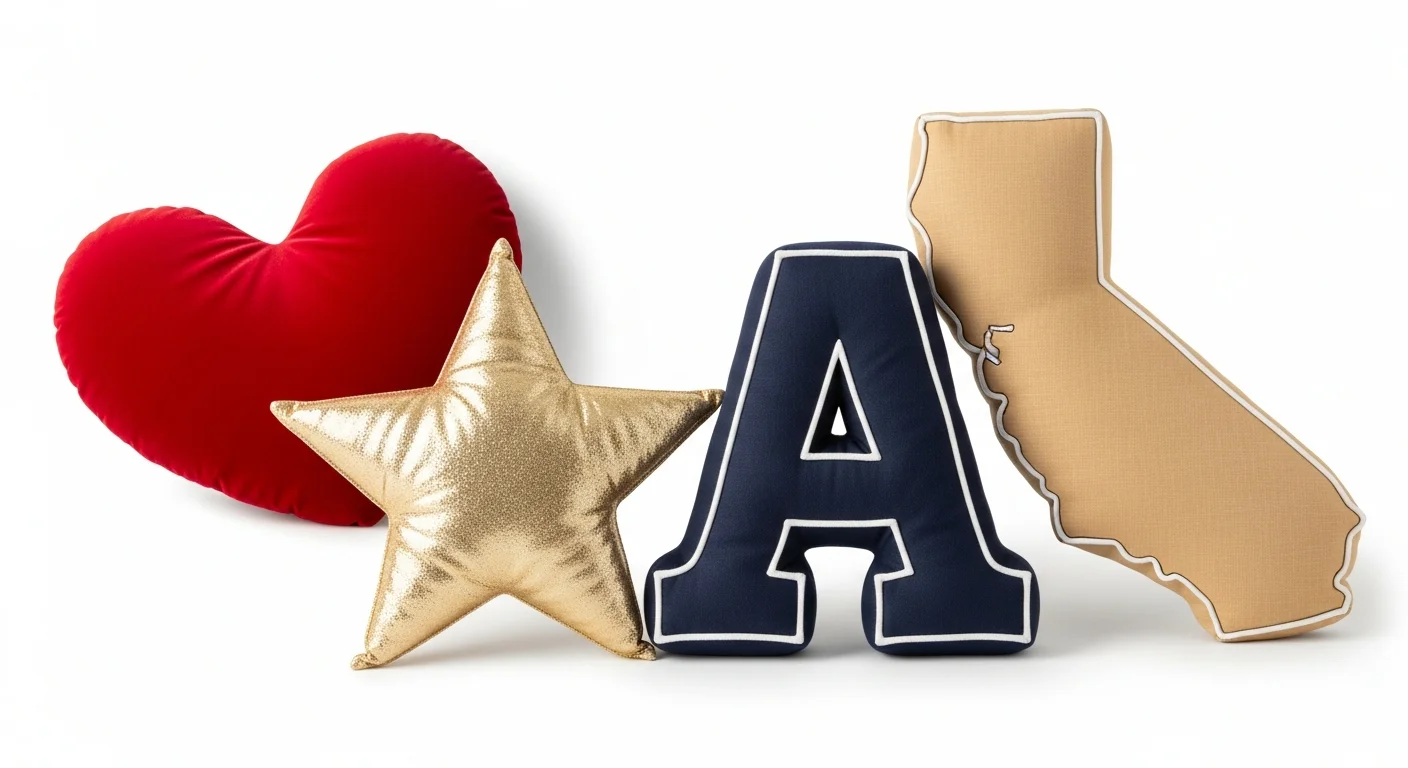
Standard rectangular and square pillows are versatile workhorses, but sometimes a design calls for something more expressive. Custom shaped pillows — also called die-cut pillows or contour pillows — break free from conventional geometry to take the form of hearts, stars, letters, state outlines, brand logos, pet silhouettes, and virtually any other shape you can imagine.
Shaped pillows transform an ordinary cushion into a sculptural object that doubles as decor and conversation starter. They are popular for nurseries, themed bedrooms, brand merchandise, event giveaways, and novelty gifts. This guide explains how custom shaped pillows are manufactured, what you need to provide for a successful order, and how to decide whether a shaped pillow is the right choice for your project.
What Are Custom Shaped Pillows
A custom shaped pillow is a pillow whose outline follows a specific contour rather than a standard rectangular or square shape. The pillow cover is cut to match the outline of your design, sewn together, filled, and finished as a three-dimensional cushion that holds the custom shape.
Unlike standard pillows where the shape is predetermined and only the surface print is customized, shaped pillows customize both the surface design and the physical form. A star-shaped pillow is actually star-shaped — five points extending from the center, each one stuffed and finished. A letter-shaped pillow forms the actual letter in three dimensions, creating a tactile object that stands up on a shelf or bed.
The manufacturing process for shaped pillows is more complex than standard pillows because each unique shape requires custom pattern cutting, which increases production time and cost. However, modern digital cutting technology has made custom shapes more accessible and affordable than ever before.
Popular Custom Pillow Shapes
While any shape is technically possible, certain shapes are ordered far more frequently than others. Here are the most popular categories of custom pillow shapes:
Hearts: The most universally popular shaped pillow. Heart pillows are ordered for Valentine's Day gifts, wedding favors, nursery decor, and romantic occasions year-round. The symmetrical shape is easy to manufacture and looks attractive from any angle. Heart pillows range from small 10-inch accent hearts to large 24-inch statement pieces.
Stars: Five-pointed stars are popular for children's rooms, patriotic themes, and holiday decor. Star-shaped pillows present a manufacturing challenge because the narrow points must be carefully stuffed to maintain their shape without becoming floppy. Quality star pillows use reinforced stitching at each point tip.
Letters and initials: Single-letter pillows spelling out a person's initial are a staple of nursery decor and personalized gifts. Full names or short words (HOME, LOVE, JOY) created as individual letter pillows that spell out the word when arranged together make dramatic visual displays. Letter pillows work best in serif or block fonts that have wide strokes — thin script fonts create narrow shapes that are difficult to stuff properly.
State and country outlines: Geographic silhouette pillows let people celebrate their home state, birthplace, or favorite travel destination. A Texas-shaped pillow, a California outline, or an Italy map cushion speaks to geographic identity and nostalgia. Complex state shapes with narrow peninsulas or irregular coastlines require careful pattern engineering. These are extremely popular for college dorm rooms and relocation gifts.
Logo and brand shapes: Companies order pillows cut to the shape of their logo for merchandise, office decor, trade show displays, and brand-building events. A shoe company might order shoe-shaped pillows. A pizza restaurant might create slice-shaped cushions. Brand-shaped pillows are powerful marketing tools because their unique form draws attention and photographs well for social media.
Animal silhouettes: Pet-shaped pillows are a natural extension of custom pet pillow designs. Instead of printing a pet photo on a standard square pillow, the pillow itself is cut to the outline of the pet — a dog-shaped pillow, a cat-shaped pillow, or even a goldfish-shaped pillow. The pet photo is printed on the shaped cushion for a result that captures both the pet's image and physical form.

How Die-Cut Pillows Are Manufactured
The production of custom shaped pillows involves several steps beyond standard pillow manufacturing. Understanding this process helps you set realistic expectations for timelines, costs, and design limitations:
Step 1 — Pattern creation: Your design file is converted into a cutting pattern that defines the pillow's exact outline. The pattern includes seam allowances (typically 0.5 inches beyond the visible outline) and marks for the fill opening. Complex shapes may require the pattern to be adjusted for manufacturability — extremely narrow sections might be widened slightly to allow proper stuffing and stitching.
Step 2 — Fabric printing: The design is printed on the pillow fabric before cutting. For sublimation pillows, the artwork is printed on transfer paper, then sublimated onto polyester fabric panels. The print area extends beyond the cutting line to ensure full coverage after the pillow is cut and sewn. Registration marks on the printed fabric ensure the cut aligns precisely with the design.
Step 3 — Digital cutting: A computer-controlled cutting machine (CNC cutter or laser cutter) cuts the printed fabric panels to the exact pillow shape. Digital cutting is far more precise than manual cutting and ensures consistent results across production runs. Two panels are cut for each pillow — front and back. Laser cutting also seals polyester fabric edges to prevent fraying.
Step 4 — Sewing: The two fabric panels are placed face-to-face and sewn together along the shaped edge, leaving a 4 to 6 inch opening for filling. Corners, points, and tight curves require skilled sewing techniques. Sharp points are reinforced with additional stitching to prevent thread breakage under tension. Curved sections are notched (small cuts perpendicular to the seam) to allow the fabric to curve smoothly when turned right-side out.
Step 5 — Filling and finishing: The sewn shell is turned right-side out, inspected for alignment, and filled with polyester fiberfill or a pre-cut foam insert. The fill opening is closed with a hidden slip stitch or a concealed zipper. For removable covers, a zipper is integrated during the sewing step. The finished pillow is fluffed, shaped, and inspected for quality.

Design File Requirements for Shaped Pillows
Shaped pillow orders require more specific design files than standard rectangular pillows. The printer needs both your surface artwork and a precise outline path that defines the pillow shape:
Outline path (required): A vector file (SVG, AI, or EPS format) defining the exact shape of the pillow. This vector outline must be a closed path with smooth curves. Avoid extremely sharp angles (less than 30 degrees) and narrow sections (less than 2 inches wide) that create manufacturing difficulties. The vector outline should be submitted as a separate layer or file from the surface artwork.
Surface artwork (required): The design that will be printed on the pillow face. This can be a raster image (PNG, JPEG, TIFF at 300 DPI minimum) or a vector file. The artwork must extend at least 0.5 inches beyond the outline path on all sides to provide bleed — ensuring full coverage after cutting and sewing. Our design tool handles bleed automatically when you upload your shape and artwork.
Resolution considerations: For a 16-inch shaped pillow at 300 DPI, your raster artwork should be at least 5,100 x 5,100 pixels (or proportionally larger for non-square shapes). The artwork resolution requirement is the same as standard pillows — the shape difference only affects the cutting pattern, not the print resolution.
Color mode: Submit artwork in CMYK color mode for the most accurate color reproduction. RGB files are accepted and automatically converted, but the conversion may shift certain colors — particularly vivid blues and greens, which can appear slightly muted after RGB-to-CMYK conversion. For brand-critical colors, provide Pantone references in addition to your digital file.
Choosing the Right Fill for Shaped Pillows
Fill material choice matters more for shaped pillows than standard pillows because the fill must conform to and maintain an irregular shape. The wrong fill type can cause a shaped pillow to look lumpy, misshapen, or flat:
Polyester fiberfill (most common): Loose synthetic fibers that can be pushed into narrow points and irregular shapes. Fiberfill is lightweight, hypoallergenic, machine washable, and affordable. The density can be adjusted by adding more or less fill. For shaped pillows, use a slightly higher fill density than standard to help the pillow hold its shape. The downside is that fiberfill can shift and clump over time, requiring occasional fluffing to redistribute the fill evenly.
Pre-cut foam insert: A foam pad cut to match the pillow shape provides consistent thickness and shape retention that fiberfill cannot match. Foam inserts do not shift, clump, or flatten over time. They are ideal for logo-shaped and letter-shaped pillows where maintaining a crisp, defined outline is important. The trade-off is less "squishability" — foam pillows feel firmer and more structured than fiberfill pillows.
Foam-fiberfill hybrid: A thin foam core wrapped in polyester fiberfill combines the shape retention of foam with the soft, plushy feel of fiberfill. This hybrid approach is the premium option that delivers the best of both materials. It is particularly effective for larger shaped pillows (20+ inches) where pure fiberfill would sag under its own weight.
Microbeads: Tiny polystyrene beads that flow and conform to pressure, similar to a bean bag. Microbead fill creates a uniquely tactile pillow that is fun to squeeze and shape. However, microbeads do not hold a fixed shape well, making them unsuitable for pillows where maintaining a crisp outline is important. Best for playful novelty shapes where the squishy, moldable feel adds to the experience.
Minimum Orders for Custom Shapes
One of the most common questions about custom shaped pillows is whether there is a minimum order requirement. The answer depends on the manufacturing approach:
Digital print-and-cut (no minimum): Modern production workflows using digital sublimation printing and CNC fabric cutting can produce a single shaped pillow economically. There is no screen setup, no die creation, and no tooling cost — the digital file drives the entire process. This makes one-off and small-batch shaped pillows accessible to individual consumers, not just large businesses. RareCustom offers shaped pillows with no minimum order quantity.
Traditional die-cut manufacturing (minimums apply): Traditional factories that use physical steel-rule dies for cutting require a die to be fabricated for each unique shape. Die fabrication costs $100 to $500+ depending on size and complexity, so manufacturers typically require minimum orders of 50 to 500 units to amortize the tooling cost. This approach is more cost-effective per unit at high volumes but impractical for small orders.
Semi-custom shapes (low or no minimum): Many producers offer a library of pre-existing shapes — hearts, stars, circles, common letters — that do not require custom die creation. Ordering from the existing shape library eliminates tooling costs and minimum order requirements. You still customize the printed design; only the outline shape is standardized.

Shaped vs Standard: Cost Comparison
Custom shaped pillows cost more than standard rectangular pillows due to the additional pattern engineering, more complex cutting, increased sewing labor, and higher fabric waste (the irregular shapes leave more unused fabric between cuts). Here is a realistic cost comparison for 2026 pricing:
Standard 18x18 square pillow (sublimation): $15 to $25 retail for a single unit. Bulk pricing drops to $10 to $16 per unit at quantities of 50 or more.
Simple shaped pillow — heart, star, circle (same overall size): $22 to $35 retail for a single unit. Approximately 40 to 60 percent premium over standard. Bulk pricing drops to $14 to $22 per unit at 50+ quantities.
Complex shaped pillow — letter, state, logo, pet silhouette: $30 to $50 retail for a single unit. Approximately 80 to 120 percent premium over standard. Bulk pricing drops to $18 to $30 per unit at 50+ quantities. Complex shapes with narrow sections or many curves require more sewing labor and generate more fabric waste.
The price premium for shaped pillows is justified by the additional production steps and material usage. For many applications — nursery decor, brand merchandise, novelty gifts — the visual impact of a custom shape far outweighs the incremental cost difference.
For information on printing options that work with shaped designs, see our pillow printing methods comparison.
Best Use Cases for Shaped Pillows
Custom shaped pillows shine brightest in applications where their unique form adds value beyond what a printed standard pillow can achieve. Here are the contexts where shaped pillows deliver the highest impact:
Nursery and children's room decor: Letter pillows spelling a child's name, animal-shaped cushions, cloud or moon shapes for a celestial theme, and number pillows for a child's age. Shaped pillows add a playful, three-dimensional quality to children's spaces that flat prints on standard pillows cannot replicate.
Brand merchandise and marketing: A pillow shaped like your company logo is an unforgettable promotional item. It sits on a couch or chair where it is seen daily, reinforcing brand awareness in a way that a standard branded pillow does not. Tech companies, sports teams, food brands, and entertainment properties all use logo-shaped pillows for merchandise programs and VIP gifts.
Wedding and event decor: Heart-shaped ring bearer pillows, initial pillows for sweetheart tables, state-shaped pillows showing where the couple met, and destination pillows for travel-themed events. Shaped pillows serve as both functional decor and keepsakes that guests and participants take home.
Themed interior design: A room with a nautical theme could feature anchor-shaped, ship wheel-shaped, and starfish-shaped pillows. A music room could showcase guitar-shaped and music note-shaped cushions. Themed shaped pillows create immersive environments that standard pillows, no matter how well designed, cannot achieve alone.
Pet-shaped keepsakes: Pillows cut to the silhouette of a beloved pet — based on a profile photo — create a life-sized plush replica that captures the pet's unique form. These are especially meaningful as memorial pieces for pets that have passed. The shaped pillow feels closer to the actual pet than a photo printed on a standard rectangle.

Custom shaped pillows open up creative possibilities that standard shapes cannot match. Whether you are designing a letter pillow for a nursery, a logo cushion for brand merchandise, or a pet-shaped memorial, the unique form factor transforms a simple cushion into a meaningful, eye-catching object. Start by exploring shapes in our custom pillow builder, upload your artwork, and see your design come to life in the exact shape you envision. For step-by-step guidance on preparing your design file, visit our how to design a custom pillow guide.
Share this article
Written by
Terrence Okafor
Head of Production at RareCustom. Terrence oversees die-cut pillow manufacturing, custom pillow forms, and specialty shape production for novelty and branded pillow orders.