Die-Cut vs Kiss-Cut vs Clear Stickers: Which Type Should You Choose?
Compare die-cut, kiss-cut, and clear stickers side by side. Understand cutting methods, cost, durability, and best use cases for each sticker type to make the right choice.
Terrence Okafor
Head of Production at RareCustom with 20+ years in commercial printing. Terrence's expertise in die-cutting and sticker production methods ensures accurate type comparisons.
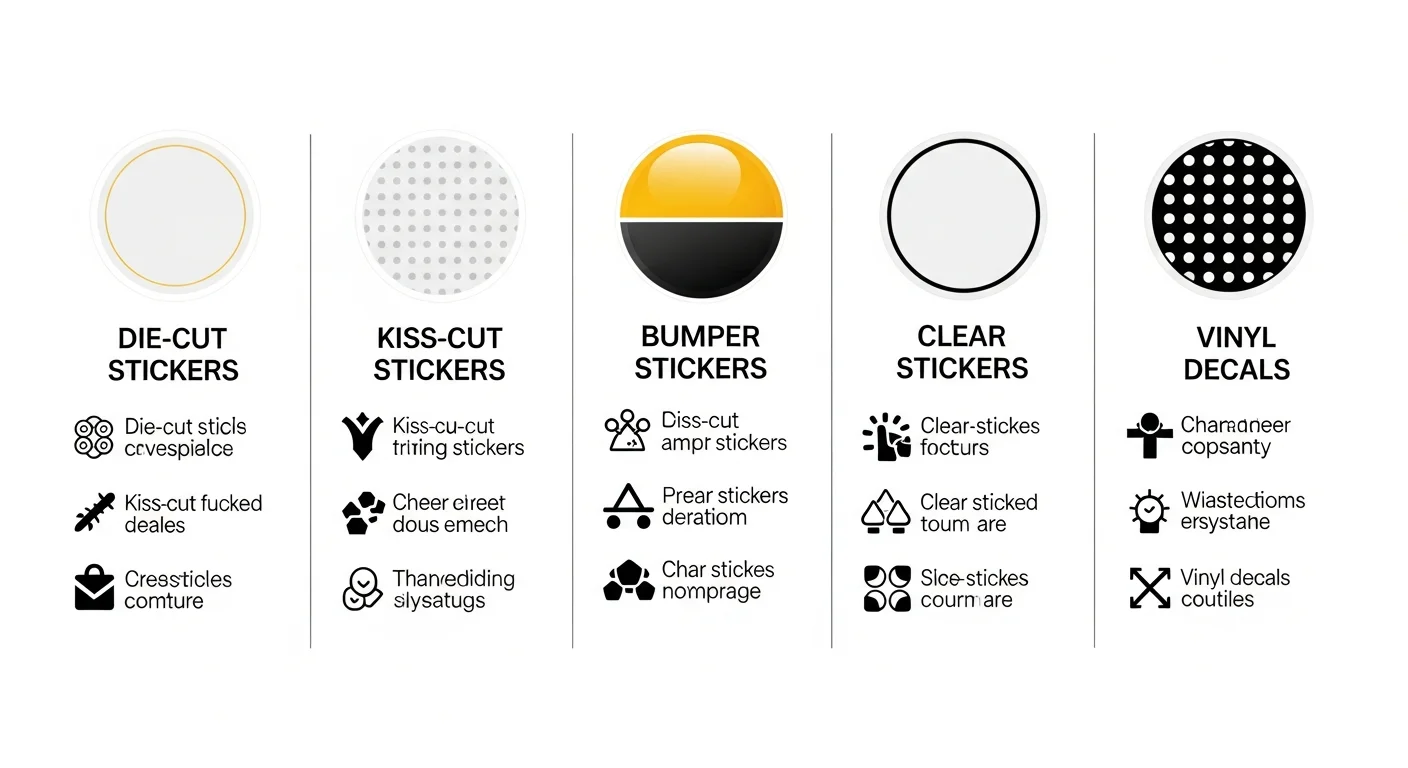
Choosing the right sticker type is one of the most impactful decisions in any custom sticker project, yet it is also one of the most confusing for first-time buyers. The terms die-cut, kiss-cut, and clear describe fundamentally different cutting methods and material configurations that affect how a sticker looks, how it is packaged, how much it costs, and where it can be applied. A die cut sticker definition centers on precision cutting that follows the exact contour of the design, while a kiss cut sticker sheet leaves individual stickers on a shared backing for easy peeling and distribution. Clear transparent stickers, meanwhile, use a see-through vinyl substrate that creates a no-background sticker effect on any surface. Understanding these distinctions ensures that every order delivers the right format for the intended application — whether that is a premium branded laptop sticker, a retail sticker pack, or a window display decal.
This sticker types comparison covers the four primary cut types — die-cut, kiss-cut, clear, and transfer — with detailed breakdowns of the sticker production process, cost at various quantities, durability ratings, design considerations, and ideal use cases. By the end, you will know exactly which type to choose for your specific project, how to prepare artwork for each format, and where each type delivers the best return on investment. If you are completely new to custom stickers, start with the complete beginner's guide to custom stickers before diving into this comparison.
What Is a Die-Cut Sticker?
A die-cut sticker is produced by cutting through both the sticker material and the backing paper to match the exact outline of the design. The result is an individual die-cut sticker where the final product's shape is determined entirely by the artwork — a logo becomes a logo-shaped sticker, a character illustration becomes a character-shaped sticker, and a circle design becomes a perfectly round sticker. There is no extra backing border extending beyond the design, which creates a clean, professional, custom shape die-cut silhouette.
The die-cutting process uses a precision cutting system — either a steel rule die for large production runs or a digital die-cutting plotter for short runs and variable shapes. Digital die-cutting uses CNC cutting sticker technology that follows a vector cut path with accuracy down to 0.1 millimeters, allowing complex contour cut sticker shapes with intricate curves, sharp angles, and interior cutouts. The sticker production process for die-cut involves printing then cutting — first, the full-color design is printed on the sticker material, then the cutting system traces the contour to separate each individual sticker.
Die-cut stickers are the most popular format for brand logos, retail merchandise, and premium giveaways. Their custom silhouette stands out on laptops, water bottles, car bumpers, and packaging because there is no rectangular backing visible — only the design itself. The full-bleed die-cut format means artwork extends all the way to the edge of the sticker with no white border, though many customers choose to add a white border vs borderless option for aesthetic preference. A thin white border (typically 1 to 2 millimeters) around a die-cut sticker creates a clean frame effect and can increase visibility on dark surfaces.

What Is a Kiss-Cut Sticker?
A kiss-cut sticker is produced by cutting through only the sticker material, not the backing paper. The blade "kisses" the surface of the sticker backing paper without penetrating it, leaving the sticker on backing paper as a complete, uncut sheet. The sticker itself can be any custom shape — circle, square, die-cut contour — but it remains attached to a rectangular or square release liner until the customer peels it off.
This format creates an easy-peel sticker experience. Users simply lift the sticker from the corner of the backing sheet, which is faster and more intuitive than peeling an individual die-cut sticker where the backing is the same shape as the sticker itself. The silicone-coated backing on a kiss-cut sheet ensures clean release without tearing or leaving adhesive residue. Kiss-cut is the default format for sticker sheets, sticker packs, and any order where multiple designs are placed on one sheet.
The sticker sheet layout possibilities with kiss-cut are extensive. A single 8.5 by 11 inch sheet can hold anywhere from 4 large stickers (3 inches each) to 35 small stickers (1 inch each), and each sticker on the sheet can be a different design, shape, and size. This makes kiss-cut ideal for multiple designs one sheet sticker pack products, which are popular in retail, subscription boxes, and promotional kits. The backing paper surrounding each sticker also provides printable space for brand logos, social media handles, care instructions, or website URLs — adding marketing value that die-cut stickers cannot match.

What Are Clear Stickers?
Clear stickers are printed on transparent vinyl or polyester film, creating a see-through vinyl sticker where only the printed elements are visible on the application surface. Unlike white vinyl or paper stickers that create a solid, opaque rectangle or shape on any surface, a clear transparent sticker allows the background surface — glass, metal, wood, plastic — to show through everywhere that ink has not been applied. The visual effect is that the design appears to "float" directly on the surface with no visible sticker boundary.
Clear stickers can be produced as either die-cut or kiss-cut. A clear die-cut sticker is cut to the exact contour of the design, while a clear kiss-cut sticker remains on a rectangular backing sheet. In both cases, the no-background sticker effect is the same once applied. For designs that include opaque elements — solid text, logos with white backgrounds, or full-color illustrations — a white ink layer is printed beneath the colored inks to prevent the transparent film from making those elements look washed out. Without the white ink base, colors appear translucent and significantly less vivid when applied to dark or colored surfaces.
Clear stickers deliver a premium look on glass, windows, and polished surfaces that no opaque sticker can replicate. They are popular for storefront window displays, product packaging where the container color should show through, glass jar labels, and any application where a "no sticker" look is desired — where the design appears to be printed directly on the surface. Application surface compatibility is critical with clear stickers: they look best on smooth, light-colored, or transparent surfaces, and may lose visibility on heavily textured or very dark backgrounds.

Transfer Stickers (Vinyl Lettering)
Transfer stickers — also known as vinyl lettering or vinyl decals — represent a fundamentally different approach to sticker application. Instead of a single adhesive piece, a transfer sticker consists of individual vinyl elements (letters, shapes, logo components) held in position on a transparent transfer tape carrier. During application, the transfer tape is pressed onto the surface, the individual elements adhere to the surface, and then the transfer tape is peeled away, leaving only the multi-piece transfer design on the surface.
This method produces a professional signage look where each letter or design element appears to be individually applied or painted onto the surface. There is no background, no border, no film — just individual vinyl pieces flush against the surface. Transfer stickers are the standard choice for vehicle lettering, storefront signage, boat registration numbers, mailbox addresses, and any application where a painted-on appearance is desired.
The multi-piece transfer format does impose design constraints. Because each element must be physically separate on the surface, intricate details and thin connecting lines can be fragile and difficult to weed (the process of removing excess vinyl between elements). Fonts with very thin strokes may not transfer cleanly, and designs with many isolated small elements increase application complexity. For text-based designs with standard fonts, transfer stickers are straightforward. For complex illustrations with many colors and fine details, die-cut or kiss-cut stickers are more practical.
Side-by-Side Comparison Table
The following table summarizes the key differences across all four sticker types to help you make a quick, informed decision based on your project requirements.
Cutting Method: Die-cut cuts through everything; kiss-cut cuts only the vinyl; clear follows either method on transparent film; transfer cuts individual elements from solid vinyl. Final Shape: Die-cut matches the design contour exactly; kiss-cut stickers sit on a rectangular backing; clear can be either contour or rectangle; transfer has no background at all. Packaging Format: Die-cut ships as individual stickers (sometimes on rolls); kiss-cut ships on sheets; clear ships individually or on sheets; transfer ships on transfer tape with a paper backing.
Ease of Application: Kiss-cut is the easiest (peel from sheet); die-cut is straightforward (peel from backing); clear requires careful alignment on smooth surfaces; transfer is the most complex (tape application, press, peel). Design Flexibility: Die-cut supports any shape and full color; kiss-cut supports any shape on a sheet; clear supports full color with optional white ink; transfer is limited to solid colors and simpler shapes. Best For: Die-cut excels at brand stickers and merchandise; kiss-cut is ideal for sticker packs and giveaways; clear is perfect for glass and premium packaging; transfer is the standard for signage and vehicle lettering.

Durability and Weather Resistance by Type
Durability is determined primarily by the sticker material, not the cut type. A die-cut vinyl sticker and a kiss-cut vinyl sticker use the same material and therefore offer identical weather resistance — the cut method affects packaging and shape, not longevity. However, clear stickers and transfer stickers introduce different material properties that affect outdoor performance.
Vinyl die-cut and kiss-cut stickers with a laminate coating are rated for 3 to 5 years of outdoor exposure, including direct sunlight, rain, snow, and temperature extremes from negative 40 to 180 degrees Fahrenheit. The laminate provides an additional UV-resistant layer that prevents fading, and the permanent adhesive maintains bond strength through repeated wet-dry cycles. These are the workhorses for indoor vs outdoor sticker type decisions where longevity matters.
Clear vinyl stickers offer comparable durability to white vinyl when properly laminated — typically 3 to 5 years outdoors. However, the transparent film is slightly thinner (typically 2mil vs 3mil for white vinyl), which makes it more susceptible to tearing during removal. Unlaminated clear stickers may show scratching more visibly than opaque stickers because the marks are visible from both sides of the transparent film.
Transfer stickers made from premium vinyl lettering material are among the most durable options available — outdoor-rated vinyl lettering can last 7 to 10 years because there is no ink layer to fade (the color is inherent in the vinyl itself). This is why transfer stickers are the standard for vehicle graphics and permanent signage. Paper stickers, regardless of cut type, are rated for indoor use only and typically last 6 to 12 months before showing wear.
Cost Comparison by Type and Quantity
Sticker pricing varies by cut type, material, size, and quantity. The following cost ranges represent typical pricing for a standard 3-inch sticker on vinyl with a matte or gloss laminate.
Die-cut stickers cost slightly more than kiss-cut at low quantities because precision cutting requires more setup time and produces more material waste. At 50 units, expect approximately $1.40 to $1.80 per sticker. At 250 units, the price drops to $0.55 to $0.75. At 1,000 units, die-cut stickers typically cost $0.25 to $0.40 each, and at 5,000 units, the per-unit cost falls below $0.12. The cost difference between die-cut and kiss-cut narrows significantly at higher quantities.
Kiss-cut stickers are the most cost-effective format, especially for sticker sheets. A sheet with 4 to 6 stickers costs roughly the same to produce as a single die-cut sticker of similar total area, making the per-sticker cost significantly lower. Individual kiss-cut stickers (one per sheet) cost approximately $1.20 to $1.60 at 50 units and $0.20 to $0.35 at 1,000 units.
Clear stickers carry a 15 to 25 percent premium over white vinyl due to the higher material cost and the white ink printing step. A 3-inch clear die-cut sticker costs approximately $1.65 to $2.10 at 50 units and $0.30 to $0.50 at 1,000 units. Transfer stickers are priced based on total area and complexity rather than per unit, with a typical 12-inch by 3-inch vinyl lettering piece costing $8 to $15 for a single unit. For a complete pricing analysis with money-saving strategies, read the custom sticker pricing breakdown.
Which Sticker Type Is Best for Your Project?
The ideal sticker type depends on three factors: how the sticker will be used, how it will be distributed, and what budget is available. Here is a decision framework organized by common use case.
Brand logo stickers for merchandise and giveaways: Die-cut vinyl is the standard choice. The custom silhouette makes the sticker feel premium, the individual format is easy to hand out or include in packaging, and vinyl durability means the sticker lasts years on laptops, water bottles, and car bumpers. If budget is a concern at low quantities, kiss-cut on individual backing sheets provides a similar experience at 10 to 15 percent lower cost.
Sticker packs for retail or subscription boxes: Kiss-cut sheets are the clear winner. Multiple designs one sheet format is engaging, cost-effective, and easy to package. Sticker packs with 4 to 8 designs per sheet are among the top-selling sticker products on Etsy, Amazon, and in retail stores. The sticker sheet layout allows mixing themes, sizes, and shapes on a single sheet.
Window displays, glass applications, and premium packaging: Clear stickers deliver a look that no opaque sticker can match. The no-background sticker effect on glass creates a high-end appearance for storefronts, product jars, and cosmetic packaging. For curved glass surfaces like candle jars and wine bottles, clear BOPP or clear vinyl conforms smoothly without bubbling.
Vehicle graphics, storefront signage, and permanent lettering: Transfer stickers are the only practical choice. The multi-piece format produces a professionally applied look without the visible edges of a die-cut or kiss-cut sticker, and outdoor-rated vinyl lettering can last a decade with minimal maintenance. For a guide to choosing the right size and shape for any application, see the custom sticker size and shape guide.
Design Considerations by Sticker Type
Each sticker type imposes different design constraints and opportunities that affect how you prepare artwork. For die-cut stickers, the design's outline becomes the sticker's physical shape. This means you need to define a contour cut path — a vector outline that tells the cutting system where to cut. Simple shapes (circles, squares, rounded rectangles) are straightforward, while complex contours with many curves and sharp angles require careful attention to minimum sticker border width. Most printers recommend a minimum 2mm corner radius on any sharp point to prevent the vinyl from lifting at pointed corners.
For kiss-cut stickers, the design can be any shape within the rectangular backing. The backing itself provides built-in protection for the sticker edges, so thin protruding elements that might be fragile on a die-cut sticker are safely supported on a kiss-cut sheet. This makes kiss-cut more forgiving for intricate designs with fine details and narrow extensions.
Clear sticker design requires special attention to the white ink layer. Any area where you want opaque, vibrant color must have a white ink underbase specified in the file. Areas without white ink will be transparent on the finished sticker. This means you need to think about how the design will look on different surfaces — a design that looks great on white paper may lose visibility on a dark surface if the white ink layer is not properly configured.
Transfer sticker design is limited to solid colors without gradients. Each color in a transfer sticker is a separate layer of vinyl, so photographic images and complex color blends are not possible. Text, logos, and simple graphic elements work best. For detailed design best practices by sticker type, visit the best fonts, colors, and layouts for sticker design guide.
Order Your Custom Stickers
Now that you understand the differences between die-cut, kiss-cut, clear, and transfer stickers, you are ready to choose the right type for your project and place an order. Whether you need a single prototype, a batch of 100 for an event, or 10,000 for a product launch, custom stickers are available with no minimum order requirements, free digital proofs, and production times as short as three business days.
Open the free sticker design tool to start building your design with type-specific templates and real-time mockup previews. Upload your logo or artwork, choose your cut type, and see exactly how the finished product will look before placing your order. Or browse all custom sticker options to compare materials, finishes, and pricing across every sticker type.
Related Articles
Share this article
Written by
Terrence Okafor
Head of Production at RareCustom with 20+ years in commercial printing. Terrence's expertise in die-cutting and sticker production methods ensures accurate type comparisons.