Vinyl vs Paper vs BOPP: Choosing the Right Custom Sticker Material
Compare vinyl, paper, and BOPP sticker materials for durability, waterproofing, print quality, and cost. Find the right material for your custom sticker project.
Aisha Patel
Head of Materials Science & Sustainability at RareCustom. M.S. in Textile Engineering from NC State with AATCC certification and ISSP Sustainability Practitioner certification. 7+ years evaluating fabrics, materials, and eco-friendly production processes.
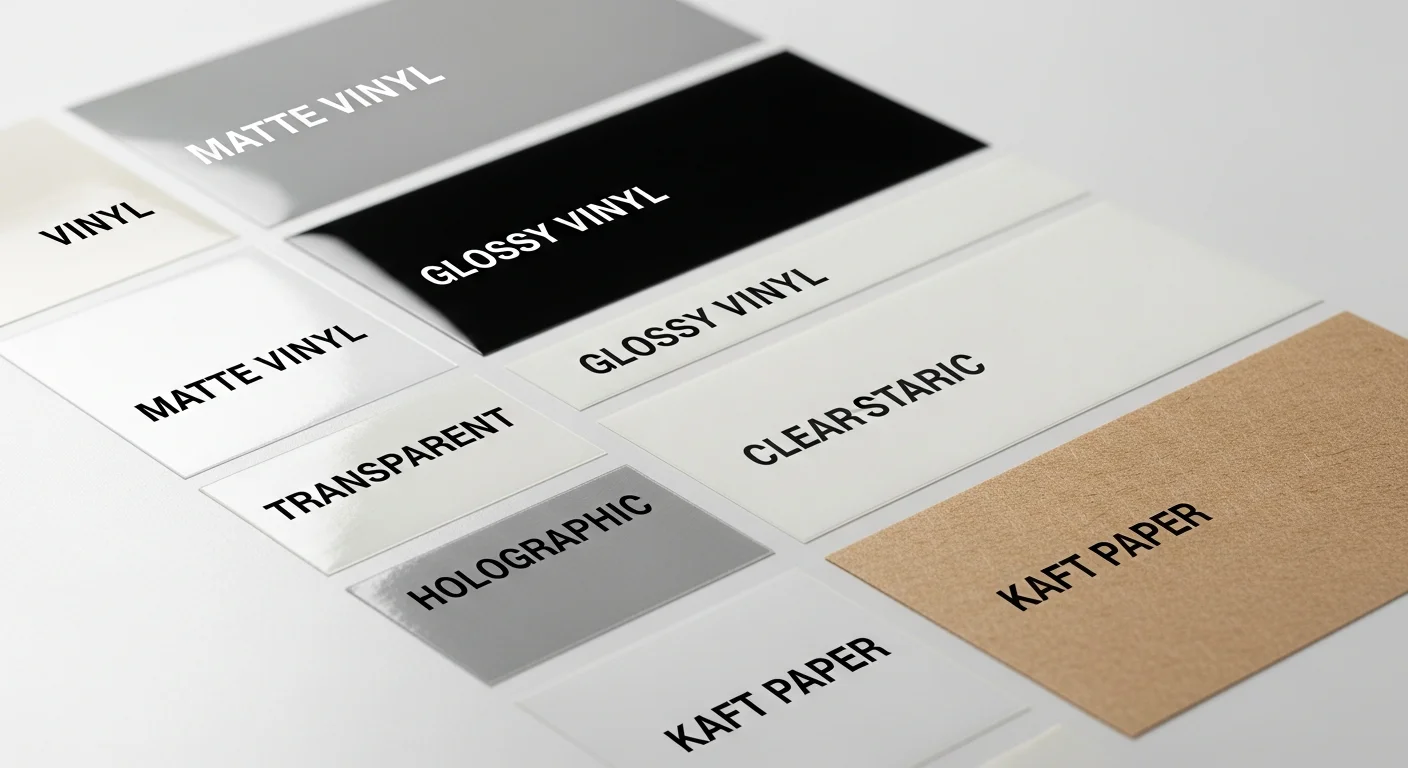
The material you choose for a custom sticker determines everything that matters after the design is finalized: how long the sticker lasts, whether it survives rain and sunlight, how vivid the colors appear, how the sticker feels to the touch, and how much each unit costs. The three most widely used sticker materials — vinyl, paper, and BOPP — occupy different positions on the spectrum of durability, price, and application versatility. A premium vinyl decal can outlast the surface it is applied to, while an uncoated paper sticker delivers a charming, eco-friendly aesthetic at a fraction of the cost. BOPP film sticker material sits in the middle, offering water resistance and tear resistance without the premium price tag of vinyl. Understanding these tradeoffs is the fastest way to ensure your custom sticker order matches both your performance requirements and your budget.
This sticker materials comparison breaks down each option across seven critical dimensions — waterproofing, print quality, adhesive performance, thickness, cost, environmental impact, and ideal use cases — with specific numbers, test results, and real-world examples. Whether you are printing product labels for a food brand, waterproof custom stickers for outdoor equipment, or affordable paper labels for handmade goods, this guide identifies the right material before you spend a dollar. If you are new to custom stickers, start with the beginner's guide to custom stickers to understand the full design and ordering process, then return here for a deep-dive on materials.
Vinyl Stickers — The Durable All-Star
Vinyl sticker material — specifically PVC-based (polyvinyl chloride) film — is the gold standard for durable sticker material applications. A white vinyl sticker starts as a smooth, flexible film typically 3mil to 4mil thick (where 1 mil equals one-thousandth of an inch), coated with a pressure-sensitive permanent adhesive on the back and a printable surface on the front. This combination produces a sticker that is fully waterproof, UV-resistant, and outdoor-rated for 3 to 5 years under direct sun exposure without significant fading or peeling.
Vinyl's flexibility allows it to conform to curved and irregular surfaces — water bottles, car bumpers, helmets, laptop lids, and tool cases — without bubbling, lifting, or cracking. The 4mil vinyl thickness provides enough rigidity to prevent the sticker from folding or wrinkling during application while remaining thin enough to lie flat against compound curves. For applications requiring maximum durability, a sticker laminate coating (available in glossy laminate or matte laminate) adds an additional protective layer that resists scratches, UV damage, and chemical exposure.
The primary drawback of vinyl is cost and environmental impact. Vinyl is the most expensive of the three mainstream materials, costing approximately 30 to 50 percent more than paper and 15 to 25 percent more than BOPP at equivalent quantities. PVC-based vinyl is also not biodegradable or easily recyclable, which may conflict with brand sustainability goals. However, for any application where longevity and weather resistance are non-negotiable — outdoor-rated stickers, vehicle decals, equipment labels, and product branding on items exposed to moisture — vinyl is the clear choice.

Paper Stickers — Affordable and Versatile
Paper sticker label material is the most budget-friendly option and the most widely used for indoor applications. Paper stickers come in two primary finishes: coated paper (semi-gloss or high-gloss surface) and uncoated paper (matte, natural texture). Coated paper stickers deliver vibrant color reproduction with a smooth, professional finish, while uncoated paper stickers produce a warm, tactile feel that works especially well with kraft (brown) paper and recycled paper stocks.
Paper stickers excel in applications where cost efficiency, writability, and eco-friendliness are priorities. An uncoated paper sticker accepts ballpoint pen, marker, and pencil ink, making it ideal for personalization — handwritten thank-you notes on envelope seals, date labeling on food jars, and customizable gift tags. Paper stickers are also available in recycled and FSC-certified options, making them the most sustainable mainstream sticker material. Many small businesses, Etsy sellers, and farmers' market vendors choose paper stickers specifically because of the natural, handcrafted aesthetic they communicate.
The limitations of paper are significant for outdoor and high-moisture environments. Paper stickers are not waterproof — exposure to water causes the paper to wrinkle, the ink to bleed, and the adhesive to weaken. Even indoor humidity can degrade uncoated paper stickers over time. Lifespan comparison data shows that paper stickers in indoor environments typically last 6 to 12 months before showing visible wear, compared to 3 to 5 years for vinyl. A laminate coating can add splash resistance and extend the indoor lifespan to 12 to 18 months, but it does not make paper stickers suitable for outdoor or submersion applications.
BOPP Stickers — The Best of Both Worlds
BOPP film sticker material — biaxially oriented polypropylene — is a synthetic film that bridges the gap between paper and vinyl in both performance and price. The manufacturing process stretches polypropylene film in two directions (biaxially), creating a 2mil BOPP sheet that is thinner than vinyl but significantly more durable than paper. BOPP is water-resistant, tear-resistant, and oil-resistant, making it the standard material for product labels in the food, beverage, cosmetics, and personal care industries.
A BOPP label handles moisture contact far better than paper — splashes, condensation, and brief submersion do not cause wrinkling or ink bleeding. However, BOPP is not fully waterproof to the same standard as vinyl. Extended outdoor exposure, prolonged submersion, and direct UV radiation degrade BOPP stickers faster than vinyl, with a typical outdoor lifespan of 1 to 2 years compared to vinyl's 3 to 5 years. For indoor and moderate-exposure applications, BOPP performs comparably to vinyl at a lower price point.
BOPP's tear-resistant, rip-proof label quality makes it particularly valuable for product packaging where handling abuse is expected. A paper label on a shampoo bottle will disintegrate after repeated shower exposure, while a BOPP label maintains its appearance indefinitely in the same environment. BOPP is also available in clear film, providing a "no-label look" on transparent containers — a popular option for premium beverages, essential oils, and cosmetic products. For food packaging applications, FDA-compliant sticker options in BOPP meet the requirements for direct and indirect food contact, including freezer-grade label formulations rated for temperatures as low as negative 40 degrees Fahrenheit.
Waterproofing and Weather Resistance
Waterproof sticker material selection is one of the most common questions in sticker ordering, and the answer depends entirely on the level of water exposure the sticker will face. The following ratings reflect real-world performance based on standard industry testing.
Vinyl (3mil to 4mil with laminate): Fully waterproof. Passes 72-hour submersion tests without ink degradation, adhesive failure, or material deformation. Rated for continuous outdoor exposure including rain, snow, and humidity for 3 to 5 years. UV lamination prevents fading under direct sunlight. This is the only material suitable for dishwasher-safe sticker applications and long-term vehicle use.
BOPP (2mil with coating): Water-resistant label grade. Withstands splashes, condensation, and brief submersion (up to 30 minutes) without visible degradation. Not rated for continuous submersion or prolonged outdoor exposure without additional UV protection. Ideal for product labels on containers stored indoors, refrigerated items, and cosmetics that encounter occasional moisture. Outdoor lifespan is 1 to 2 years depending on UV exposure.
Paper (with laminate): Splash-resistant only. A matte or glossy laminate coating adds a moisture barrier that protects against brief contact with water — a spilled drink, a damp hand — but does not prevent damage from sustained moisture. Without laminate, paper stickers have zero water resistance. Indoor vs outdoor sticker material decisions are simple: paper is indoor-only, BOPP handles moderate moisture, and vinyl handles everything.

Print Quality and Color Reproduction
All three materials support high-quality digital printing, but differences in surface texture, coating, and ink absorption produce noticeably different color results from the same artwork file.
Vinyl delivers the best color saturation and vibrancy, particularly on white vinyl sticker stock. The smooth, non-porous surface allows ink to sit on top of the material rather than absorbing into it, producing sharp edges, vivid colors, and excellent contrast between light and dark areas. A glossy laminate further enhances color intensity by adding a reflective surface layer. Vinyl is the material of choice when photographic images, gradients, and vibrant brand colors must reproduce faithfully.
BOPP produces excellent color reproduction that is nearly indistinguishable from vinyl in most applications. The polypropylene surface has a slightly different ink receptivity than PVC, which can result in marginally less color saturation in extreme dark tones and deep blues, but the difference is imperceptible without side-by-side comparison. BOPP's main advantage over vinyl in print quality is its availability in ultra-clear transparent film, which produces cleaner no-label-look results than clear vinyl on many containers.
Paper offers good print quality with a different character. Coated paper sticker surfaces produce sharp, saturated prints comparable to magazine quality. Uncoated paper sticker surfaces absorb more ink, producing slightly softer, warmer tones — an effect that many designers intentionally seek for artisanal, hand-crafted, or vintage-inspired aesthetics. The natural texture of uncoated paper adds a tactile dimension that synthetic materials cannot replicate. For detailed illustrations and fine line art, high-quality coated paper can rival vinyl in reproduction accuracy.
Adhesive Options by Material
The adhesive on the back of a sticker determines how strongly it bonds to a surface, whether it can be removed without damage, and how it performs under temperature extremes. Each material is available with different adhesive types suited to different applications.
Permanent adhesive is the standard for vinyl stickers and most BOPP labels. Once applied and pressed firmly, a permanent adhesive sticker bonds to the surface within 24 to 48 hours and becomes extremely difficult to remove without damaging the sticker. Permanent adhesive is rated for temperatures from negative 40 to 200 degrees Fahrenheit and maintains bond strength through humidity, vibration, and UV exposure. This is the default for brand stickers, product labels, bumper stickers, and any application where the sticker should stay in place indefinitely.
Removable adhesive provides a lower-tack bond that allows the sticker to be peeled off without leaving residue on the surface. Removable adhesive stickers are ideal for temporary promotions, window displays, laptop stickers that may need to be replaced, and product labels on reusable containers. The repositionable quality means the sticker can be lifted and re-applied multiple times within the first few hours of application, allowing for precise placement. After 48 to 72 hours, even removable adhesive begins to develop a stronger bond, making removal more difficult.
Freezer-grade adhesive is a specialty formulation designed for BOPP and vinyl stickers that will be applied to surfaces stored at freezing or sub-zero temperatures. Standard adhesives lose tack below 40 degrees Fahrenheit, but freezer-grade label adhesive maintains bond strength down to negative 40 degrees. This is essential for food packaging, frozen product labels, and laboratory specimen identification.

Cost Comparison by Material
Material cost directly affects per-unit pricing, and the difference becomes significant at higher quantities. The following ranges represent typical pricing for a standard 3-inch die-cut sticker with laminate finish at various order quantities.
Paper stickers are the most affordable across all quantities. At 100 units, expect $0.60 to $0.90 per sticker. At 500 units, the price drops to $0.25 to $0.40. At 2,000 units, paper stickers cost approximately $0.10 to $0.18 each. The savings are most pronounced at low quantities, where paper can be 40 to 50 percent less expensive than vinyl.
BOPP stickers occupy the middle ground. At 100 units, expect $0.80 to $1.20 per sticker. At 500 units, BOPP costs $0.35 to $0.55. At 2,000 units, per-unit pricing falls to $0.14 to $0.25. BOPP's price premium over paper is typically 20 to 35 percent, which reflects the significantly better durability and moisture resistance.
Vinyl stickers are the most expensive. At 100 units, expect $1.00 to $1.60 per sticker. At 500 units, vinyl costs $0.45 to $0.70. At 2,000 units, per-unit pricing drops to $0.18 to $0.32. The vinyl premium over paper ranges from 40 to 60 percent at low quantities and narrows to 30 to 40 percent at high quantities. For a comprehensive pricing breakdown with money-saving strategies, see the custom sticker pricing guide.
Choosing the Right Material for Your Project
Selecting the correct sticker material is a straightforward decision when framed around three questions: where will the sticker be used, how long does it need to last, and what is the budget?
Choose vinyl when: The sticker will be exposed to weather, moisture, or UV light. The sticker must last 2 or more years. The application is on a vehicle, outdoor equipment, or any surface that gets wet regularly. You need a waterproof custom sticker for water bottles, dishwasher-rated products, or marine environments. Color vibrancy and print sharpness are the top priority.
Choose BOPP when: The sticker will be on product packaging that encounters occasional moisture (bathroom, kitchen, refrigerator). You need a tear-resistant, rip-proof label for products that are handled frequently. The application involves food packaging with an FDA-compliant sticker requirement. You want better-than-paper durability without the full cost of vinyl. BOPP is particularly popular for cosmetics, candles, food jars, and beverages.
Choose paper when: The sticker is for indoor use only (envelopes, packaging inserts, planners, gift tags). Budget is the primary concern and the sticker does not need to survive moisture. You want a writable surface for handwritten personalization. An eco-friendly, natural aesthetic aligns with your brand identity. The sticker has a short intended lifespan (event-specific, seasonal promotion, prototype testing).
Specialty Materials
Beyond the three mainstream materials, several specialty options serve niche applications. Holographic vinyl features a prismatic film that creates rainbow light effects as the viewing angle changes — popular for collectible stickers, premium branding, and eye-catching packaging. For a deep-dive on holographic and other specialty finishes, see the holographic and specialty finish stickers guide.
Kraft paper is a brown, uncoated paper with a natural, rustic appearance. Kraft stickers are popular for artisanal food brands, handmade products, and eco-conscious businesses. They accept letterpress, screen printing, and digital printing, and pair well with minimalist designs and earth-tone color palettes.
Textured vinyl and canvas-finish paper add a tactile dimension to stickers, creating a premium feel that standard smooth materials cannot achieve. These materials cost 25 to 50 percent more than their smooth counterparts but deliver a distinctive sensory experience that enhances perceived value. Foil materials — gold, silver, rose gold, and copper — produce a metallic sheen that works particularly well for luxury branding, wedding stickers, and premium product labels. For stickers that prioritize sustainability, see the eco-friendly and sustainable custom stickers guide.

Choose Your Sticker Material
The right material transforms a good design into a great sticker. Whether you need the all-weather durability of vinyl, the cost efficiency of paper, or the balanced performance of BOPP, custom stickers are available in every material with no minimum order quantities and free digital proofs before production.
Open the free design tool to start your project and select your material during the configuration step. Or browse all custom sticker materials and finishes to compare options side by side and see real-time pricing for your specific quantity and size requirements.
Related Articles
Share this article
Written by
Aisha Patel
Head of Materials Science & Sustainability at RareCustom. M.S. in Textile Engineering from NC State with AATCC certification and ISSP Sustainability Practitioner certification. 7+ years evaluating fabrics, materials, and eco-friendly production processes.