Phone Case Compatibility Guide: Finding the Right Fit for iPhone, Samsung & More
Find the right custom phone case for your exact device model. Complete compatibility charts for iPhone 12–17, Samsung Galaxy S21–S25, Google Pixel, button cutout alignment, MagSafe support, and cross-generation fit notes.
Terrence Okafor
Head of Production at RareCustom with 20+ years in commercial printing. Terrence's technical expertise in device specifications helps customers find the perfect phone case fit.
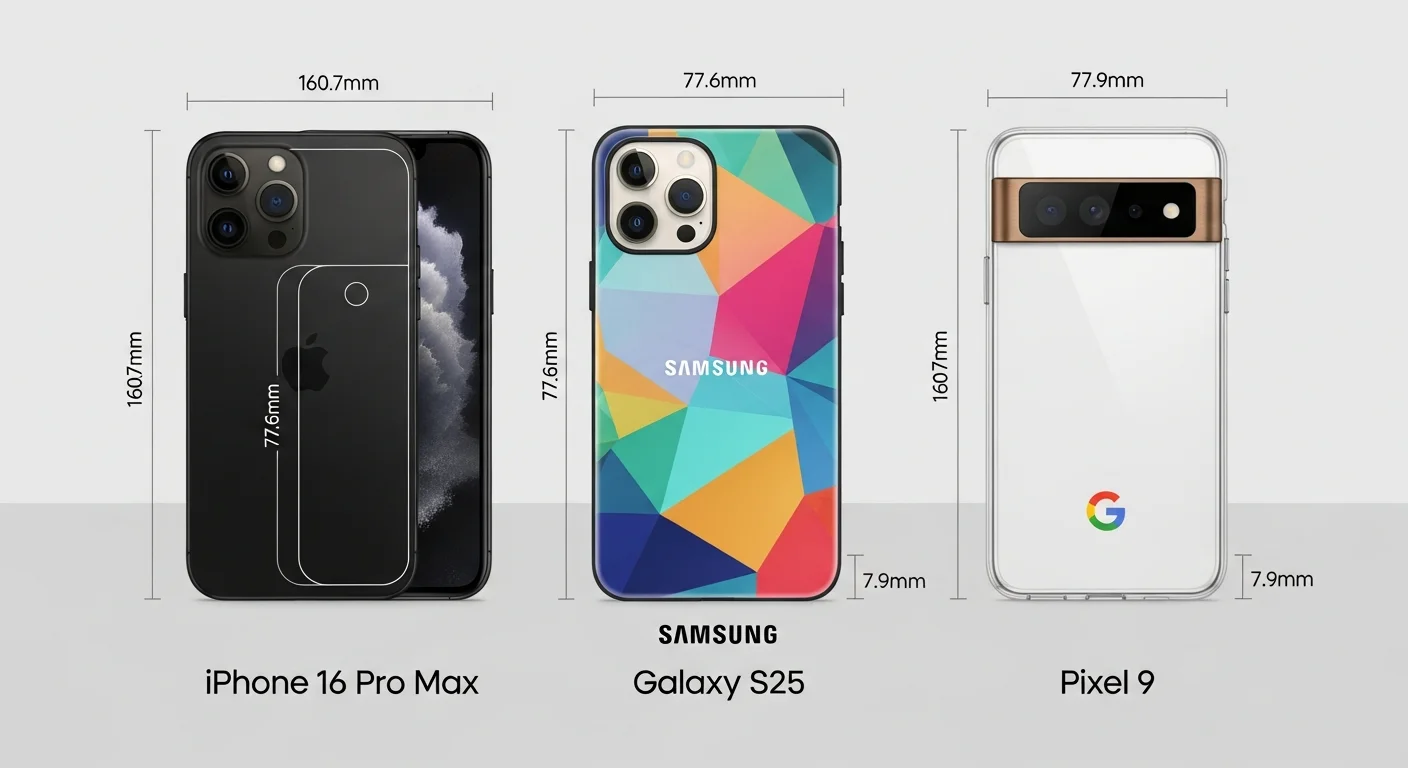
Ordering a custom phone case is exciting — until the case arrives and the camera cutout sits two millimeters too far to the left, the volume buttons are blocked, or the MagSafe magnets fail to align. Phone case compatibility is the single most overlooked factor in custom case ordering, and getting it wrong wastes money, time, and the effort you invested in your design. This phone case compatibility guide covers every detail you need to ensure your custom case fits perfectly on your specific device, whether you own an iPhone, Samsung Galaxy, Google Pixel, or another popular smartphone brand.
Modern smartphones change dimensions, camera module layouts, and button placements with every generation — sometimes even within the same generation (think iPhone 16 versus iPhone 16 Pro versus iPhone 16 Pro Max). A case designed for the iPhone 15 will not fit the iPhone 16 despite looking nearly identical in photographs. Samsung's Galaxy S line undergoes similar year-over-year changes, and Google Pixel devices have some of the most dramatic redesigns from generation to generation. Understanding these differences before you order is essential for a case that fits like it was molded for your phone — because it was. This guide provides iPhone case compatibility charts, Samsung Galaxy case guides, Google Pixel case custom sizing references, and practical tips for confirming your exact model before placing an order.
Why Phone Case Compatibility Matters More Than You Think
A phone case that almost fits is worse than no case at all. Here is why compatibility deserves your full attention before you finalize a custom design. First, an ill-fitting case compromises protection. If the case is even slightly loose, the phone can shift inside during a drop, exposing corners and edges to direct impact. Research from SquareTrade found that 29 percent of smartphone damage occurs because the case did not fully cover the device's vulnerable points — a statistic driven largely by cases designed for similar but incompatible models.
Second, misaligned button cutout alignment creates daily frustration. When the power button, volume rocker, or mute switch does not line up perfectly with the case's button openings, you end up pressing harder, missing presses, or activating the wrong control entirely. Over weeks and months of use, this seemingly minor annoyance becomes a genuine usability issue. Third, camera module alignment affects photo quality. If the case's camera cutout encroaches even slightly on the lens housing, you may see vignetting (dark shadows in photo corners) or lens flare caused by light bouncing off the case edge. Premium custom cases are precision-machined to within 0.3 millimeters of the camera module boundary — but only if you order the correct model.
Finally, a case designed for the wrong model can block wireless charging coils, NFC antennas, or MagSafe magnet arrays. Apple's MagSafe system relies on a precise ring of magnets positioned at exact coordinates on the back of the phone. A case intended for a different iPhone generation may offset those magnets by several millimeters, causing MagSafe accessories to attach weakly or not at all. Similarly, Qi and Qi2 wireless charging pads require the phone's charging coil to sit within a narrow alignment window. The wrong case pushes the coil out of range, resulting in failed or extremely slow charging. Compatibility is not a nice-to-have — it is the foundation of a functional custom phone case.
iPhone Case Compatibility Chart: iPhone 12 Through iPhone 17
Apple releases new iPhone models annually, and while some generations share dimensions (allowing case cross-compatibility), most require model-specific cases due to changes in camera module size, button placement, or overall thickness. The following iPhone case compatibility chart covers every major model from iPhone 12 through the anticipated iPhone 17 lineup, listing the key dimensions and noting which models can share cases and which cannot. Understanding iPhone 16 case dimensions versus iPhone 15 dimensions, for example, prevents one of the most common ordering mistakes.
| Model | Height (mm) | Width (mm) | Depth (mm) | Camera Module | MagSafe | Cross-Compatible With |
|---|---|---|---|---|---|---|
| iPhone 12 | 146.7 | 71.5 | 7.4 | Dual diagonal | Yes | iPhone 12 Pro |
| iPhone 12 Pro | 146.7 | 71.5 | 7.4 | Triple diagonal | Yes | iPhone 12 |
| iPhone 12 Pro Max | 160.8 | 78.1 | 7.4 | Triple diagonal | Yes | None |
| iPhone 13 | 146.7 | 71.5 | 7.65 | Dual diagonal | Yes | iPhone 13 Pro (body only) |
| iPhone 13 Pro | 146.7 | 71.5 | 7.65 | Triple larger | Yes | iPhone 13 (body only) |
| iPhone 13 Pro Max | 160.8 | 78.1 | 7.65 | Triple larger | Yes | None |
| iPhone 14 | 146.7 | 71.5 | 7.80 | Dual diagonal | Yes | iPhone 13 (partial) |
| iPhone 14 Pro | 147.5 | 71.5 | 7.85 | Triple larger | Yes | None |
| iPhone 14 Pro Max | 160.7 | 77.6 | 7.85 | Triple larger | Yes | None |
| iPhone 15 | 147.6 | 71.6 | 7.80 | Dual diagonal | Yes | iPhone 15 Pro (body close) |
| iPhone 15 Pro | 146.6 | 70.6 | 8.25 | Triple larger | Yes | None (thinner frame) |
| iPhone 15 Pro Max | 159.9 | 76.7 | 8.25 | Triple tetraprism | Yes | None |
| iPhone 16 | 147.6 | 71.6 | 7.80 | Dual vertical | Yes | None (camera layout change) |
| iPhone 16 Pro | 149.6 | 71.5 | 8.25 | Triple larger | Yes | None |
| iPhone 16 Pro Max | 163.0 | 77.6 | 8.25 | Triple tetraprism | Yes | None |
| iPhone 17 (projected) | 148.2 | 71.8 | 7.60 | Dual updated | Yes (Qi2) | None (new chassis) |
| iPhone 17 Pro (projected) | 150.0 | 71.8 | 8.30 | Triple updated | Yes (Qi2) | None |

Key takeaways from this phone case dimension chart: iPhone 12 and 12 Pro share body dimensions and can use the same case if the camera cutout accommodates the larger Pro module. The same partial compatibility exists between iPhone 13 and 13 Pro. Starting with iPhone 14 Pro, Apple introduced a larger body for Pro models, breaking cross-compatibility with base models. The iPhone 16 introduced a vertical camera layout replacing the diagonal orientation used since iPhone 12, making iPhone 15 cases incompatible even though body dimensions are similar. Always verify the camera module layout and not just the overall phone dimensions when checking case generation compatibility.
Samsung Galaxy Case Compatibility Chart
Samsung's Galaxy S and Galaxy A series follow their own evolution path, with changes in screen curvature, camera module design, and button placement across generations. The Samsung Galaxy case guide below covers the flagship S series from S21 through S25, the most commonly ordered models for custom cases. Samsung tends to make more dramatic design changes between generations than Apple, which means cross-generation compatibility is even less common. Understanding Galaxy S25 case size versus S24 dimensions is essential for Samsung users ordering custom cases.
| Model | Height (mm) | Width (mm) | Depth (mm) | Camera Module | Qi Charging | Cross-Compatible |
|---|---|---|---|---|---|---|
| Galaxy S21 | 151.7 | 71.2 | 7.9 | Contour cut | Yes | None |
| Galaxy S21 Ultra | 165.1 | 75.6 | 8.9 | Quad lens | Yes | None |
| Galaxy S22 | 146.0 | 70.6 | 7.6 | Triple island | Yes | None |
| Galaxy S22 Ultra | 163.3 | 77.9 | 8.9 | Quad no island | Yes | None (S Pen slot) |
| Galaxy S23 | 146.3 | 70.9 | 7.6 | Triple floating | Yes | S22 (partial body) |
| Galaxy S23 Ultra | 163.4 | 78.1 | 8.9 | Quad floating | Yes | S22 Ultra (partial) |
| Galaxy S24 | 147.0 | 70.6 | 7.6 | Triple floating | Yes (Qi2) | None (flat display) |
| Galaxy S24 Ultra | 162.3 | 79.0 | 8.6 | Quad floating | Yes (Qi2) | None (titanium frame) |
| Galaxy S25 | 146.9 | 70.1 | 7.2 | Triple floating | Yes (Qi2) | None |
| Galaxy S25 Ultra | 162.8 | 77.6 | 8.2 | Quad floating | Yes (Qi2) | None (rounded corners) |
Samsung's transition from contour-cut camera modules (S21) to floating individual lenses (S23 onward) is the single biggest compatibility breaker in the Galaxy lineup. Even when body dimensions are close between generations, the camera cutout shape and position differs enough that a case designed for one model will not properly frame the cameras on another. The Galaxy S24 also introduced a fully flat display after years of curved-edge screens, which changed the way cases wrap around the front bezels. If you are ordering a custom phone case for a Samsung device, always confirm the exact model number (SM-SXXX) rather than relying on the marketing name alone.

Google Pixel Case Compatibility Chart
Google Pixel devices undergo some of the most dramatic year-over-year design changes in the smartphone industry. The Pixel 6 introduced the signature camera bar that spans the full width of the phone, and subsequent models have refined but maintained that distinctive design language. For Google Pixel case custom orders, the camera bar dimensions and position are the critical compatibility factors, as even small changes in bar height, lens arrangement, or corner radius make cases non-interchangeable between generations.
The Pixel 7 series kept the camera bar concept but with a more refined, metallic bridge design. The Pixel 8 and 8 Pro introduced rounded corners on the camera bar, breaking compatibility with Pixel 7 cases. The Pixel 9 series moved to a more compact, oval-shaped camera island that is no longer a full-width bar — the most dramatic redesign since the Pixel 5's rear fingerprint scanner era. Each of these changes requires a model-specific case mold. When ordering custom cases for Pixel devices, always specify the exact model (Pixel 9, Pixel 9 Pro, Pixel 9 Pro Fold) to ensure proper camera bar clearance and button alignment.
How to Find Your Exact Phone Model Number
Knowing your phone's marketing name (like "iPhone 16 Pro" or "Galaxy S25") is a good start, but confirming the exact model number eliminates any possibility of ordering the wrong case. Here is how to find your model number on each major platform. On iPhone, navigate to Settings, then General, then About. The model number appears as a string like "A3290" — this is the definitive identifier. On Samsung Galaxy, go to Settings, then About Phone, and look for the Model Number field (format: SM-S926U for Galaxy S24+, for example). On Google Pixel, open Settings, then About Phone, and note the Model field. Each of these identifiers maps to a specific set of dimensions, camera positions, and button placements that your custom case manufacturer uses to select the correct mold.

If you are ordering custom phone cases for a group or corporate event, collecting model numbers from each recipient is even more important. A group order that mixes up model variants — say, ordering all Galaxy S24 cases when some team members have the S24+ or S24 Ultra — results in cases that either do not fit at all or fit poorly enough to be unusable. Creating a simple spreadsheet with each person's name, phone brand, marketing name, and model number prevents these issues entirely. For a detailed walkthrough of custom case design from start to finish, see our beginner's guide to custom phone cases.
Camera Module Alignment: The Most Critical Compatibility Factor
Camera module alignment is the single most important compatibility factor for modern smartphones, surpassing even overall body dimensions in significance. Here is why: two phones can have identical height, width, and depth measurements but completely different camera module positions, shapes, and sizes. The iPhone 15 and iPhone 16 have nearly identical body dimensions, but the camera module rotated from a diagonal arrangement to a vertical stack — making their cases completely incompatible despite the phones feeling the same size in your hand.
Custom case manufacturers use precision CNC machining or injection molding to create camera cutouts with tolerances as tight as 0.2 to 0.3 millimeters. This precision ensures that the cutout frames the camera module cleanly without any overhang that could cause lens obstruction, and without excess gap that would collect dust and debris. When the case cutout is designed for the wrong model, even a small misalignment can cause the flash to be partially blocked, the microphone opening to be offset, or the LiDAR sensor (on Pro models) to be covered. Always verify camera module compatibility — not just body fit — when selecting your phone model during the custom case ordering process.
MagSafe and Wireless Charging Compatibility by Model
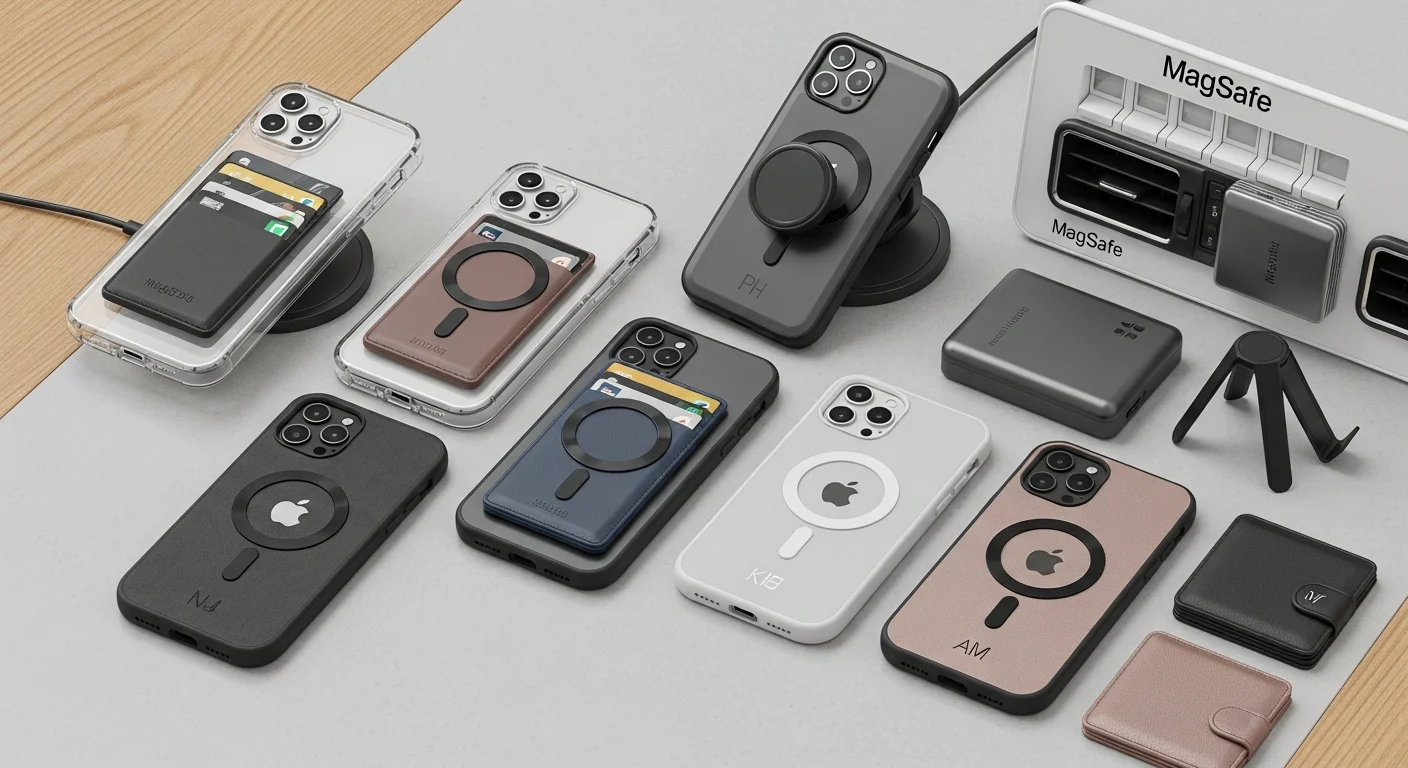
MagSafe compatibility by model is a growing concern as more accessories — chargers, wallets, mounts, battery packs — rely on the magnetic alignment system. Apple introduced MagSafe with the iPhone 12 series, and every iPhone since has included the ring of magnets necessary for the system to function. However, the strength and precise positioning of these magnets can vary between generations, and the case material and thickness directly affect magnetic coupling strength. For a comprehensive exploration of MagSafe and other functional features, see our MagSafe and functional phone case features guide.
Custom cases designed with MagSafe compatibility include an embedded or aligned magnet ring that matches the phone's internal magnet array. If the case is designed for the wrong iPhone generation, the magnet ring offset — even by one or two millimeters — weakens the magnetic connection, causing wallets to slide off, chargers to misalign, and battery packs to disconnect during use. Samsung's adoption of Qi2 (the universal magnetic charging standard based on MagSafe technology) starting with the Galaxy S24 adds another compatibility dimension for Samsung users. Qi2 phone cases for Samsung devices must align with Samsung's specific coil and magnet placement, which differs from Apple's. When ordering a custom case with wireless charging or magnetic accessory support, always confirm that the case is designed for your specific model and charging standard.
Screen Protector Compatibility with Custom Cases
Screen protector compatibility is an often-overlooked aspect of phone case selection that can cause significant frustration. The relationship between case and screen protector is a matter of geometry: the case's front lip (the raised edge that surrounds the screen) must be deep enough to protect the screen from face-down drops but not so deep that it prevents a screen protector from adhering properly at the edges. Most custom cases feature a front lip of 0.5 to 1.0 millimeters above the screen surface — a range that works with the majority of tempered glass and film screen protectors.
However, certain screen protector styles, such as full-coverage tempered glass with curved edges or privacy-filter protectors with thicker profiles, can interfere with the case's front lip. This is particularly common with Samsung Galaxy devices that have curved-edge screens (Galaxy S21 through S23), where the screen protector must follow the curve and the case's lip must accommodate that extra curvature without lifting the protector's edges. When ordering a custom case, check whether your preferred screen protector has known compatibility issues with cases from the same manufacturer. Most case makers publish screen protector compatibility notes for each model.
Cross-Generation Compatibility Notes and Common Mistakes
Cross-generation compatibility — using a case designed for one generation on a phone from a different generation — is the most common mistake in custom case ordering. It happens because consecutive models often look nearly identical from the outside, leading customers to assume the same case will work. Here are the most common cross-generation mistakes and how to avoid them. The iPhone 14 and iPhone 15 have similar body dimensions, but the iPhone 15 has a slightly different camera module position and a USB-C port instead of Lightning. A case designed for the iPhone 14 will fit the iPhone 15's body but will have the wrong port cutout and may partially obstruct the camera. Similarly, the Galaxy S23 and Galaxy S24 appear similar in size, but the S24's flat display versus the S23's curved edges means the case's front lip geometry is completely different.
Another common mistake is ordering a case for the base model when you actually have the Plus, Pro, or Ultra variant. These variants are always larger — sometimes by 15 millimeters or more in height — and their camera modules are always different from the base model. A case for the Galaxy S25 will not fit the Galaxy S25 Ultra under any circumstances. Always double-check the full model name, including the variant suffix, before completing your order. For guidance on which case material works best for your device type, consult our materials comparison guide.

Design Your Perfect-Fit Custom Phone Case Today
Finding the right fit for your custom phone case comes down to three verifiable steps: confirm your exact model number in your phone's settings, cross-reference that model against the compatibility charts above, and select the matching model option in the design tool. When you get compatibility right, every other aspect of your custom case — the print alignment, the button responsiveness, the camera clarity, the wireless charging performance — works exactly as intended. RareCustom's design tool automatically loads the correct template, camera cutout positions, and button placement guides for your selected model, so you can focus entirely on creating the perfect design without worrying about fit.
Whether you are designing a single personal case or coordinating a group order for an event, starting with the correct model selection saves time, prevents reprints, and ensures every recipient gets a case that fits their phone like a glove. Try the free design tool to see your artwork on the exact phone model you own, preview it in 3D, and order with confidence that compatibility has been handled for you.
Frequently Asked Questions
Can I use an iPhone 15 case on an iPhone 16? No. While body dimensions are similar, the iPhone 16's vertical camera layout differs from the iPhone 15's diagonal arrangement, making the camera cutout incompatible. The Action Button placement also changed between these models.
Do Samsung Galaxy S24 cases fit the Galaxy S25? No. The Galaxy S25 has a slightly narrower body (70.1 mm versus 70.6 mm) and a thinner profile (7.2 mm versus 7.6 mm), resulting in a loose fit with an S24 case. Camera module positioning also shifted between generations.
Will a case block MagSafe if it is designed for the right model? A properly designed MagSafe-compatible case for the correct model will not block MagSafe functionality. The key is ensuring the case includes properly aligned magnets and that the overall thickness does not exceed 3 millimeters, which is the maximum distance for reliable magnetic coupling.
How do I know if my phone has Qi2 wireless charging? Qi2 was introduced in 2024 and is standard on all iPhones from iPhone 12 onward (via MagSafe) and on Samsung Galaxy S24 and later models. Check your phone's specifications page or settings for "Qi2" or "magnetic wireless charging" support.

Related Articles
Share this article
Written by
Terrence Okafor
Head of Production at RareCustom with 20+ years in commercial printing. Terrence's technical expertise in device specifications helps customers find the perfect phone case fit.