Surlyn vs Urethane Golf Ball Covers: Which Is Best for Custom Printing?
Compare surlyn and urethane golf ball covers for custom printing. Covers durability, spin, feel, print adhesion, compression, and which material suits your needs best.
Aisha Patel
Head of Materials Science & Sustainability at RareCustom. M.S. in Textile Engineering from NC State with AATCC certification and ISSP Sustainability Practitioner certification. 7+ years evaluating fabrics, materials, and eco-friendly production processes.
The cover material on your golf ball affects everything — how it feels off the putter face, how it spins around the green, how far it flies off the tee, how long the custom print lasts, and ultimately, how much each custom golf ball costs. The two dominant cover materials in golf ball manufacturing are surlyn (an ionomer resin) and urethane (a thermoset elastomer), and understanding their differences is essential for anyone ordering personalized golf balls. Choosing the wrong cover material means either overpaying for performance the recipient will never notice, or under-delivering quality to a player who expects tour-level feel.
This guide provides a comprehensive golf ball cover comparison across performance, durability, print adhesion, compression, and aerodynamics. Whether you are ordering 1,000 promotional golf balls for a corporate event or a dozen premium custom tour balls for your regular foursome, the cover material decision shapes every aspect of the finished product. For a broader overview of the entire customization process, start with the beginner's guide to custom golf balls.
Golf Ball Construction 101 — What's Under the Cover
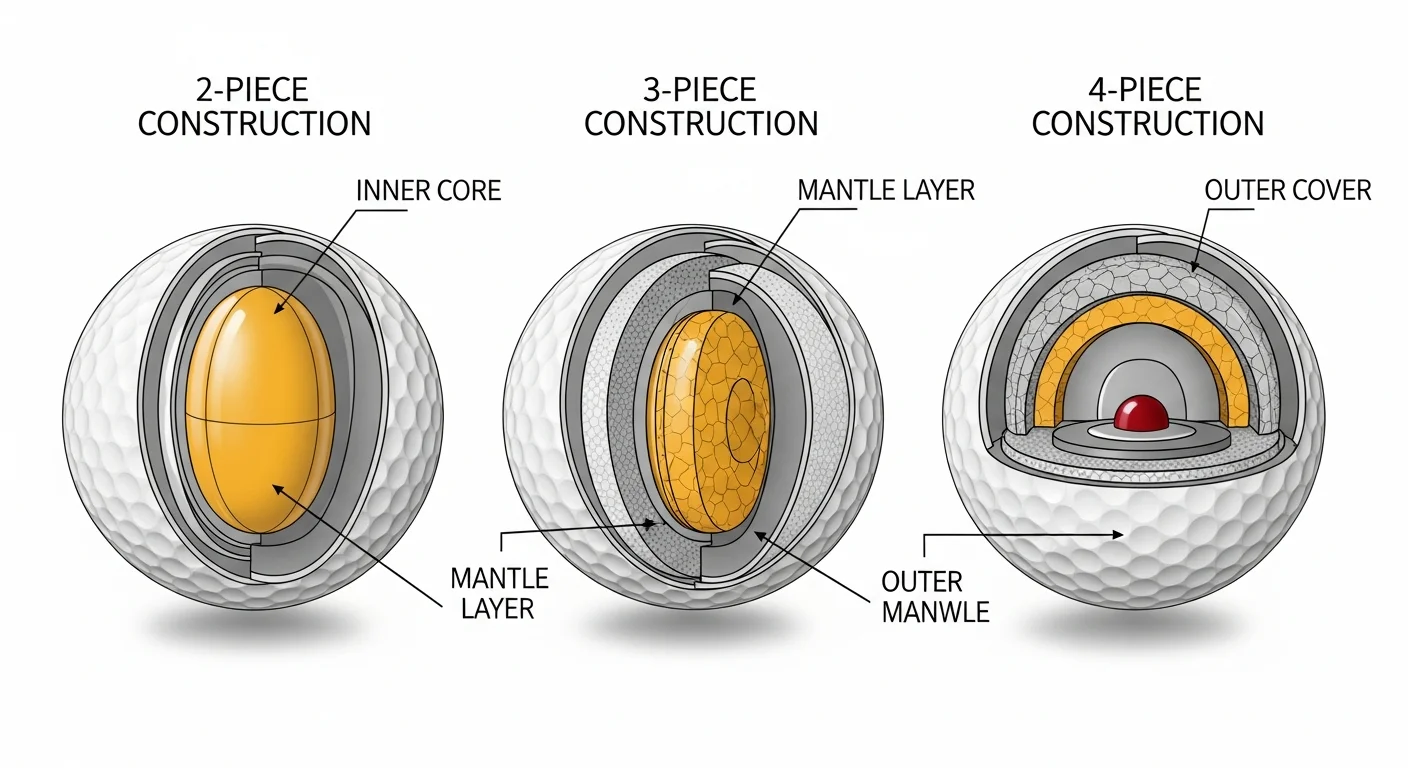
Every golf ball starts with a core — a solid or wound rubber sphere that stores and releases energy at impact. The core's size, density, and composition determine the ball's initial velocity and overall compression. Surrounding the core is a system of optional mantle layers (also called inner covers) that fine-tune spin behavior at different swing speeds. Finally, the outermost layer — the cover — is the only part of the ball that contacts the club face, the turf, and the printing press.
A 2-piece golf ball has the simplest architecture: a large solid core wrapped in a single cover. This construction maximizes distance and durability at the lowest cost, making 2-piece balls the standard for recreational golfers and bulk promotional orders. The cover on a 2-piece ball is almost always surlyn ionomer cover material, chosen for its hardness and cut resistance.
A 3-piece golf ball adds a mantle layer between the core and cover, creating a spin separation between full shots (low spin for distance) and short-game shots (higher spin for control). Three-piece balls can feature either surlyn or urethane covers, though urethane is more common in this construction tier because players who choose 3-piece balls typically prioritize feel and greenside performance.
A 4-piece golf ball (and the rare 5-piece) uses multiple mantle layers to create an even more refined spin gradient. These are tour-level balls — Titleist Pro V1x, TaylorMade TP5x — designed for elite players with swing speeds above 100 mph. Four-piece balls exclusively use urethane elastomer cover material for maximum spin and feel around the greens. They are customizable but carry a premium price that is best reserved for executive gifts or personal orders.

What Is Surlyn (Ionomer)?
Surlyn is a brand name for ionomer resin originally developed by DuPont in the 1960s. It is a thermoplastic material made from ethylene and methacrylic acid, with metal ions (typically sodium or zinc) creating cross-links between polymer chains. These ionic bonds give surlyn its characteristic hardness, elasticity, and remarkable resistance to cuts, scuffs, and abrasion. When a golf ball with a surlyn cover scrapes across a cart path or catches a sharp bunker lip, the ionic bonds allow the material to "self-heal" — the surface deformation partially recovers to its original shape, unlike urethane which permanently marks.
Surlyn covers typically measure 1.5-2.0mm thick and produce a firmer feel at impact. The hardness translates to lower spin rates on all shots — beneficial for distance off the tee and reducing hooks and slices for high-handicap players, but limiting for greenside control where higher spin helps the ball stop quickly. Golf ball distance is generally greater with surlyn covers because the lower spin reduces lift-induced drag on full shots.
Common surlyn-covered golf balls include the Callaway Supersoft, Titleist Velocity, Titleist TruFeel, Pinnacle Rush, Top Flite XL, and Srixon Soft Feel. These balls range from $15-$28 per dozen at retail, making them the most cost-effective option for custom golf balls intended for promotional distribution, tournament giveaways, or gifts for casual golfers.
What Is Urethane?
Urethane (specifically thermoset polyurethane or cast urethane) is an elastomer material that produces a softer, more responsive cover with dramatically higher spin rates around the green. Unlike surlyn's thermoplastic structure, urethane's thermoset chemistry means the material is cast as a liquid that chemically cures around the mantle layer, creating an exceptionally uniform cover with precise thickness control (typically 0.5-1.0mm).
The softness of urethane allows the club face's grooves to grip the ball at impact, generating the high greenside spin rates (8,000-10,000+ rpm with a lob wedge) that tour professionals rely on for stopping the ball near the pin. This same softness produces the "buttery" feel that skilled players describe when putting or chipping with a urethane-covered ball. The trade-off is reduced golf ball durability — urethane covers show scuffs and abrasion marks more quickly than surlyn, and a single mishit off a cart path can leave a visible mark.
Premium urethane-covered golf balls include the Titleist Pro V1 and Pro V1x, TaylorMade TP5 and TP5x, Callaway Chrome Soft and Chrome Soft X, Bridgestone Tour B RX and RXS, and Srixon Z-Star. These balls range from $40-$55 per dozen at retail, reflecting both the more expensive manufacturing process and the performance engineering invested in their multi-layer construction.
Performance Comparison — Distance, Spin, Feel
Performance differences between surlyn and urethane covers are measurable on launch monitors and noticeable on the course. The following comparison addresses the three primary performance dimensions that golfers care about most: distance, spin rate, and feel.
Distance: Surlyn-covered balls typically produce 2-5 yards more distance off the tee compared to urethane balls at the same swing speed. This advantage comes from lower driver spin rates (200-400 rpm less) that reduce ballooning and produce a more penetrating ball flight. For golfers with swing speeds below 90 mph, the distance difference narrows because lower swing speeds do not generate enough spin differential between the two materials to produce a meaningful gap.
Spin: Urethane covers generate 1,000-3,000 rpm more greenside spin than surlyn covers on wedge shots. This spin difference is the primary performance justification for the higher cost of urethane balls. Around the green, higher spin means the ball checks and stops faster after landing, giving the player more control over approach shots, pitches, and chips. With mid-irons (6-8 iron), the spin difference narrows to 500-1,000 rpm, and with woods and driver, the difference is 200-400 rpm.
Feel: This is subjective but consistently reported. Urethane balls produce a softer, more responsive golf ball feel that skilled players describe as "clicking" off the putter face and "zipping" off wedge grooves. Surlyn balls feel firmer and more "clicky" — which many recreational golfers actually prefer because it provides stronger acoustic feedback on solid contact. Neither feel is inherently better; it depends on player preference and skill level.
| Performance Metric | Surlyn Cover | Urethane Cover |
|---|---|---|
| Driver distance | +2-5 yards | Baseline |
| Driver spin | 2,200-2,600 rpm | 2,400-3,000 rpm |
| Wedge spin | 5,000-7,000 rpm | 8,000-10,500 rpm |
| Feel at impact | Firm, clicky | Soft, responsive |
| Typical compression | 30-70 (low-mid) | 80-100+ (mid-high) |
| Best for skill level | Beginner to intermediate | Intermediate to advanced |

Durability and Lifespan
Surlyn's ionic molecular structure makes it the clear winner in golf ball durability. A surlyn-covered ball can withstand 50+ rounds of play before showing significant cosmetic wear, and the cover is virtually cut-proof under normal playing conditions. Cart path scrapes, bunker sand abrasion, and tree strikes produce minor cosmetic marks that often partially self-heal within hours as the ionic bonds reorganize. This scuff resistance is why surlyn is the standard cover material for range balls and value-priced retail balls.
Urethane covers, by contrast, show visible scuff marks after as few as 3-5 rounds of play. A mishit that catches the leading edge of a club face, a cart path bounce, or aggressive wedge play on firm turf can leave permanent marks on the cover surface. The softer material that enables high spin performance is the same property that makes it vulnerable to abrasion. Most urethane-ball golfers consider their ball "game-worn" after 2-4 rounds and replace it — which is fine for personal use but a consideration for customized balls where the print also needs to last.
For promotional golf ball material selection in corporate and event contexts, surlyn's superior golf ball longevity means the custom print survives longer and continues to deliver brand impressions for more rounds. Urethane is appropriate for premium gifts where the recipient values performance over longevity, and where the emotional impact of receiving a custom tour ball justifies the shorter cosmetic lifespan.
Print Adhesion — How Cover Material Affects Customization
Cover material directly impacts how well custom printing adheres to the ball's surface and how long the printed design lasts through play. Golf ball print adhesion surlyn surfaces is generally excellent across both UV and pad printing methods. Surlyn's firm, slightly textured surface provides good mechanical bonding for UV inks, and its ionic chemistry creates favorable conditions for pad printing ink adhesion. The hardness of surlyn also means the cover does not deform under the print head, producing sharper, more consistent print quality.
Golf ball print adhesion urethane surfaces presents different challenges. The softer, more porous urethane material can absorb UV ink unevenly, potentially causing color inconsistencies in large solid fills. UV ink on urethane benefits significantly from a primer coat that seals the surface and creates a uniform base for ink deposition. Without priming, UV prints on urethane may show slight color variation across the print area, particularly in areas where the cover thickness varies or where the dimple geometry creates uneven ink film thickness.
UV ink on surlyn produces the most consistent print quality because the hard, uniform surface accepts ink evenly. Pad printing works well on both materials, though pad printing on urethane may require adjusted ink viscosity and pressure settings to prevent the soft surface from deforming under the silicone pad's contact pressure. For detailed guidance on printing methods for each material, read the UV printing vs pad printing comparison.

Compression and Swing Speed Matching
Golf ball compression rating measures how much the ball deforms at impact, expressed as a number typically ranging from 30 (very soft) to 110+ (very firm). Compression is determined primarily by the core construction but is influenced by the cover material's contribution to overall ball stiffness. Matching compression to swing speed optimizes energy transfer and ball flight — a mismatch wastes energy and reduces distance.
Low compression golf balls (30-60 rating) are designed for swing speeds below 85 mph. These balls compress more easily, allowing slower swingers to achieve full energy transfer and maximize distance. Most low-compression balls use surlyn covers — examples include the Callaway Supersoft (38 compression) and Titleist TruFeel (60 compression). These are excellent choices for custom golf balls intended for beginners, seniors, or mixed-skill-level corporate events.
High compression golf balls (90-110+ rating) require swing speeds of 100+ mph to compress fully. Players with slower swing speeds hitting a high-compression ball will not compress the core sufficiently, resulting in shorter distance and a harsh, boardy feel. High-compression balls almost exclusively feature urethane covers — the Titleist Pro V1 (87 compression), TaylorMade TP5 (85 compression), and Bridgestone Tour B X (96 compression) represent this tier.
Swing speed matching is critical for customized golf balls intended as thoughtful gifts. If you know the recipient plays with a 90+ mph swing speed and prioritizes greenside control, a high compression urethane ball is the right choice. If the order is for a mixed audience (corporate event, charity tournament), a mid-compression surlyn ball in the 50-70 range satisfies the widest range of players.

Dimple Patterns and Aerodynamics
Golf ball dimple patterns are engineered into the cover mold and directly affect the ball's aerodynamic performance. Dimples create turbulent airflow around the ball's surface, reducing drag and allowing the ball to fly approximately twice as far as a smooth sphere would at the same launch conditions. The dimple count on modern golf balls ranges from 300 to 500+, with most falling in the 320-392 range.
Dimple geometry affects customization in a practical way: ink deposited into dimple cavities appears slightly different from ink on the flat "land" areas between dimples. Deeper dimples create more pronounced visual texture in printed designs, while shallower dimples produce smoother-looking prints. Surlyn-covered balls tend to have shallower, more uniform dimple patterns because the harder material holds its shape more precisely during the injection molding process. Urethane-covered balls, cast in liquid form, can achieve more complex dimple geometries — including variable-depth and multi-radius dimple designs that optimize golf ball aerodynamics — but these complex patterns can create slightly more visual texture in printed areas.
For custom printing, neither dimple pattern type presents a practical problem. Modern UV printers and pad printing pads are designed to deposit ink evenly across dimpled surfaces. The visual texture created by dimple geometry is a natural characteristic of printed golf balls that recipients expect and accept. However, if your design includes a large solid-color fill, testing with a golf ball mockup that simulates dimple texture can help set realistic expectations for the finished appearance.

Which Cover Material for Your Custom Golf Balls?
The right cover material depends on three factors: who is receiving the ball, what the customization is for, and what budget you are working with. Here is a decision framework that covers the most common scenarios.
Choose surlyn for: Corporate events and golf tournament giveaways where recipients have mixed skill levels. Promotional campaigns where quantity and cost-per-ball matter. Orders where print durability and golf ball longevity are priorities. Bulk orders of 100+ dozen where budget efficiency is critical. Casual golfers and beginners who benefit from the distance-oriented performance profile.
Choose urethane for: Executive gifts for avid, low-handicap golfers. Premium groomsmen or birthday gifts where quality signals thoughtfulness. Personal orders for skilled players who play the same ball model regularly. Small-quantity orders where per-ball cost is less important than perceived value. Custom golf balls for a personalized golf ball collection.
When in doubt, err toward surlyn. It costs less, lasts longer, prints more consistently, and performs well for 80%+ of golfers. Reserve urethane for situations where you know the recipient is a dedicated golfer who will appreciate — and notice — the performance difference. For design tips that work equally well on both cover materials, visit the logo and text design tips guide.
Design Your Custom Golf Balls Today
Understanding cover materials puts you in a stronger position to order custom golf balls that genuinely match the occasion, the recipient, and your budget. Whether you choose the durable, distance-friendly surlyn cover for a 500-ball corporate tournament order or the premium, spin-optimized urethane cover for a set of executive gifts, RareCustom offers both options with professional UV and pad printing, free digital proofs, and no minimum order requirements on UV-printed designs.
Use the free online design tool to upload your logo or photo, preview it on your chosen ball model, and place your order in minutes. From single-dozen personal gifts to multi-thousand-ball corporate programs, every order receives the same attention to print quality, color accuracy, and packaging detail.
Related Articles
Share this article
Written by
Aisha Patel
Head of Materials Science & Sustainability at RareCustom. M.S. in Textile Engineering from NC State with AATCC certification and ISSP Sustainability Practitioner certification. 7+ years evaluating fabrics, materials, and eco-friendly production processes.