How to Design Custom Golf Balls: A Complete Beginner's Guide
Learn how to design custom golf balls from scratch. Covers ball selection, printing methods, logo upload, file prep, and ordering. Start creating personalized golf balls today.
Natalie Voss
Founder & CEO of RareCustom. MBA from Stanford with 8 years in e-commerce operations. Natalie provides strategic overviews to help beginners navigate custom golf ball design.
Whether you are commemorating a hole-in-one, branding your company's next golf outing, or creating a one-of-a-kind gift for the golfer who has everything, custom golf balls transform an everyday sports essential into something truly personal. The custom golf ball market has grown steadily alongside the broader golf industry, which now counts over 30 million active players in the United States alone. From monogrammed golf balls for Father's Day to full-color printed golf balls for a corporate charity scramble, the possibilities are virtually limitless — and the technology behind golf ball customization has never been more accessible.
This beginner's guide walks through every decision you will face when designing personalized golf balls for the first time. You will learn about golf ball construction, printing methods, file preparation, ordering logistics, and creative ideas that make custom golf ball gifts memorable. By the end, you will have the confidence to design your own golf ball and place an order that arrives exactly as you envisioned.
Why Custom Golf Balls Are the Perfect Personalized Item
Custom golf balls hold a unique position among personalized products because recipients actually use them. Unlike a branded pen that sits in a desk drawer or a promotional tote that gets tossed in a closet, a custom logo golf ball accompanies the golfer onto the course, providing repeated brand exposure across four-plus hours of play. Industry surveys indicate that promotional golf balls generate an average of 14 brand impressions per round, making them one of the highest-ROI promotional items in corporate gifting.
The universal appeal of golf ball customization spans every occasion. Corporate teams order branded golf balls for client appreciation gifts and tournament giveaways. Couples choose personalized golf balls as wedding favors and groomsmen gifts. Families create photo golf balls featuring newborns, beloved pets, or retirement portraits. Golfers themselves order monogrammed golf balls for easy identification on shared fairways. The practical nature of the product — combined with a price point starting around $20 per dozen — makes custom golf balls accessible for every budget and event size.
Beyond practicality, there is an emotional dimension. A golfer pulling a customized ball from their bag — emblazoned with a company logo, a family crest, or a loved one's photograph — experiences a moment of connection every time they tee up. That emotional resonance is what separates personalized golf balls from generic promotional merchandise.
Understanding Golf Ball Construction Basics
Before selecting a ball for customization, it helps to understand what is inside. Golf ball construction directly affects performance, price, and how well the ball accepts printed designs. The three primary construction types are 2-piece golf balls, 3-piece golf balls, and 4-piece (or multi-layer) golf balls, each engineered for different player profiles.
A 2-piece golf ball features a large solid rubber core wrapped in a single outer cover — typically surlyn (ionomer resin). This construction maximizes distance and durability while minimizing spin, making it the most popular choice for beginners, high-handicap golfers, and bulk promotional orders. The firm surlyn cover resists cuts and scuffs, which also means printed designs last longer through regular play. Brands like Titleist Velocity, Callaway Supersoft, and Pinnacle Rush use this construction.
A 3-piece golf ball adds a mantle layer between the core and cover, creating a spin gradient that offers more greenside control without sacrificing too much distance. These balls typically feature a urethane cover — softer, more responsive, and preferred by mid- to low-handicap players. Examples include the Bridgestone Tour B and Callaway Chrome Soft. The softer urethane surface requires slightly different printing considerations, which we cover in detail in the surlyn vs urethane cover materials guide.
Four-piece and five-piece golf balls (like the Titleist Pro V1x and TaylorMade TP5) represent tour-level engineering with multiple mantle layers that produce optimized spin at different swing speeds. While these premium balls can absolutely be customized, they carry a higher per-ball cost that is best suited for executive gifts or personal orders rather than high-volume promotional runs.

Choosing the Right Golf Ball for Customization
Matching the golf ball to the recipient's skill level and the intended use case is the first critical decision. For corporate golf balls and tournament giveaways where recipients span a wide range of abilities, a mid-range 2-piece ball with a surlyn cover strikes the best balance between performance, durability, and cost. Brands like Callaway personalized Warbird, Titleist custom TruFeel, and Bridgestone custom e6 are popular choices that perform well for most golfers.
For gifts intended for avid, low-handicap golfers, stepping up to a 3-piece urethane ball shows thoughtfulness and quality. A custom-printed Titleist Pro V1 or TaylorMade TP5 communicates that the giver understands the recipient's game. Keep in mind that urethane covers are slightly more porous, so UV printed golf ball designs may show marginally more wear after heavy play compared to the same design on a surlyn-covered ball.
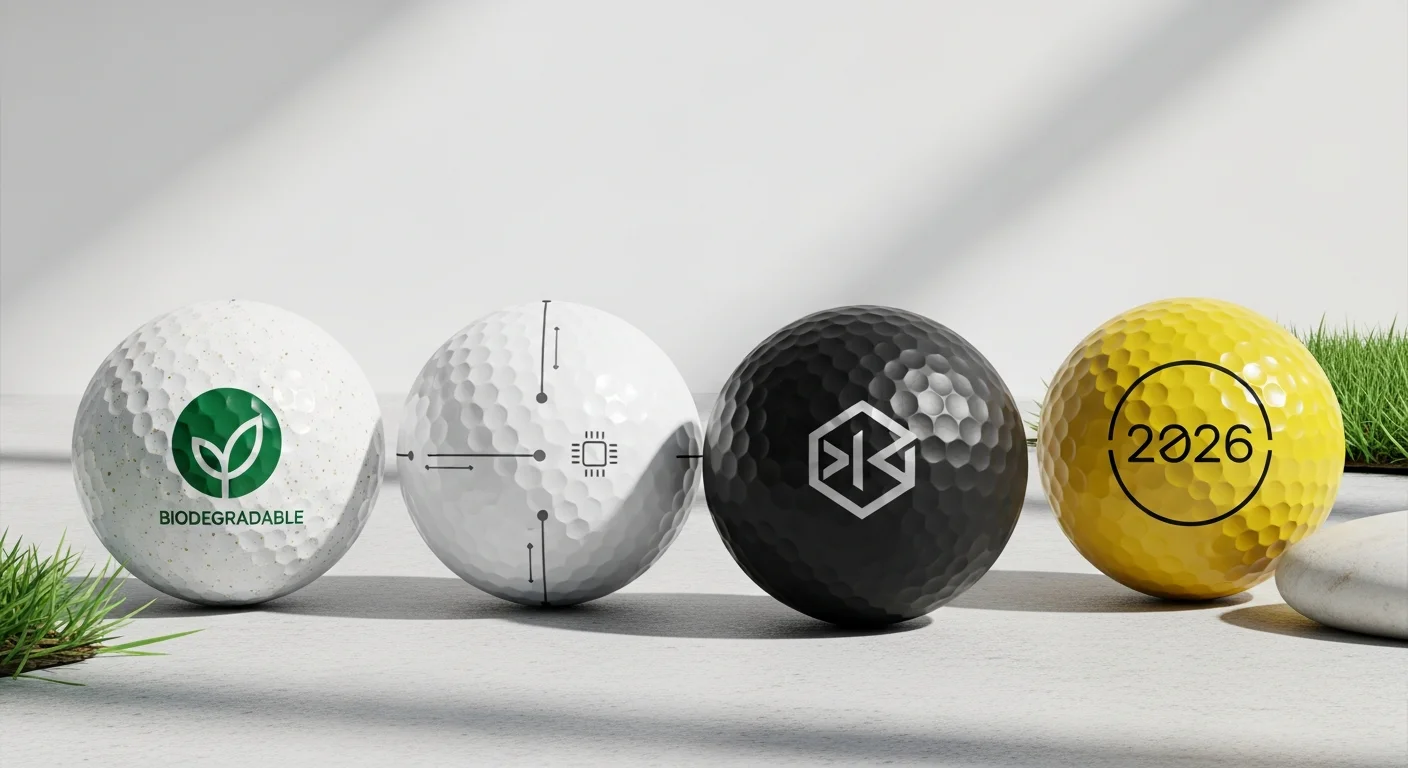
Color options extend beyond the traditional white. Yellow golf balls are the second most popular choice, offering enhanced visibility on the course. Orange, pink, green, and matte-finish options are available from several manufacturers, adding another dimension of personalization. Colored balls can be especially effective for tournament golf balls where organizers want every player's ball to stand out.
Types of Customization Available
Modern golf ball customization goes far beyond a simple company logo. Understanding the full range of personalization options helps you choose the right approach for your project. The four primary customization types are logo printing, text and monograms, photo printing, and alignment aids.
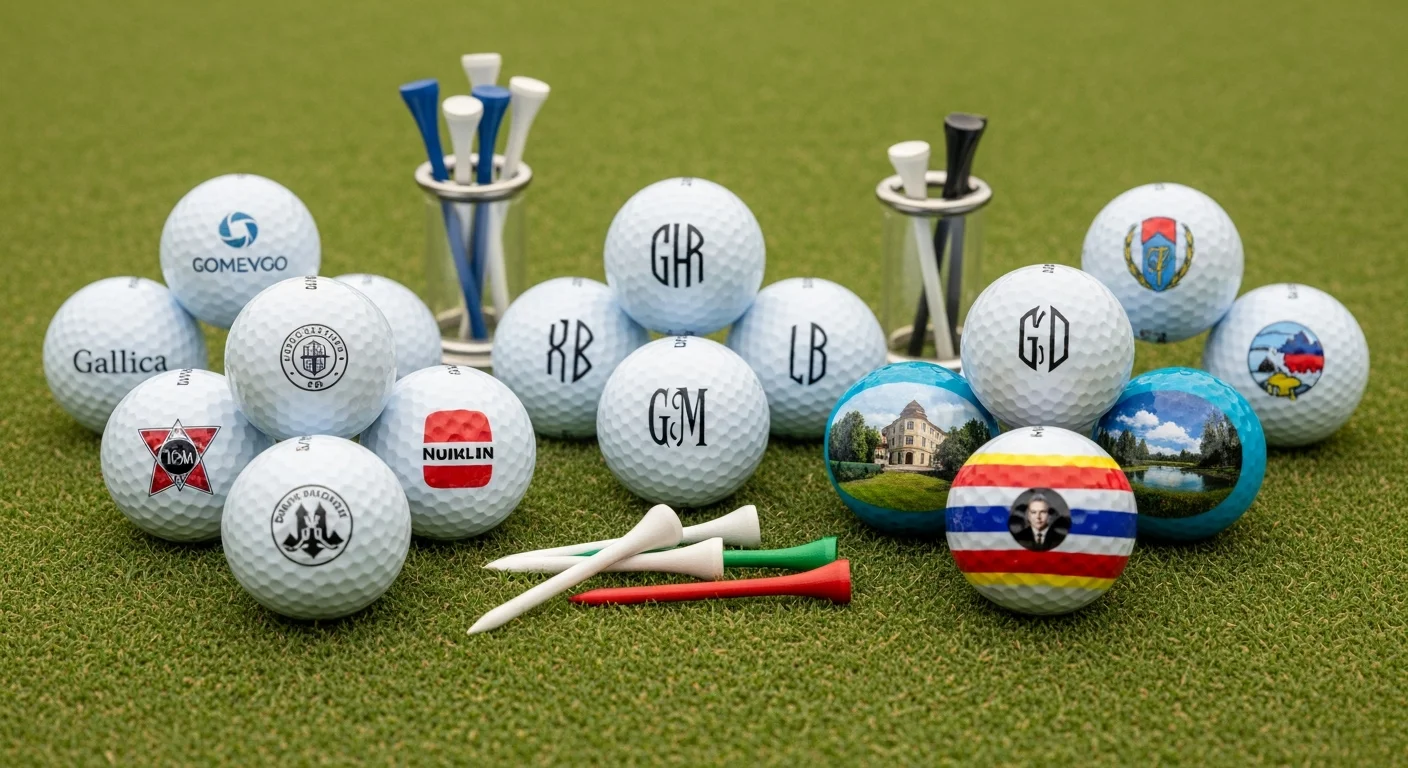
Logo printing is the most common form of customization, available in single-pole printing (one design on one side of the ball) or two-pole printing (designs on opposite sides). Single-pole printing places a logo, emblem, or graphic on the ball's primary viewing area, while two-pole printing allows a company logo on one side and a tournament name, event date, or secondary graphic on the other. Two-pole printing is the standard for corporate golf balls and event merchandise.
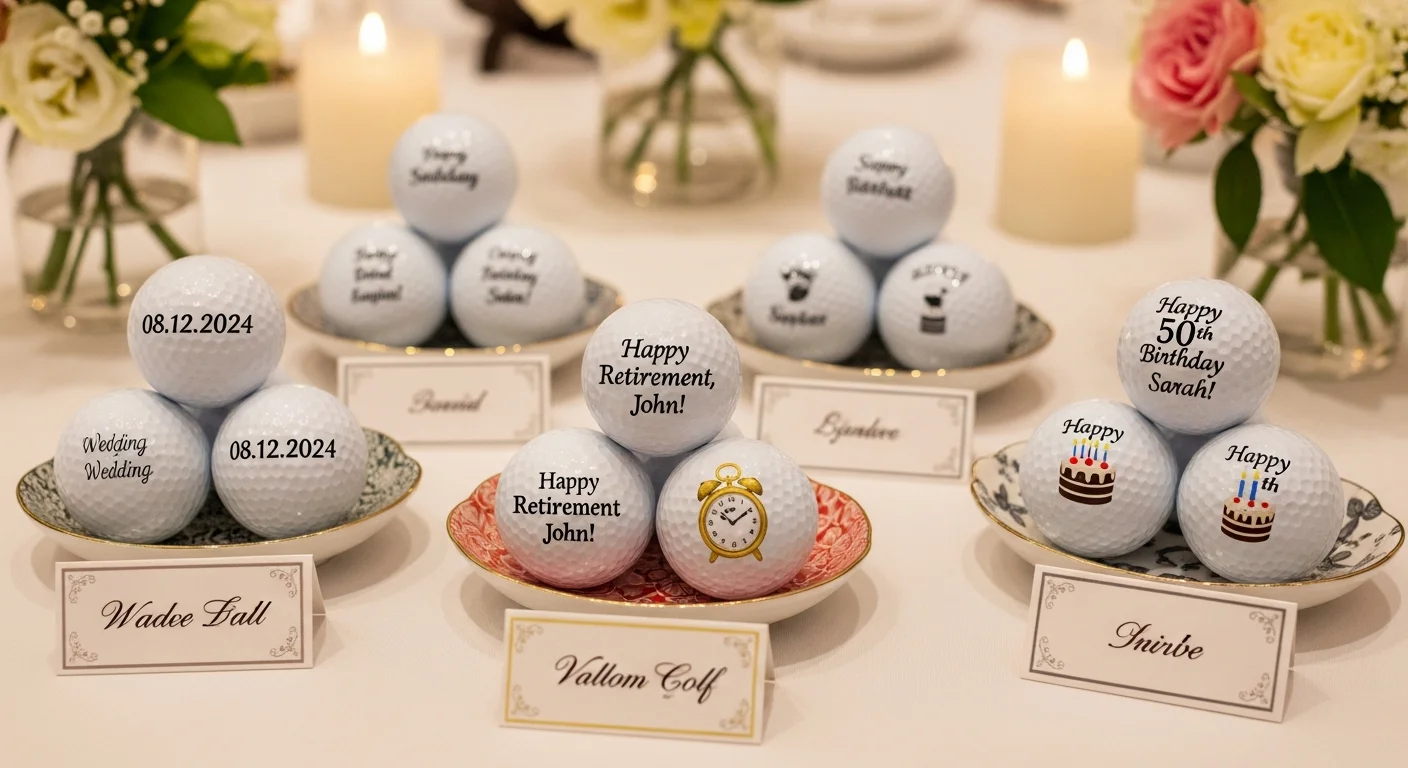
Custom text golf balls and monogrammed golf balls feature names, initials, dates, short messages, or humorous phrases. Text personalization is popular for gifts — "Happy 50th Birthday, Dad" or "Best Man 2026" adds a personal touch that transforms a sleeve of golf balls into a meaningful keepsake. Most providers offer a selection of fonts, though uploading custom typography as an image file provides maximum creative control.
For a deep dive into getting the best results with photographs on golf balls, check out the custom photo golf balls tips guide. Photo golf balls reproduce full-color photographs — faces, pets, scenery, or any image — directly on the ball's surface using UV printing technology. This is the most visually striking customization option, though it requires careful image preparation to account for the curved surface and small print area.
Golf ball alignment aids are functional customizations that help golfers line up putts. Custom alignment marks — arrows, lines, or personalized aiming graphics — can be printed alongside or instead of traditional logos, combining personalization with on-course utility.

Printing Methods Explained — UV vs Pad Printing
The two dominant methods for printing on golf balls are UV printing and pad printing, and each serves different design needs. Understanding the differences helps you select the right process for your project's color requirements, budget, and durability expectations.
UV printed golf balls use digital inkjet technology with ultraviolet LED curing to apply full-color CMYK designs in a single pass. The ball is placed in a precision jig, and a print head deposits ink directly onto the surface before UV light instantly cures (hardens) the ink. UV printing excels at reproducing photographs, gradients, and complex multi-color artwork with no limit on the number of colors. There are no plates or setup fees, making UV printing ideal for small batches and no minimum order quantities.
A pad printed golf ball uses the traditional indirect offset method that has been the golf industry standard for over 75 years. Ink is transferred from an etched plate (called a cliché) to the ball via a soft silicone pad. Pad printing delivers 1-4 spot colors per run with exceptional durability — the ink bonds deeply into the ball's surface and withstands heavy play, bunker shots, and cart path contact. However, each color requires a separate pass and its own cliché, which adds setup cost and limits the method to solid-color logos and text. For a comprehensive side-by-side comparison of both methods, read the UV printing vs pad printing guide.
For most beginners, UV printing is the simpler starting point — upload your design, approve a digital proof, and the balls are printed exactly as shown. Pad printing becomes the better choice at higher volumes (500+ balls) with simple 1-2 color logos where maximum durability is the priority.
Preparing Your Design Files
Proper file preparation is the single most important step in achieving professional-looking printed golf balls. The print area on a standard golf ball is approximately 25mm in diameter — roughly the size of a quarter — so every pixel matters. Submitting the right file format at the right resolution prevents blurry, pixelated, or color-shifted results.
For logo-based designs, submit a vector logo golf ball file whenever possible. Vector formats (AI, EPS, SVG, PDF) scale to any size without losing quality, giving the print operator clean edges and precise color data. If only a raster file is available (PNG, JPEG), ensure it meets the minimum 300 DPI resolution at the final print size — that translates to approximately 660 pixels across for the 25mm print circle. Lower-resolution files will appear soft or pixelated when printed on the curved ball surface.
For brand-critical corporate orders, specify PMS color matching (Pantone Matching System) to ensure logo colors are reproduced accurately. PMS matching is standard for pad printing (where ink is mixed to match specific Pantone shades) and available with UV printing through color profile calibration. If your brand guidelines specify PMS 186 for red, communicating that to the printer prevents the common mistake of receiving a slightly orange or slightly magenta result.
Common file formats accepted include PNG with transparent background (preferred for raster), AI or EPS (preferred for vector), SVG, and high-resolution PDF. Avoid submitting logos embedded in Word documents, low-resolution screenshots, or JPEG files with heavy compression artifacts — these produce poor print results every time.

Step-by-Step Ordering Process
Ordering personalized golf balls follows a straightforward process that most providers have streamlined into five or six steps. Understanding each step in advance eliminates surprises and ensures your order arrives on schedule.
Step 1: Select your ball brand and model. Choose a golf ball that matches the recipient's skill level and your budget. Consider the cover material (surlyn for durability, urethane for performance), compression rating, and color. Most providers offer 5-15 ball models spanning value, mid-range, and premium tiers.
Step 2: Upload or create your design. Upload your logo, photo, or text using the provider's online design tool. The golf ball design tool typically shows a real-time golf ball mockup of how your design will appear on the curved surface. If you do not have a design ready, many tools offer templates, text editors, and clipart libraries to build a design from scratch.
Step 3: Choose printing method and quantity. Select UV printing for full-color designs or pad printing for 1-2 color logos. Enter your quantity — from a single dozen for a personal gift to thousands for a corporate event. Most providers offer a bulk golf ball discount starting at 5-10 dozen.
Step 4: Review your digital proof. Before production begins, you will receive a golf ball proof approval — a digital rendering showing exactly how the finished product will look. Review placement, colors, text accuracy, and overall composition carefully. This is your last chance to catch errors before the press runs.
Step 5: Approve and place your order. Once the proof is approved, production begins. Standard turnaround is 5-10 business days depending on quantity and printing method. Rush options are usually available for 2-3 day turnaround at a premium.
Step 6: Receive and inspect. When your order arrives, inspect a sample from each batch to verify print quality, color accuracy, and ball condition. Reputable providers include a satisfaction guarantee and will reprint orders that do not meet the approved proof specifications.

Minimum Order Quantities and Packaging Options
One of the most common questions beginners ask is how many custom golf balls they need to order. The answer depends on the printing method and provider. UV printing enables true no minimum order quantities — you can order as few as 3 balls (one sleeve) for a personal gift. Pad printing typically requires minimums of 12-48 balls (1-4 dozen) because the cliché plate setup cost needs to be amortized across enough units to be cost-effective.
Standard golf ball packaging options include sleeves of 3 balls (the most popular gift format), boxes of 12 (one dozen, ideal for individual gifts or small events), and bulk cases of 144 balls (12 dozen, the standard for large tournament orders). Many providers also offer premium gift packaging — custom-printed boxes, ribbon wrapping, and branded tissue paper — that elevate the unboxing experience for executive gifts or wedding favors.
For event and corporate orders, custom packaging can include branded sleeves with the tournament name and date, logo-printed boxes, and even coordinated accessories like tees and ball markers. For a comprehensive guide on managing large-quantity orders, see the bulk custom golf ball ordering checklist.
Common Mistakes to Avoid
Even experienced marketers and event planners make mistakes when ordering custom golf balls for the first time. Avoiding these common pitfalls saves time, money, and frustration.
Low-resolution images are the number-one cause of disappointing results. A logo that looks crisp on a computer screen at 72 DPI will appear blurry and pixelated when printed at that resolution on a golf ball. Always submit files at 300 DPI or higher. If you only have a small web-resolution logo, have it professionally redrawn as a vector file before ordering.
Too many fine details in a small print area is another frequent problem. Remember that the printable surface is only about 25mm across — intricate flourishes, tiny text below 6-point size, and complex gradients may not reproduce clearly. Simplify your design for the golf ball format. If your logo has a tagline in small type, consider removing it for the golf ball version.
Ignoring the curvature can distort designs that look perfect on a flat screen. Flat rectangular logos or wide horizontal text will appear to curve and compress at the edges when printed on a sphere. Circular or square designs with centered elements translate most naturally to the curved surface. A good golf ball mockup tool will show you exactly how curvature affects your specific design.
Wrong ball selection for the audience wastes budget and disappoints recipients. Giving a low-compression beginner ball to a scratch golfer, or an expensive tour ball to a once-a-year golfer, misses the mark. When in doubt, choose a versatile mid-range ball that performs well across skill levels.
Skipping the proof review is a costly shortcut. Always request and carefully review the digital proof before approving production. Check for typos, color accuracy, logo orientation, and overall design alignment. A five-minute proof review can prevent a five-hundred-dollar reprint.
Custom Golf Ball Ideas for Every Occasion
The versatility of golf ball customization means there is an ideal design concept for virtually every occasion. Here are proven ideas organized by use case that consistently produce the best results and strongest emotional reactions.
Corporate gifts and client appreciation: Company logo on one pole, client's name or a thank-you message on the other. Pair with a branded sleeve or gift box for a polished presentation. For detailed corporate strategies, read the corporate golf gifts and tournaments guide.
Golf tournament giveaways: Tournament name, date, and course logo. Consider two-pole printing with the title sponsor on one side and the event details on the other. Include in the registration swag bag with tees and a divot tool for a complete player package.
Weddings and groomsmen gifts: Couple's names and wedding date, "Best Man" or "Groomsman" titles, or a playful message like "Last Round as a Single Man." For more wedding and event inspiration, visit the weddings and special events guide.
Father's Day and birthdays: Photo of kids or grandkids, "World's Best Dad" messaging, or the recipient's name with their handicap or a personal joke. Photo golf balls are particularly impactful for milestone birthdays.
Retirement celebrations: Years of service, retirement date, a humorous message ("Officially on the Back Nine"), or a company logo with a personalized farewell. Custom golf balls make memorable custom golf ball gifts that retirees use and appreciate for years.
Memorial and tribute: Honor a loved one with their photo, name, and dates on a golf ball they can carry on the course. Memorial golf balls are deeply meaningful gifts for golfers who have lost someone close.

Design Your Custom Golf Balls with RareCustom
Ready to bring your vision to life? RareCustom makes designing custom golf balls simple — whether you are ordering three balls for a personal gift or three thousand for a corporate tournament. The free online design tool lets you upload logos, add text, preview photos on a realistic 3D golf ball mockup, and see exactly how your finished product will look before you order.
With no minimum order requirements, free digital proofs, PMS color matching for brand accuracy, and both UV and pad printing options, RareCustom handles every customization need from single-sleeve gifts to bulk event orders. Production turnaround is 5-7 business days with rush options available. Learn more about the complete process on the how it works page, or jump straight into the design tool and start creating today.
Related Articles
Share this article
Written by
Natalie Voss
Founder & CEO of RareCustom. MBA from Stanford with 8 years in e-commerce operations. Natalie provides strategic overviews to help beginners navigate custom golf ball design.