UV Printing vs Sublimation vs DTF for Custom Phone Cases: Which Is Best?
Compare UV printing, sublimation, and DTF for custom phone cases. Durability, cost, color range, material compatibility, and best use cases for each printing method explained in depth.
Terrence Okafor
Head of Production at RareCustom with 20+ years in commercial printing. SGIA certified with expertise in UV, sublimation, and DTF printing methods for custom phone cases.
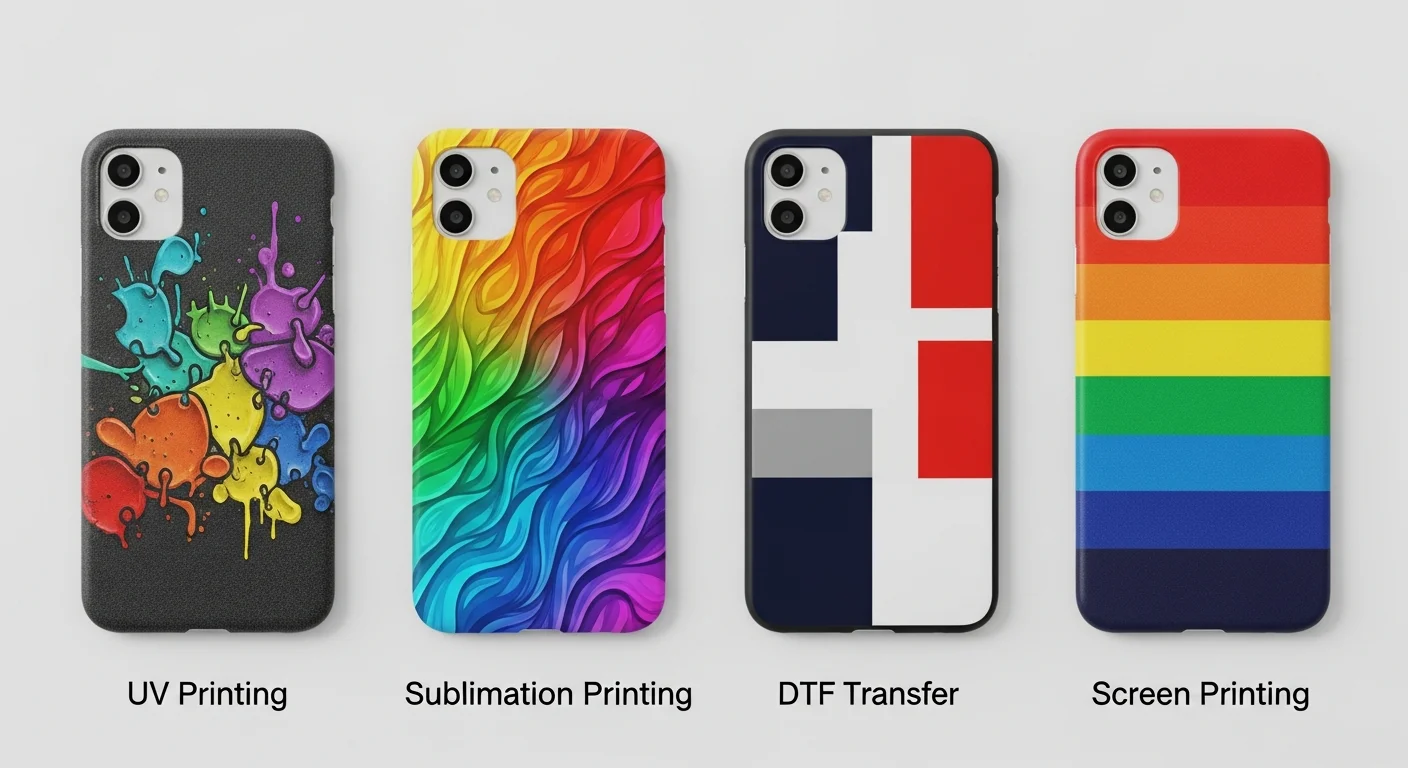
The printing method used to decorate a custom phone case determines almost everything about the finished product — how vibrant the colors look, how long the design survives daily use, which case materials are compatible, and how much the order costs at various quantities. Three technologies dominate custom phone case production in 2026: UV printing, sublimation, and DTF (direct-to-film). Each method uses fundamentally different chemistry and equipment, which means each delivers a distinct combination of strengths and trade-offs.
Choosing the wrong printing method can result in premature fading, peeling edges, dull color reproduction, or unnecessarily high per-unit decoration cost. Choosing the right method means getting a case that looks exactly like the design preview, survives months of daily handling, and arrives at a price point that makes sense for the order size. This guide breaks down each technology in detail, compares them head-to-head on the criteria that matter most, and provides a decision framework to help you select the ideal method for any custom phone case project.
How UV Printing Works on Phone Cases
UV printing is a direct-to-substrate technology that jets specialized UV-curable ink from a digital printhead directly onto the phone case surface. Immediately behind the printhead, a UV LED curing array emits ultraviolet light that polymerizes (hardens) each ink droplet the instant it lands on the substrate. This UV LED curing ink process eliminates drying time entirely — the printed case emerges from the flatbed UV printer ready to handle within seconds of the last pass.
The key advantage of UV printing is universal material compatibility. Because the ink bonds through photo-initiated polymerization rather than chemical absorption, it adheres to virtually any surface: rigid polycarbonate, flexible TPU, soft silicone, hybrid dual-layer constructions, metal plates, and even glass. This UV direct-to-substrate phone case approach means there is no need for special coatings, pretreatments, or dedicated blanks — any case blank can be loaded onto the printer's bed and decorated immediately.
Modern flatbed UV printer systems achieve resolutions of 1,440 DPI or higher, producing photorealistic image quality with smooth gradients, fine detail, and accurate color reproduction across the full CMYK gamut plus white and clear (varnish) channels. The white ink channel is particularly important for phone cases: it allows opaque printing on dark, colored, or transparent cases by laying down a white base layer beneath the colored inks. Without white ink, colored designs would appear washed out or invisible on non-white surfaces.
An additional capability unique to UV printing is the ability to create raised texture or 3D relief effects. By programming multiple passes of clear UV varnish over selected areas of the design, the printer builds up a tactile layer that you can feel with your fingernail. This embossed phone case effect adds a premium, three-dimensional quality to logos, patterns, and text elements without any additional tooling or setup costs. Production speed ranges from 30 to 90 seconds per case depending on resolution settings and the number of texture passes, making UV the fastest per-unit production method for custom phone cases.
How Sublimation Printing Works on Phone Cases
Sublimation printing uses heat and pressure to convert solid dye sublimation transfer inks into a gas that permanently penetrates the molecular structure of a polymer-coated surface. The process begins with a digital print of the design onto specialty sublimation transfer paper using dye-sub inks. The printed transfer is then placed face-down against a polymer-coated phone case blank and loaded into a heat press phone case fixture that applies even pressure across the entire case surface.
At temperatures between 360 and 400 degrees Fahrenheit, the dye sublimation transfer inks sublimate — transitioning directly from solid to gas without passing through a liquid phase. The gaseous ink molecules penetrate the polymer coating on the case surface, and when the temperature drops during removal from the press, the gas resolidifies within the polymer matrix. The result is a permanent, infused print where the ink literally becomes part of the case material rather than sitting on top of it.

This infusion produces several distinctive qualities. Sublimation prints are extremely scratch-resistant because there is no surface layer to abrade — the ink exists beneath the surface. Colors are vivid and continuous-tone, with no visible dot pattern even under magnification. Edge-to-edge printing is a signature advantage: specially designed polymer-coated phone case blank shells allow the transfer to wrap completely around the case, covering the back panel and sides with a seamless, full-wrap image.
The primary limitation of sublimation is material dependency. The process requires a white or light-colored polymer-coated blank because the inks are transparent dyes, not opaque pigments. Sublimation cannot print white, and it cannot produce vibrant results on dark or uncoated surfaces. This restriction limits the technique to dedicated sublimation blanks — typically polycarbonate shells with a polyester or polymer spray coating. Production time runs three to five minutes per case, including press heating, transfer, and cooling.
How DTF (Direct-to-Film) Printing Works on Phone Cases
DTF printing (direct-to-film) takes a two-stage approach. In the first stage, the design is printed onto a transparent PET DTF transfer film using a specialized inkjet printer loaded with CMYK plus white pigment inks. Unlike sublimation inks, DTF inks are opaque pigments that sit on the film surface rather than absorbing into it. After printing, a fine layer of hot-melt adhesive powder is applied to the wet ink surface and cured in an oven or with an inline dryer at approximately 230 degrees Fahrenheit.
In the second stage, the prepared transfer film — now carrying the printed design backed by a layer of adhesive — is placed against the phone case surface and heat-pressed at 300 to 330 degrees Fahrenheit for 10 to 15 seconds. The hot-melt adhesive melts and bonds the printed design to the case surface, creating a flexible, stretchable decoration layer that conforms to the case's shape. After cooling, the PET carrier film is peeled away, leaving only the design and adhesive on the case.

DTF printing offers several practical advantages. Like UV printing, it works on virtually any case material without special coatings or pretreatments. The white ink layer allows vibrant full-color printing on dark, colored, and transparent cases alike. DTF transfers are flexible enough to handle moderate case curvature without cracking. And because the design is prepared offline on transfer film, multiple transfers can be pre-printed and stored, enabling rapid batch production when orders arrive.
The trade-off is that DTF creates a surface-bonded decoration layer — essentially a thin printed film adhered to the case. Under extreme stress (aggressive scratching, edge peeling, prolonged friction), the decoration layer can separate from the substrate. However, modern hot-melt adhesive formulations have improved dramatically, and quality DTF transfers on phone cases routinely survive six to twelve months of normal daily use without visible degradation.
Durability and Longevity Comparison
Durability is often the deciding factor when choosing a printing method for a phone case that will be handled, pocketed, and set down on surfaces dozens of times every day. Each method's durability profile reflects its underlying chemistry.
| Factor | UV Printing | Sublimation | DTF |
|---|---|---|---|
| Scratch Resistance | High — cured ink forms hard surface layer | Very High — ink infused below surface | Moderate — surface film can scuff |
| Fade Resistance | Excellent — UV-resistant inks | Excellent — protected within polymer | Good — pigments may fade with UV exposure |
| Peel/Chip Resistance | Very High — chemical bond to substrate | N/A — no surface layer to peel | Good — adhesive bond, edges vulnerable |
| Flexibility | Good — cured ink flexes with TPU | Excellent — infused ink moves with material | Very Good — flexible transfer film |
| Water Resistance | Excellent — sealed surface | Excellent — subsurface ink | Good — sealed but edges can wick |
| Expected Lifespan | 12–24 months daily use | 12–24 months daily use | 6–12 months daily use |

In real-world testing, UV-printed and sublimation-printed phone cases perform comparably over extended periods of daily use, with both methods retaining color vibrancy and scratch resistance after six months of pocket carry, desk placement, and occasional drops. DTF transfers show earlier signs of edge wear, particularly at corners and around button cutouts where friction is highest, but the central design area typically remains intact and vibrant. For applications requiring maximum longevity — corporate branded cases expected to last a full year or more — UV printing and sublimation are the strongest choices.
Color Range and Design Complexity
All three printing methods support full-color reproduction, but they differ in gamut range, special capabilities, and performance on specific design types.
UV printing delivers the widest practical color gamut for phone cases because it prints with CMYK plus white plus clear ink channels on any surface color. This six-channel system handles everything from photorealistic portraits with subtle skin tones to bold corporate logos on jet-black cases. The white ink capability is a significant advantage: it enables opaque elements on dark, metallic, or transparent substrates where sublimation is physically incapable of producing visible results. Additionally, the 3D texture effect available through multi-pass clear varnish layering adds a tactile dimension that no other method can replicate at the same per-unit cost.
Sublimation excels at photographic reproduction on light-colored polymer-coated phone case blank surfaces. Because the dye is infused into the polymer rather than sitting on top, sublimation prints have a characteristic depth and richness that some users describe as appearing backlit. Gradient transitions are silky-smooth with no visible banding. However, the absence of a white ink channel means sublimation cannot print white — any white area in the design will simply show the white coating of the blank. On colored or dark substrates, sublimation is not viable.
DTF printing produces vibrant, opaque colors on any surface thanks to its white ink layer. It handles complex designs including photographs, gradients, and fine text competently. The color gamut is slightly narrower than UV printing at the extremes of saturation due to the adhesive layer between ink and eye, which can very slightly reduce perceived vibrancy. However, for most practical applications — logos, artwork, text, and standard photographs — DTF color quality is excellent and indistinguishable from UV to the untrained eye.
Material Compatibility Matrix
Not every printing method works on every case material. This compatibility matrix summarizes which combinations produce reliable, high-quality results. Understanding material compatibility helps you avoid ordering a case that cannot be properly decorated with your preferred method.
| Case Material | UV Printing | Sublimation | DTF |
|---|---|---|---|
| Polycarbonate (PC) | Excellent | Excellent (coated only) | Good |
| TPU (Flexible) | Excellent | Not recommended | Good |
| Silicone | Good (primer may help) | Not compatible | Fair (adhesion varies) |
| Hybrid PC+TPU | Excellent (on PC back) | Good (on coated PC) | Good (on PC back) |
| Clear PC/TPU | Excellent (with white ink) | Not recommended | Good (with white base) |
| Leather/PU Leather | Good | Not compatible | Good |
UV printing emerges as the most material-versatile option, working reliably across all common phone case substrates. Sublimation requires a specific polymer-coated phone case blank, limiting material choice but delivering superior print integration on compatible blanks. DTF works on most materials but may require case-by-case adhesion testing on softer substrates like silicone. For a deeper exploration of how material properties affect print quality, protection, and overall case performance, see the TPU vs polycarbonate vs silicone phone case materials guide.
Cost Comparison by Order Size
The per-unit decoration cost varies significantly between methods depending on order quantity, setup requirements, and material costs. Understanding cost structures helps you budget effectively and choose the most economical method for your specific order size.
| Order Size | UV Printing (per unit) | Sublimation (per unit) | DTF (per unit) |
|---|---|---|---|
| 1 unit | $3.50–$5.00 | $4.00–$6.00 | $3.00–$4.50 |
| 10 units | $2.80–$4.00 | $3.00–$4.50 | $2.50–$3.50 |
| 50 units | $2.00–$3.00 | $2.20–$3.00 | $1.80–$2.50 |
| 100 units | $1.50–$2.50 | $1.80–$2.50 | $1.30–$2.00 |
| 500+ units | $1.00–$1.80 | $1.20–$1.80 | $0.80–$1.30 |

UV printing has zero setup cost — each design is printed directly from a digital file with no plates, screens, or transfer preparation. This makes it the most cost-effective option for single units and very small orders. Sublimation has a slightly higher per-unit cost at low quantities due to the cost of polymer-coated blanks and transfer paper, but costs converge with UV at higher volumes. DTF offers the lowest per-unit decoration cost at scale because transfer films can be batch-printed efficiently, but the separate heat-press step adds labor time per unit. For a comprehensive analysis of total costs including case blanks, shipping, and packaging, refer to the custom phone case pricing guide.
Which Method Is Best for Your Project?
The best printing method depends on your specific project requirements. Use this decision framework to narrow your choice:
Choose UV printing when: You need to print on dark, colored, or clear cases. You want a single unit or small batch with no setup costs. You want tactile 3D texture effects on your design. You need the fastest possible production turnaround. You are printing on TPU, silicone, or hybrid case materials. You want maximum material flexibility for your custom phone case production process.
Choose sublimation when: You prioritize the most integrated, scratch-proof finish possible. You are using white or light-colored polymer-coated phone case blank shells. You want seamless full-wrap edge-to-edge coverage. You are printing photographic designs with complex gradients and continuous tones. You plan to order in moderate to large quantities where the coated blank cost is amortized across units.
Choose DTF when: You need the lowest per-unit cost at high volumes (500+ units). You want vibrant printing on dark cases but do not require 3D texture effects. You want to pre-produce transfers in advance and press them to cases on demand. You need good flexibility for moderate case curvature. You are producing cases for event giveaways or promotional distribution where moderate durability (six to twelve months) is acceptable.
What RareCustom Uses and Why
RareCustom employs multiple printing methods across its custom phone case product line, matching the optimal technology to each case style, material, and customer use case. UV printing serves as the primary production method for its versatility, speed, and ability to handle the widest range of case materials and design types. Sublimation is used for premium full-wrap cases on dedicated polymer-coated blanks where maximum durability and seamless edge coverage are priorities.
Every order goes through a quality assurance process that includes color calibration verification, adhesion spot-checks on sample units, and visual inspection of print alignment against the approved digital proof. Customers who are unsure which method best suits their project can order a sample unit to evaluate the finish, color accuracy, and tactile quality before committing to a larger production run.
Frequently Asked Questions
Can you UV print on a clear phone case? Yes. UV printing on clear cases is one of the technology's standout capabilities. A white ink base layer is printed first in the shape of the design, followed by CMYK color layers on top. Areas without white ink remain fully transparent, creating an effect where the design appears to float over the phone's original color. This technique is particularly popular for minimalist logos and monogram designs.
How long does sublimation printing last on a phone case? Sublimation prints are among the most durable available. Because the ink is infused into the polymer coating rather than sitting on the surface, sublimation designs resist scratching, peeling, and fading for 12 to 24 months of daily use under normal conditions. Fade resistance is excellent indoors; prolonged outdoor UV exposure may gradually diminish colors over many months.
Is DTF printing waterproof on phone cases? DTF transfers on phone cases are water-resistant — the printed surface sheds water and resists brief submersion. However, prolonged soaking or aggressive scrubbing can cause the adhesive bond at the edges to weaken over time. For applications requiring full waterproof durability (outdoor work environments, frequent gym use), UV printing offers superior water and chemical resistance.
Can UV printing create embossed or 3D texture effects? Yes. By programming the flatbed UV printer to apply multiple passes of clear UV varnish over selected areas, it builds up a measurable raised layer — typically 0.1 to 0.3 millimeters in height. This tactile embossed phone case effect can be applied to logos, text, patterns, or borders, creating a premium feel that distinguishes the case from flat-printed alternatives at minimal additional cost.
Related Articles
- How to Design Custom Phone Cases: The Complete Beginner's Guide — Start-to-finish walkthrough of the design and ordering process.
- TPU vs Polycarbonate vs Silicone Phone Case Materials — How case material affects print adhesion, durability, and feel.
- Custom Phone Case Pricing Guide — Full cost breakdown including printing, blanks, and volume discounts.
Share this article
Written by
Terrence Okafor
Head of Production at RareCustom with 20+ years in commercial printing. SGIA certified with expertise in UV, sublimation, and DTF printing methods for custom phone cases.