Custom Mugs for Corporate Gifts & Employee Branding: The Complete Strategy
Build lasting brand visibility with custom mugs for employees, clients, and trade shows. Logo placement strategy, material selection, volume pricing, and ROI data for corporate mug programs.
Rohan Mehta
Head of Marketing at RareCustom. Rohan combines data-driven strategy with storytelling to help businesses build brand visibility through custom drinkware programs.
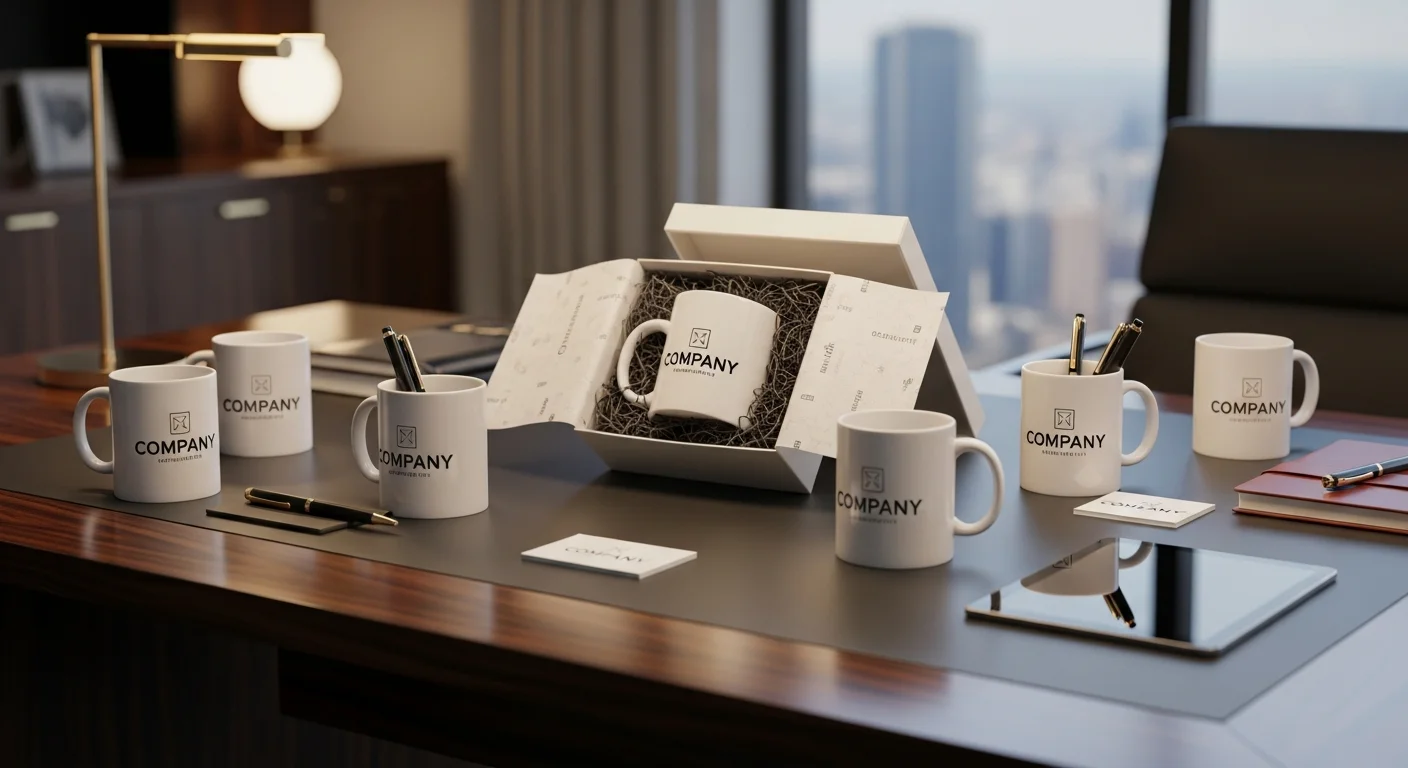
A custom branded mug sitting on an employee's desk generates more brand impressions per dollar than almost any other promotional product. The Advertising Specialty Institute's 2025 research found that promotional drinkware delivers an average cost-per-impression of $0.004 — making it one of the most cost-effective branding investments available. The math is straightforward: a $6 branded mug used daily for two years generates roughly 1,500 impressions (the user plus everyone who sees the mug during meetings, video calls, and office interactions), resulting in a fraction-of-a-penny cost per impression that outperforms digital advertising, print ads, and most other physical promotional products.
This guide covers every aspect of building a corporate mug program — from selecting the right material and designing for brand compliance to volume pricing strategies and measuring ROI. Whether the goal is 50 onboarding welcome mugs, 200 client appreciation gifts, or 1,000 trade show giveaways, the strategies here ensure the investment delivers maximum brand impact. For businesses new to custom merchandise, the beginner's guide to custom mugs covers the design fundamentals, while this guide focuses specifically on the corporate branding strategy.
Why Custom Mugs Are the Best Corporate Gift
Branded mugs outperform other promotional products on four key metrics that corporate marketers track: retention rate, daily usage, perceived value, and cost-efficiency. Research from the Promotional Products Association International shows that 80 percent of consumers can recall the brand on a promotional mug they received in the past two years — compared to 55 percent for branded pens and 42 percent for branded tote bags. The retention rate is equally impressive: 73 percent of recipients keep a branded mug for more than two years, and many keep them indefinitely.
The daily usage factor is what separates mugs from most promotional items. A branded pen sits in a drawer between uses. A branded tote bag hangs in a closet. A branded mug sits on a desk or kitchen counter, visible to the user and everyone around them for multiple hours every day. For office workers, a branded mug is present during meetings, video calls, lunch breaks, and casual conversations — creating ambient brand impressions in exactly the professional contexts where brand awareness matters most.
Perceived value relative to actual cost is exceptionally favorable for mugs. A ceramic mug with full-color sublimation printing costs $5 to $8 per unit at typical corporate volumes (50 to 200 mugs), yet recipients perceive it as a $12 to $20 gift. This perception gap means the company gets premium gift credit at mid-range pricing — a balance that is difficult to achieve with other promotional products. Compare this to branded USB drives ($8 to $15 per unit, perceived as $5 to $10) or branded power banks ($15 to $25 per unit, perceived as $10 to $15) where the perceived value often falls below the actual cost.
Five Corporate Use Cases for Custom Mugs
1. Employee onboarding and welcome kits. A branded mug in a new hire's welcome kit creates an immediate sense of belonging. The mug becomes part of the employee's daily routine from day one, reinforcing company culture and team identity with every cup of coffee. Companies like Google, HubSpot, and Salesforce include branded mugs in their onboarding kits as a standard practice. The kit typically includes the mug alongside a branded notebook, stickers, and a welcome card — total kit cost of $15 to $25 that creates a disproportionately positive first impression.
2. Client appreciation and retention gifts. Sending a quality branded mug to clients at year-end, after a project milestone, or as a thank-you creates a physical touchpoint that keeps the company top of mind. For B2B relationships where contract renewals and referrals drive revenue, a well-designed mug that sits on a client's desk serves as a constant, subtle reminder of the business relationship. Premium options (stainless steel, gift-boxed) are appropriate for high-value client relationships.
3. Trade show and conference giveaways. Mugs are among the most popular trade show giveaway items because attendees perceive them as high-value gifts worth visiting a booth to receive. A branded mug at a trade show booth generates foot traffic, creates a conversation starter with prospects, and continues promoting the brand long after the event ends. The key to trade show mugs is eye-catching design that attendees are genuinely proud to use — a generic logo slapped on a cheap mug gets left in the hotel room, while a well-designed mug travels home and into the office.
4. Holiday corporate gift programs. End-of-year corporate gifting is a $242 billion industry, and custom mugs are one of the most versatile options because they work for virtually every recipient regardless of dietary restrictions, personal preferences, or religious considerations. A branded mug paired with specialty coffee or tea creates a thoughtful gift set at a $15 to $30 price point that feels personal without being too intimate for professional relationships.
5. Company milestone celebrations. Anniversary mugs (company founding dates, employee tenure milestones, product launch commemorations) create collectible keepsakes that employees value. "10 Years of [Company Name]" or "Team [Department] — Founded 2016" designs become conversation pieces and morale builders that reinforce organizational pride and longevity.
Logo Placement and Brand Guidelines
Front-center positioning is the most common and effective logo placement for corporate mugs. The logo should be centered on the front face of the mug (opposite the handle) at a size that is easily readable from arm's length — typically 2 to 3 inches wide for a standard 11-ounce mug. Position the logo vertically centered in the print area, with equal space above and below. This placement ensures the logo faces outward when the mug sits on a desk or table, maximizing visibility to passersby.
Full-wrap brand patterns are an alternative for brands with repeating visual elements — pattern designs, icon arrays, or branded typography that covers the entire circumference of the mug. Full-wrap designs create a more immersive brand experience but require careful consideration of the handle interruption, where 1 to 1.5 inches of the design is hidden behind the handle when the mug is viewed from certain angles. Design the wrap so that the brand name or primary logo is positioned directly opposite the handle for maximum front-facing visibility.
Pantone (PMS) color matching is critical for brands with strict color guidelines. Sublimation printing uses CMYK to simulate PMS colors, which means there may be slight color shifts from the specified PMS values. For most corporate applications, the difference is imperceptible — but for brands in industries where exact color compliance is monitored (pharmaceutical companies, financial institutions, government agencies), request a color proof sample before approving the full production run. Sublimation can achieve within 5 to 10 percent of most PMS colors, which is acceptable for the majority of corporate applications.

Choosing the Right Mug Material for Corporate Gifts
Material selection communicates the level of investment the company is making in the relationship. Standard white ceramic ($4 to $7 per unit all-in at corporate volumes) is the best value option for broad distribution — employee onboarding, trade show giveaways, and large event programs. The quality is professional, the print is vibrant, and the unit cost allows generous quantities without straining the promotional budget. For a detailed material breakdown, read the mug materials comparison guide.
Stainless steel travel mugs ($10 to $18 per unit all-in) signal premium positioning and are appropriate for executive gifts, high-value client appreciation, and programs where the brand needs to communicate quality leadership. Double-wall vacuum insulation adds practical value (hot for 4 to 6 hours, cold for 8 to 12 hours) that recipients genuinely appreciate, increasing the likelihood the mug becomes a daily-use item rather than a shelf decoration.
Enamel mugs ($6 to $10 per unit all-in) suit brands with outdoor, adventure, artisanal, or vintage positioning. Craft breweries, outdoor gear companies, camping brands, and farm-to-table restaurants find that enamel mugs perfectly match their brand personality while differentiating their merchandise from the standard ceramic mugs that every other company distributes.
Packaging and Presentation
Individual gift boxes transform a branded mug from a promotional item into a premium gift. A white or kraft cardboard box with tissue paper, a branded sticker seal, and a printed insert card takes the unboxing experience from functional to memorable. Individual boxing adds $1.50 to $3.00 per unit but significantly increases the perceived value — a gift-boxed mug feels like a $20 to $30 present rather than a $6 promotional giveaway. For client gifts and executive presents, the packaging investment is almost always worthwhile.
Bulk carton packaging is appropriate for internal distribution (employee onboarding, office events) and trade shows where individual packaging is unnecessary. Mugs are packed 24 to 36 per carton with individual foam dividers to prevent breakage during shipping. This is the most cost-effective packaging option, adding only $0.50 to $1.00 per unit for protective materials.

Budget Planning and Volume Pricing
Corporate mug programs benefit significantly from volume pricing, with per-unit costs decreasing substantially at higher quantities. Typical pricing tiers for standard 11-ounce white ceramic mugs with full-color sublimation printing: 25 mugs at $8 to $10 each; 50 mugs at $7 to $9 each; 100 mugs at $5 to $7 each; 250 mugs at $4 to $6 each; 500 or more mugs at $3 to $5 each. These prices include the blank mug, printing, and standard packaging — gift boxing, premium materials, and expedited shipping are additional. For detailed pricing data across all materials and quantities, see the complete pricing guide, and for ordering logistics, consult the bulk ordering checklist.
Budget allocation guidance: Marketing departments typically allocate $5 to $15 per unit for standard promotional products and $15 to $50 per unit for premium corporate gifts. Ceramic mugs fit comfortably in the standard range, while stainless steel and gift-boxed options align with the premium tier. A practical approach is to maintain two tiers — standard ceramic for broad distribution and premium stainless steel for VIP relationships — which maximizes both reach and impact within a single promotional budget.
Measuring ROI on Promotional Mugs
Cost-per-impression (CPI) is the primary ROI metric for promotional products. A $6 branded ceramic mug used daily for two years in an office environment generates approximately 1,500 impressions (assuming the user plus 2 to 3 colleagues or visitors see the mug daily). CPI = $6 / 1,500 impressions = $0.004 per impression. Compare this to LinkedIn sponsored content ($5 to $15 per thousand impressions = $0.005 to $0.015 per impression) or Google Display ads ($2 to $5 per thousand impressions = $0.002 to $0.005 per impression). Branded mugs deliver comparable or better CPI than digital advertising while offering higher engagement quality — a physical object on a desk creates a more meaningful brand association than a fleeting banner ad.
Brand recall surveys consistently show that physical promotional products generate higher unaided recall than digital advertising. The combination of tactile interaction, visual presence, and daily utility creates multi-sensory brand encoding that digital impressions cannot match. For companies tracking brand awareness metrics, custom mug programs regularly rank among the highest-performing promotional investments per dollar spent.

Order Custom Corporate Mugs
Building a corporate mug program starts with defining the objective (brand awareness, employee engagement, client retention), selecting the right material for the audience, and designing for brand compliance. The free design tool includes corporate templates with logo upload, Pantone color simulation, and bulk pricing calculators. Start a design to see pricing at the corporate volume or contact the team for custom quotes on large orders. Browse the complete custom mugs collection to see all available mug types, sizes, and finishes with free shipping on orders over $75.
Frequently Asked Questions
What is the most cost-effective mug for corporate giveaways?
Standard 11-ounce white ceramic mugs with sublimation printing are the most cost-effective option, ranging from $3 to $7 per unit depending on order quantity. At volumes of 100 or more, per-unit costs typically fall below $6 including printing and standard packaging. Volume discounts increase significantly at 250 and 500 unit thresholds.
Can I get exact Pantone color matching on custom mugs?
Sublimation printing simulates PMS colors using CMYK, achieving within 5 to 10 percent of most Pantone values. For most corporate applications, this accuracy is sufficient. If exact PMS matching is required, request a color proof sample before approving the full production run. Screen printing on ceramic mugs offers more precise PMS matching for orders of 250 or more units.
How far in advance should I order corporate gift mugs?
Allow 3 to 4 weeks for standard orders (1 week for proof and approval, 1 to 2 weeks for production, 1 week for shipping). For holiday gift programs, place orders by early November to ensure December delivery. Rush production is available for urgent needs, typically adding 25 to 40 percent to the base price.
Related Articles
Share this article
Written by
Rohan Mehta
Head of Marketing at RareCustom. Rohan combines data-driven strategy with storytelling to help businesses build brand visibility through custom drinkware programs.