How to Design Custom Mugs: The Complete Beginner's Guide
Learn to design custom mugs from scratch — choose materials, upload artwork, and place your order with confidence. No minimums, free design tools, and fast shipping for personalized coffee mugs.
Jordan Reeves
Brand Experience Strategist at RareCustom. BFA in Graphic Design from Parsons School of Design with 8+ years helping brands craft visual identities. Specialist in color theory, layout composition, and design systems.
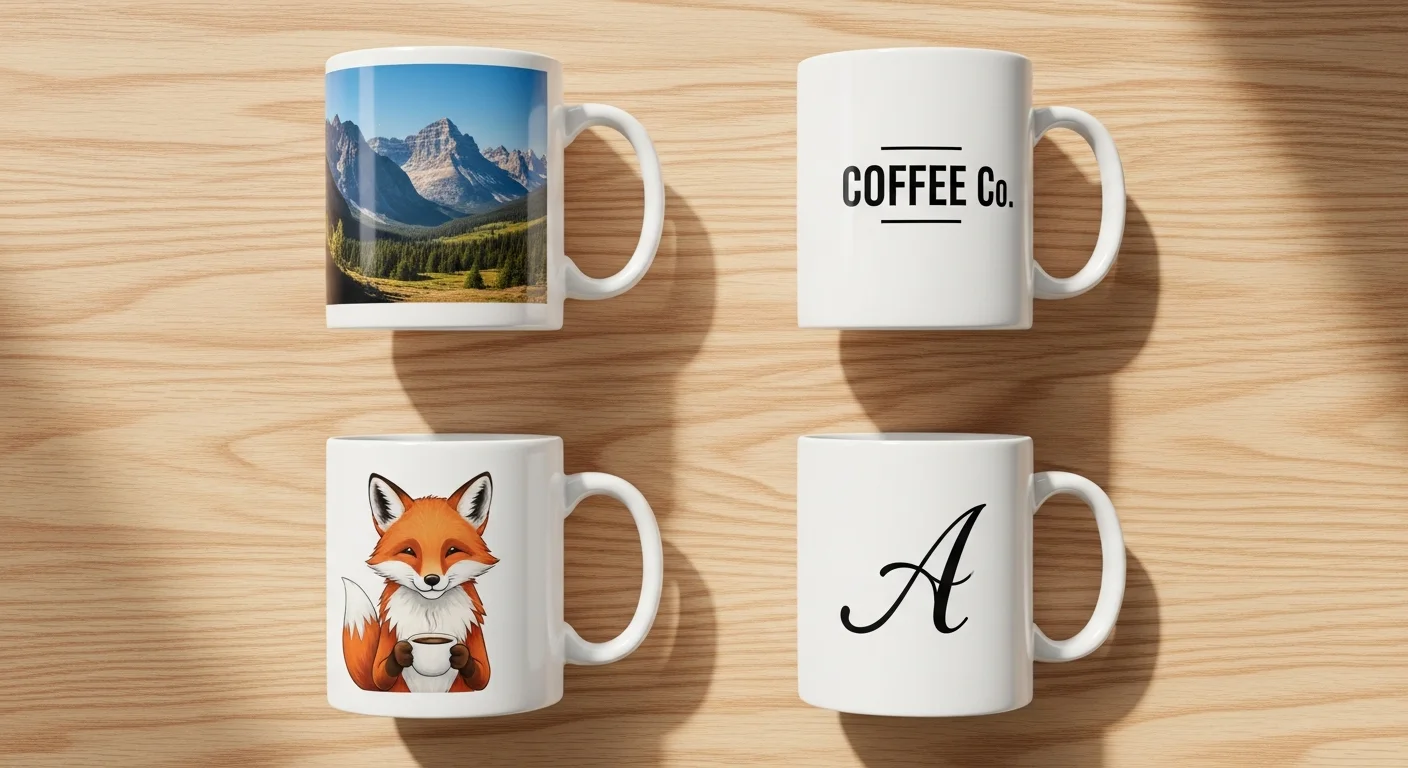
Designing a custom mug combines personal creativity with a few technical details that most beginners overlook. Unlike printing on flat surfaces such as custom t-shirts or custom stickers, mug decoration wraps around a curved cylindrical surface, which changes how artwork is positioned, how colors render, and how the final product feels in someone's hand every morning. This guide walks through every decision — from selecting the right mug type and size to uploading print-ready artwork to placing the first order — so the finished product arrives exactly as envisioned.
The personalized drinkware market has grown steadily, driven by demand for meaningful gifts, corporate branding solutions, and small-business merchandise. Whether the goal is a single photo mug for a grandparent's birthday, 50 branded mugs for a company retreat, or 200 fundraiser mugs for a school event, understanding the fundamentals of mug construction and printing prevents costly mistakes and ensures professional results from day one. Here is everything a first-time custom mug buyer needs to know.
Why Custom Mugs Are the Perfect Personalized Product
Custom mugs occupy a unique position in the personalized merchandise landscape because they combine daily utility with emotional connection. The average coffee drinker uses their favorite mug three to four times per day, which means a well-designed custom mug gets more daily impressions than almost any other promotional or gift item. Compare that to a custom blanket that stays folded on a couch or a phone case that faces away from the user — a mug sits on a desk, a kitchen counter, or a conference table where it is seen by the user and everyone around them for hours at a time.
No size or fit concerns make mugs one of the simplest custom products to order. Unlike custom apparel where a wrong size means returns and exchanges, a mug is universally functional. An 11-ounce ceramic mug works for everyone from a teenager to a grandparent, eliminating the sizing headaches that come with ordering custom hoodies or custom jerseys for groups. The typical retail price of $10 to $18 per mug also hits a sweet spot — affordable enough for bulk gifting yet perceived as premium enough to feel like a thoughtful present rather than a throwaway trinket.
Year-round demand separates mugs from seasonal products. While holiday gift mugs spike three to four times in volume during November and December, birthdays, anniversaries, corporate events, weddings, and teacher appreciation weeks create consistent ordering opportunities every month. For businesses, custom mugs provide desktop brand visibility — a logo mug sitting on an employee's desk for eight hours a day delivers more brand impressions per dollar than virtually any other promotional product.
Understanding Mug Types and Sizes
The first decision in any custom mug project is selecting the right mug type and size. The 11-ounce standard ceramic mug is the most popular choice, accounting for roughly 60 percent of all custom mug orders. It holds a standard cup of coffee, fits comfortably in one hand, and provides approximately 3.5 inches of printable height by 8 inches of printable circumference for single-side or full-wrap designs. The 15-ounce large ceramic mug is the second most popular option, offering about 15 percent more print surface area and appealing to customers who prefer a bigger cup or want more room for photo collages and detailed artwork.
Two-tone mugs feature a white exterior with a colored interior and matching colored handle, available in options like red, blue, black, green, orange, and pink. The colored interior adds a design element that complements the printed artwork on the exterior without any additional printing cost. Color-changing mugs (also called magic mugs) are coated with a thermochromic material that turns transparent when hot liquid is poured inside, revealing the printed design beneath — a novelty option popular for gifts and promotions. For a comprehensive comparison of every material option, read the ceramic vs glass vs stainless steel vs enamel guide.

How Custom Mug Printing Works
Sublimation printing is the dominant method for custom ceramic mugs and the method used by most print-on-demand services including RareCustom. The process works by heating specialized sublimation ink to approximately 400 degrees Fahrenheit, at which point the ink converts from a solid to a gas and permanently infuses into the polymer coating on the mug's surface. Because the ink becomes part of the coating rather than sitting on top of it, sublimation prints are dishwasher safe, microwave safe, and resistant to fading for the lifetime of the mug.
Sublimation excels at reproducing full-color photographic images, gradients, and complex multi-color designs with no additional cost per color — a 16-million-color photo prints at the same price as a single-color logo. The limitation is that sublimation only works on white or light-colored mugs with a polymer coating, which is why most custom mugs start as white ceramic blanks. Screen printing is an alternative method used for large bulk orders (typically 250 units or more) where the design uses one to four spot colors. Ceramic ink is applied through a stencil and then kiln-fired at 1,300 to 1,500 degrees Fahrenheit, permanently fusing it into the glaze. For a detailed comparison of all printing methods, read the sublimation vs screen printing vs vinyl guide.

Designing Your First Custom Mug Step by Step
Step 1: Choose the mug type and size. Start with the standard 11-ounce white ceramic mug for a first order — it is the most affordable, has the widest compatibility with design tools, and is universally familiar to recipients. Two-tone mugs add visual interest for a modest price increase of $1 to $2 per unit. Select 15-ounce only if the design requires more print area or the recipient specifically prefers a larger cup.
Step 2: Decide on the design approach. Custom mug designs generally fall into four categories: text-only (quotes, names, jokes), photo-based (portraits, group shots, pet photos), graphic-based (logos, illustrations, patterns), and combination (photo plus text, logo plus tagline). Text-only designs are the easiest starting point because they require no external artwork files — just type the message and choose a font. Photo-based designs require high-resolution images, which is covered in detail in the photo mugs guide.
Step 3: Use the free online design tool to create or upload artwork. The design tool provides mug templates with accurate print area boundaries, text editing with font selection, image upload with positioning controls, and a 3D preview that shows exactly how the design will appear wrapped around the mug. Upload a PNG or SVG file for logos and graphics, or a high-resolution JPEG for photos.
Step 4: Preview the mockup and adjust. The 3D preview is critical for mugs because it reveals how the design wraps around the curved surface. Text that looks perfectly centered on a flat template may appear slightly shifted on the curved preview. Check that important elements (faces in photos, key words in text) are positioned in the center of the front face of the mug, away from the handle, where they will be most visible when the mug is held or sitting on a desk.
Step 5: Place the order. Review the final proof, confirm quantity and shipping details, and submit. RareCustom has no minimum order quantity — a single mug is welcome alongside bulk orders. Standard production takes 5 to 7 business days, with rush options available for time-sensitive gifts.

Photo Mugs — Getting the Perfect Print
Photo mugs are the most popular personalized gift category because they transform everyday snapshots into meaningful keepsakes. The single most important factor in photo mug quality is image resolution. The minimum recommended resolution is 300 DPI (dots per inch) at the final print size. A standard 11-ounce mug print area is approximately 3.5 by 8 inches, which means the ideal image should be at least 1,050 by 2,400 pixels. Most modern smartphone cameras (iPhone 12 and later, Samsung Galaxy S21 and later) capture images at 12 to 108 megapixels, which far exceeds the minimum requirement.
Color mode matters for sublimation. Unlike commercial print shops that work in CMYK, sublimation printers use RGB color profiles. Submit photos in their original RGB format rather than converting to CMYK, which can dull colors. Bright, well-lit photos with good contrast produce the best mug prints. Photos taken in dim lighting or with heavy shadows often appear even darker once sublimated because the heat process slightly deepens tones. For ten expert tips on getting perfect photo mug prints every time, read the complete photo mugs guide.
Text and Typography on Mugs
Text-based designs account for roughly 70 percent of all custom mug orders, making font selection one of the most important design decisions. The curved surface of a mug creates unique readability challenges that flat-surface products like posters or custom phone cases do not face. Sans-serif fonts (Montserrat, Open Sans, Lato, Bebas Neue) are the safest choice for mug text because their clean, uniform strokes maintain legibility on curved surfaces. Serif fonts (Playfair Display, Merriweather, Georgia) work well for elegant, formal designs but require slightly larger minimum sizes because the thin serifs can become hard to read when wrapped around the mug.
Script and handwritten fonts (Pacifico, Great Vibes, Dancing Script) add personality but should be used sparingly — typically for a single word or short phrase. Long passages of script text become difficult to read on a curved surface, especially at smaller sizes. The minimum recommended text height for any font on a mug is 0.25 inches (approximately 18 point) for sans-serif and 0.30 inches for serif and script fonts. For detailed font pairing recommendations and color combinations, consult the fonts, colors, and layouts design guide.
Design File Formats and Specifications
PNG files are the recommended format for most custom mug designs because they support transparency (useful for logos on white mugs) and preserve image quality without compression artifacts. Use PNG for photos with text overlays, logos with transparent backgrounds, and complex graphics with sharp edges. SVG files are ideal for vector-based logos and line art because they scale to any size without losing quality — particularly valuable if the same logo will be used on mugs, custom tumblers, and other drinkware at different print sizes.
PDF files are accepted for print-ready artwork that includes bleed areas and crop marks, though most online design tools handle these automatically. JPEG files are acceptable for photographs but should be saved at maximum quality (minimum compression) to avoid visible artifacts on the printed mug. Avoid using JPEGs for logos or text-heavy designs because compression creates fuzzy edges around sharp lines and letterforms.

Common Beginner Mistakes to Avoid
Low-resolution images are the number one reason custom mug prints disappoint. Images pulled from social media, screenshots from phones, or thumbnails from websites are almost always too low-resolution for quality printing. The telltale sign is visible pixelation — jagged edges on text, blurry faces in photos, and blocky color transitions. Always use the original, full-resolution photo file rather than a compressed version shared through messaging apps.
Text too close to edges causes important content to wrap into the handle zone or get cut off at the top and bottom of the print area. Most design tools show a safe zone boundary — keep all critical elements at least 0.25 inches inside this boundary. Too many design elements create visual clutter that looks worse on a small curved surface than on a flat screen. A clean design with one focal element (a photo, a quote, a logo) and adequate white space almost always looks more professional than a collage of competing elements.
Not ordering a sample first is a common mistake for bulk orders. Colors on a computer screen never match a physical print exactly because screens emit light while prints reflect it. For orders of 50 or more mugs, investing $15 to $20 in a single sample mug reveals color accuracy, text legibility, and overall design impact before committing to the full production run.
Ordering Your Custom Mugs
RareCustom offers no minimum order quantities for custom mugs — order one personalized mug as a birthday gift or 500 branded mugs for a corporate event with the same straightforward process. After submitting the design, a digital proof is provided for review and approval before production begins. Carefully check the proof for spelling errors, image positioning, and color accuracy before approving.
Standard production takes 5 to 7 business days from proof approval, with rush production available for 3 business days at an additional charge. Shipping typically adds 3 to 7 business days for standard delivery within the continental United States, with expedited shipping options available. Mugs are individually wrapped in protective packaging with foam inserts to prevent breakage during transit — check the shipping information page for current delivery estimates. For bulk orders of 25 or more, volume discounts apply automatically — see the pricing breakdown guide for complete tier details, or consult the bulk ordering checklist for large order logistics.
Care and Maintenance Tips
Sublimation-printed mugs are top-rack dishwasher safe — the ink is infused into the polymer coating, not sitting on the surface, so it will not wash off or fade from normal dishwashing cycles. For maximum longevity, avoid abrasive scrubbers and harsh chemical cleaners that can gradually wear down the polymer coating over years of use. Hand washing with mild dish soap and a soft sponge is the gentlest option for preserving print vibrancy indefinitely.
Sublimation mugs are also microwave safe because the ink contains no metallic components. The ceramic body heats normally, and the print is unaffected by microwave energy. Two-tone mugs with colored interiors and handles are equally microwave and dishwasher safe. Color-changing (magic) mugs should be hand-washed only and are not recommended for microwave use, as the thermochromic coating is more sensitive to extreme heat cycles.
Start Designing Custom Mugs Today
The process of creating a custom mug is straightforward once the fundamentals are understood: choose a mug type that matches the occasion, prepare artwork at the right resolution with a clean layout, preview the design on the 3D mockup to verify curvature and positioning, and approve the proof before production. Whether the project is a single photo mug for a loved one or a branded mug program for an entire office, the free online design tool simplifies the entire workflow — upload artwork, customize text, preview the result, and order in minutes with no minimums and no setup fees.
For those ready to dive deeper into specific aspects of custom mug design, the following guides cover each topic in comprehensive detail.
Frequently Asked Questions
What is the best file format for custom mug designs?
PNG is the recommended format for most custom mug designs because it supports transparency and preserves image quality without compression artifacts. Use SVG for vector logos that need to scale cleanly, and JPEG at maximum quality for photographs. Avoid low-resolution images from social media or messaging apps — the minimum recommended resolution is 300 DPI at the final print size.
Are custom mugs dishwasher safe?
Sublimation-printed ceramic mugs are top-rack dishwasher safe. The ink is infused into the polymer coating during the heat transfer process, making it permanent and resistant to washing, fading, and scratching under normal use. For maximum longevity, avoid abrasive scrubbers and harsh chemicals.
How long does a custom mug order take?
Standard production takes 5 to 7 business days from proof approval, with rush production available in 3 business days for an additional fee. Shipping adds 3 to 7 business days for standard delivery within the continental United States. For detailed shipping timelines and expedited options, check the shipping information page.
Is there a minimum order for custom mugs?
There is no minimum order quantity at RareCustom. A single personalized mug can be ordered alongside bulk orders of hundreds or thousands. Volume discounts apply automatically for orders of 10 or more mugs, with increasing savings at higher quantities.
Related Articles
Share this article
Written by
Jordan Reeves
Brand Experience Strategist at RareCustom. BFA in Graphic Design from Parsons School of Design with 8+ years helping brands craft visual identities. Specialist in color theory, layout composition, and design systems.