How to Design Custom Socks from Scratch: Complete Beginner's Guide
Learn how to design personalized custom socks step by step. Covers sock anatomy, choosing styles, setting up your design canvas, preparing artwork, and placing your first order with confidence.
Jordan Reeves
Brand Experience Strategist at RareCustom. BFA in Graphic Design from Parsons School of Design with 8+ years helping brands craft visual identities. Specialist in color theory, layout composition, and design systems.
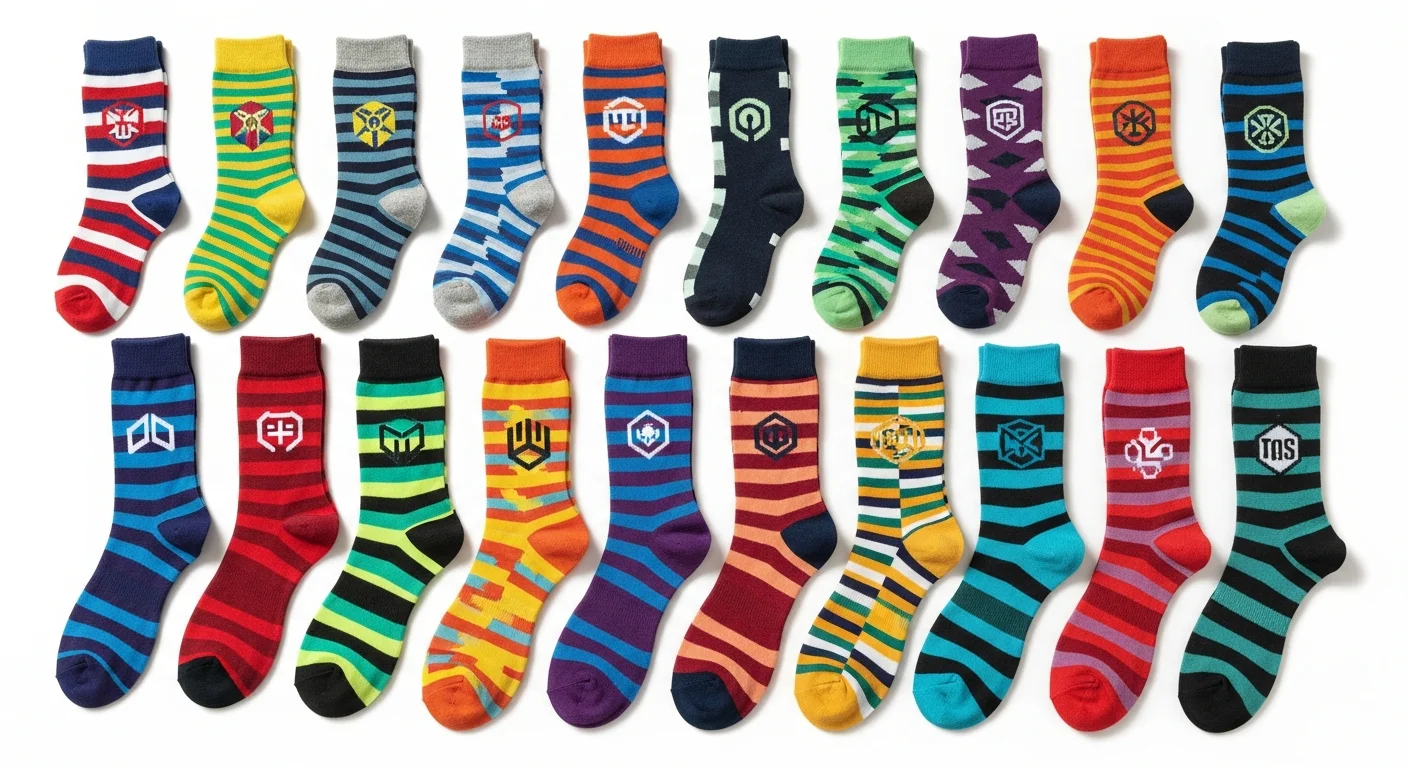
Designing custom socks might seem straightforward — pick a color, slap on a logo, done. But the reality is that socks are three-dimensional, stretch across multiple zones of the foot and leg, and require precise artwork placement to look professional once worn. This guide walks you through every decision from anatomy to artwork to checkout so your first custom sock order arrives exactly as envisioned.
Socks share some design principles with other custom apparel like custom t-shirts, but the canvas is dramatically different. A t-shirt offers a large, flat print area measuring roughly 12 × 14 inches. A sock wraps around a curved foot with a heel turn, toe closure, and ribbed cuff — each zone with its own stretch behavior and visibility. Understanding these zones before you start designing prevents the most common beginner mistakes and ensures your artwork translates beautifully from screen to fabric.
Understanding Sock Anatomy: Cuff, Leg, Heel, and Toe
Every sock is divided into distinct zones, and each zone affects how your design appears when worn. The cuff is the topmost band — typically one to three inches of ribbed knit that holds the sock up. Cuffs use a tighter stitch pattern, which limits design detail in that area. Most cuffs are produced in a 1×1 or 2×1 rib stitch that compresses slightly to grip the calf. The standard cuff width on a crew sock is approximately 1.5 inches, though fashion-forward designs may use a taller 2.5-inch cuff for a chunkier look.
The leg is the main canvas between the cuff and the heel, offering the largest and most visible print area. On a standard crew sock, the leg panel measures roughly 6 × 3.5 inches when laid flat, though the visible area when worn is closer to 5 × 3 inches because the back of the calf is partially hidden by pants or shoes. The leg zone is where your hero design element should live — this is the area that shows when the wearer is standing, sitting, or crossing their legs.
The heel is a reinforced pocket that wraps around the back and bottom of the heel bone. Most manufacturers produce heels in a solid accent color because the complex three-dimensional shaping — called a heel turn — distorts printed images and makes detailed printing difficult. The heel turn involves short rows of knitting that create the cup shape, and any artwork spanning this area will warp unpredictably. The foot bed runs along the bottom of the foot from heel to toe and is rarely visible, so it is typically left as a solid color for comfort. Some brands use the foot bed for a subtle branded message visible only when the sock is removed.
The toe is another reinforced zone similar to the heel, usually produced in a matching accent color. The toe box extends approximately 2 inches from the tip and uses a linked or looped closure seam. Understanding these zones helps you place your most important artwork — logos, text, patterns — where they will actually be seen and where the fabric provides a stable, undistorted printing surface.

Choosing Your Sock Style: Crew, Ankle, Knee-High, and No-Show
The sock style you choose determines how much design real estate you have and who your audience is. Crew socks sit six to eight inches above the ankle and offer the most print area — they are the most popular choice for custom orders, making up roughly 55% of all custom sock sales in 2025. The leg panel on a crew sock gives you approximately 6 × 3.5 inches of printable canvas per side, enough for detailed logos, multi-line text, patterns, and photographic images.
Ankle socks hit just below the ankle bone with a three-to-four-inch leg, giving you a smaller but still visible canvas (roughly 4 × 3 inches) perfect for athletic branding and corporate giveaways. Knee-high socks extend to just below the knee, doubling your design canvas compared to crew socks with up to 12 × 4 inches of printable area. They are ideal for sports teams, marching bands, and fashion-forward brands. No-show socks sit entirely below the shoe line and offer virtually no visible design area, making them better suited for comfort branding (logo on the foot bed) rather than visual design.
For an in-depth comparison of every sock style with sizing data and trend analysis, read the crew vs. ankle vs. knee-high style guide. The style you choose also affects unit cost — no-show socks use the least material and are cheapest ($4-$7 per pair), while knee-high socks use the most material and are the most expensive ($10-$20 per pair).
Setting Up Your Design Canvas
Most custom sock manufacturers provide a flat template that shows the sock unfolded into a two-dimensional rectangle. This template is divided into zones matching the anatomy described above. The standard crew sock template measures approximately 16 inches wide by 4.5 inches tall, representing the full wrap-around circumference of the sock laid flat. Your design occupies this rectangle, and the manufacturer wraps it around the sock during production.
Pay close attention to the template's safe zone markings. Artwork that extends too close to the heel turn or toe seam may distort or get cut off during production. Most templates include a 0.25-inch bleed area on all edges and mark the heel and toe zones as restricted or accent-only areas. Place your most critical design elements — logos, text, focal imagery — in the center of the leg panel where they will sit prominently on the outer calf when worn.
If your design wraps fully around the sock (360-degree coverage), pay special attention to the seam line that runs along the inside of the leg. Designs that cross this seam need careful alignment to avoid a visible mismatch where the two edges meet. Many designers avoid placing critical elements directly on the seam line and instead use repeating patterns that camouflage any minor alignment variation during production.
File Preparation: Resolution, Color Modes, and Bleed
The file requirements for custom socks depend on the printing method. For sublimation and DTG printing, submit artwork at 300 DPI in RGB color mode. The final file should be a PNG or TIFF with a transparent background. Avoid JPEG compression for sock artwork because the small design area makes compression artifacts (blocky areas in gradients and fine details) more visible than on larger garments. Total file size for a crew sock template at 300 DPI typically falls between 15 and 40 MB depending on design complexity.
For knit-in (Jacquard) socks, you will work with a pixel grid rather than a high-resolution image — each pixel represents one stitch, so a typical crew sock design is roughly 200 stitches wide by 85 stitches tall. This creates an intentionally pixelated look that becomes smooth at the small stitch scale. Vector formats (SVG, AI) are ideal for knit-in because the manufacturer can convert them to the stitch grid accurately without losing detail.
Color accuracy matters more with socks than with most garments because the small canvas makes color shifts more noticeable. Request a Pantone color match if your brand has specific color standards. Most manufacturers can match to within one shade of a Pantone reference for an additional $25-$50 setup fee. If your design uses gradients, sublimation or DTG is required — knit-in construction cannot produce smooth gradients and is limited to approximately eight to twelve distinct colors per design.
Using a Design Tool to Place Your Artwork
Online sock design tools let you upload artwork, position it on a 3D sock mockup, and preview how the finished product will look from multiple angles. Start by selecting your sock style (crew, ankle, knee-high) and base color, then upload your logo or pattern. Most tools offer snap-to-grid alignment and automatic centering to keep your design balanced across both the left and right sock.
When placing text, keep font sizes above 14 points for sublimation and above 24 points for knit-in to maintain legibility. Small, thin fonts lose detail when knitted and can appear muddy when sublimated onto textured fabric. Sans-serif fonts generally perform better on socks than serifs because the simpler letterforms translate more cleanly at small sizes. For typography recommendations tailored to socks, see the best fonts and patterns for custom sock design guide.
Take advantage of the 3D preview to check how your design looks from the front, back, left side, and right side. Designs that look perfect on a flat template can sometimes appear unbalanced when wrapped around a three-dimensional foot shape. Pay particular attention to how the design interacts with the heel turn — any elements near the heel edge should be checked for distortion in the 3D view.

Reviewing Your Proof and Placing the Order
Before production begins, you will receive a digital proof showing your design on a flat template and usually a 3D rendering. Check every detail: logo positioning relative to the heel and toe zones, text legibility, color accuracy against your brand guidelines, and symmetry between left and right socks. If your order includes multiple sizes, verify that the design scales proportionally — a logo that looks perfect on a men's large may appear slightly compressed on a women's small due to the reduced circumference.
Request a physical sample if your order exceeds 200 pairs or if this is your first time working with a new manufacturer. A sample pair costs $15-$30 and takes one to two weeks to produce, but it reveals issues that digital proofs cannot — fabric texture, color vibrancy on the actual material, heel fit, and cuff elasticity. This small investment can prevent costly reprints and returns on a large order.
Minimum order quantities vary by printing method. Sublimation typically starts at 50 to 100 pairs, knit-in at 100 to 200 pairs, and DTG at 12 to 25 pairs. Unit pricing drops significantly at higher volumes — a crew sock that costs $12 per pair at 50 units might drop to $6 per pair at 500 units. For exact pricing breakdowns and volume discount tiers, consult your manufacturer's quote tool. Before committing to a large order, see the sizing guide to ensure every pair fits properly across your size range.
Frequently Asked Questions
Do you need design software to create custom socks?
No. Most custom sock providers offer browser-based design tools with drag-and-drop interfaces. You upload your artwork as a PNG, JPEG, or vector file, position it on the template, choose colors, and preview the result in 3D. No software downloads, plugins, or design experience required. Advanced users who prefer to work in Adobe Illustrator or Photoshop can download the manufacturer's template file and submit a finished design directly.
What is the best file format for custom sock artwork?
For sublimation and DTG socks, use a PNG or TIFF at 300 DPI with a transparent background. For knit-in Jacquard socks, submit a vector file (SVG or AI) or a clean pixel-art-style image with limited colors. Vector formats scale cleanly and let the manufacturer convert to their stitch grid accurately without losing sharpness or introducing artifacts.
How many colors can you use on a custom sock?
Sublimation and DTG allow unlimited colors including gradients and photographic imagery at no extra per-color cost. Knit-in Jacquard socks are limited to eight to twelve colors per design because each color requires a separate yarn feed in the knitting machine. More colors increase production cost by $0.50-$1.00 per pair and add one to two days of lead time per additional color beyond eight.
How long does it take to receive custom socks after ordering?
Production timelines range from two to six weeks depending on the method and order size. DTG orders with low minimums typically ship in two to three weeks. Sublimation orders ship in three to four weeks. Knit-in Jacquard socks take four to six weeks due to the yarn setup and knitting process. Rush production is available from most manufacturers for an additional 15-25% surcharge, cutting one to two weeks off the standard timeline.
Share this article
Written by
Jordan Reeves
Brand Experience Strategist at RareCustom. BFA in Graphic Design from Parsons School of Design with 8+ years helping brands craft visual identities. Specialist in color theory, layout composition, and design systems.