Custom Sock Fabric Guide: Cotton, Bamboo, Merino Wool & Performance Blends
Explore every custom sock fabric option from combed cotton and bamboo to merino wool and performance polyester blends. Includes GSM weight guide and printing method compatibility.
Aisha Patel
Head of Materials Science & Sustainability at RareCustom. M.S. in Textile Engineering from NC State with AATCC certification and ISSP Sustainability Practitioner certification. 7+ years evaluating fabrics, materials, and eco-friendly production processes.
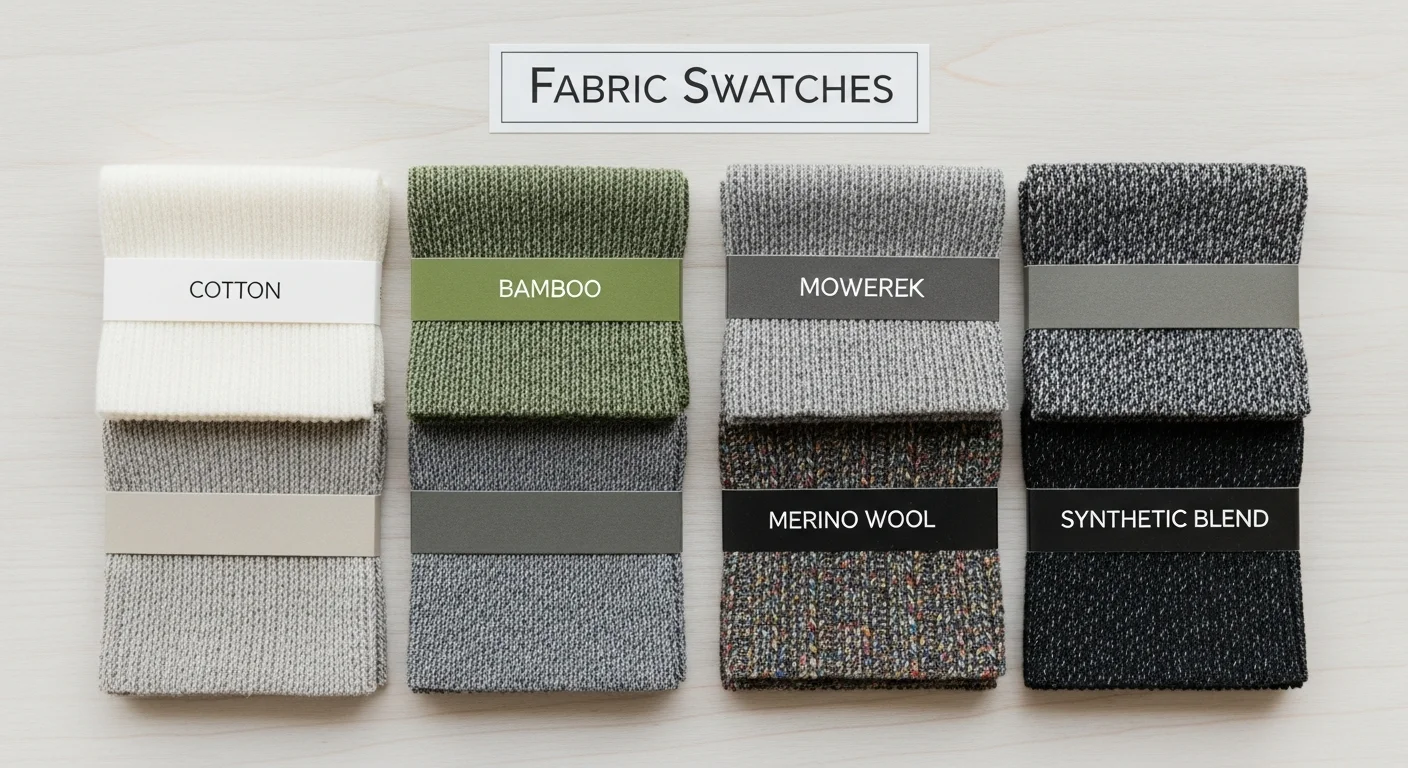
The fabric you choose for custom socks determines everything your customer feels — literally. Softness, breathability, moisture management, stretch recovery, cushioning, and durability all come down to fiber selection and blend ratios. The wrong fabric turns a beautifully designed sock into an uncomfortable product that gets shoved to the back of a drawer after one wear. The right fabric makes your custom socks a daily favorite that keeps your brand on someone's feet — and in their mind — for years.
This guide covers every major sock fiber from everyday combed cotton to premium merino wool, including blend ratios, GSM weight ranges, printing method compatibility, and cost implications. Whether you are designing athletic performance socks, eco-conscious lifestyle products, or premium corporate gift sets, this fabric breakdown ensures your material choice matches your design goals, target audience, and budget.
Combed Cotton and Ringspun Cotton
Cotton is the most familiar sock fiber, and for good reason — it is soft, breathable, affordable, and available worldwide. Combed cotton has been processed through fine brushes that remove shorter fibers and impurities, resulting in a smoother, stronger yarn that resists pilling. The combing process removes approximately 15% of the raw fiber by weight. Ringspun cotton is twisted more tightly during spinning, creating a finer, softer yarn with better durability. Both are excellent choices for everyday custom socks and casual wear.
A typical cotton sock blend uses 75-80% combed cotton, 15-20% polyester or nylon for structural reinforcement, and 3-5% spandex for stretch. The polyester component adds durability in high-wear zones and helps the sock maintain its shape after washing. Pure 100% cotton socks tend to lose their form quickly, bag around the ankle, and dry slowly — making them a poor choice for athletic applications.
Cotton socks are best produced using the knit-in Jacquard method, which preserves the natural softness and breathability of the fiber without adding any surface coating or ink layer. DTG printing also works well on cotton blends, producing vibrant colors with good adhesion on the cotton surface. Sublimation is not compatible with cotton because sublimation dye requires polyester fibers to bond — the dye simply washes out of cotton after a few laundering cycles. If you want cotton socks with full-color photographic designs, DTG is the only viable printing method. Unit pricing for combed cotton custom socks ranges from $5 to $10 per pair at 100+ unit volumes, making cotton the most budget-friendly natural fiber option for custom orders.
Bamboo Fiber: Eco-Friendly Performance
Bamboo viscose has become one of the fastest-growing sock fibers, prized for its exceptional softness, natural antimicrobial properties, and sustainability story. Bamboo yarn is approximately 40% more absorbent than cotton, wicking moisture away faster and reducing the bacterial growth responsible for foot odor. The fiber is naturally smooth and round, producing less friction against the skin than cotton or wool.
Custom bamboo socks typically use a blend of 70-80% bamboo viscose, 15-20% polyester or nylon, and 3-5% spandex. Bamboo socks feel noticeably silkier than cotton — the hand feel is often compared to cashmere — and they drape more smoothly around the foot, giving them a premium quality that customers notice immediately.
From a sustainability perspective, bamboo grows without pesticides, uses 30% less water than cotton, and is biodegradable. For brands targeting eco-conscious consumers, bamboo socks offer a compelling environmental narrative. Bamboo is compatible with knit-in and DTG methods but not sublimation. Expect a 15-25% premium over cotton — a bamboo crew sock at 100 pairs typically costs $7 to $12 per pair.

Merino Wool: Temperature Regulation
Merino wool is the premium choice for custom socks, offering unmatched temperature regulation, odor resistance, and moisture management. Unlike standard sheep wool, merino fibers are extremely fine (17-19 microns versus 30-40 for regular wool) and do not feel itchy against the skin. Merino absorbs up to 30% of its weight in moisture vapor without feeling wet, then releases it as conditions change — keeping feet warm in cold weather and cool in heat. This thermoregulation works in both directions, making merino socks a genuine four-season fiber rather than a cold-weather-only material.
A high-performance merino sock blend uses 55-70% merino wool, 25-35% nylon for abrasion resistance, and 3-5% spandex. The nylon is critical because pure merino wears through quickly in high-friction zones like the heel and ball of the foot. Reinforced heel and toe areas with higher nylon content (up to 50% in those zones) extend the lifespan from months to years of daily wear.
Merino also has natural antimicrobial properties that resist odor buildup even after multiple consecutive days of wear — a property that makes merino socks popular among hikers, travelers, and anyone who values freshness over extended use. Unlike synthetic fibers that trap odor-causing bacteria, merino wool fibers absorb moisture vapor and release it before bacteria can colonize, resulting in socks that stay fresh significantly longer between washes.
Merino custom socks are exclusively produced using the knit-in Jacquard method. Neither sublimation nor DTG works on wool fibers. This limits designs to eight to twelve colors with no gradients, but the premium material quality compensates for the design constraints. Merino socks are ideal for outdoor brands, hiking and skiing teams, corporate premium gifts, and compression sock applications. Pricing reflects the premium fiber — $12 to $22 per pair at 100+ units, with organic-certified merino at the higher end of that range.
Polyester and Nylon Blends: Sublimation Compatibility
Polyester-dominant socks are engineered for sublimation printing and athletic performance. A typical sublimation-ready sock uses 80-100% polyester with 0-15% nylon and 3-5% spandex. Modern microfiber polyester rivals cotton in softness while offering superior moisture-wicking, faster drying, and better color retention through wash cycles.
The key advantage is print compatibility. Sublimation dye bonds into polyester fibers at a molecular level, producing the most vivid, durable designs possible — including full photographic images, unlimited gradients, and seamless 360-degree coverage. If your design requires photographic imagery or edge-to-edge color, polyester is the only viable base fabric.
Polyester socks are the most affordable option for complex designs, with unit pricing starting at $5 to $8 per pair at 100+ units. They are standard for promotional socks, event giveaways, and retail novelty products. For higher-end applications, look for microdenier polyester — finer fibers that produce a softer texture while maintaining full sublimation compatibility.
Spandex and Elastane: Stretch and Recovery
Spandex (also marketed as Lycra or elastane) is blended into every quality sock at 2-5% to provide stretch and elastic recovery. Without spandex, socks would bag and lose their shape after a single wearing. Higher spandex content (5-8%) is used in compression socks where a snug fit is essential. Lower content (2-3%) suits casual and dress socks. Spandex does not affect printing compatibility with any method.
GSM Weight Guide
GSM (grams per square meter) measures fabric weight and density, providing a standardized way to compare sock thickness across different fiber types and manufacturers. Lighter GSM socks are thinner, more breathable, and less cushioned; heavier GSM socks are thicker, warmer, and more padded underfoot. Choosing the right weight depends on the intended season of use, activity level, footwear pairing, and customer comfort preference.
Lightweight (100-140 GSM): Thin dress socks, summer no-show socks, and cycling-specific socks. Minimal cushioning with maximum breathability and a sleek profile that fits comfortably inside fitted shoes without adding bulk. Best for formal wear, warm climates, and activities where shoe fit is tight. Mid-weight (140-200 GSM): The most versatile range covering everyday crew socks, athletic training socks, and all-season casual wear. Moderate cushioning in the heel and toe with good breathability through the leg and instep. This is the sweet spot for approximately 70% of custom sock orders. Heavyweight (200-300 GSM): Thick, heavily cushioned socks for hiking, skiing, snowboarding, cold-weather athletics, and work boot socks. Maximum warmth and shock absorption with reduced breathability. Often paired with merino wool or terry-loop interior construction for added cushioning and insulation underfoot. These socks feel noticeably thicker and may require a half-size larger shoe to accommodate the added volume.

Matching Fabric to Printing Method
Your fabric choice directly constrains — or expands — your printing options, so these two decisions should be made together rather than sequentially. Here is a quick compatibility summary. Polyester and polyester-dominant blends (65%+ polyester) are compatible with all three methods: sublimation, DTG, and knit-in. Cotton and cotton-dominant blends work with DTG and knit-in but are incompatible with sublimation. Bamboo viscose is compatible with DTG and knit-in but not sublimation. Merino wool works exclusively with knit-in construction.
If you are choosing your fabric and printing method simultaneously, start with the design rather than the fiber. Photographic or gradient-heavy designs require sublimation, which in turn requires polyester fabric. Simple logos, geometric patterns, and text-based designs open up knit-in construction with any fiber type. Small-batch orders with complex full-color designs on natural fibers point to DTG as the only viable method. For a complete method comparison with cost and durability data, see the printing methods guide. For help choosing between similar fabrics in the custom hoodie category, many of the same fiber selection principles apply — and the jersey fabric guide covers performance polyester in even greater detail for athletic applications.
Frequently Asked Questions
What is the best fabric for everyday custom socks?
Combed cotton blended with 15-20% polyester and 3-5% spandex offers the best balance of softness, durability, breathability, and affordability for everyday wear. This blend is compatible with knit-in and DTG printing methods and costs $5 to $10 per pair at 100+ unit volumes. For a slight upgrade in softness and moisture management, bamboo viscose blends offer a premium feel at a 15-25% cost increase.
Are bamboo socks really more sustainable than cotton?
Bamboo requires 30% less water to grow than cotton, needs no pesticides or synthetic fertilizers, regenerates from its own root system without replanting, and is fully biodegradable at end of life. However, the chemical process of converting raw bamboo stalks into viscose fiber involves solvents like sodium hydroxide and carbon disulfide. Closed-loop production systems (like the lyocell process used by responsible manufacturers) recapture 99%+ of these solvents for reuse, making bamboo socks significantly more sustainable than conventional cotton when sourced from certified producers.
Can merino wool socks be machine washed?
Yes, but with care. Wash merino socks on a gentle or wool-specific cycle with cold water (below 30°C / 86°F) and a mild, pH-neutral detergent. Air dry flat rather than hanging (which can stretch the fibers) or tumble drying on high heat (which causes felting and irreversible shrinkage). Avoid bleach and fabric softeners. Quality merino sock blends with 25%+ nylon reinforcement handle machine washing well when these guidelines are followed, maintaining their shape and softness through dozens of wash cycles.
Which sock fabric works best for sublimation printing?
100% polyester produces the most vibrant, color-accurate sublimation results because every fiber in the sock accepts the dye equally. Blends with 65% or more polyester content also produce acceptable results but may show slightly muted colors or a subtle heathered effect where non-polyester fibers are present (since those fibers do not absorb the sublimation dye). Cotton, bamboo, and merino wool are completely incompatible with sublimation because the dye requires synthetic polyester fibers to bond at the molecular level.
Share this article
Written by
Aisha Patel
Head of Materials Science & Sustainability at RareCustom. M.S. in Textile Engineering from NC State with AATCC certification and ISSP Sustainability Practitioner certification. 7+ years evaluating fabrics, materials, and eco-friendly production processes.