Custom T-Shirt Size Guide: How to Get the Perfect Fit Every Time
Master our custom t-shirt size guide with measurement tips, size charts, fit comparisons, and group ordering strategies for men, women, youth, and plus sizes.
Tony Vu
Founder & President of RareCustom. Tony has personally evaluated thousands of garment samples across dozens of suppliers, building the sizing expertise that helps RareCustom customers find their perfect fit every time.
Ordering custom t-shirts is exciting until you open the box and realize half your order does not fit the way you expected. Sizing is the single most common source of disappointment in custom apparel, and it does not have to be. A custom t-shirt size guide that covers measuring techniques, size chart interpretation, fit variations, and fabric shrinkage puts you in control of the outcome and ensures every shirt feels as good as it looks.
Whether you are ordering a single shirt for yourself, coordinating sizes for a team of fifty, or launching a print-on-demand business that needs to serve customers of every body type, this comprehensive sizing guide gives you the knowledge to get the perfect fit every time. We cover men's, women's, unisex, youth, and plus-size considerations so no one in your group gets left behind.
Why Sizing Matters More Than You Think
The difference between a custom shirt someone wears proudly and one that stays folded in a drawer often comes down to fit. A shirt that is too tight feels uncomfortable and unflattering. A shirt that is too loose looks sloppy and swallows the carefully designed print you spent hours creating. Getting the correct t-shirt fit is not just about comfort; it directly affects how your design is displayed and perceived.
For businesses and organizations ordering custom shirts for groups, sizing mistakes have financial consequences. Returns, exchanges, and reorders cost money and time. More importantly, they create frustration among the people you are trying to impress, whether those are employees, event attendees, customers, or team members. A well-fitting shirt communicates professionalism and attention to detail, while a poorly fitting one does the opposite.
Sizing also affects print placement and design appearance. A design that looks perfectly centered on a medium shirt may shift awkwardly on an XXL because the proportional relationship between the design and the garment changes. Understanding how designs scale across sizes helps you adjust artwork or placement to ensure consistency across your entire size run.
How to Measure Yourself for a Custom T-Shirt

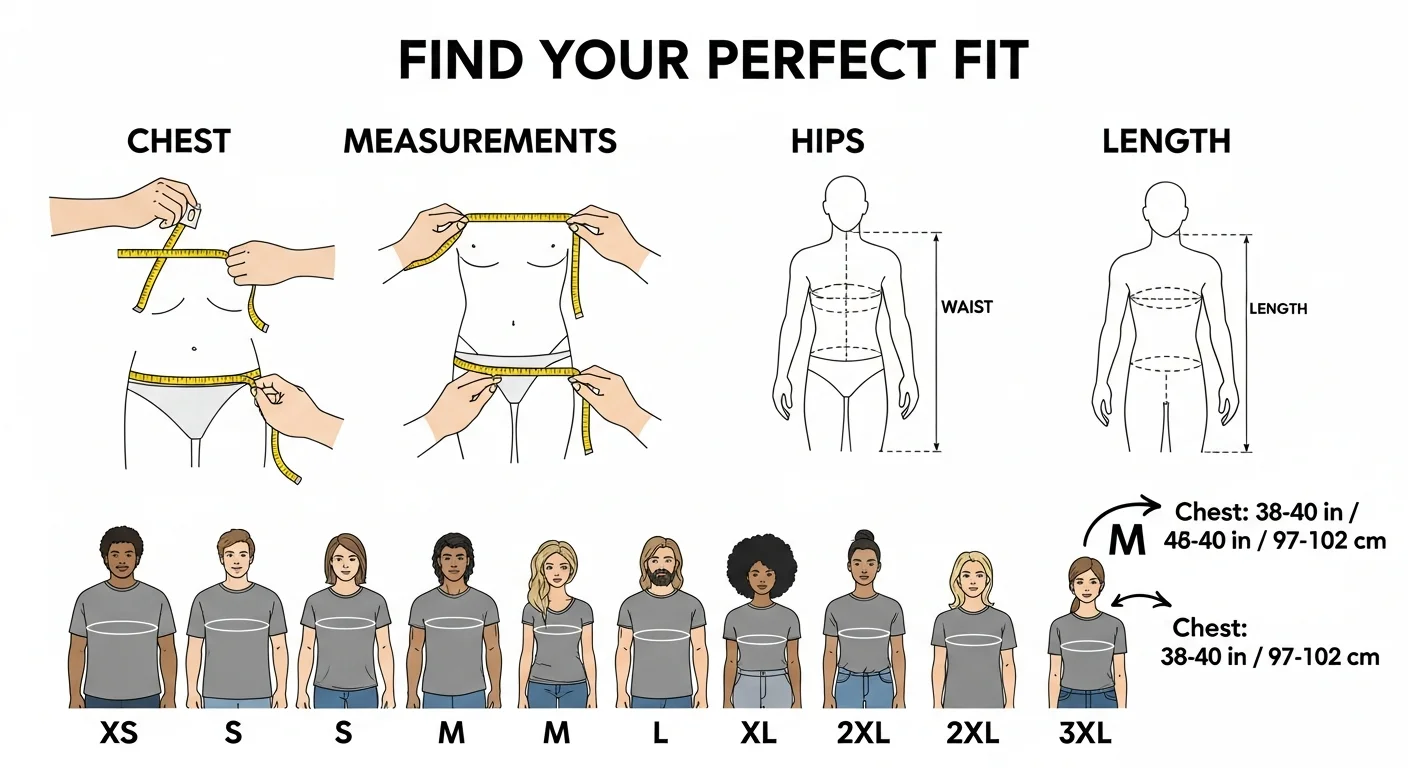
Accurate measurements are the foundation of getting the right fit. Here is how to measure yourself using a flexible tape measure, or a piece of string that you can measure against a ruler.
Chest Width
The chest measurement is the most important dimension for t-shirt sizing. Stand straight with your arms relaxed at your sides. Wrap the tape measure around the fullest part of your chest, typically just under your armpits and across your shoulder blades. Keep the tape snug but not tight. Record the measurement in inches. This number corresponds to the chest measurement on most size charts and determines your base size.
Body Length
Measure from the highest point of your shoulder, near the base of your neck, straight down to where you want the shirt to end. For a standard fit, this is typically at mid-hip level. For a longer, more relaxed fit, measure to upper thigh. Body length preferences vary significantly between individuals, so knowing your preferred length helps you choose between standard and tall sizing options.
Sleeve Length
For standard crew neck t-shirts, sleeve length is less critical than for long-sleeve or performance garments. However, if you have a preference for how your sleeves fall, measure from the shoulder seam to your desired endpoint on the upper arm. Most standard t-shirt sleeves hit at mid-bicep, while slim-fit styles tend to run slightly shorter.
Using a Favorite Shirt as Reference
One of the easiest ways to find your ideal size is to lay a well-fitting t-shirt flat on a table and measure it. Measure the chest width from armpit seam to armpit seam across the front, then double it. Measure the length from the highest point of the shoulder to the bottom hem. Compare these measurements against the size chart of the specific brand and style you are ordering. This method accounts for your personal fit preferences because you are measuring a shirt you already know fits you well.
Understanding T-Shirt Size Charts
Size charts are your best friend when ordering custom apparel, but they can be confusing because sizing varies between brands, styles, and garment types. A medium in one brand may fit like a large in another. Always reference the specific size chart for custom shirts you are ordering rather than assuming your usual size will apply.
| Size | Chest Width (inches) | Body Length (inches) | Fits Chest (inches) |
|---|---|---|---|
| S | 18 | 28 | 34-36 |
| M | 20 | 29 | 38-40 |
| L | 22 | 30 | 42-44 |
| XL | 24 | 31 | 46-48 |
| 2XL | 26 | 32 | 50-52 |
| 3XL | 28 | 33 | 54-56 |
Note: This is a representative unisex size chart. Actual measurements vary by brand and style. The "Chest Width" column refers to the garment laid flat, measured from armpit to armpit. The "Fits Chest" column indicates the body chest circumference the size is designed to accommodate with a standard fit.
When reading a size chart, pay attention to whether the measurements reference the garment itself or the body measurements the garment fits. Some charts show flat garment dimensions, while others show the recommended body measurements. Confusing these two formats is a common source of ordering the wrong size.
Men's vs Women's vs Unisex Sizing

Understanding the differences between men's, women's, and unisex t-shirt sizing is essential for ordering custom shirts that fit everyone in a mixed group.
Men's Sizing
Men's t-shirts are cut with broader shoulders, a straighter body line from chest to hem, and longer sleeves and body length compared to women's styles. The fit is designed to accommodate a wider range of body types with a boxy, relaxed silhouette. Men's sizes run from small through 5XL or larger with most brands.
Women's Sizing
Women's t-shirts feature a contoured cut with narrower shoulders, a tapered waist, and a slightly shorter body length. Sleeve openings are typically smaller and sleeves are shorter. Women's sizing uses a different number scale, and a women's medium is significantly smaller than a men's medium. If you are ordering for a mixed group, do not assume the same size label means the same measurements across gendered cuts.
Unisex Sizing
Unisex t-shirts are the most popular choice for group orders because they eliminate the complexity of managing two separate size runs. Unisex shirts are generally cut similarly to men's sizing with a slightly more relaxed fit through the torso. Women who prefer a more fitted look typically size down one from their usual men's or unisex size. A woman who wears a women's medium often finds a unisex small or extra-small most comfortable.
For group orders where simplicity is paramount, unisex sizing is the recommended approach. It reduces the number of SKUs to manage, simplifies the ordering process, and ensures everyone can find a comfortable fit. If fit-consciousness is a high priority for your group, offering both unisex and women's cut options in the same design gives everyone the best possible experience.
Youth Sizing for Kids' Custom Shirts
Youth t-shirt sizing follows its own scale that does not correspond to adult sizes. Understanding youth sizing is critical for school spirit wear, kids' birthday parties, family reunions, and any custom shirt project that includes children.
| Youth Size | Age Range (Approx.) | Chest Width (inches) | Body Length (inches) |
|---|---|---|---|
| YXS (2-4) | 2-4 years | 13 | 17 |
| YS (6-8) | 5-7 years | 15 | 20 |
| YM (10-12) | 8-10 years | 17 | 22 |
| YL (14-16) | 11-13 years | 19 | 25 |
| YXL (18-20) | 14-16 years | 20 | 27 |
Age ranges are approximate because children grow at vastly different rates. Always recommend that parents measure their child's current best-fitting shirt rather than relying solely on age. For school and organizational orders involving children, our schools and spirit wear guide includes additional sizing tips for youth groups.
Plus Size Considerations
Inclusive sizing is not optional; it is essential for any custom shirt project that serves a diverse group. Plus size custom t-shirts require attention to both measurement accuracy and garment construction to ensure comfort and a flattering appearance for all wearers.
Extended sizes from 2XL through 6XL are available from most quality blank shirt manufacturers. However, not all extended sizes are created equal. Some brands simply scale up the pattern proportionally, resulting in shirts that are proportionally wider but not proportionally longer. This creates an unflattering fit for taller plus-size individuals. Look for brands that offer both wide and tall variations in extended sizes.
Design placement should also be adjusted for larger sizes. A design that looks proportionally balanced on a medium shirt can appear too small and high on a 3XL. Consider scaling your design up by ten to fifteen percent for sizes 2XL and above, or repositioning the design slightly lower on the chest to maintain visual balance. These adjustments show thoughtfulness and ensure every recipient feels included rather than afterthought.
Slim Fit vs Regular Fit vs Oversized: Choosing Your Style
Beyond size numbers, t-shirt fit style dramatically affects how a garment looks and feels on different body types. Understanding the three primary fit categories helps you select the right style for your custom project.
Slim fit shirts are cut closer to the body with narrower shoulders, shorter sleeves, and a tapered torso. They create a modern, fashion-forward silhouette that looks polished and put-together. Slim fit is popular for branded merchandise, retail t-shirt lines, and events where style is a priority. However, slim fit is less forgiving for a wide range of body types, making it a risky choice for group orders where comfort across all sizes is important.
Regular fit shirts offer a classic, versatile silhouette with moderate ease through the chest and torso. They are neither tight nor baggy, providing a comfortable middle ground that flatters most body types. Regular fit is the safest choice for group orders, promotional shirts, and any project where you need universal satisfaction across sizes small to 3XL and beyond.
Oversized fit shirts are intentionally cut larger with dropped shoulders, extended body length, and a boxy silhouette. This style has surged in popularity driven by streetwear trends and a cultural shift toward comfort-first fashion. Oversized shirts work well for casual brand merchandise and younger demographics. When ordering oversized, size down one from your usual size to get the intended relaxed look without being excessively large.
Fabric Shrinkage Factors
The fabric composition of your chosen shirt directly affects how much it will shrink after washing, which means fabric shrinkage should factor into your sizing decisions. Ignoring shrinkage can turn a perfectly fitting shirt into an uncomfortably tight one after just a few wash cycles.
One hundred percent cotton shirts are the most susceptible to shrinkage. They can shrink three to five percent in both width and length after the first hot wash and tumble dry. This means a shirt that fits perfectly out of the package may become noticeably tighter and shorter after a single laundry cycle. If you know the shirts will be washed in warm or hot water, consider sizing up a half size to account for shrinkage.
Cotton-polyester blends (such as the popular 50/50 or 60/40 blends) shrink less than pure cotton, typically one to three percent. The polyester content stabilizes the fabric and reduces dimensional change. Tri-blend fabrics (cotton, polyester, and rayon) shrink the least of all common t-shirt fabrics, making them a reliable choice when consistent sizing across multiple washes is important.
One hundred percent polyester shirts experience virtually zero shrinkage because synthetic fibers do not contract when exposed to heat and water. If consistent sizing over the life of the garment is your top priority, polyester is the most dimensionally stable option. For more detail on how different fabrics perform, read our fabric guide for custom printing.
Ordering Samples Before a Large Run
Sample ordering is one of the smartest investments you can make before committing to a large custom shirt order. Spending twenty to thirty dollars on two or three sample shirts in different sizes can save you hundreds or thousands of dollars in returns, exchanges, and disappointed recipients.
When you order samples, request the exact same blank shirt brand and style that your production run will use. Wash and dry each sample according to the care instructions before evaluating the fit. This gives you an accurate picture of how the finished shirts will look and feel after real-world use, including any shrinkage that occurs.
Have multiple people try on the samples and provide feedback. What feels like a perfect medium to one person may feel too tight or too loose to another. Gathering input from a small test group helps you calibrate your size recommendations for the broader order. If you are running a business, sample testing also lets you take product photos and create accurate fit descriptions for your customers.
Group Ordering Size Collection Tips
Collecting accurate sizes from a group of people is one of the most operationally challenging parts of ordering custom shirts for teams, events, and organizations. The following strategies streamline the process and reduce sizing errors.
Use a digital size survey. Create a simple Google Form or similar survey that includes a link to the specific size chart for the shirts you are ordering. Ask each person to measure themselves or reference a well-fitting shirt before selecting their size. Set a firm deadline for responses and send reminder messages two days before the cutoff.
Include a size chart in the survey. Do not assume people know their size. Embed the actual measurements alongside the size labels so respondents can make an informed choice rather than guessing. Many people order the wrong size simply because they do not realize that a medium from Brand A is different from a medium from Brand B.
Order a buffer. Always add five to ten percent extra shirts in the most popular sizes (typically medium, large, and extra-large). These extras handle late additions, size exchanges, and the inevitable few people who change their minds. For group ordering best practices, consult our bulk ordering checklist.
Set an exchange policy. Communicate clearly before ordering that size exchanges may be available but are subject to availability and additional shipping time. Setting expectations upfront reduces complaints and gives people an incentive to provide accurate sizing information the first time.
International Size Conversion
If your group or customer base spans multiple countries, international size conversion adds another layer of complexity to the sizing process. T-shirt sizing standards vary significantly between the United States, Europe, the United Kingdom, and Asia.
| US Size | EU Size | UK Size | Chest (inches) |
|---|---|---|---|
| XS | 44 | 34 | 32-34 |
| S | 46 | 36 | 34-36 |
| M | 48-50 | 38-40 | 38-40 |
| L | 52-54 | 42-44 | 42-44 |
| XL | 56 | 46 | 46-48 |
| 2XL | 58-60 | 48-50 | 50-52 |
When ordering for an international group, always provide chest measurements in both inches and centimeters alongside size labels. This removes the guesswork from conversion and ensures everyone can find their correct size regardless of which sizing system they are accustomed to.
Common Sizing Mistakes to Avoid
Even experienced custom shirt buyers fall into common sizing traps that lead to disappointing results. Here are the mistakes we see most frequently and how to avoid them:
Assuming your usual size applies to every brand. A Gildan 5000 medium fits differently from a Bella+Canvas 3001 medium. Always check the specific size chart for the blank you are ordering. Brand-specific sizing variations can represent a full inch or more difference in chest width.
Ignoring shrinkage. If you are ordering one hundred percent cotton shirts and plan to wash them in warm water, size up. The three to five percent shrinkage in cotton can turn a comfortable fit into a too-tight shirt after just one laundry cycle.
Ordering too few sizes for a group. Offering only small through extra-large excludes people who need 2XL, 3XL, or above. Always include extended sizes in your group orders. Exclusion is never a good look for any organization.
Not accounting for unisex vs gendered sizing differences. A woman who normally wears a women's medium should typically order a unisex small. Failing to communicate this guidance leads to oversized shirts for women and dissatisfaction with the overall order. For more ordering pitfalls, see our complete custom t-shirt mistakes to avoid guide.
Frequently Asked Questions
How do I know if I should order a unisex or women's cut?
If you prefer a relaxed, boxy fit, go with unisex sizing. If you prefer a tapered waist and contoured silhouette, choose the women's cut. For group orders, offering both options in the same design is the most inclusive approach. Most women size down one from their unisex size (e.g., women's M typically corresponds to unisex S).
Do custom t-shirts shrink more than store-bought shirts?
No, shrinkage is determined by the blank shirt fabric, not the printing process. A custom printed t-shirt on a 100% cotton blank will shrink the same amount as an unprinted version of that same blank. DTG, screen printing, and vinyl do not affect shrinkage. Polyester and blended fabrics shrink less than pure cotton.
What size should I order if I am between two sizes?
If you are between sizes, we generally recommend sizing up. It is easier to wear a slightly loose shirt comfortably than a too-tight one. If you prefer a fitted look, consider ordering a slim-fit style in the larger size rather than the regular fit in the smaller size.
How do I handle sizing for a group with a wide range of body types?
Send a digital size survey with the specific size chart embedded, set a response deadline, and order five to ten percent extra in the most popular sizes. Offering both unisex and women's cuts accommodates the widest range of body types and preferences. For detailed group ordering strategies, visit our how it works page.
Get the Perfect Fit with RareCustom
Finding the right custom t-shirt size should not feel like a guessing game. With accurate measurements, the right size chart, and an understanding of fit styles and fabric behavior, every custom shirt you order can feel like it was made just for you. RareCustom provides detailed size charts for every blank in our catalog, free design previews across all sizes, and a responsive support team ready to help with sizing questions. Start your order with confidence using our free design tool and get perfectly fitting custom t-shirts delivered with free shipping and no minimums.
Related Articles
Share this article
Written by
Tony Vu
Founder & President of RareCustom. Tony has personally evaluated thousands of garment samples across dozens of suppliers, building the sizing expertise that helps RareCustom customers find their perfect fit every time.