DTF vs Sublimation vs Vinyl: Advanced Printing Methods Compared
Compare DTF, dye sublimation, and heat transfer vinyl printing for custom t-shirts. Durability, cost, color range, and which method fits your project best.
Terrence Okafor
Head of Production at RareCustom. SGIA certified with expertise in every major printing technology. Terrence evaluates and compares printing methods to help customers make informed choices.
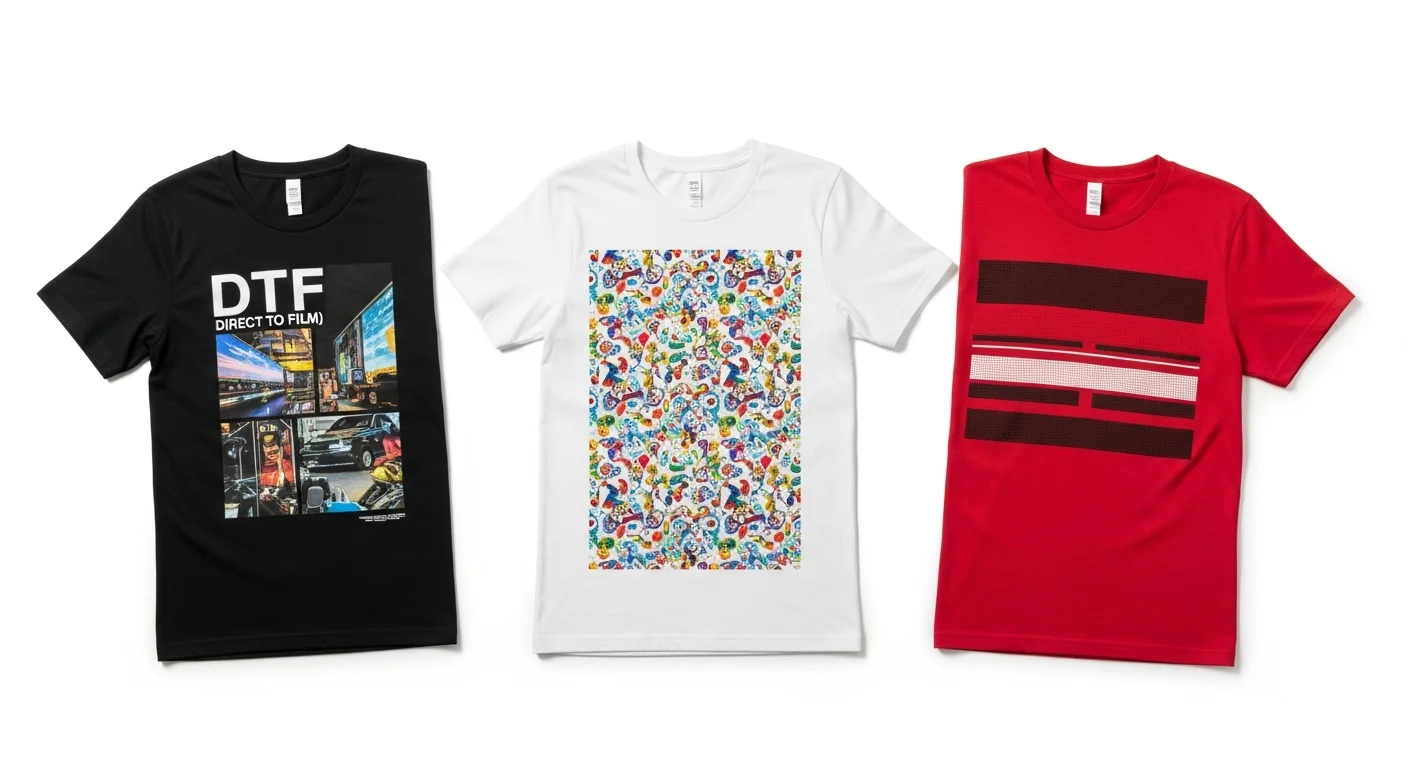
If you have already explored screen printing and DTG for your custom t-shirts, you may be wondering about the other printing methods that have been gaining traction in the custom apparel industry. DTF (direct to film), dye sublimation, and HTV (heat transfer vinyl) each occupy a distinct niche in the market, and understanding their strengths, limitations, and ideal use cases helps you choose the right method for every project.
This guide provides a comprehensive side-by-side comparison of these three advanced printing methods. We will cover how each process works, compare them across key performance metrics, and help you determine which method best fits your specific needs based on fabric type, order size, design complexity, and budget. If you have already read our screen printing vs DTG comparison, consider this guide the next chapter in your printing education.
What Is DTF (Direct to Film) Printing?

Direct to Film printing is the newest of the three methods and has rapidly become one of the most versatile options in custom apparel. The process works by printing a design onto a special PET film using CMYK inks plus white ink, applying a hot-melt adhesive powder to the wet ink, curing the powder, and then heat-pressing the completed transfer onto the garment.
The defining advantage of DTF is its universal fabric compatibility. Unlike sublimation, which only works on polyester, and unlike DTG, which works best on cotton, DTF transfers can be applied to virtually any fabric: cotton, polyester, blends, nylon, denim, canvas, and even leather. The prints are vibrant, durable, and maintain excellent detail across fine text and complex graphics.
DTF prints have a slightly different hand feel compared to DTG. The transfer sits on top of the fabric surface rather than being absorbed into the fibers, creating a smooth, slightly raised texture that some customers prefer and others find less desirable than the softer feel of a DTG print. However, modern DTF technology has significantly reduced the thickness and stiffness of the transfer layer, making it far more comfortable than earlier generations of heat transfer printing.
From a cost perspective, DTF is competitive for small to medium order quantities. There are no screen setup fees like screen printing, no garment pre-treatment required like DTG, and no fabric restrictions like sublimation. This makes DTF an excellent all-around choice for businesses that handle diverse product lines across different fabric types.
What Is Dye Sublimation Printing?
Dye sublimation is a heat-based printing method where special inks are printed onto transfer paper and then heated to approximately 400 degrees Fahrenheit. At that temperature, the inks transform from a solid directly into a gas (skipping the liquid phase), which penetrates the polyester fibers and bonds permanently at a molecular level. When the fabric cools, the gas reverts to a solid state, locking the color into the fibers permanently.
The result is a print that is literally part of the fabric. Sublimated prints will never crack, peel, or fade because there is no ink layer sitting on top of the garment. The colors are extraordinarily vibrant, the detail is photographic, and the printed area feels identical to the unprinted fabric because there is no additional layer. This makes sublimation the gold standard for all-over print designs, performance athletic wear, and any application where hand feel and color vibrancy are paramount.
The critical limitation of sublimation is fabric compatibility. The process only works on polyester or polyester-coated substrates, and only on white or very light-colored garments. The sublimation inks are transparent, meaning they rely on the white fabric to reflect color. On dark garments, the colors simply do not show up. This fabric restriction is the primary reason sublimation has not replaced other printing methods despite its superior print quality. For a deep dive into how fabric choice impacts printing outcomes, our fabric guide for custom printing covers compatibility in detail.
What Is Heat Transfer Vinyl (HTV)?
Heat transfer vinyl, commonly called HTV, is a method where designs are cut from sheets of colored vinyl using a cutting machine (like a Cricut or Silhouette) and then heat-pressed onto the garment. Unlike DTF and sublimation, which reproduce full-color photographic designs, HTV is fundamentally a cut-and-weed process that works best for text, simple graphics, numbers, and single-color designs.
HTV comes in an enormous variety of finishes: matte, glossy, metallic, glitter, holographic, glow-in-the-dark, flock (velvet texture), and reflective. This range of specialty finishes gives HTV a unique advantage for designs that require textures and effects that no ink-based method can replicate. A jersey number in reflective HTV, a name in glitter vinyl, or a logo in metallic gold creates a visual impact that printed ink simply cannot match.
The limitations of HTV are design complexity and scalability. Because each color requires a separate layer of vinyl, multi-color designs become labor-intensive and expensive. Detailed photographic images are not feasible with HTV. And because each transfer must be manually cut, weeded (removing excess vinyl), and pressed, production speed is significantly slower than digital printing methods. HTV is best suited for small batches, single-color designs, name and number personalization, and specialty finish applications.
Side-by-Side Comparison

| Feature | DTF | Sublimation | HTV (Vinyl) |
|---|---|---|---|
| Fabric Compatibility | All fabrics | Polyester only (white/light) | Most fabrics |
| Color Range | Full CMYK + white | Full CMYK (no white ink) | Limited to vinyl sheet colors |
| Detail Capability | High (fine text, gradients) | Very high (photographic) | Low to medium (cut shapes only) |
| Durability (Washes) | 50+ washes | Permanent (life of garment) | 25-50 washes |
| Hand Feel | Slight texture on surface | No feel (part of fabric) | Raised vinyl layer |
| Cost per Unit (Small Runs) | Low to moderate | Low to moderate | Low (simple designs) |
| Cost per Unit (Bulk) | Moderate | Low | High (labor intensive) |
| Setup Time | Minimal | Minimal | Moderate (cutting and weeding) |
| Best For | Versatile mixed-fabric projects | All-over prints, athletic wear | Names, numbers, specialty finishes |
| Dark Garment Printing | Yes (white ink underbase) | No | Yes |
When to Use Each Method
Choose DTF when you need to print on multiple fabric types, your designs include full-color graphics with fine detail, you want to print on dark-colored garments, or you need a versatile method that handles diverse product lines without switching processes. DTF is the most flexible option for custom apparel businesses that serve a wide range of customers and product types.
Choose sublimation when you are printing on white or light polyester garments, you need all-over edge-to-edge coverage, hand feel is a top priority, and color vibrancy and longevity are critical. Sublimation is ideal for performance athletic wear, fashion-forward all-over print designs, and any product where the print should be indistinguishable from the fabric itself.
Choose HTV when your design is primarily text, numbers, or simple shapes, you want specialty finishes like glitter, metallic, or reflective, you are doing small personalized batches such as individual names on jerseys, or the design has very few colors. HTV excels at personalization and specialty effects that ink-based methods cannot replicate.
Combining Methods for Complex Designs
Advanced custom apparel producers often combine multiple printing methods on a single garment to leverage the strengths of each. For example, a sports jersey might use sublimation for the team pattern and background, DTF for the full-color chest crest, and HTV for the player name and number on the back. This layered approach delivers the best possible result for each design element while maintaining production efficiency.
Combining methods requires careful planning of the application sequence. Heat-sensitive prints like sublimation should be applied first, followed by DTF transfers, and finally HTV elements. Each layer must be pressed at the correct temperature and duration to avoid damaging previously applied elements. While this approach adds complexity, the results can be genuinely spectacular and difficult for competitors to replicate.
Industry Trends: Why DTF Is Gaining Ground
The custom apparel industry has seen a significant shift toward DTF printing over the past two years. Several factors are driving this trend. First, DTF equipment has become more affordable, putting it within reach of small businesses and startups that previously relied on outsourced printing. Second, the universal fabric compatibility eliminates the frustration of telling customers that their preferred garment color or material is not compatible with the printing method.
Third, DTF quality has improved dramatically. Early DTF prints were criticized for a plastic-like feel and poor wash durability, but current-generation films and adhesives have largely resolved these issues. Modern DTF prints are soft, flexible, and durable through fifty or more wash cycles. As the technology continues to mature, DTF is positioned to become the default printing method for small to medium custom apparel operations that need one versatile process for all their products.
That said, sublimation retains its dominance for athletic wear and all-over prints, and HTV remains irreplaceable for specialty finishes and quick personalization jobs. The healthiest custom printing operation is one that understands all three methods and deploys each where its strengths are maximized. For a broader understanding of how these advanced methods compare to the more traditional approaches, revisit our custom t-shirt printing options to see the full landscape, or check the pricing breakdown to understand how method choice impacts your per-unit costs.
Frequently Asked Questions
What is the difference between DTF and sublimation printing?
DTF prints a full-color design onto a transfer film that is then heat-pressed onto any fabric type. Sublimation uses heat to turn ink into gas that permanently bonds with polyester fibers. DTF works on all fabrics including dark colors, while sublimation only works on white or light polyester. Sublimation prints feel like part of the fabric with no added layer, while DTF transfers sit on top of the fabric with a slight texture.
Is DTF printing durable and long-lasting?
Yes. Modern DTF prints are rated for 50 or more wash cycles when properly cared for. The adhesive bond between the transfer and the fabric is strong and resistant to cracking and peeling. To maximize durability, wash garments inside out in cold water and avoid high-heat drying. DTF durability has improved dramatically in recent years and now rivals screen printing for longevity.
Can you sublimate on cotton t-shirts?
No. Dye sublimation only works on polyester or polyester-coated surfaces. The sublimation process requires polyester fibers for the ink to bond with at a molecular level. Attempting to sublimate on cotton will result in a faded, washed-out print that does not adhere properly. If you need to print on cotton, DTG, DTF, screen printing, or HTV are all viable alternatives.
When should I choose heat transfer vinyl over DTF or sublimation?
Choose HTV when your design is primarily text, names, numbers, or simple shapes, when you want specialty finishes like glitter, metallic, holographic, or reflective effects, or when you are doing very small personalized batches. HTV is also the fastest method for quick single-unit customizations. For full-color photographic designs or large orders, DTF or sublimation are more efficient and cost-effective.
Which advanced printing method is the most cost-effective?
Cost-effectiveness depends on order size and design complexity. For small runs of full-color designs on mixed fabrics, DTF is typically the most cost-effective because it has no setup fees and works on any material. For bulk orders on white polyester, sublimation offers the lowest per-unit cost. For simple one or two color designs in small quantities, HTV can be the cheapest option because material costs are minimal. Always compare quotes across methods for your specific project.
Share this article
Written by
Terrence Okafor
Head of Production at RareCustom. SGIA certified with expertise in every major printing technology. Terrence evaluates and compares printing methods to help customers make informed choices.