Dye Sublimation vs Digital Printing for Custom Rugs: Which Is Better?
Compare dye sublimation and digital printing for custom rugs. Covers color vibrancy, durability, material compatibility, and cost to help you choose the best method.
Terrence Okafor
Head of Production at RareCustom with 20+ years in commercial printing. Terrence's deep expertise in dye sublimation and digital inkjet technologies helps customers choose the ideal printing method for custom rugs.
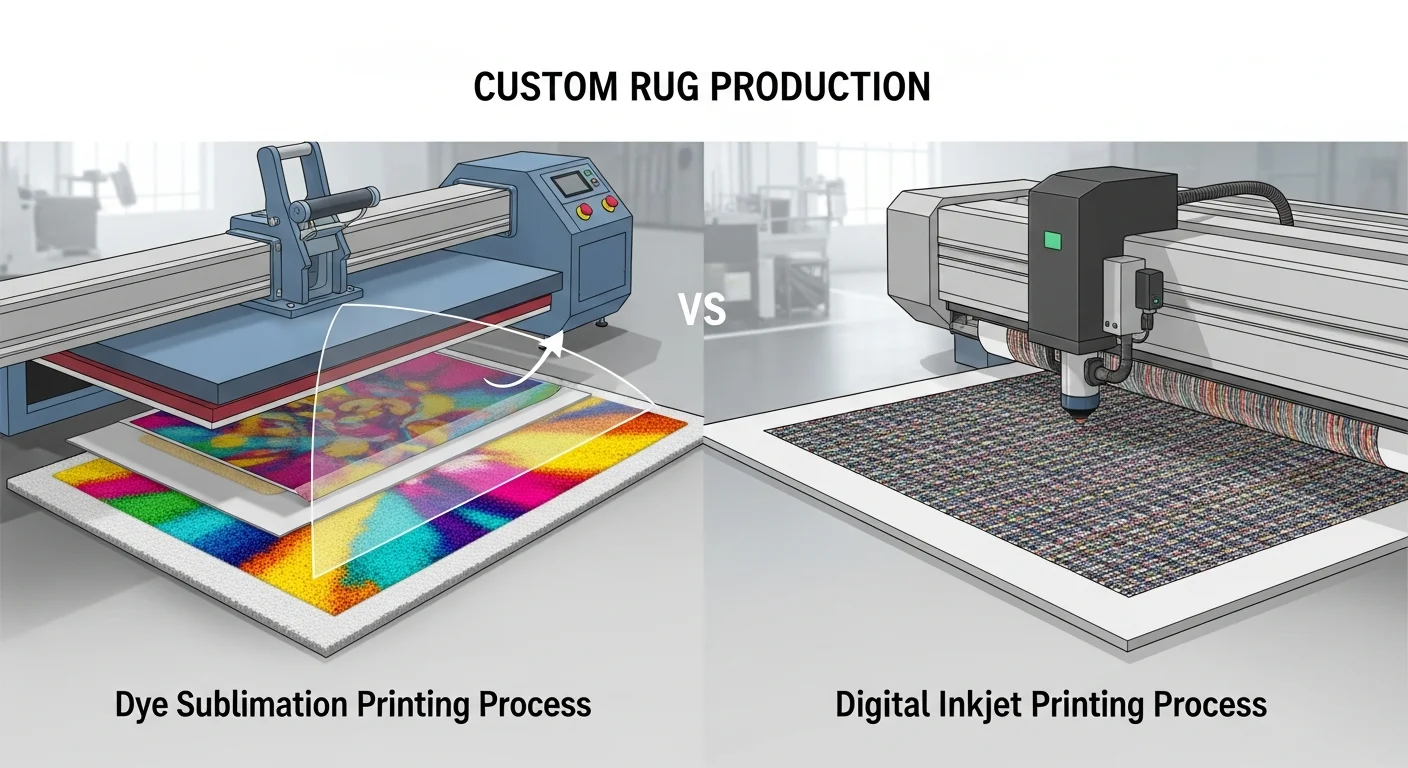
The difference between a stunning custom rug and a disappointing one often comes down to a single decision: the printing method. Dye sublimation rug printing and digital inkjet rug printing are the two dominant technologies for custom rug production, and each offers distinct advantages depending on your material, design complexity, and durability requirements. Choosing the right method before you place your order ensures that your finished custom rug meets your expectations for color accuracy, longevity, and overall quality.
This guide provides a thorough side-by-side comparison of both printing methods — covering the science behind each process, real-world performance differences, material compatibility, cost considerations, and practical guidance for choosing the right approach for your specific project. Whether you are ordering a single photo rug for your living room or sourcing bulk rug printing for a corporate client, understanding these production methods will help you make an informed decision.
How Dye Sublimation Printing Works
Dye sublimation is a heat-transfer process that permanently fuses ink into synthetic fibers at the molecular level. The workflow begins with your design being printed onto a special transfer paper using sublimation inks formulated to transition from solid to gas under controlled heat conditions. The printed transfer paper is then placed against the polyester rug surface and subjected to intense heat (375–400°F) and pressure for a precise duration.
At these temperatures, the solid sublimation dyes convert directly into a gas — skipping the liquid phase entirely — in a process called sublimation dye fusion. The gaseous dye molecules penetrate the open pores of the heated polyester fibers and bond permanently with the polymer chains as the fabric cools. The result is a print that is literally part of the fabric structure, not a coating sitting on the surface. This molecular integration is what gives sublimation its exceptional permanence and resistance to cracking, peeling, and fading.
The heat transfer rug process produces the most vibrant, saturated colors of any textile printing method. Because the dye is embedded within the fibers rather than layered on top, colors appear deeper, blacks are richer, and color gradations are smoother than surface-printed alternatives. Sublimation also enables true edge-to-edge rug print coverage — the dye reaches every fiber uniformly, eliminating the unprinted border margins that can occur with other methods.
The primary limitation of sublimation is material compatibility. The process requires polyester or polymer-coated substrates because the dye molecules bond specifically with synthetic polymer chains. Natural fibers like cotton, wool, and jute cannot be sublimated. This restriction means polyester sublimation is the standard pairing, and buyers who prefer natural fiber rugs must use alternative printing methods.

How Digital Inkjet Printing Works
Digital inkjet rug printing uses high-resolution print heads to spray specialized textile inks directly onto the rug surface. The fabric is typically pre-treated with a chemical coating that helps the ink adhere to and partially penetrate the fibers, improving both color vibrancy and wash durability. Modern inkjet systems achieve excellent resolution — 200 DPI and above — producing sharp details, clean text, and accurate photographic reproduction.
Unlike sublimation, inkjet printing works on a broad range of materials including polyester, nylon, chenille, cotton blends, and mixed-fiber fabrics. This material versatility is inkjet's primary advantage: it opens up synthetic rug printing options that sublimation cannot reach, as well as natural and blended fiber rugs that offer different textures, weights, and aesthetic qualities.
The ink application in digital inkjet printing sits on the surface and partially penetrates the upper layers of the fiber structure, depending on the pre-treatment and ink chemistry. Advanced systems push ink deeper into the fabric for improved durability, but the bond is not as permanent as sublimation's molecular integration. Surface-printed rugs are more susceptible to wear in high-traffic areas over time, though modern inks and coatings have significantly improved longevity compared to earlier inkjet technologies.
Inkjet printing also excels at reproducing intricate fine detail, thin lines, and small text — making it the preferred method for detailed logo reproduction, intricate patterns, and designs with fine typography. The sharp rug image sharpness achievable with modern inkjet heads rivals or exceeds sublimation for line-art and text applications, even though sublimation typically produces richer photographic color depth.

Color Vibrancy and Accuracy Compared
Rug color vibrancy is often the deciding factor for buyers choosing between sublimation and inkjet printing. Both methods can produce beautiful, full-color rugs, but the underlying science creates measurable differences in how colors appear on the finished product.
Sublimation consistently produces deeper color saturation, richer blacks, and smoother tonal gradations. Because the dye becomes part of the fiber itself, light passes through the colored polymer rather than reflecting off a surface coating. This creates a luminous quality — colors appear to glow from within the fabric rather than sitting on top. For photorealistic rug printing where color accuracy and vibrancy are paramount, sublimation is the superior choice.
Digital inkjet produces excellent color range but typically achieves slightly less saturation than sublimation, particularly in deep shadow areas and highly saturated hues. The surface application of ink can create a subtle "matte" appearance compared to sublimation's characteristic depth. However, for designs with large areas of solid color, text-heavy layouts, and geometric patterns, the difference is minimal and often imperceptible at normal viewing distances.
Both methods support unlimited color counts — unlike screen printing, there is no per-color cost increase for complex multi-color designs. Both methods also benefit from sRGB rug output color management, and requesting a rug color proof before production ensures that rug color shift between your screen and the finished fabric stays within acceptable tolerances. Always view your proof on a color-calibrated monitor and understand that fabric reproduction will never match an LED screen exactly.

Durability and Longevity
Rug print durability varies significantly between the two methods and is a critical consideration for buyers planning long-term use or high-traffic placement. The permanence of the printing method directly determines how your rug will look after months and years of regular use.
Sublimation-printed rugs offer the longest printed rug lifespan in the industry. Because the dye is chemically bonded within the fiber structure, it cannot be worn away by foot traffic, removed by washing, or degraded by UV exposure under normal indoor conditions. A well-made sublimation rug can maintain its visual quality for five to seven years or more with proper care — no rug print cracking, peeling, or flaking will occur because there is no surface layer to degrade.
Inkjet-printed rugs have a moderate lifespan of three to five years under similar conditions. The surface-applied ink is more vulnerable to abrasion from foot traffic, particularly in high-wear zones like doorways and walkways. Over time, the print may show gradual fading in heavily trafficked areas while maintaining its original vibrancy in less-used portions of the rug. Modern UV-protective coatings and advanced ink formulations have improved inkjet durability considerably, but the inherent difference in print depth means sublimation retains a structural advantage.
Environmental factors also affect longevity differently for each method. A fade-resistant rug produced through sublimation maintains color integrity even under indirect UV exposure, while inkjet prints may show gradual rug color fastness degradation in sun-facing windows or outdoor applications. For outdoor or semi-outdoor use, sublimation on polyester with UV-stable inks is the strongly recommended choice.

Material Compatibility
Material compatibility is often the factor that makes the printing decision for you. Sublimation works exclusively with polyester and polymer-coated substrates — if you want a nylon, chenille, cotton, or blended-fiber rug, inkjet is your only option.
Polyester sublimation is the industry-standard pairing that delivers the best combination of color vibrancy, print permanence, and cost-effectiveness. Most custom rug providers default to polyester sublimation for good reason — it produces consistently excellent results at competitive prices. For buyers who prioritize print quality above all else, this pairing is the clear recommendation.
Inkjet's material flexibility is its key competitive advantage. Nylon rugs for commercial high-traffic areas, chenille rugs for soft luxury, velvet rugs for premium aesthetics, and cotton-blend rugs for natural-fiber preferences all require inkjet printing. This versatility makes inkjet the method of choice for buyers whose material preference is driven by texture, durability requirements, or environmental concerns that steer them away from polyester. For a comprehensive guide to rug materials, read the polyester vs nylon vs chenille custom rug materials comparison.
Hybrid approaches are also emerging. Some manufacturers offer a base coat treatment that allows limited sublimation-like results on blended fabrics with high polyester content. While not yet mainstream, these developments suggest that the material compatibility gap between the two methods will continue to narrow in the coming years.
Print Resolution and Detail
Both printing methods support 200 DPI rug resolution and above at full rug dimensions, producing sharp, professional-grade results suitable for photographs, logos, and detailed artwork. However, the way each method renders fine detail differs due to the underlying ink application physics.
Sublimation can produce a very slight softening of ultra-fine edges because the gaseous dye disperses minutely as it bonds with the fibers. For most designs — including photographs, bold graphics, and standard text — this softening is imperceptible. It only becomes noticeable in extremely thin hairline details or very small text (below 8pt at print size), where the dye spread can cause a fraction of a millimeter of blurring.
Inkjet printing delivers marginally sharper edge definition because the ink is applied as discrete droplets that maintain their boundaries more precisely. For intricate line art, small serif typography, and complex logo marks with fine details, inkjet can produce crisper results. This advantage is particularly relevant for all-over print rug designs with detailed repeating patterns or corporate logo rugs where brand mark precision is paramount.
For photorealistic rug printing with photographs and continuous-tone artwork, both methods produce excellent results. The resolution difference is subtle enough that the average viewer cannot distinguish between sublimation and inkjet at normal viewing distances. The more important factor is ensuring your source file meets the minimum rug print resolution requirements — any printing method will produce poor results from a low-resolution source file.
Washability and Maintenance
Rug print washability is a practical concern for any custom rug that will see regular use. Rugs in kitchens, entryways, kids' rooms, and pet areas inevitably encounter spills, dirt, and the need for periodic deep cleaning.
Sublimation-printed rugs are the clear winner for wash durability. Because the dye is part of the fiber structure, a machine washable printed rug produced through sublimation can withstand repeated cold-water machine washing, tumble drying on low heat, and even careful steam cleaning without any degradation to the printed design. The colors remain vibrant through dozens of wash cycles — a critical advantage for rugs in kitchens, nurseries, and commercial entrances that require frequent cleaning.
Inkjet-printed rugs require gentler care. Hand washing or cold gentle machine cycles are recommended, and bleach and harsh chemical cleaners should be avoided entirely. Steam cleaning carries some risk of lifting surface ink, and aggressive scrubbing during spot cleaning can accelerate wear on the printed surface. Following the manufacturer's care recommendations will maximize the lifespan of an inkjet-printed rug, but buyers should understand that the print will show some gradual fading with repeated washing — a natural consequence of the surface-applied ink technology.
For both methods, the best practice is to address spills immediately by blotting (never rubbing), use mild detergent solutions for spot cleaning, and air dry flat whenever possible. Rotating the rug periodically evens out wear patterns and extends the overall life of the print.
Cost Comparison
The rug print cost comparison between sublimation and inkjet involves both per-unit pricing and total cost of ownership over the life of the rug. Understanding both perspectives helps you make the best value decision for your specific project.
On a per-unit basis, sublimation typically costs slightly more than inkjet for small production runs. The sublimation process requires specialized transfer paper, heat press equipment, and longer production time per piece. For single-rug orders and small quantities, this translates to a modest price premium — typically 10–20% above comparable inkjet production.
For bulk rug printing orders, both methods offer volume discounts that narrow the cost gap. At higher quantities (25+ units), the per-unit difference becomes minimal as fixed setup costs are distributed across more pieces. Print on demand rug services — where each rug is produced individually as orders arrive — predominantly use sublimation because the quality consistency and minimal inventory risk justify the slightly higher per-piece cost.
Total cost of ownership tells a different story. Sublimation's superior durability means a sublimation rug may last five to seven years while an inkjet rug of the same quality might need replacement after three to five years. When amortized over the product's useful life, sublimation often proves more economical despite its higher initial cost — particularly for commercial rug printing applications where replacement involves not just product cost but also installation downtime and logistical coordination.
Which Method Should You Choose?
The right printing method depends on a handful of key variables. Use the following decision framework to identify the best choice for your project.
Choose dye sublimation when: you want the most vibrant, longest-lasting print possible; your rug will be polyester; the rug will see moderate to heavy foot traffic; machine washability is important; the rug will be exposed to indirect sunlight; you are printing photographs or designs with rich color gradations; or you need outdoor-rated UV durability.
Choose digital inkjet when: you prefer a non-polyester material (nylon, chenille, velvet, cotton blend); your design requires ultra-fine line detail or small text precision; the rug is for a low-traffic decorative application; budget is the primary concern for a short-term project; or you need compatibility with natural fiber substrates.
For most buyers ordering custom rugs for personal or commercial use, polyester sublimation represents the best overall value — combining vibrant color, permanent print quality, machine washability, and competitive pricing. Inkjet becomes the preferred choice primarily when material preferences or ultra-fine detail requirements steer the decision away from polyester. Both methods produce professional, high-quality results when paired with proper file preparation and a reputable printer.

The Future of Rug Printing Technology
The custom rug printing industry continues to evolve rapidly, driven by advances in ink chemistry, print head technology, and material science. Several emerging trends point toward an increasingly capable and accessible future for custom rug production.
Water-based eco-friendly inks are reducing the environmental impact of textile printing while maintaining color quality that rivals traditional solvent-based formulations. These sustainable inks produce less waste, emit fewer VOCs (volatile organic compounds) during production, and are safer for residential environments. As environmental regulations tighten globally, water-based inks are expected to become the industry standard within the next five years.
AI-driven color matching is improving the accuracy of screen-to-fabric color reproduction. Machine learning algorithms analyze the specific interaction between ink, heat, and fabric to predict color outcomes more precisely than manual calibration, reducing the need for multiple rug sample print runs and shortening rug production timeline from order to delivery.
3D texture printing is an emerging technology that adds tactile dimension to printed rugs — creating raised patterns, embossed effects, and variable pile heights within a single rug. This technology is still in its early commercial stages but promises to blur the line between printed and woven rugs in the coming years.
Print Your Custom Rug with RareCustom
RareCustom uses professional-grade dye sublimation technology to produce custom rugs with vivid, permanent color and exceptional durability. Every rug is printed to order with no minimums, free shipping, and a satisfaction guarantee that ensures your finished product meets your expectations.
Upload your design, choose your size and material, and preview your rug in real time using our free online design tool. Whether you are creating a photorealistic photo rug, a branded logo mat, or a decorative accent piece, our production team ensures that every detail is reproduced with precision and care. For beginners getting started with custom rug design, read the complete beginner's guide to custom rugs.
Related Articles
Continue learning about custom rug production and materials:
Share this article
Written by
Terrence Okafor
Head of Production at RareCustom with 20+ years in commercial printing. Terrence's deep expertise in dye sublimation and digital inkjet technologies helps customers choose the ideal printing method for custom rugs.