Eco-Friendly Custom Mugs: Sustainable Materials, Printing, and Sourcing Guide
Choose sustainable custom mugs with confidence — recycled ceramic, bamboo fiber, organic inks, and ethical sourcing options explained. Reduce environmental impact without sacrificing print quality or durability.
Rohan Mehta
Head of Marketing at RareCustom. Rohan covers sustainability trends and helps businesses choose eco-friendly custom drinkware that aligns with their environmental commitments.
The demand for eco-friendly custom mugs is growing as consumers, businesses, and organizations increasingly factor environmental impact into purchasing decisions. A 2025 survey by the Advertising Specialty Institute found that 46 percent of consumers have a more favorable impression of a brand that gives them an eco-friendly promotional product compared to a conventional one — and 73 percent of Gen Z and millennial respondents actively prefer sustainable merchandise over standard alternatives. For businesses ordering branded mugs, schools running fundraisers, and event planners selecting favors, the environmental credentials of the product now influence both buyer perception and purchase decisions.
This guide covers the full landscape of sustainable custom mug options available in 2026 — from recycled ceramic and bamboo fiber composites to organic ink formulations and ethical manufacturing certifications. Each option is evaluated on environmental impact, print quality, durability, cost, and practicality so that buyers can make informed decisions that balance sustainability goals with product requirements. For general material comparisons without the sustainability focus, the materials comparison guide covers all standard mug types in detail.
Why Eco-Friendly Mugs Matter
A single reusable ceramic mug replaces approximately 500 disposable paper cups per year for an average daily coffee drinker. Over a five-year lifespan, one ceramic mug prevents 2,500 paper cups (plus plastic lids and cardboard sleeves) from entering the waste stream. When a company distributes 200 branded ceramic mugs to employees, the collective impact is significant: 100,000 fewer paper cups per year — a tangible environmental benefit that translates directly into a sustainability story the brand can communicate to stakeholders.
Custom mugs are inherently sustainable products compared to most promotional items because they are designed for long-term daily use rather than single use. A branded pen runs out of ink and gets discarded. A branded plastic water bottle degrades and is replaced. A branded notepad is used up and thrown away. A quality ceramic mug, by contrast, lasts 5 to 15 years under normal use, making it one of the most sustainable promotional products available by default — even before choosing eco-friendly materials and production methods. The sustainability advantage extends to gifting contexts: a mug favor at a wedding or event replaces disposable favors (wrapped candy, mini candles, plastic trinkets) that often end up in the trash within days.
For organizations with formal sustainability goals — carbon neutrality pledges, waste reduction targets, sustainable sourcing policies — choosing eco-friendly mugs demonstrates tangible commitment. Corporate Social Responsibility (CSR) reports can quantify the impact: "Our 2026 employee onboarding program used 300 recycled ceramic mugs, preventing approximately 150,000 paper cups from entering the waste stream over three years." That is a concrete, measurable contribution that resonates with investors, employees, and customers who evaluate companies on environmental performance.
Recycled Ceramic Mugs
Recycled ceramic mugs are manufactured using post-consumer or post-industrial ceramic waste mixed with virgin clay. The recycled content typically ranges from 10 to 30 percent of the total clay body, depending on the manufacturer and the structural requirements of the specific mug shape. Higher recycled content reduces the demand for virgin clay extraction (which disrupts ecosystems and requires significant energy for mining and processing) and diverts ceramic waste from landfills where it would persist indefinitely since ceramic is not biodegradable.
From a print quality perspective, recycled ceramic mugs are virtually identical to standard ceramic. The recycled content is mixed at the raw material stage before the mug is formed and fired, resulting in the same dense, smooth surface that accepts sublimation coating and produces vibrant prints. Most consumers cannot distinguish a recycled ceramic mug from a standard ceramic mug by appearance, weight, or feel. The primary difference is a subtle variation in the natural clay color before glazing, which is invisible under the white sublimation coating. Recycled ceramic mugs carry a 5 to 15 percent price premium over standard ceramic — adding $0.25 to $0.75 per unit at typical wholesale volumes.
Bamboo Fiber Composite Mugs
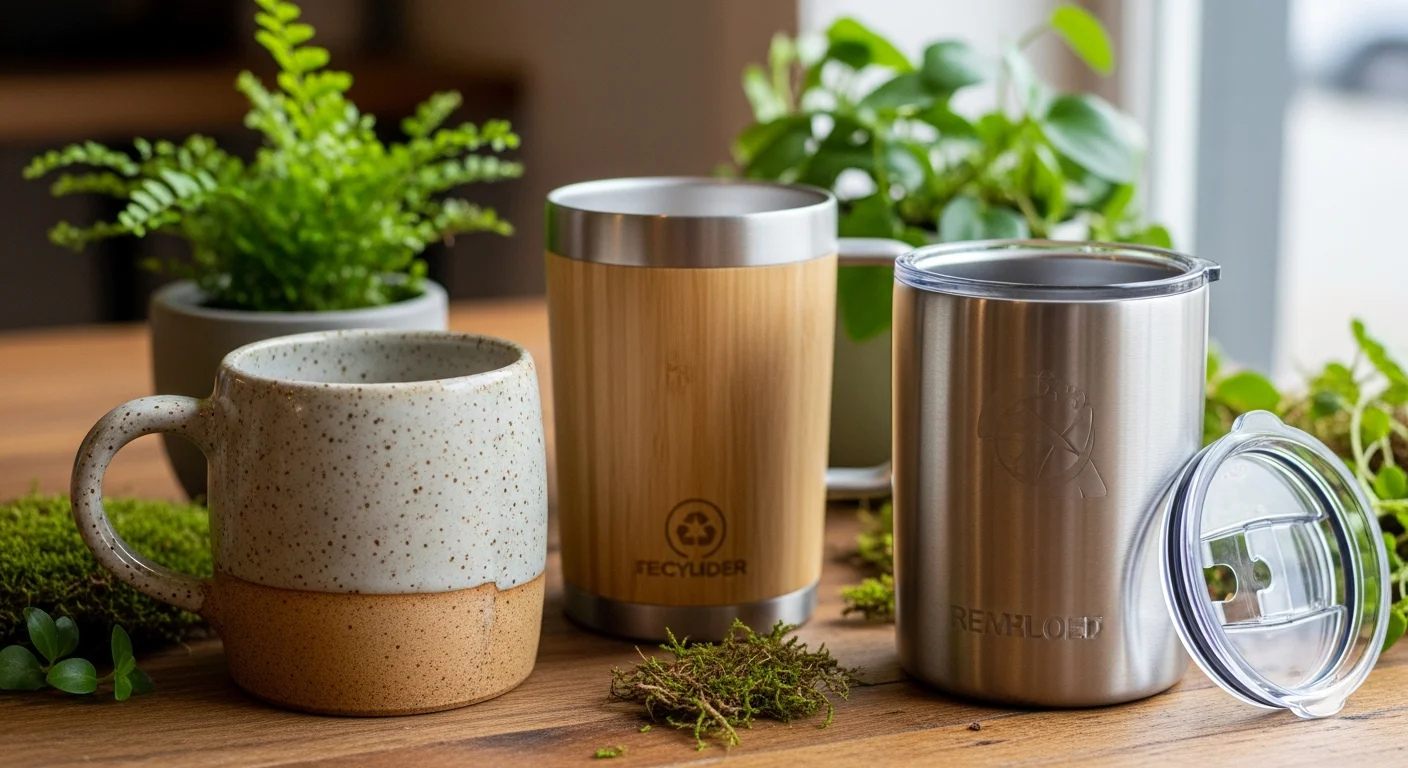
Bamboo fiber mugs are made from a blend of bamboo fiber (40 to 60 percent), corn starch, and melamine resin. Bamboo is one of the most sustainable raw materials available — it grows up to 35 inches per day, requires no pesticides or fertilizers, regenerates from its root system without replanting, and sequesters more carbon per acre than most tree species. The resulting mug is lightweight (30 to 40 percent lighter than ceramic), shatter-resistant, and has a distinctive natural texture and appearance that communicates sustainability visually.
Bamboo fiber mugs accept UV printing and pad printing but are not compatible with sublimation because they lack the polymer coating required for dye infusion. This limits full-color photographic printing capability, making bamboo mugs best suited for logo-based and text-based designs with limited colors. The print durability is moderate — UV-printed designs on bamboo fiber are hand-wash recommended and may show wear after 100 to 200 wash cycles, compared to the essentially permanent durability of sublimation on ceramic. Bamboo mugs are not microwave safe and should be hand-washed rather than machine-washed for maximum longevity.
Cost comparison: Bamboo fiber mugs typically cost $2.50 to $5.00 per blank — comparable to standard ceramic. However, the printing costs may be higher due to the UV printing process ($3 to $5 per mug for single-side printing), making the all-in cost slightly more than sublimated ceramic at equivalent quantities.

Stainless Steel — The Durability-Sustainability Combination
Stainless steel mugs are the most durable option available, with a functional lifespan of 10 to 20 years or more. This extreme longevity makes stainless steel one of the most sustainable mug materials per year of use, despite the higher initial energy required for steel manufacturing. A stainless steel mug used daily for 15 years replaces approximately 7,500 disposable cups and 3 to 5 ceramic mugs that might break during the same period.
Stainless steel is infinitely recyclable — it can be melted down and reformed into new stainless steel products without any degradation in quality. Approximately 85 percent of all stainless steel products are recycled at end of life, giving stainless steel one of the highest recycling rates of any material. When a stainless steel mug eventually reaches the end of its useful life, it can be recycled into new steel products rather than entering a landfill.
The trade-off is higher per-unit cost ($5 to $12 per blank for double-wall insulated models) and more limited printing options. Laser engraving is the most sustainable decoration method for stainless steel — it uses no ink or chemicals, produces a permanent mark by etching the metal surface, and generates zero liquid waste. For organizations with premium sustainability positioning, laser-engraved stainless steel mugs communicate quality, durability, and environmental responsibility simultaneously. The materials comparison guide provides detailed analysis of stainless steel properties.
Sustainable Ink and Printing Methods
Sublimation inks used in custom mug printing are water-based dispersal dyes that do not contain the heavy metals, volatile organic compounds (VOCs), or hazardous solvents found in some traditional printing inks. The sublimation process itself produces minimal waste — the transfer paper is the primary consumable, and modern operations use paper made from sustainably managed forests (FSC-certified or equivalent). The heat press uses electricity (which can be sourced from renewable energy) and produces no liquid effluent or air emissions beyond standard heating.
Water-based and soy-based inks are available alternatives for screen printing on mugs. These inks replace petroleum-based binders with vegetable-oil derivatives, reducing the carbon footprint of the ink manufacturing process and improving biodegradability at end of life. Water-based inks also produce lower VOC emissions during the printing and curing process, improving air quality in the printing facility.
Laser engraving is the most environmentally friendly decoration method because it uses no consumable materials whatsoever — no ink, no transfer paper, no chemicals. The laser physically removes a thin layer of material from the mug surface to create the design. The only input is electricity, and the only output is a small amount of vaporized material that is captured by exhaust filtration systems. For organizations seeking the lowest-impact decoration method, laser engraving on stainless steel or enamel is the optimal choice.

Ethical Sourcing and Certifications
Beyond the material itself, the sourcing and manufacturing conditions contribute to the overall sustainability profile of custom mugs. Look for these certifications and standards when evaluating suppliers:
Fair Trade Certified ensures that workers involved in manufacturing receive fair wages, work in safe conditions, and benefit from community development funds. Fair Trade ceramic mugs are available from several specialty suppliers, though availability is more limited than conventional sources.
ISO 14001 is the international standard for environmental management systems, indicating that the manufacturer has formal processes for managing environmental impact, reducing waste, and improving environmental performance over time.
FSC (Forest Stewardship Council) certification applies to packaging materials — boxes, tissue paper, and inserts made from sustainably managed forests.
B Corp Certification indicates that the supplier meets rigorous standards of social and environmental performance, accountability, and transparency. Working with B Corp-certified suppliers aligns the entire supply chain with sustainability values.
Packaging and Shipping Sustainability
The environmental impact of packaging and shipping can equal or exceed the impact of the mug itself, especially for bulk orders. Recycled and recyclable packaging — kraft cardboard boxes, paper-based packing material, and cardboard dividers — replaces polystyrene foam, plastic bubble wrap, and virgin cardboard. Many suppliers now offer plastic-free packaging options upon request.
Consolidating shipments reduces the carbon footprint of transportation. Ordering the full quantity in a single shipment rather than splitting into multiple smaller orders reduces the total number of delivery trips, packaging materials, and transportation emissions. For organizations with multiple locations, shipping to a central distribution point and redistributing internally is more sustainable than shipping individual mugs to each location.
Making the Sustainable Choice
Choosing eco-friendly custom mugs does not require compromising on quality, design, or budget. The most practical approach for most organizations is to start with standard ceramic mugs with sublimation printing — which is already inherently sustainable as a long-lasting reusable product — and add environmental credentials incrementally: recycled ceramic blanks, plastic-free packaging, consolidated shipping, and renewable energy sourcing. Each incremental improvement adds 5 to 15 percent to the per-unit cost while significantly strengthening the sustainability story. Browse the custom mugs collection to explore available options, or use the free design tool to start creating eco-friendly branded merchandise today.
Frequently Asked Questions
Are recycled ceramic mugs as durable as standard ceramic?
Yes. Recycled ceramic mugs are manufactured using a blend of recycled ceramic waste and virgin clay, fired at the same temperatures as standard ceramic. The resulting product has the same density, strength, and durability characteristics. Most consumers cannot distinguish a recycled ceramic mug from a standard one by appearance, weight, or performance. Print quality is also identical.
What is the most eco-friendly mug material?
Stainless steel offers the best sustainability per year of use because it lasts 10 to 20 years and is infinitely recyclable. Bamboo fiber composites use the most sustainable raw material. Recycled ceramic reduces virgin clay extraction. The best choice depends on the specific priorities — longevity, raw material sourcing, recyclability, or overall lifecycle impact.
Do eco-friendly mugs cost significantly more?
Recycled ceramic mugs add 5 to 15 percent to the per-unit cost ($0.25 to $0.75 per mug at wholesale volumes). Bamboo fiber mugs are priced comparably to standard ceramic. Stainless steel is the most expensive option ($5 to $12 per blank) but its 10 to 20 year lifespan provides the lowest cost per year of use. Sustainable packaging options add $0.50 to $1.50 per unit.
Related Articles
Share this article
Written by
Rohan Mehta
Head of Marketing at RareCustom. Rohan covers sustainability trends and helps businesses choose eco-friendly custom drinkware that aligns with their environmental commitments.