How to Start a Custom Mug Business in 2026: From Side Hustle to Full-Time Income
Launch a custom mug business with this complete guide covering print-on-demand vs inventory models, startup costs, pricing for profit, marketing channels, and scaling from first sale to six figures.
Natalie Voss
Founder & CEO of RareCustom. MBA from Stanford with 8 years in e-commerce operations. Natalie shares business strategy insights for aspiring custom mug entrepreneurs.
Starting a custom mug business in 2026 is one of the most accessible paths to entrepreneurship because the barrier to entry is remarkably low: no upfront inventory investment required (with print-on-demand), no specialized equipment needed, no physical storefront necessary, and a virtually unlimited market of customers who buy mugs for gifts, personal use, office accessories, and brand merchandise year-round. The global custom drinkware market is valued at approximately $27 billion and growing at 5 to 7 percent annually, driven by consumer demand for personalized products, corporate promotional spending, and the rise of e-commerce platforms that connect independent sellers with buyers worldwide.
This guide covers every step of building a custom mug business from zero — choosing between print-on-demand and inventory-based models, calculating startup costs and pricing for profit, setting up sales channels, creating designs that sell, marketing to target customers, and scaling from a side hustle into a sustainable full-time income. Whether the goal is supplemental income from a part-time Etsy shop or a six-figure e-commerce brand, the fundamentals covered here provide the roadmap. For readers interested in starting apparel businesses alongside mugs, the t-shirt business guide covers the apparel side of the custom merchandise industry.
Business Model: Print-on-Demand vs Inventory
Print-on-demand (POD) is the recommended model for new custom mug businesses because it eliminates the largest financial risk: unsold inventory. With POD, mugs are printed and shipped only after a customer places an order. The business owner creates designs and lists them on a sales platform, and the POD provider handles production, packaging, and shipping directly to the customer. The business owner never touches a physical mug — they focus entirely on design, marketing, and customer service.
Advantages of POD: Zero upfront inventory cost (no need to purchase blank mugs in advance). No storage space required. No risk of unsold inventory. Unlimited design variety (list 100 different designs with no additional cost until one sells). Automatic fulfillment (orders are produced and shipped without manual intervention). Easy to test new designs — list them, promote them, and let sales data determine which designs succeed.
Disadvantages of POD: Lower profit margins per unit ($3 to $8 profit per mug vs $8 to $12 with self-fulfilled inventory) because the POD provider charges for production, packaging, and handling. Less control over production quality (dependent on the POD provider's standards). Longer shipping times (production plus shipping vs pre-printed inventory that ships same-day).
Inventory-based (self-fulfilled) model involves purchasing blank mugs and sublimation equipment, printing mugs in-house, and shipping directly to customers. This model requires a $500 to $2,000 upfront equipment investment but delivers higher per-unit profit margins because the production cost is $1 to $3 per mug versus $6 to $12 with POD. The inventory model is recommended for businesses that have validated their designs through POD sales and are ready to scale with higher margins.
Startup Costs Breakdown
Print-on-demand startup costs: Design software $0 to $20 per month (Canva Free to Pro, or free tools like Figma); e-commerce platform $0 to $29 per month (Etsy free listing with per-sale fees, or Shopify at $29/month); domain name $10 to $15 per year; initial marketing budget $50 to $200 (social media ads to drive first sales). Total startup investment: $60 to $250. This is one of the lowest startup costs of any legitimate business, making it accessible to virtually anyone.
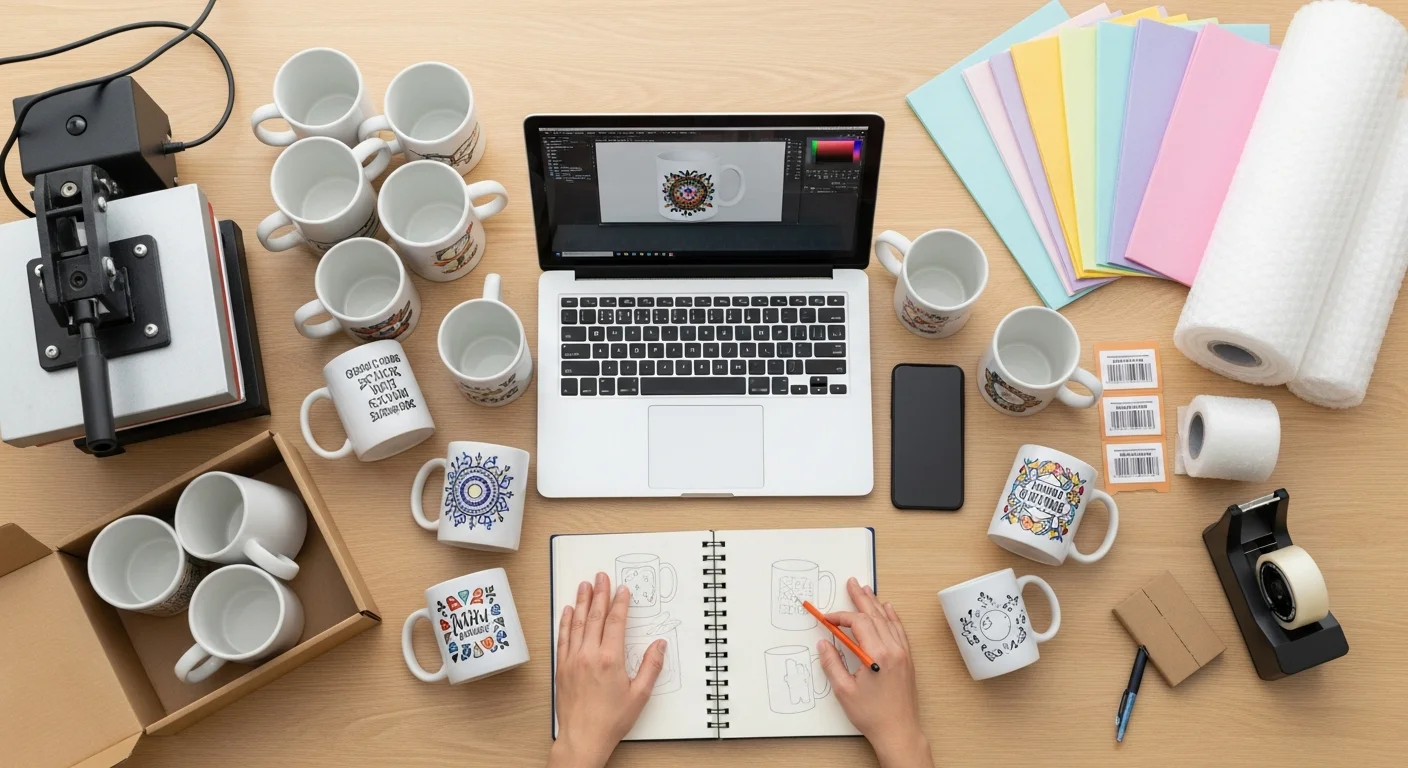
Self-fulfilled (inventory) startup costs: Sublimation printer $200 to $500 (converted Epson EcoTank or dedicated sublimation printer); heat press with mug attachment $150 to $400; sublimation ink $30 to $60; sublimation transfer paper $20 to $40; blank mugs (initial stock of 50 to 100) $75 to $250; packaging materials $30 to $50. Total startup investment: $505 to $1,300. This is still remarkably affordable compared to most product-based businesses, and the equipment pays for itself after selling 50 to 100 mugs.
Pricing Strategy for Profit
Profitable pricing requires understanding the full cost structure and setting prices that cover costs, generate profit, and remain competitive. For POD businesses, the typical cost structure per mug is: POD production cost $8 to $12 (includes mug, printing, packaging); platform fees $1 to $2 (Etsy listing and transaction fees, or Shopify payment processing); advertising cost per sale $2 to $5 (varies by ad efficiency). Total cost per sale: $11 to $19.
Retail pricing for POD mugs: $18 to $28 per mug, depending on the design type and target market. Basic text mugs with generic designs sell at the lower end ($18 to $22). Photo mugs, premium designs, and niche-targeted mugs sell at the higher end ($22 to $28). The profit per sale ranges from $3 to $12, with the average POD mug business earning $5 to $8 profit per unit.
For self-fulfilled businesses: Production cost per mug is $2 to $4 (blank, ink, transfer paper, packaging). With a retail price of $18 to $24, profit per sale is $14 to $22 — roughly 2 to 3 times the profit of POD. The higher margin justifies the equipment investment after approximately 30 to 50 sales, at which point the equipment has paid for itself and every subsequent sale generates significantly higher profit. For comprehensive pricing data on mugs at every quantity and material, see the pricing breakdown guide.
Finding Your Niche and Target Customer
Niche specialization is the key to standing out in the custom mug market. The market is too large and competitive for a generic "mugs for everyone" approach to succeed. Successful mug businesses target a specific audience with designs tailored to their interests, identity, and humor. Examples of profitable niches:
Profession-specific humor: Nurses, teachers, accountants, developers, lawyers, real estate agents — each profession has insider jokes and experiences that make excellent mug content. "I'm a nurse, my level of sarcasm depends on your level of stupidity" resonates deeply with nurses and their friends/family who buy gifts.
Pet breeds: Dog breed-specific mugs (Golden Retriever owner, French Bulldog mom, Dachshund dad) target one of the most passionate consumer groups. Pet owners spend an average of $136 per year on pet-related merchandise, and breed-specific designs tap into strong identity attachment.
Hobbies and interests: Gardeners, readers, gamers, hikers, fishers, crafters — hobby communities have strong internal identity and gift-giving culture. A "Plant Mom" mug with a botanical illustration sells year-round to gardeners and to anyone buying gifts for gardeners.
Life milestones: Retirement, new baby, new home, promotion, graduation — milestone mugs are gift-driven purchases with high emotional value and willingness to pay premium prices.

Creating Designs That Sell
Research before designing. Study the top-selling mugs on Etsy, Amazon Handmade, and Redbubble to identify which designs, quotes, and styles are currently popular. Look at the bestseller lists, read customer reviews (which reveal what buyers love and what they wish were different), and analyze the design styles (typography, color palettes, layout patterns) that appear repeatedly among top sellers. Do not copy designs — use this research to understand market preferences and create original designs that serve the same customer needs.
Design principles for sellable mugs: Keep text concise (15 words or fewer for maximum impact). Use bold, readable fonts (see the design guide). Create designs that photograph well (important for listing images and social media). Ensure the design communicates clearly from arm's length (legibility test: hold your phone at arm's length and check if the design reads clearly at the listing thumbnail size).
Seasonal and trending designs provide sales spikes throughout the year. Create designs for every major holiday (Christmas, Valentine's Day, Mother's Day, Father's Day, Halloween) 4 to 6 weeks before each holiday. Monitor trending topics, viral phrases, and pop culture moments that can be adapted into timely mug designs. The holiday mug guide provides design themes and ordering timelines for every season.
Sales Channels for Custom Mugs
Etsy is the most popular marketplace for custom mug businesses because it attracts buyers actively searching for personalized and handmade products. Etsy charges $0.20 per listing (renewed every 4 months or upon sale), a 6.5 percent transaction fee, and a 3 percent + $0.25 payment processing fee. Despite the fees, Etsy provides built-in traffic from millions of shoppers — new businesses can make their first sales within weeks by optimizing listings for Etsy's search algorithm with relevant tags, titles, and descriptions.
Shopify ($29 to $79 per month) provides a standalone e-commerce store with full branding control and no marketplace competition. Shopify requires driving traffic through the business's own marketing efforts (social media, paid ads, SEO) since there is no built-in marketplace audience. Shopify is best for businesses ready to invest in brand building and customer acquisition.
Amazon Merch on Demand handles POD production for mugs sold through Amazon's marketplace, providing access to Amazon's massive customer base. Amazon's audience is more price-sensitive than Etsy's, so profit margins per unit are typically lower, but the volume potential is higher.
Social media selling through Instagram, TikTok Shop, and Facebook Marketplace provides direct-to-consumer sales with no platform fees (other than payment processing). Instagram and TikTok are particularly effective for visual products like mugs because the product photographs well and video content showing the design process or the "unboxing" experience drives engagement and sales.
Marketing Your Mug Business
Social media content strategy: Post 3 to 5 times per week featuring new designs, customer photos (with permission), behind-the-scenes design process, seasonal promotions, and engagement posts (polls, questions about mug preferences). Instagram and Pinterest drive the most sales for visual products like mugs. TikTok videos showing the design-to-print process (screen recording of the design tool, heat press in action, packaging, and the finished product) consistently generate high engagement and sales.
Etsy SEO: Optimize listing titles and tags with the specific terms buyers search for. Include the product type ("custom mug," "personalized coffee mug"), the design theme ("funny nurse mug," "dog mom gift"), and the occasion ("birthday gift for dad," "teacher appreciation"). Use all 13 available tags per Etsy listing, and include long-tail phrases that match how customers describe what they want.
Paid advertising: Start with $5 to $10 per day on Etsy Ads or Facebook/Instagram Ads to test which designs attract clicks and conversions. Focus ad spend on top-performing designs and seasonal products (ramp up holiday ad budgets 4 to 6 weeks before each holiday). Track return on ad spend (ROAS) — a profitable mug ad campaign typically achieves 3x to 5x ROAS, meaning every $1 spent on ads generates $3 to $5 in revenue.

Scaling from Side Hustle to Full-Time
Phase 1: Validation (months 1-3). List 20 to 30 designs using POD. Spend $100 to $200 on initial marketing. Target: 10 to 30 sales to validate demand and identify best-selling designs. Revenue: $200 to $600. Investment: $150 to $400 total.
Phase 2: Optimization (months 4-6). Expand the design library to 50 to 100 designs based on sales data. Double down on top sellers. Optimize listings for search. Increase ad spend on proven designs. Target: 30 to 100 sales per month. Revenue: $600 to $2,000 per month.
Phase 3: Growth (months 7-12). Consider transitioning top-selling designs to self-fulfilled for higher margins. Expand to additional sales channels (add Shopify if only on Etsy, or vice versa). Develop seasonal collections for holiday peaks. Target: 100 to 300 sales per month. Revenue: $2,000 to $6,000 per month.
Phase 4: Scale (year 2+). Full self-fulfillment operation for margin maximization. Hire part-time help for printing and shipping. Expand product line to related items (tumblers, stickers, tote bags). Develop wholesale/B2B sales channel for corporate and event orders. Target: 300+ sales per month. Revenue: $6,000 to $15,000+ per month.
Launch Your Custom Mug Business Today
The best time to start a custom mug business is before the next major holiday season, when gift-driven demand peaks and new designs get maximum exposure to buyers. Use the free online design tool to create initial designs, set up a shop on Etsy or Shopify, and list the first products. The POD model means there is zero financial risk — no inventory to buy, no equipment to purchase, and no products to store. The only investment is time for creating designs and marketing them to the right audience. Browse the custom mugs collection for design inspiration and to understand the product options available for the business.
Frequently Asked Questions
How much money can a custom mug business make?
Custom mug businesses using print-on-demand typically earn $5 to $8 profit per mug sold. A part-time operation selling 50 mugs per month generates $250 to $400 in monthly profit. Full-time businesses with self-fulfillment and established marketing sell 200 to 500 mugs per month for $2,000 to $6,000 in monthly profit. Top-performing mug businesses on Etsy report $10,000 to $20,000 or more in monthly revenue.
Do I need to invest in equipment to start?
No. The print-on-demand model requires zero equipment investment — the POD provider handles all production, packaging, and shipping. Total startup costs for a POD mug business are $60 to $250 (design software, e-commerce platform fees, initial marketing). Equipment investment ($500 to $1,300 for a sublimation setup) is only recommended after validating demand through POD sales.
What is the best platform to sell custom mugs?
Etsy is the best starting platform for new custom mug businesses because it provides built-in traffic from millions of shoppers actively looking for personalized products. After establishing a customer base and validating best-selling designs on Etsy, consider expanding to Shopify for full brand control and direct customer relationships, and to Amazon for volume sales.
Related Articles
Share this article
Written by
Natalie Voss
Founder & CEO of RareCustom. MBA from Stanford with 8 years in e-commerce operations. Natalie shares business strategy insights for aspiring custom mug entrepreneurs.