How to Start a Custom Tumbler Business in 2026: From Idea to First Sale
Learn how to start a custom tumbler business in 2026 with this complete guide covering niche selection, business models (POD, DIY, wholesale), pricing strategy, marketing channels, sales platforms, fulfillment, and scaling past your first 100 sales.
Natalie Voss
Founder & CEO of RareCustom. MBA from Stanford with 8 years in e-commerce operations. Natalie shares business strategy insights for aspiring custom tumbler entrepreneurs.
The custom tumbler market represents one of the most accessible entry points into product entrepreneurship in 2026. Unlike apparel businesses that require complex sizing inventories or electronics businesses that demand heavy upfront investment, a custom tumbler business startup can begin with as little as a single design, no physical inventory, and a free online storefront. The global personalized drinkware market is projected to reach $52 billion by 2028, growing at a compound annual rate of 6.2%, and custom tumblers are the fastest-growing segment within that market. Whether you are looking for a custom tumbler side hustle that generates an extra $500–2,000 per month or a full-time tumbler entrepreneur business that scales to six figures, the fundamentals are the same: find a niche, create compelling designs, price for profit, and market relentlessly.
This guide walks through every step of launching a custom tumbler business plan, from initial tumbler market research and tumbler niche selection through your first sale and beyond. The advice is grounded in real-world data from successful tumbler sellers on Etsy, Shopify, and Amazon, as well as insights from POD tumbler business operators and DIY sublimation entrepreneurs. Whether you plan to use print on demand tumblers through a fulfillment partner like RareCustom, invest in your own sublimation equipment, or build a wholesale custom tumbler ordering operation, the strategic framework below applies. For a complementary perspective on starting a custom mug business with overlapping skills and audiences, see the custom mug business guide.
Why Custom Tumblers Are a Profitable Business in 2026
Several market factors make 2026 an exceptionally strong year to start a tumbler business. First, the reusable drinkware movement continues to gain momentum as municipalities ban single-use plastics and consumers seek sustainable alternatives. Second, the "hydration culture" trend — driven by social media influencers promoting daily water intake goals — has normalized carrying large, personalized tumblers as lifestyle accessories rather than mere containers. Third, the print on demand tumblers infrastructure has matured to the point where a new business can offer dozens of tumbler styles without holding any inventory.
The tumbler profit margins are compelling compared to other product categories. A custom 20oz stainless steel tumbler can be produced (or sourced through POD) for $7–12 per unit and sold for $22–35 retail, yielding a 50–70% gross margin before marketing costs. Premium tumblers — 30oz or 40oz with handles, custom powder coats, and laser engraving — command $35–55 retail with similar percentage margins. These margins provide enough room for paid advertising, platform fees, and shipping costs while still delivering healthy profit per unit.
The barrier to entry is low but the ceiling is high. Successful Etsy tumbler business sellers report revenues of $3,000–15,000 per month within their first year, with top sellers exceeding $50,000 per month. The key differentiator between businesses that stall at a few hundred dollars per month and those that scale to significant revenue is not the tumbler itself — it is the niche specificity, design quality, and marketing execution.
Choosing Your Niche
Tumbler niche selection is the single most important strategic decision in your custom tumbler business plan. A broad "custom tumblers" business competes with thousands of sellers and Amazon listings. A focused niche — tumblers for nurses, tumblers for dog breeds, tumblers for fishing enthusiasts — faces a fraction of the competition while speaking directly to a passionate, identifiable audience. The target audience for tumblers in a well-chosen niche is easier to find, easier to market to, and more willing to pay premium prices for designs that speak to their identity.

High-Potential Niche Categories
Tumbler market research for 2026 reveals several high-demand, moderate-competition niches. Occupation-based tumblers (nurse tumblers, teacher tumblers, realtor tumblers, firefighter tumblers) attract buyers seeking gifts for colleagues or self-expression through their profession. Hobby-based tumblers (fishing, hunting, gardening, knitting, running) target enthusiast communities with strong identity attachment to their hobbies. Life-stage tumblers (new mom, retiree, empty nester, college freshman) capture buyers at emotionally significant transitions. Pet breed tumblers (specific dog and cat breeds with breed-accurate illustrations) tap into the passionate pet owner demographic. Location-based tumblers (state shapes, city skylines, national park illustrations) appeal to travel and local pride communities.
Validating Your Niche
Before committing to a niche, validate demand using free tools. Search Etsy for your niche keyword (e.g., "nurse tumbler") and count the number of results — under 10,000 results indicates manageable competition. Check the top-selling listings for review counts — if the top sellers have 1,000+ reviews, the market is proven. Use Google Trends to confirm the niche is stable or growing (avoid declining trends). Search TikTok and Instagram for your niche hashtag to gauge social media engagement and content creation potential. A niche with strong social media presence indicates an audience that shares purchases online, driving organic word-of-mouth marketing.
Business Model Options
There are three primary business models for a custom tumbler business, each with different capital requirements, profit margins, and operational complexity. Your choice depends on your budget, time availability, and long-term goals.

Model 1: Print on Demand (POD)
The POD tumbler business model requires zero inventory and minimal startup capital. You create designs and list them on your storefront. When a customer places an order, the POD partner (like RareCustom) produces and ships the tumbler directly to the customer. You never touch the product. Startup cost: $0–200 (domain, basic marketing). Pros: no inventory risk, wide product selection, fast launch. Cons: lower per-unit margin (typically 25–40% of retail price), less control over production quality and shipping speed. Best for: beginners, side hustlers, design-focused entrepreneurs.
Model 2: DIY Production
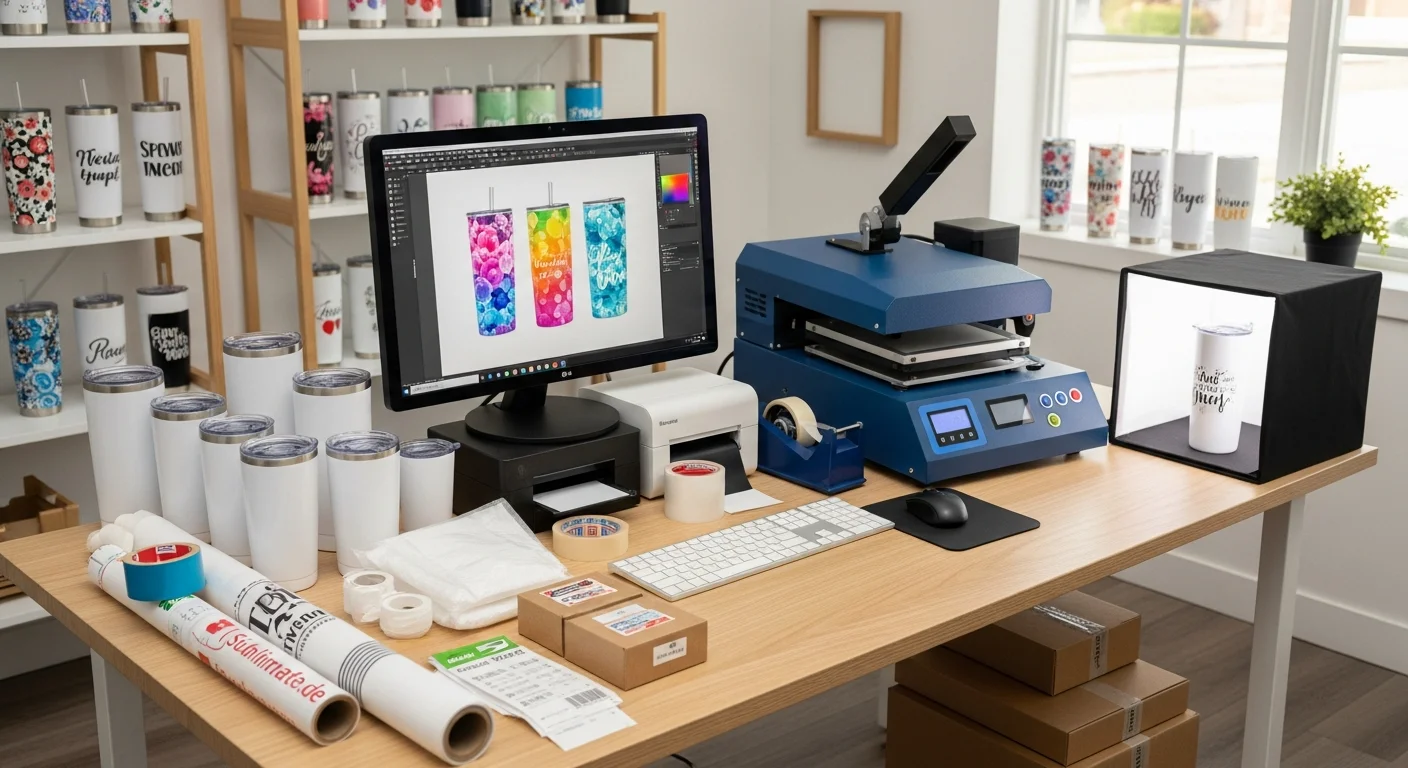
The DIY model involves purchasing tumbler blanks, sublimation equipment, and producing decorated tumblers yourself. This gives you full control over quality and the fastest production turnaround, but requires a significant upfront investment in sublimation equipment (tumbler press, sublimation printer, heat-resistant tape, tumbler blanks) and a learning curve to master the sublimation process. Startup cost: $500–3,000 for basic equipment. Pros: highest per-unit margin (60–75%), full quality control, ability to offer custom one-off designs quickly. Cons: time-intensive production, equipment maintenance, physical workspace required. Best for: crafters, hands-on entrepreneurs, Etsy sellers.
Model 3: Wholesale/White Label
The wholesale model involves ordering decorated tumblers in bulk from a tumbler printing partner and reselling them through your own channels. This model works best for established businesses adding tumblers to an existing product line or entrepreneurs who want to build inventory for events, pop-up shops, or local retail placement. Startup cost: $1,000–5,000 for initial inventory. Pros: consistent quality from professional production, lower per-unit cost at volume, inventory on hand for immediate shipping. Cons: inventory risk, storage requirements, minimum order quantities. Best for: established sellers, local market sellers, event-based businesses.
Setting Up Your Business
The tumbler business legal requirements vary by state and locality, but several steps are universal. Register a business name with your state (DBA or LLC formation — an LLC costs $50–500 depending on the state). Obtain a business license from your city or county. Apply for a sales tax permit in your state (required for collecting sales tax on physical goods in most states). Open a separate business bank account to keep personal and business finances distinct.
Tumbler business branding starts with a business name and visual identity. Choose a name that is memorable, available as a .com domain, and available on all major social media platforms. Create a simple logo using free tools like Canva or invest $50–200 in a freelance designer. Your branding should reflect your niche — a tumbler business targeting outdoor enthusiasts will have a different visual identity than one targeting bridal parties. Consistent branding across your website, social media profiles, packaging, and product listings builds recognition and trust from the first customer interaction.
Sourcing Tumbler Blanks and Supplies
For DIY producers, tumbler supplier comparison is critical. The quality of your tumbler blanks directly determines the quality of your finished product. Key factors to evaluate include: material quality (18/8 vs 18/0 stainless steel — 18/8 is the food-grade standard), insulation performance (test cold retention — a quality blank holds ice for 12+ hours), coating consistency (for sublimation blanks, the polymer coating must be even and defect-free), and lid quality (seal integrity, BPA-free certification, straw/sip functionality).
For POD and wholesale operators, the tumbler printing partner handles blank sourcing, but you should still evaluate the partner's blank quality by ordering samples before committing. The tumbler materials guide provides detailed specifications for evaluating tumbler construction quality across different materials and price points.
Pricing Your Custom Tumblers for Profit
Tumbler pricing strategy is where many new businesses fail. The most common mistake is pricing based on what competitors charge rather than calculating the actual cost structure and required margins. A profitable tumbler pricing strategy starts with the total landed cost — every dollar that goes into getting a finished tumbler to the customer — and applies a markup calculation that covers all costs and delivers a target profit.

Cost Components
- Tumbler blank cost: $3–8 for standard blanks, $8–15 for premium brands
- Decoration cost: $2–5 for sublimation, $3–7 for laser engraving, $2–6 for UV printing (varies by complexity and whether you are doing it yourself or outsourcing)
- Packaging cost: $1–3 for individual boxing with protective insert
- Shipping cost: $5–10 for domestic shipping (USPS/UPS/FedEx)
- Platform fees: 6.5% of sale price on Etsy, 2.9% + $0.30 on Shopify (payment processing), 15% referral fee on Amazon
- Marketing cost allocation: Budget 15–25% of revenue for customer acquisition
Pricing Formula
A healthy tumbler business targets a 3x markup on total product cost (blank + decoration + packaging). For a tumbler with a $12 total product cost (blank + sublimation + box), the retail price should be $36. After $8 shipping, $2.34 Etsy fees (6.5%), and $5.40 marketing allocation (15%), the profit per unit is approximately $8.26 — a 23% net margin. At 100 units per month, that is $826 in monthly profit. At 500 units per month, $4,130. These numbers improve as volume increases and per-unit costs decrease through bulk blank purchasing and optimized ad spend. The pricing breakdown guide provides detailed cost analysis by decoration method and order volume.
Marketing Your Tumbler Business
Tumbler marketing strategy in 2026 is dominated by visual platforms where product photography and video content drive purchasing decisions. A social media tumbler sales approach requires consistent content creation, audience engagement, and strategic paid advertising.
Social Media Marketing
The TikTok tumbler business ecosystem is the single most powerful organic marketing channel for new tumbler sellers. Short-form videos showing the design process, sublimation wrapping, unboxing, and "design reveal" content consistently generate high engagement. Successful tumbler TikTok accounts post 3–5 videos per week, with top-performing content types including: time-lapse creation videos (showing blank to finished tumbler in 15–30 seconds), before-and-after reveal videos, customer unboxing reactions, and niche-specific content that tags relevant communities (#nurselife, #dogmom, #fishinglife).
Instagram serves as a portfolio platform where potential customers browse your full design catalog. Use Instagram Reels for short-form video content (similar to TikTok), grid posts for high-quality product photography, and Stories for behind-the-scenes content, polls, and flash sales. Pinterest drives significant traffic for tumbler businesses — create pins for each design that link to your product listings, optimizing pin descriptions with keywords like "custom nurse tumbler gift" or "personalized fishing tumbler."
Paid Advertising
For new tumbler businesses, start with a modest paid advertising budget of $5–15 per day on Facebook/Instagram ads targeting your niche demographics. Use carousel ads showing multiple tumbler designs, and retarget website visitors who viewed products but did not purchase. As you identify winning ad creatives and audiences, scale spending on high-performing campaigns while pausing underperformers. Target a cost per acquisition (CPA) of $8–15 for a tumbler with a $25–35 retail price.
Sales Channels and Platforms
A multi-channel sales approach maximizes visibility and reduces dependence on any single platform. Each channel has different characteristics, costs, and audience behaviors.

Etsy
An Etsy tumbler business benefits from the platform's built-in audience of buyers actively searching for personalized and handmade products. Etsy charges a $0.20 listing fee, 6.5% transaction fee, and 3% + $0.25 payment processing fee. The platform excels for personalized, made-to-order tumblers where the handmade/custom nature is a selling point. Competition is high but manageable in well-chosen niches. Optimize listings with keyword-rich titles, all 13 tag slots filled, and high-quality mockup images showing the tumbler in lifestyle contexts.
Shopify
A Shopify tumbler store gives you full control over branding, pricing, and customer experience at a cost of $39/month (Basic plan) plus 2.9% + $0.30 per transaction. Shopify is ideal for building a branded tumbler business with a professional website, email marketing integration, and the ability to create bundles, gift sets, and subscription programs. The trade-off is that Shopify does not provide built-in traffic — you must drive all visitors through marketing efforts.
Amazon
An Amazon tumbler seller reaches the largest e-commerce audience in the world but faces the highest fees (15% referral fee + FBA fulfillment fees if using Fulfilled by Amazon). Amazon works best for standardized, ready-to-ship tumbler designs where speed of delivery is a key purchase driver. Custom/personalized tumblers are more challenging on Amazon due to the logistics of made-to-order production, but sellers who offer a curated selection of pre-designed tumblers with 2-day FBA shipping can capture significant volume.
Fulfillment and Shipping
Tumbler packaging for shipping is a critical operational detail that directly impacts customer satisfaction and review ratings. A tumbler that arrives with a dented body, a cracked lid, or a scratched decoration generates a negative review that costs far more than the packaging materials that would have prevented it.
For DIY shippers, use a corrugated box sized to the tumbler with 2 inches of cushioning on all sides. Wrap the tumbler in bubble wrap, secure the lid separately to prevent scratching, and fill void space with crumpled kraft paper or air pillows. Include a branded thank-you card and care instructions. Total packaging cost per unit: $1.50–3.00.
For POD businesses, your fulfillment partner handles packaging and shipping, but you should order a sample to evaluate their packaging quality before launching. Ask about their packaging standards: is each tumbler individually boxed? Is bubble wrap or foam used? Is the box branded or generic? The answers to these questions affect the customer unboxing experience, which influences reviews and repeat purchases.
Scaling Beyond Your First 100 Sales
The transition from 0 to 100 sales validates your niche and designs. Scaling tumbler business operations beyond 100 sales requires systematizing every aspect of the operation: design creation, listing optimization, marketing, production, and customer service.
- Expand your design catalog: The most successful tumbler businesses offer 50–200+ designs across variations of their niche. Use customer feedback and sales data to identify which themes, colors, and styles resonate, then create more designs in those directions.
- Optimize best sellers: Your top 20% of designs will generate 80% of revenue. Invest in professional photography, additional keyword optimization, and paid advertising for these top performers.
- Introduce new products: Once your tumbler business is established, expand to complementary products — matching mugs, can coolers, water bottles, or wine tumblers — that your existing audience will buy.
- Build an email list: Capture customer emails from day one and send monthly newsletters with new designs, seasonal promotions, and reorder reminders. Email marketing delivers the highest ROI of any marketing channel for repeat purchases.
- Consider wholesale vs retail: Once you are processing 200+ orders per month, evaluate whether wholesale accounts (selling to boutiques, gift shops, corporate buyers) can provide more predictable revenue at lower per-unit marketing costs. The bulk ordering guide covers the logistics of scaling to wholesale quantities.
Tumbler business growth follows a predictable pattern: months 1–3 are about validation (product-market fit, first reviews), months 4–6 are about optimization (ad performance, listing conversion, best sellers), and months 7–12 are about scaling (expanding catalog, adding channels, building systems). Patience and consistency are the most important traits for tumbler entrepreneurs — the businesses that succeed are the ones that show up every day, create new designs, engage with customers, and iterate based on data.
Launch Your Tumbler Business with RareCustom
Starting a custom tumbler business in 2026 is more accessible than ever, with POD platforms eliminating the need for inventory, equipment, or production space. Whether you choose the zero-inventory POD model, the hands-on DIY approach, or the volume-oriented wholesale model, the fundamentals of niche selection, compelling design, strategic pricing, and consistent marketing apply equally.
RareCustom offers a complete print on demand tumblers solution for tumbler entrepreneurs: no minimums, no inventory requirements, and professional production quality on every order. Upload your designs to our free design tool, set your retail prices, and we handle production and shipping for each customer order. Explore our full range of custom tumbler blanks — from 12oz wine tumblers to 40oz handled hydration tumblers — and contact our wholesale team for volume pricing on bulk orders. Your tumbler business is one design away from its first sale.
Related Articles
Share this article
Written by
Natalie Voss
Founder & CEO of RareCustom. MBA from Stanford with 8 years in e-commerce operations. Natalie shares business strategy insights for aspiring custom tumbler entrepreneurs.