Photo Socks & Personalized Face Socks: The Ultimate Custom Gift Guide
Everything you need to know about ordering photo socks and personalized face socks. Covers photo preparation, pet and baby socks, holiday gifting, DPI requirements, and pricing for singles versus gift sets.
Jordan Reeves
Brand Experience Strategist at RareCustom. BFA in Graphic Design from Parsons School of Design with 8+ years helping brands craft visual identities. Specialist in color theory, layout composition, and design systems.
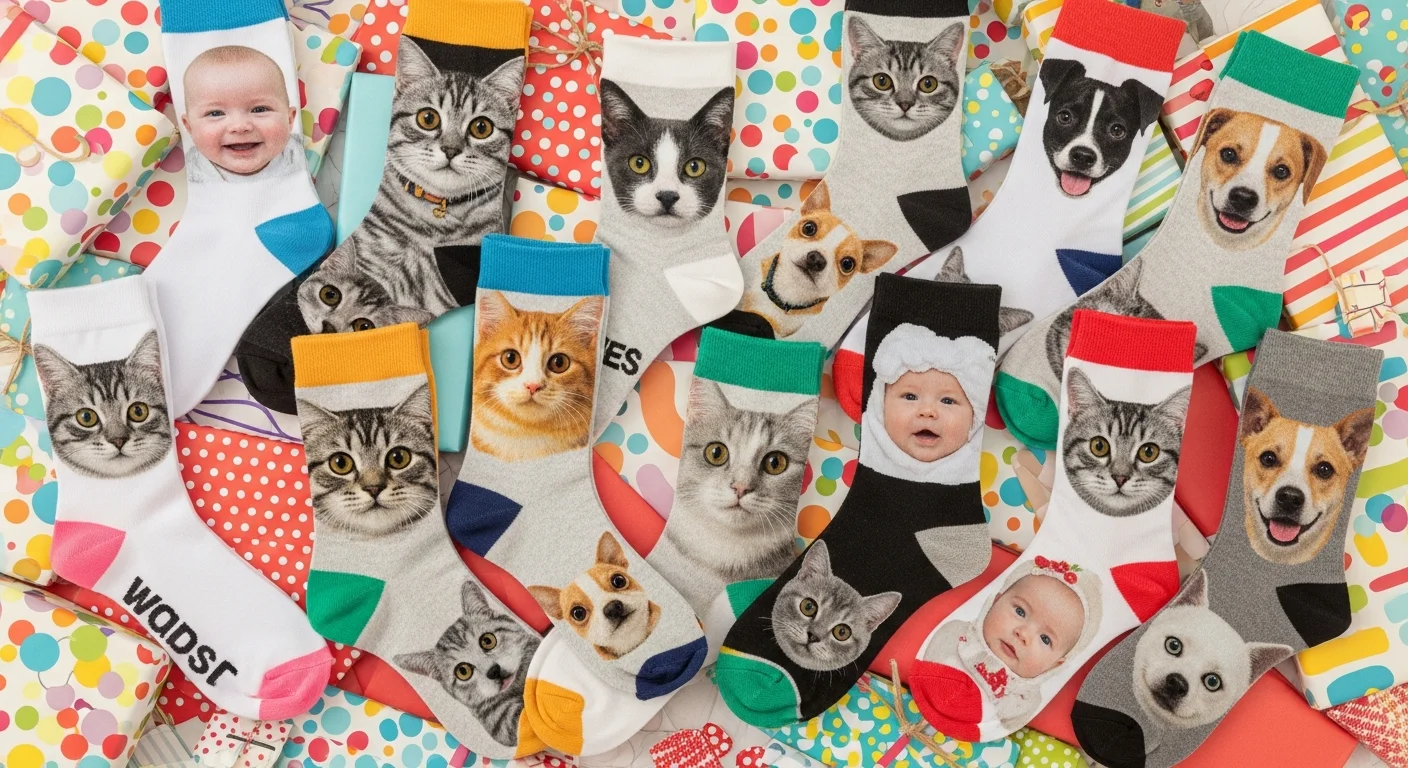
Photo socks — those playful, personalized socks featuring faces, pets, and custom photographs — have exploded into one of the most popular gift categories in custom apparel. The global personalized gifts market surpassed $38 billion in 2025, and custom photo socks consistently rank among the top five best-selling items in that category. The appeal is simple: they are affordable, universally wearable, instantly recognizable, and genuinely funny. A pair of socks covered in a friend's face or a beloved pet's portrait sparks laughter every time they are worn or gifted.
But behind the humor is a product that requires careful photo preparation, the right printing method, and proper material selection to look sharp rather than blurry. This guide covers every step from photo selection to delivery, ensuring that personalized face socks arrive as a delightful surprise rather than a pixelated disappointment. For shoppers looking to pair photo socks with other custom gifts, consider bundling with custom t-shirts or hoodies for a complete personalized gift package.
How Photo Socks Work: Sublimation on Polyester
Photo socks use dye sublimation printing to transfer photographic images onto sock fabric. Sublimation works by converting special inks into gas under heat (around 400°F), which then bonds permanently into polyester fibers. The result is a full-color, full-wrap print that covers the entire sock surface — top, bottom, and sides — without any texture difference between printed and unprinted areas.
Sublimation is the only practical printing method for photographic sock designs because it reproduces continuous-tone images with smooth gradients and fine detail. Knit-in construction, while excellent for geometric patterns and logos, cannot reproduce photographic images with sufficient resolution. Direct-to-garment (DTG) printing works on cotton socks but produces a raised ink layer that cracks over time. For a complete comparison of sock printing technologies, see the sock printing methods guide.
Because sublimation requires polyester to bond properly, photo socks are manufactured from 95–100% polyester with 0–5% spandex for stretch. The polyester base must be white or very light colored because sublimation inks are translucent — they tint the existing fiber color rather than covering it. This is why most photo socks have a white base with the printed design covering the entire visible surface.
Photo Preparation: Resolution, Background Removal, Face Cropping
The quality of the final product depends almost entirely on the quality of the source photo. A blurry, low-resolution smartphone photo produces a blurry sock. A sharp, high-resolution image produces a crisp, vibrant result. Understanding the technical requirements before uploading saves time and prevents disappointing outcomes.

Resolution requirements: The ideal source image should be at least 1000 x 1000 pixels for face-only designs and 2000 x 2000 pixels for full-body or multi-subject layouts. In DPI terms, 300 DPI produces the sharpest prints with clearly defined features, while 150 DPI is the absolute minimum for acceptable quality. Images below 150 DPI will appear visibly pixelated on the finished sock, with jagged edges around facial features and fuzzy text.
Background removal: For face socks, the background must be removed from the source photo so only the face (or pet) appears against the sock's base pattern. Most photo sock services offer automatic background removal, but results vary in quality. For the best outcome, submit a PNG file with a transparent background that has been manually cropped using photo editing software. This prevents hair from being accidentally trimmed or background elements from bleeding into the design.
Face cropping: The face should be cropped from the hairline (or top of the head) to just below the chin. Include ears unless the hairstyle covers them. Avoid cropping too tightly — leaving a small margin around the face prevents any features from being cut off when the image is tiled across the sock surface. Most photo sock designs tile the face 4–8 times across the sock in a repeating pattern.
Pet Face Socks and Baby Photo Socks
Pet face socks are the single most popular category within photo socks, accounting for approximately 45% of all photo sock orders according to industry data. Dog face socks lead the category, followed by cat face socks, with guinea pigs, rabbits, and horses making up a small but growing niche. The emotional connection people have with their pets makes these socks both a personal indulgence and a crowd-pleasing gift.
Pet photos present unique preparation challenges. Animals rarely pose with even lighting and a clean background, so photo editing is almost always required. Front-facing photos with both eyes visible produce the best results. Side profiles and action shots do not tile well across a sock surface. For dogs with dark fur, ensure the photo has sufficient lighting to distinguish facial features — a black Labrador photographed in shadow becomes an indistinct dark blob on the finished sock.
Baby photo socks are the second most popular category, frequently ordered as gifts for new parents and grandparents. Monthly milestone photos (newborn, 3 months, 6 months) and first birthday portraits are common source images. Baby socks work particularly well as gifts because the subject changes rapidly — the sock becomes a keepsake of a specific moment in time. For design inspiration and pattern ideas, see the fonts, patterns, and graphics guide.
Couple and Family Portrait Socks
Couples ordering matching photo socks for each other has become a popular anniversary, Valentine's Day, and "just because" gift. The most common format places one partner's face on the socks worn by the other, creating a playful mutual tribute. Engagement photos, wedding portraits, and candid couple shots all work well as source material.
Family portrait socks expand the concept to include parents, children, and extended family members. These are particularly popular for family reunions, holiday gatherings, and milestone celebrations like grandparents' anniversaries. The design challenge increases with more faces — each face needs to be large enough to be recognizable, which limits the total number that can fit on a single sock. Most designs accommodate 2–4 faces comfortably; beyond that, the faces become too small for clear identification at sock scale.
Memorial and Tribute Socks
A growing and deeply meaningful category, memorial socks feature photographs of loved ones who have passed away. These are ordered for funeral services, anniversary remembrances, and as ongoing personal tributes. The emotional significance of these orders demands extra attention to photo quality, color accuracy, and production timelines to ensure they arrive when needed.
Memorial socks often incorporate text elements alongside the photo — birth and death dates, a short quote, or a simple "Forever in Our Hearts" message. Keep text at 18-point equivalent or larger to remain legible on the sock surface. Subdued color palettes (black, navy, gray, or muted earth tones) with the photo as the sole color element create a dignified, respectful design. Custom socks also serve as meaningful keepsakes at weddings and memorial celebrations.
Holiday Gift Occasions: Father's Day, Mother's Day, Valentine's, Christmas
Photo socks follow a predictable seasonal demand pattern that influences both ordering timelines and design choices. Understanding peak periods helps ensure timely delivery and maximizes sales for retailers:

Valentine's Day (February 14): Couple face socks and pet-parent socks are top sellers. Orders spike from January 15 through February 1. Production timelines of 7–14 days mean orders placed after February 1 risk late delivery without rush shipping ($8–15 extra).
Mother's Day (second Sunday of May): Baby photo socks, family portrait socks, and grandchild face socks dominate. This is the second-highest volume period for photo socks after Christmas. Order by April 20 for standard delivery.
Father's Day (third Sunday of June): Pet face socks, baby socks, and hobby-themed designs (golf, fishing, grilling with the recipient's face) perform well. Order by June 1 for standard delivery.
Christmas (December 25): The highest-volume season for all custom socks, accounting for 35–40% of annual photo sock orders. Family face socks, pet socks, and matching family sets are top sellers. Order by November 25 for standard delivery; many providers impose hard cutoff dates of December 5–10 for Christmas delivery guarantees.
Photo Quality Requirements: Minimum DPI
Digital images are composed of tiny squares called pixels, and DPI (dots per inch) measures how many pixels are packed into each inch of the printed output. Higher DPI means more detail, smoother gradients, and sharper facial features on the finished sock.
300 DPI is the gold standard for photo socks. At this resolution, individual pixels are invisible to the naked eye, and facial features appear crisp with smooth skin tones and clearly defined edges. All professional portrait photos and modern smartphone cameras (12+ megapixels) produce images that exceed 300 DPI at sock-print scale.
150 DPI is the minimum acceptable quality. Below this threshold, individual pixels become visible as jagged edges around facial features, and color gradients show visible banding rather than smooth transitions. Social media downloads (Instagram, Facebook) are often compressed to 72 DPI and are unsuitable for photo socks without access to the original, uncompressed file.
A quick test: if the source image looks sharp when viewed at full size on a computer monitor (not a phone screen), it almost certainly meets the 300 DPI requirement for sock printing. If it looks slightly fuzzy on a monitor, it will look significantly worse printed on fabric.
Ordering Single Pairs vs Gift Sets
Photo sock pricing follows a volume-based structure that makes gift sets significantly more cost-effective per pair than single orders:
Single pair: $15–22 per pair depending on the provider and printing complexity. This includes one design on one pair of socks. Single pairs are ideal for individual gifts but carry the highest per-unit cost due to one-time setup and production handling.
Sets of 3 pairs: $12–18 per pair, representing a 15–25% savings over single-pair pricing. Three-pair sets allow different designs on each pair (for example, three different pet faces, or one pet, one baby, and one couple photo). This is the most popular gift set format for holiday giving.
Sets of 6+ pairs: $10–15 per pair, with savings of 25–40% compared to singles. Six-pair sets are popular for families ordering matching socks for all members, friend groups exchanging gifts, or office teams creating a group gift for a departing colleague. At this volume, some providers include free gift packaging (belly band wrap, branded box, or gift bag).
For bulk corporate orders (50+ pairs), prices drop to $7–12 per pair. Company holiday gifts, event giveaways, and promotional sock campaigns at this volume provide excellent per-unit value with full customization on every pair.
Frequently Asked Questions
Can a screenshot from social media be used for photo socks?
Social media screenshots are generally not suitable because platforms compress images to 72 DPI, which produces visibly pixelated results on printed socks. Request the original photo file from the person who took it, or use the "download original" option available on some platforms. Photos taken directly with a smartphone camera at full resolution work excellently.
How many times does the face appear on the sock?
Most photo sock designs tile the face 4–8 times across the sock surface in a repeating pattern. The exact count depends on the face-crop size and the sock dimensions. Some providers allow adjustment of the repeat scale — larger faces appear fewer times but with more visible detail, while smaller faces create a busier, all-over pattern.
Do photo socks fade after washing?
Sublimation-printed photo socks on polyester fabric retain their vibrancy through 50–100+ wash cycles when washed in cold water and tumble dried on low heat. The sublimation ink is embedded in the polyester fibers rather than sitting on the surface, so it cannot crack or peel. Hot water washing and high-heat drying may gradually reduce vibrancy over time.
Share this article
Written by
Jordan Reeves
Brand Experience Strategist at RareCustom. BFA in Graphic Design from Parsons School of Design with 8+ years helping brands craft visual identities. Specialist in color theory, layout composition, and design systems.