Jacket Decoration Methods: Embroidery vs Printing vs Patches Compared
Compare every jacket decoration method side by side — embroidery, screen printing, DTG, custom patches, and heat transfer vinyl. Learn which technique delivers the best quality, durability, and value for your custom jacket project.
Aisha Patel
Head of Materials Science & Sustainability at RareCustom. Aisha compares embroidery, screen printing, DTG, and patch methods to help customers choose the best jacket decoration technique.
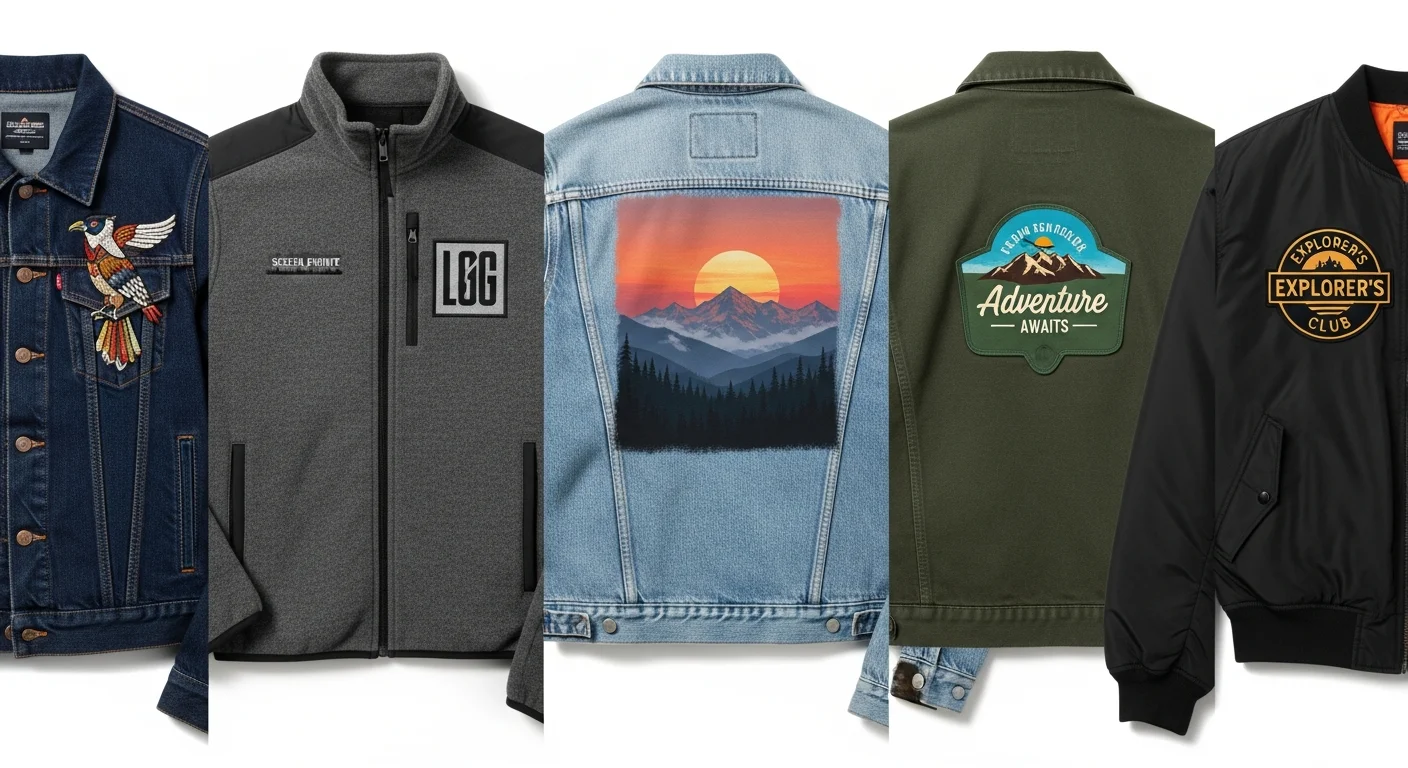
Choosing the right decoration method for your custom jacket is one of the most important decisions you will make in the production process. The method you select affects how your design looks, how long it lasts, how much it costs, and which fabrics you can use. Embroidery, screen printing, DTG (direct-to-garment), custom patches, and heat transfer vinyl each have distinct strengths and limitations — and the best choice depends on your specific design, jacket material, order quantity, and budget.
This comprehensive guide examines each decoration method in detail, compares them across key factors like durability, cost, and design flexibility, and helps you determine which technique is the right fit for your project. Whether you are decorating leather jackets, work jackets, or fashion outerwear, understanding these methods ensures you get the results you envision.
Overview of Jacket Decoration Methods
Before diving into the details of each method, here is a high-level summary of the five primary techniques used for custom jacket decoration:
Embroidery: Thread stitched directly into the fabric using computerized machines. Creates a raised, textured design with a premium feel. Best for logos, text, and designs with limited colors.
Screen printing: Ink pushed through mesh screens onto the fabric surface. Produces bold, vibrant designs with excellent durability. Most cost-effective for large orders with limited color counts.
DTG (Direct-to-Garment): Inkjet printing technology that applies full-color designs directly onto fabric. Best for photographic images, complex artwork, and small orders where screen printing setup costs are prohibitive.
Custom patches: Embroidered, woven, or printed designs produced on a separate backing material, then sewn, ironed, or adhered to the jacket. Removable and repositionable, with a distinct vintage or military aesthetic.
Heat transfer vinyl (HTV): Pre-cut vinyl designs applied to fabric using heat and pressure. Best for names, numbers, and simple graphics. Popular for sports uniforms and personalized items.
Embroidery Deep Dive
Embroidery is the gold standard for premium jacket decoration. The dimensional quality of stitched thread conveys craftsmanship and permanence that no flat printing method can match. For corporate logos, team branding, and any design where perceived quality matters, embroidery is the default choice.
Thread types: Polyester thread is the industry standard for commercial embroidery — it is colorfast, strong, and resistant to bleach and UV fading. Rayon thread offers a silkier sheen and slightly richer colors but is less durable and not bleach-resistant. Metallic threads (gold, silver, copper) add luxury accents but require slower machine speeds and specialized needles to prevent breakage.
Digitizing: Converting artwork into an embroidery file (digitizing) is a skilled process that determines stitch direction, density, underlay, and thread changes. Poor digitizing produces puckered, misaligned, or thread-bare results even with quality materials and equipment. Professional digitizing typically costs $20-75 depending on design complexity and is a one-time cost that can be reused for unlimited future production runs.
Color limitations: Each color in an embroidered design requires a separate thread change, which adds production time and cost. Designs with 1-6 colors are the sweet spot for embroidery — complex enough to be visually interesting but efficient enough to keep costs reasonable. Designs requiring more than 12 colors should consider printing methods instead.
Fabric compatibility: Embroidery works on virtually every jacket fabric — cotton, polyester, nylon, denim, fleece, leather (with specialized needles), and canvas. Heavier fabrics produce cleaner results because they provide more structural support for the stitching. Lightweight or stretchy fabrics require additional stabilizer backing to prevent distortion.

Screen Printing for Jackets
Screen printing is the workhorse of the custom apparel industry and translates effectively to jacket decoration with some important considerations. The technique uses mesh screens with stenciled designs to apply ink onto the fabric surface, producing bold, opaque prints with excellent wash durability.
Setup and screens: Each color in a screen-printed design requires a separate screen, with setup costs typically ranging from $25-50 per screen. This means a 4-color design costs $100-200 in screen charges alone before any jackets are printed. These setup costs are amortized across the order — a 100-jacket run absorbs them easily, while a 5-jacket order makes screen printing expensive per unit.
Ink options: Plastisol ink is the traditional choice for jacket printing — it produces bright, opaque colors on any fabric color and has excellent wash durability. Water-based inks offer a softer hand-feel and are more environmentally friendly but work best on lighter-colored fabrics. Discharge inks chemically remove the fabric's dye and replace it with the design color, producing an ultra-soft print that feels like part of the fabric rather than sitting on top.
Durability: Properly cured screen prints are among the most durable decoration methods available. Quality plastisol prints withstand 50+ wash cycles without significant fading or cracking. The key is proper curing — ink must reach the correct temperature (typically 320°F for plastisol) and be held there long enough for full polymerization.
Jacket-specific challenges: Jackets present challenges that t-shirts do not. Zippers, buttons, seams, and thick fabrics can interfere with screen placement and ink application. Back panel prints must account for the center back seam on many jacket styles. Sleeves require specialized cylindrical platens for screen printing. These challenges are manageable but require experienced printers familiar with outerwear production.

DTG Printing on Jackets
Direct-to-garment printing uses modified inkjet technology to spray full-color designs directly onto fabric. DTG excels where screen printing struggles — photographic images, designs with many colors, gradients, and small order quantities where screen setup costs are prohibitive.
Process: The jacket panel is positioned on a flatbed platen, pre-treated with a bonding agent (for dark fabrics), and fed through the printer. The inkjet heads apply water-based textile inks in CMYK plus white, building up the design in a single pass. The print is then heat-cured to bond the ink permanently to the fabric fibers.
Color capability: DTG produces unlimited colors in a single print pass with no additional cost per color. Photographic images, complex gradients, and designs with hundreds of colors print as easily as a simple two-color logo. This makes DTG the ideal choice for custom jacket designs featuring photographs, detailed illustrations, or complex artwork.
Material compatibility: DTG works best on 100% cotton and cotton-dominant blends. Results on polyester, nylon, and synthetic fabrics are inconsistent because water-based DTG inks do not bond as reliably with synthetic fibers. For polyester and nylon jackets, sublimation printing produces superior results. Cotton canvas jackets, denim jackets, and cotton-shell coach jackets are ideal candidates for DTG.
Order quantity sweet spot: DTG's per-unit cost is nearly the same whether you print 1 jacket or 100, because there are no setup costs. This makes DTG the most economical choice for orders of 1-24 pieces. Above 25 units, screen printing's lower per-unit cost (once setup is amortized) typically makes it the better value.

Custom Patches: Types and Production
Custom patches occupy a unique space in jacket decoration. They combine the premium feel of embroidery with the flexibility of being removable, repositionable, and collectible. Patches have deep roots in military, motorcycle, scouting, and punk culture, giving them an automatic aesthetic association that other decoration methods lack.
Embroidered patches: The classic patch type, featuring thread stitched onto a twill or felt backing. Embroidered patches produce the same premium look as direct embroidery but can be mass-produced independently and applied to jackets later. They are available with merrowed (overlocked) borders, die-cut shapes, and various backing options.
Woven patches: Produced on a loom using thin threads that create a flat, detailed surface. Woven patches reproduce finer detail than embroidered patches and have a smoother texture. They are ideal for designs with small text, intricate logos, and photographic elements that embroidered patches cannot capture cleanly.
PVC patches: Molded from flexible PVC plastic, these patches are waterproof, extremely durable, and have a modern, three-dimensional appearance. PVC patches are popular for outdoor brands, military-style jackets, and any application where the patch will be exposed to rain, mud, or heavy wear. They can be produced in any color and shaped into virtually any outline.
Attachment methods: Patches can be sewn on (most permanent), ironed on (convenient but less durable), or attached with hook-and-loop (Velcro) for interchangeable displays. For jackets that will be worn daily, sew-on attachment is recommended. For promotional jackets where recipients may want to add or remove patches, hook-and-loop provides maximum flexibility.
For an in-depth guide to patch design, placement strategies, and production, see our custom patches for jackets guide. You can also explore our custom jackets collection to see which jacket styles are most compatible with patch decoration.
Heat Transfer Vinyl (HTV)
Heat transfer vinyl involves cutting designs from colored vinyl sheets and heat-pressing them onto the jacket fabric. HTV is popular for names, numbers, and simple graphics — particularly for sports jackets and personalized items where each piece has unique text.
Advantages: HTV produces bold, opaque colors on any fabric color. Individual personalization (names, numbers) is easy because each piece can be cut uniquely without setup costs. HTV is also fast — a skilled operator can cut and press a design in minutes, making it ideal for same-day or next-day delivery requirements.
Limitations: HTV has a noticeable texture and weight on the fabric surface. Complex multi-color designs require layering multiple vinyl cuts, which increases both thickness and the risk of peeling at edges. HTV is not suitable for photographic images or designs with fine detail. Over time, HTV can crack, peel, or lift at the edges — especially on jackets that are frequently folded or compressed in storage.
Best applications: Sports team jackets with player names and numbers, personalized gift jackets with individual names, and simple logo applications where budget is a primary concern. HTV works on virtually all jacket fabrics including polyester, nylon, cotton, and leather.
Cost Comparison Across Methods
Cost is often the deciding factor in choosing a decoration method. Here is how the five methods compare at different order quantities for a standard chest-sized logo design on a custom jacket:
1 jacket: DTG ($8-15) and HTV ($5-10) are the most affordable for single units. Embroidery ($15-25) is mid-range due to digitizing costs spread across one piece. Screen printing ($30-50) is the most expensive because setup costs hit a single unit hard. Patches ($10-15 each) fall in the middle.
12 jackets: Screen printing ($6-10 per jacket) becomes competitive as setup costs spread. Embroidery ($10-18) remains consistent. DTG ($8-15) holds steady. HTV ($5-10) stays affordable. Patches ($4-8 each at this quantity) benefit from bulk pricing.
50+ jackets: Screen printing ($3-6 per jacket) is the clear cost leader for simple designs. Embroidery ($8-15) offers the best perceived value relative to cost. DTG ($7-12) maintains consistent pricing. HTV ($4-8) remains budget-friendly for simple designs. Patches ($2-5 each) reach their most competitive pricing at scale.

Durability Comparison
How long your decoration lasts depends on the method, the quality of execution, and how the jacket is cared for. Here is how each method ranks for long-term durability:
Most durable — Embroidery: Quality embroidery outlasts the jacket itself. Thread colors remain vibrant after hundreds of washes, and the stitching actually becomes more integrated with the fabric over time. The only durability concern is thread pulls from snags, which can be repaired.
Very durable — Screen printing: Properly cured screen prints maintain their appearance for 50-100+ washes. Plastisol prints on outerwear tend to last even longer than on t-shirts because jackets are washed less frequently. Minor cracking may appear after years of heavy use.
Durable — PVC and embroidered patches: Patches themselves are extremely durable, but the attachment method is the weak point. Sewn-on patches last as long as the jacket. Iron-on patches may lift at edges after extended wear and washing. Velcro patches last indefinitely but can detach during activities.
Moderate — DTG: DTG prints on cotton jackets maintain good color and detail for 30-50 washes with proper care. Fading is gradual and affects the entire design evenly rather than cracking or peeling. DTG on synthetic fabrics has lower durability and is generally not recommended for jackets that will be washed frequently.
Least durable — HTV: Heat transfer vinyl typically lasts 20-30 washes before showing signs of cracking, peeling, or edge lifting. Quality HTV materials and proper application can extend this, but HTV will generally need replacement before other decoration methods show significant wear.
When to Choose Each Method
With all the details covered, here are clear recommendations for when each decoration method is the best choice for your custom jacket project:
Choose embroidery when: You want a premium, professional look. Your design has 1-8 colors. You are decorating corporate jackets, team outerwear, or gifts where perceived quality matters. Your budget allows $10-25 per decoration. You need maximum durability.
Choose screen printing when: You are ordering 24+ jackets with the same design. Your design has 1-6 bold colors. Cost-per-unit is a primary concern. You need excellent durability. The jacket fabric is smooth and flat enough for screen placement.
Choose DTG when: Your design is photographic or has many colors. You are ordering 1-24 jackets. The jacket is cotton or cotton-blend. You want a soft, breathable print that does not add noticeable weight or texture to the fabric.
Choose patches when: You want a removable or interchangeable design. The aesthetic of patches fits your brand or project (military, scout, motorcycle, workwear). You want to produce patches in bulk and apply them to jackets over time. Your work jacket program requires replaceable identification.
Choose HTV when: You need individual personalization (names, numbers). Turnaround time is extremely tight. Budget is the primary constraint. The design is simple text or basic graphics. The jacket will not be washed frequently.
Still not sure which method is right for your project? Upload your design to our free design tool, select your jacket style from our custom jackets collection, and our system will recommend the best decoration method based on your design complexity, fabric type, and order quantity. For inspiration on how different methods look on specific jacket types, browse our retro and vintage jacket styles guide.
Share this article
Written by
Aisha Patel
Head of Materials Science & Sustainability at RareCustom. Aisha compares embroidery, screen printing, DTG, and patch methods to help customers choose the best jacket decoration technique.