Crew vs. Ankle vs. Knee-High: Choosing the Right Custom Sock Style
Compare no-show, ankle, quarter, crew, and knee-high custom sock styles. Learn which length fits your activity, audience, and design goals with size and trend data for 2026.
Camille Dupont
Creative Director at RareCustom. BFA from RISD with 9+ years in graphic design. Camille guides customers through selecting the perfect sock style for every occasion and outfit.
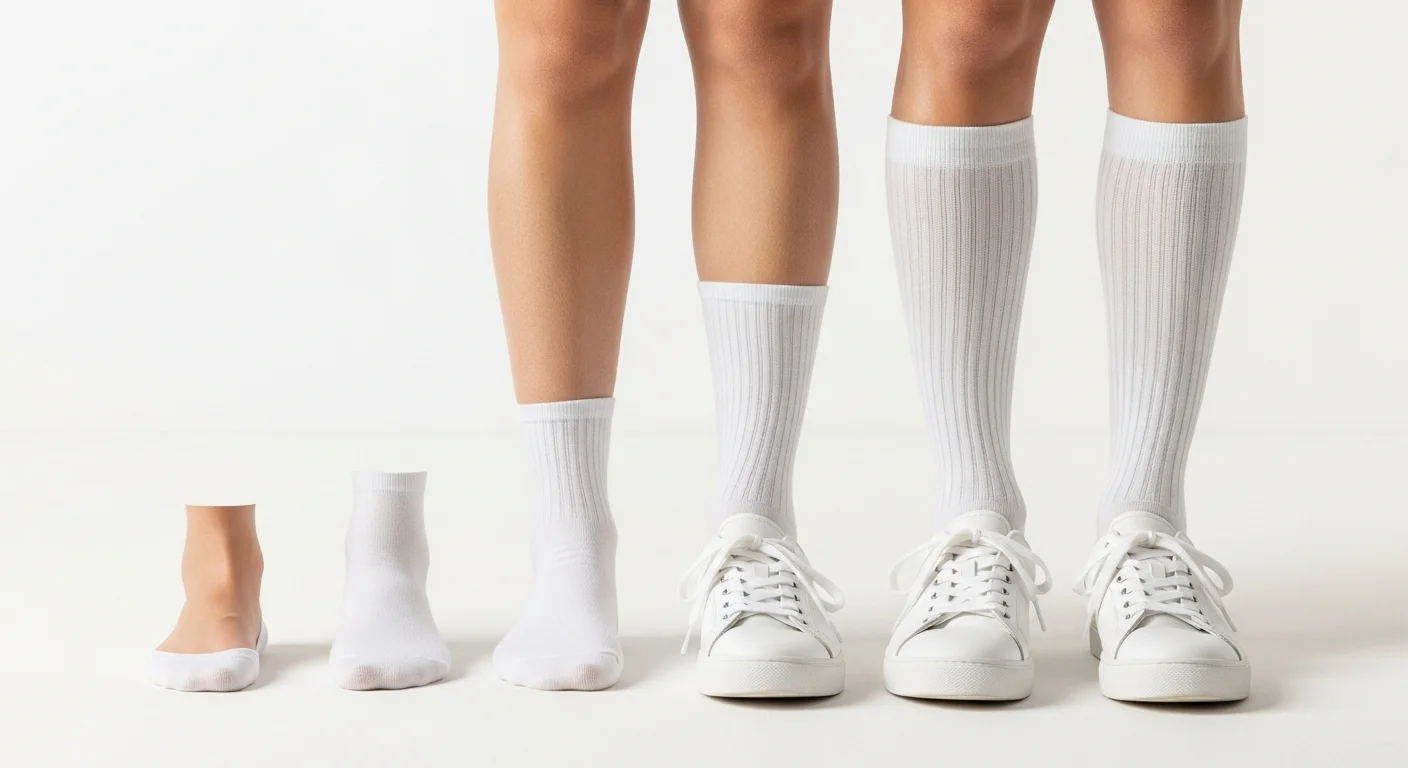
The length of a custom sock is not just a fashion choice — it determines how much design area you have, which activities the sock suits, how much material is used (affecting cost), and which audience will actually wear them. Just as choosing between a pullover and zip-up matters for custom hoodies, selecting the right sock length shapes the entire product experience. Choosing the wrong style wastes your design budget: a gorgeous all-over print on a no-show sock will never be seen, and a knee-high for a summer 5K race will overheat runners by mile two.
This guide compares every custom sock length from no-show to over-the-calf with specific measurements, use cases, cost data, and trend analysis for 2026. By the end, you will know exactly which style fits your project — whether you are outfitting a sports team, branding a corporate event, launching a retail sock line, or creating memorable wedding favors.
No-Show and Liner Socks
No-show socks (also called invisible socks or liners) sit entirely below the shoe line, with the top edge typically 1 to 1.5 inches above the sole. They are designed to be worn with low-cut sneakers, loafers, boat shoes, and slip-ons where visible socks would disrupt the clean aesthetic. The leg portion is essentially nonexistent, so the only printable area is the top of the foot — roughly 3 × 2 inches — and the sole.
From a custom design perspective, no-show socks offer minimal branding opportunity. A small logo on the toe bridge, a branded sole message, or a colored heel grip is the extent of what you can display. They are best used as comfort-branded items where the wearer appreciates the quality and brand identity without needing visual impact. Common use cases include premium hospitality gifts at luxury hotels, high-end brand merchandise, and employee welcome kits at tech companies.
No-show socks require a silicone grip strip on the inside heel to prevent slipping, adding $0.50-$1.00 to unit cost. Pricing ranges from $4 to $8 per pair. Because of the limited design canvas, no-show socks are rarely the best choice for promotional purposes — crew or ankle socks provide dramatically more visibility for a similar investment.
Ankle Socks
Ankle socks rise three to four inches above the sole, sitting just below or at the ankle bone. They expose most of the lower leg while covering the ankle joint and providing a buffer between the shoe collar and the skin. The visible design area is roughly 4 × 3 inches on each side — enough for a logo, short text, or simple pattern but not enough for complex multi-element illustrations.
Ankle socks are the most popular athletic sock length, making up approximately 35% of the U.S. sock market by unit volume. They are ideal for running, tennis, gym workouts, and warm-weather sports where minimal coverage reduces heat buildup and keeps the lower leg free for unrestricted movement. For custom athletic team socks, ankle length works well for sports typically played in shorts — tennis, basketball practice, cross-country running, pickleball, and volleyball training.
Corporate and promotional ankle socks are popular for summer trade shows, outdoor events, fitness brand giveaways, and health and wellness companies. The compact size makes ankle socks slightly cheaper to ship than crew socks — a meaningful consideration when mailing hundreds of promotional pairs. Pricing ranges from $5 to $10 per pair at 100+ units, comparable to crew socks but with slightly lower material costs.
Quarter-Length Socks
Quarter socks hit one to two inches above the ankle bone, sitting between ankle and crew height. The leg measures four to five inches from sole to cuff. Quarter-length is sometimes called "low crew" and occupies a middle ground that appeals to wearers who want more coverage and design space than an ankle sock without the full height of a traditional crew sock.
The design area is moderately sized — roughly 5 × 3.5 inches per side — allowing for medium logos, horizontal stripe patterns, word marks, and simple repeated motifs. Quarter socks have gained popularity in running and hiking communities because they provide just enough height to protect against shoe collar chafing and trail debris without trapping excess heat around the calf. Several major running shoe brands now recommend quarter-length socks as the optimal pairing with their mid-cut trail runners.
For custom orders, quarter socks typically cost the same as ankle socks (the material difference is negligible), making them a good value when you need slightly more design canvas. They are an excellent compromise for organizations that cannot decide between ankle and crew — quarter socks satisfy both the "visible branding" camp and the "minimal coverage" camp reasonably well.

Crew Socks
Crew socks extend six to eight inches above the ankle, hitting the mid-calf. They are the most versatile and most-ordered custom sock style, representing roughly 55% of all custom sock orders across the industry. The design canvas is generous — approximately 6 × 3.5 inches on each side of the leg — giving you enough space for detailed logos, multi-line text, all-over patterns, complex illustrations, and even photographic images that wrap around the full circumference.
A significant trend worth noting: crew socks have experienced a massive resurgence among Gen Z and millennial consumers since 2022. Search data from fashion retail platforms shows that "crew socks" queries are up 340% since 2022, driven by the "socks as accessories" movement where bold, visible socks are intentionally styled with shorts, skirts, cropped pants, and platform shoes as statement pieces. Social media platforms have amplified this trend, with custom sock haul videos and outfit styling content generating millions of views. In terms of printable area, crew socks offer approximately 140 sq cm of design canvas per sock — compared to just 45 sq cm on ankle socks and a massive 280 sq cm on knee-highs. For brands and teams looking to maximize design visibility and cultural relevance, crew socks are the safest and most impactful choice in 2026.
Crew socks work for virtually every use case: sports teams (basketball, volleyball, lacrosse), corporate gifts, retail products, wedding parties, fundraising campaigns, school spirit wear, and brand merchandise. They offer enough height for full branding visibility while remaining comfortable for all-day wear in both warm and cool weather. Pricing typically falls between $6 and $14 per pair depending on fabric, printing method, and order volume, with the sweet spot at $8-$10 per pair for orders of 100-250 pairs.
Knee-High and Over-the-Calf
Knee-high socks extend to just below the knee, measuring 15 to 18 inches from the sole. Over-the-calf variants extend slightly higher, reaching the lower portion of the knee joint, and are commonly used in formal dress socks, equestrian wear, and certain athletic applications. The design canvas is enormous — roughly 12 × 4 inches per side — allowing for large graphics, full-length graduated patterns, multi-zone artwork with different themes at the ankle, calf, and knee, and detailed scenes that tell a visual story from bottom to top.
Knee-high socks are standard equipment in several sports: soccer (where they are tucked over shin guards), baseball and softball (traditionally worn pulled up to the knee), field hockey, lacrosse, and marching band. They are also increasingly popular for fashion brands, cosplay merchandise, themed event products, and retail novelty lines where the tall canvas enables striking designs that are impossible on shorter sock styles.
The increased material means higher unit costs — typically $10 to $20 per pair at 100+ units — and the taller leg requires careful attention to sizing and fit because calf circumference varies more dramatically than ankle circumference across sizes. A knee-high sock that fits a 14-inch calf perfectly will be loose and unflattering on a 12-inch calf and uncomfortably tight on a 17-inch calf. Offering two or three calf-width options in addition to standard foot sizes significantly improves fit satisfaction for knee-high orders.
For 2026 design trends, knee-high socks are seeing growth in lifestyle and fashion categories with bold graphic prints, gradient color transitions that flow from ankle to knee, and collaborative artist collections that use the tall canvas as a wearable art surface.

Matching Sock Style to Activity and Occasion
Choosing the right sock length starts with understanding the end use and the audience who will wear them. For team sports, match the sock length to the sport's convention: knee-high for soccer and baseball, crew for basketball and volleyball, ankle for tennis and running. Deviating from sport norms is rarely advisable because league rules may specify sock height and players have strong preferences based on years of habit.
For corporate events and promotional giveaways, crew socks offer the best balance of design visibility, universal wearability, and perceived value. A well-designed crew sock in quality packaging feels like a premium gift rather than a throwaway promotional item. For retail product lines, offer multiple lengths to capture different customer preferences — a crew and ankle version of the same design doubles your addressable market without requiring entirely new artwork, since the same core design elements can be scaled to fit either template.
For wedding and event gifts, crew socks are the overwhelming favorite because they photograph well in group shots (groomsmen pulling up pant legs to reveal matching socks is a wedding photo staple) and offer enough room for names, dates, custom illustrations, and wedding color schemes. For fitness and athletic brands, match the sock length to the primary activity of your target audience — runners prefer ankle or quarter socks, CrossFit athletes favor crew socks, and soccer players need knee-highs. The beginner's design guide covers how to adapt your artwork to each sock style's unique template dimensions.
Seasonal Recommendations
Spring and summer orders should lean toward ankle and quarter socks — lighter weight, less coverage, and better suited to warm-weather styling with shorts, sneakers, and sandals-with-socks (a trend that shows no sign of slowing in 2026). Cotton-polyester blends at 120-160 GSM keep feet cool without sacrificing print quality. Lighter colors and brighter designs tend to sell better in warm months, aligning with seasonal fashion palettes.
Fall and winter orders are ideal for crew and knee-high styles in heavier fabrics like merino wool blends, fleece-lined constructions, or heavyweight cotton terry at 180-240 GSM. Darker base colors and richer design palettes match seasonal aesthetics. Seasonal collections that rotate between warm-weather ankle socks and cool-weather crew socks perform well for retail brands seeking year-round revenue without large unsold inventory.
Trade show and event timing also matters. Summer trade shows should feature ankle socks as giveaways because attendees are more likely to wear them immediately with their current warm-weather wardrobe. Winter corporate gifts pair well with premium crew socks in branded gift boxes or drawstring pouches — the packaging elevates the perceived value significantly. Matching your sock style to the season increases the chance your recipients will actually wear them, turning your branded socks into walking advertisements that generate impressions for months.
Frequently Asked Questions
Which custom sock style sells the most?
Crew socks are the most popular custom sock style, accounting for approximately 55% of all custom orders across the industry. Their popularity stems from the large design canvas (6 × 3.5 inches per side), universal wearability across activities and demographics, and the current fashion trend toward visible socks as intentional accessories styled with shorts and cropped pants.
Can you put a detailed design on an ankle sock?
Ankle socks have a limited design area of roughly 4 × 3 inches per side. Simple logos, short text, small icons, and basic geometric patterns work well. Complex illustrations, multi-element layouts, and detailed photographic images are better suited to crew or knee-high socks where the larger canvas preserves fine detail and gives the design room to breathe visually.
Are knee-high custom socks significantly more expensive?
Yes. Knee-high socks use 40-60% more material than crew socks and require more knitting or printing time per unit. Expect to pay 30-50% more per pair compared to crew socks of the same fabric and printing method. At 100 pairs, a custom knee-high sock might cost $12 to $18 per pair versus $8 to $12 for the same design on a crew sock.
Share this article
Written by
Camille Dupont
Creative Director at RareCustom. BFA from RISD with 9+ years in graphic design. Camille guides customers through selecting the perfect sock style for every occasion and outfit.