10 Common Custom Sock Mistakes (And How to Avoid Them)
Avoid the 10 most common custom sock ordering mistakes — from choosing the wrong printing method and low-resolution artwork to skipping samples, bad sizing, and forgetting care instructions. Save time and money on every order.
Marcus Chen
E-Commerce Growth & Merchandising Lead at RareCustom. MBA from Wharton, former Shopify strategist. Marcus has helped 200+ merchants launch custom merchandise lines and specializes in business strategy, bulk ordering, and fundraising programs.
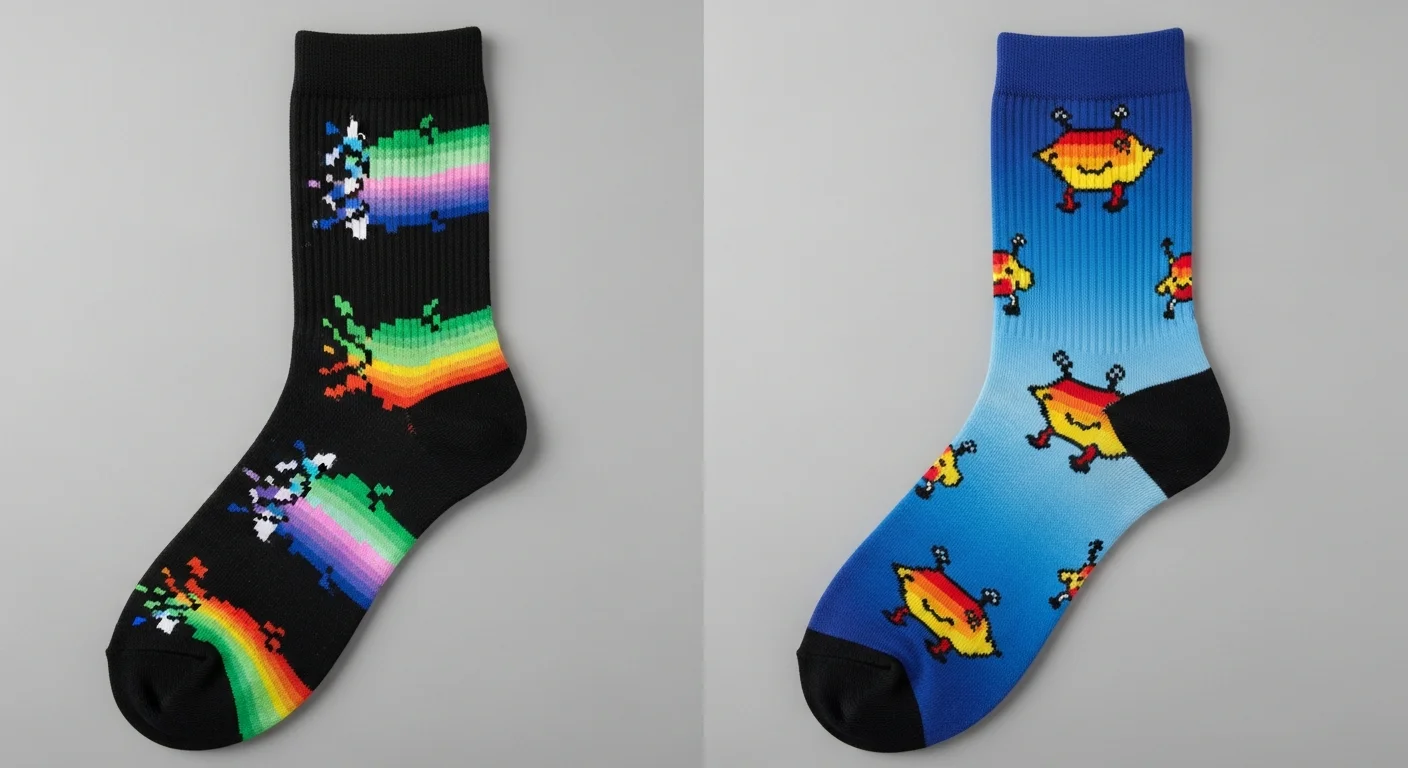
Ordering custom socks should be straightforward, but the gap between expectation and reality catches a surprising number of first-time buyers — and even some experienced ones. A survey of custom sock manufacturers found that 38% of first orders require at least one revision before production, and 12% of completed orders result in partial or full returns due to preventable mistakes. Each revision adds 5–10 business days to the timeline, and returns cost the buyer 15–30% of the order value in restocking and reshipping fees.
The good news: virtually every common mistake is avoidable with proper planning. This guide covers the ten most frequent errors, explains why they happen, and provides specific, actionable steps to sidestep each one. Whether this is a first custom sock order or a hundredth, this checklist ensures the final product matches the vision. The same principles apply to avoiding mistakes with custom jersey orders and other personalized apparel.
Mistake 1: Wrong Printing Method for Your Fabric
The most consequential mistake happens before any design work begins: selecting a printing method that is incompatible with the chosen sock fabric. Sublimation printing requires polyester-dominant fabric (minimum 65% polyester) because the sublimation ink bonds chemically with polyester fibers. Attempting sublimation on cotton or cotton-blend socks produces faded, washed-out results that deteriorate after a few washes.
Conversely, knit-in (jacquard) construction works with cotton, nylon, and blended fabrics but is limited to approximately 6–8 colors per design and cannot reproduce photographic images. Direct-to-garment (DTG) printing works on cotton but produces a raised ink layer that cracks over time on the high-flex areas of socks.
The fix: decide on fabric first, then choose the compatible printing method. For detailed compatibility guidance, the sock printing methods comparison provides a fabric-to-method matching chart.
Mistake 2: Low-Resolution Artwork
Submitting artwork below 300 DPI is the second most common mistake, affecting roughly 25% of first-time orders. Logos and graphics that look perfectly sharp on a computer screen may be only 72 DPI (screen resolution), which produces visibly pixelated, blurry results when printed on fabric. The difference is dramatic — fine lines become jagged, text edges blur, and color gradients show visible banding.

Vector files (SVG, AI, EPS) are always preferred because they scale to any size without quality loss. If only raster images (PNG, JPEG) are available, they must be at least 300 DPI at the actual print size — not at the screen display size. A quick check: zoom into the image at 400% on a computer. If edges look smooth, the resolution is likely adequate. If edges look staircase-stepped, the resolution is too low for print production.
Mistake 3: Ignoring Sock Stretch Distortion
Socks are not flat surfaces. When worn, the fabric stretches 15–20% horizontally across the foot and calf, which distorts the printed or knit design. A perfectly circular logo becomes an oval. A square pattern becomes a rectangle. Text becomes wider and shorter. Ignoring this distortion means the design that looked perfect on a flat sample appears warped on an actual foot.
The fix: work with the manufacturer to create a pre-distorted design template that accounts for the expected stretch. Most experienced sock manufacturers provide templates with stretch-compensation grids. Logos should be narrowed by 15–20% horizontally in the design file so they appear correctly proportioned when the sock stretches during wear. Always request a wear-test photo (not just a flat-lay photo) of the sample to verify proportions.
Mistake 4: Bad Color Contrast on a Small Canvas
Socks offer a much smaller design canvas than t-shirts, hoodies, or jerseys. The printable area on a crew sock calf panel is approximately 3 x 5 inches — smaller than a smartphone screen. Fine details and subtle color differences that work beautifully on a 12-inch t-shirt chest print become muddy and indistinguishable at sock scale.
The fix: increase contrast between design elements. Use dark logos on light sock bodies or light logos on dark sock bodies. Avoid placing design elements that are similar in value (lightness/darkness) adjacent to each other. Text should be at least 14-point equivalent at sock scale, and line weights should be at least 2 points. Test the design by printing it at actual sock size on paper — if details are hard to read at arm's length, they will be harder to read on a foot across the room. For color and contrast guidance across all custom apparel, see the fabric and color guide.
Mistake 5: Skipping Samples Before Bulk
Ordering 500 pairs without first approving a physical sample is a gamble that experienced buyers never take. Digital mockups and on-screen proofs cannot fully represent how colors translate to fabric, how the design handles stretch, or how the sock feels when worn. Colors that look identical on screen may differ noticeably in knit or sublimation output due to fabric dye absorption and screen calibration differences.
The fix: always order 2–3 physical samples before committing to a bulk production run. Samples typically cost $25–50 each and take 7–14 days to produce. Yes, this adds time and cost to the front end — but a $100 sample investment protects a $3,000+ bulk order from color mismatches, sizing issues, and design distortion that would otherwise require a full reprint.
Mistake 6: Wrong Sizing Collection Method
For group orders (teams, events, corporate programs), collecting accurate sizes from every recipient is logistically challenging — and doing it poorly results in a pile of unworn socks in the wrong sizes. The most common sizing mistake is letting recipients self-report using vague categories ("medium" or "large") without providing a size chart keyed to shoe size or foot length.
The fix: distribute a specific size chart that maps sock sizes to shoe sizes and foot measurements. The custom sock sizing guide provides downloadable charts for adult, youth, and toddler sizes. Use a digital form (Google Forms, Typeform, or a shared spreadsheet) with dropdown menus that force respondents to select from defined options rather than typing free-text sizes. Set a firm collection deadline at least two weeks before the order submission date.
Mistake 7: Overlooking Packaging and Presentation
Custom socks arrive from the manufacturer folded and bagged in plain poly bags by default. For personal use or team distribution, this is adequate. But for retail sales, corporate gifts, and fundraising programs, generic packaging undermines the perceived value of a premium custom product. Recipients judge product quality partly by packaging — a beautifully designed sock stuffed in a wrinkled clear bag sends the wrong message.

The fix: specify packaging at the time of ordering, not after production. Options include branded belly bands ($0.30–0.75/pair), custom hang tags ($0.15–0.40/pair), branded boxes ($1.50–3.00/pair), and gift bags ($0.50–1.25/pair). For retail or fundraising socks, belly bands with a UPC barcode and product information are the minimum professional standard. For a comprehensive pre-order checklist, see the bulk order checklist.
Mistake 8: Not Accounting for Production Timeline
Custom socks are not available overnight. Standard production takes 4–6 weeks from order confirmation to delivery, including 1–2 weeks for proofing, 2–3 weeks for manufacturing, and 1 week for shipping. Rush production (available from some manufacturers at a 20–40% surcharge) can compress this to 2–3 weeks but is not guaranteed during peak seasons (October–December).
The fix: work backward from the event date or deadline. If socks are needed for an October 15 homecoming game, the order should be placed by September 1 at the latest — and ideally by August 15 to allow buffer for revisions. Create a project timeline at the start of the ordering process: design finalization → sample approval → bulk order → production → shipping → delivery → distribution.
Mistake 9: Choosing the Cheapest Materials
The lowest-cost sock is rarely the best value. Socks manufactured with thin, low-nylon-content yarn (under 15% nylon) develop holes at the heel and toe within 10–20 wears. Cheap elastic loses its stretch after a few washes, causing socks to sag and slide. For a product that is worn, walked on, and washed repeatedly, material quality directly determines lifespan and wearer satisfaction.
The fix: request the full material composition breakdown before ordering. Quality custom socks should contain a minimum of 20% nylon for durability, 3–5% spandex for retention, and a primary fiber (cotton, polyester, bamboo, or merino) at 60–75%. The difference between a $3.50/pair sock and a $5.50/pair sock often comes down to nylon content and yarn thickness — both of which dramatically affect how long the sock lasts. Paying $2 more per pair for a sock that lasts three times longer is basic economics.
Mistake 10: Forgetting Care Instructions
Custom socks that are improperly washed fade, shrink, and deteriorate far faster than they should. Yet many custom sock orders ship without any care instructions, leaving recipients to guess whether their new socks can handle a hot wash or need cold-water delicacy. The result: preventable complaints about fading, pilling, and elastic failure that are actually laundry problems, not product defects.
The fix: include a care instruction card or tag with every pair. The essential information fits on a 2 x 3 inch card: machine wash cold, tumble dry low, do not bleach, do not iron directly on print. For sublimation-printed socks, add "wash inside out to extend print vibrancy." Care cards cost $0.05–0.15 per pair when ordered alongside the socks — a negligible investment that reduces complaints and returns significantly.
Frequently Asked Questions
What is the most expensive mistake to fix after production?
Color errors are the costliest because they typically require a full reprint of the entire order. A color that looks correct on screen but prints incorrectly on fabric — due to differences in screen calibration and dye absorption — cannot be corrected after production without starting over. Physical samples eliminate this risk for $25–50 per sample versus thousands for a reprint.
How many samples should be ordered before a bulk run?
Order a minimum of 2–3 samples in different sizes (typically Small, Large, and one middle size). Wear-test at least one sample for a full day to evaluate comfort, fit, and design appearance under real conditions. If the design has multiple colorways, sample each colorway separately. The total sample cost of $75–150 is insurance against a failed bulk order worth 10–50 times more.
Can mistakes be fixed after the bulk order is placed?
Once production begins, changes are extremely limited. Most manufacturers allow minor adjustments during the proofing stage (before knitting or printing starts), but any changes after production begins require a new production run at full cost. This is why the sample-approval stage is critical — it is the last opportunity to catch and correct issues at minimal cost.
Share this article
Written by
Marcus Chen
E-Commerce Growth & Merchandising Lead at RareCustom. MBA from Wharton, former Shopify strategist. Marcus has helped 200+ merchants launch custom merchandise lines and specializes in business strategy, bulk ordering, and fundraising programs.