Custom Sticker Size & Shape Guide: Dimensions for Every Use Case
Find the perfect sticker dimensions for any application with our complete size and shape guide covering circles, rectangles, die-cuts, bumper stickers, and sticker sheets.
Terrence Okafor
Head of Production at RareCustom with 20+ years in commercial printing. Terrence's hands-on experience with sticker dimensions and die-cutting ensures accurate sizing guidance.
Choosing the right size and shape for a custom sticker is one of the most consequential decisions in the entire design process. A beautifully illustrated logo sticker loses its impact if printed at one inch when the design demands three, and a bumper sticker cut to the wrong standard sticker dimensions will look awkward on any vehicle. Sticker size chart references and custom sticker measurements vary widely across the industry, which is why having a definitive guide to sticker dimensions — covering circle sticker sizes, rectangle sticker dimensions, square sticker sizes, oval sticker proportions, and custom shape sticker contours — saves time, money, and frustration. Whether you are creating laptop stickers, water bottle sticker dimensions for branded drinkware, or product label dimensions for retail packaging, the information in this guide will help you select the ideal dimensions before you ever open a design tool.
Beyond aesthetics, size directly affects cost, readability, and application success. A sticker that is too small sacrifices readability at small sizes — fine text becomes illegible and intricate details merge together. A sticker that is too large may not fit the intended surface, or it may push your per-unit cost beyond budget. Understanding standard sticker dimensions, sticker aspect ratio guidelines, and the relationship between portrait vs landscape sticker orientation and design proportions puts you in control of every project, from a single phone sticker size order to a 5,000-unit run of packaging sticker sizing for e-commerce fulfillment. If you are new to custom stickers entirely, start with our beginner's guide to custom stickers and then return here for dimension-specific guidance.
Standard Sticker Shapes
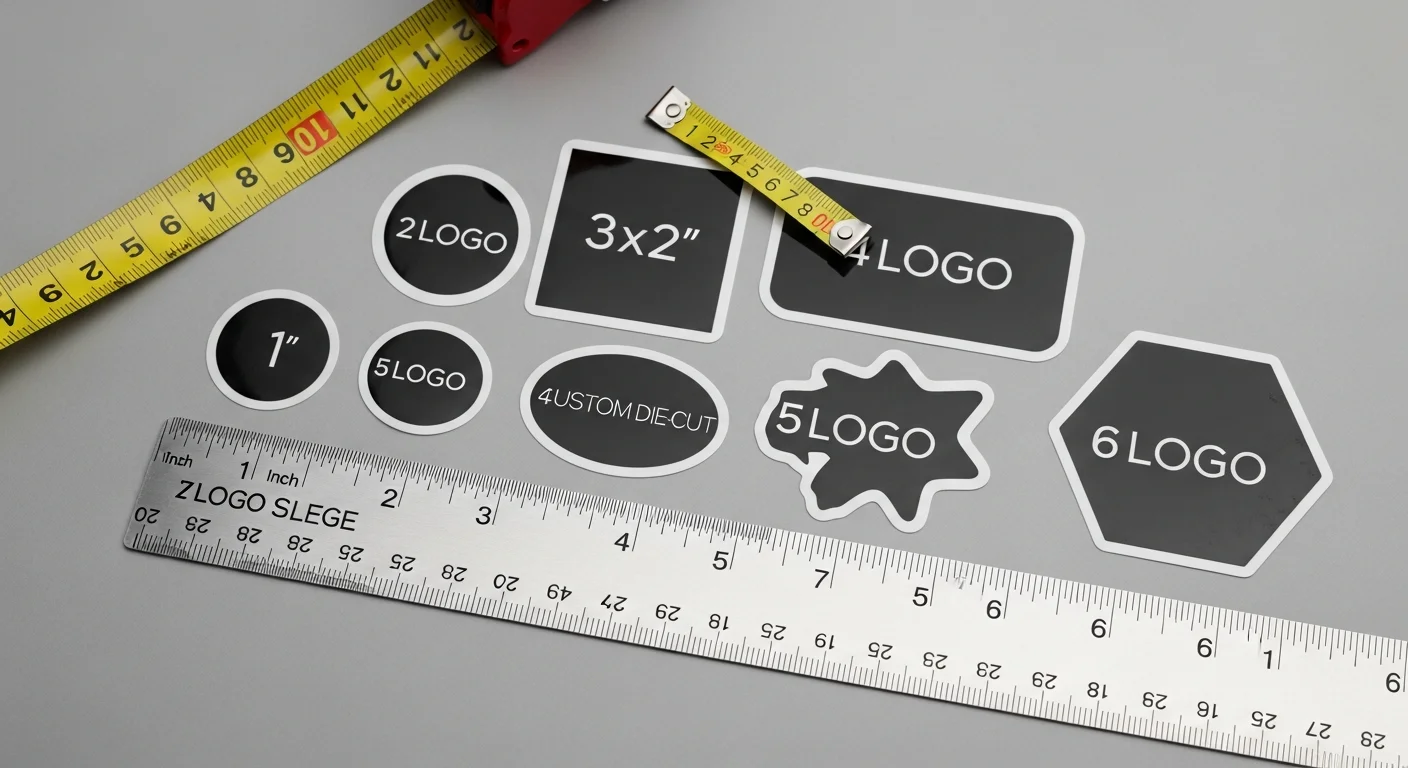
Every sticker begins with a shape, and the shape you choose determines how the design interacts with the surface it is applied to. The most common standard shapes are circles, squares, rectangles, ovals, and custom die-cut contours. Each shape carries its own visual associations and practical considerations.

Circles and rounds are the most popular shape in sticker printing. A round sticker 2 inch or round sticker 3 inch is universally recognized as a seal or badge, making circular label dimensions the default for product labels, envelope seals, and promotional giveaways. Circles draw the eye naturally and work equally well on flat surfaces and curved ones like water bottles or tumblers.
Squares and rectangles provide maximum printable area for a given footprint. Rectangle sticker dimensions are ideal for bumper stickers, address labels, and designs that include significant text. Square sticker sizes work well for QR codes, social media handles, and icon-style branding. The clean lines of rectangular and square shapes lend a professional, structured appearance.
Ovals offer a softer alternative to rectangles while still providing generous horizontal space. An oval sticker is a classic choice for product labels — wine bottles, cosmetics, and artisanal food packaging frequently use oval shapes because they wrap gracefully around curved surfaces.
Custom shape stickers — also called die-cut shape stickers — follow the exact contour of the artwork. A contour cut dimensions approach eliminates excess background material, leaving only the design itself. This is the premium option for brand logos, character illustrations, and any design where the silhouette is part of the identity. Learn more about cut types in our sticker types comparison guide.
Popular Sticker Sizes by Shape
While custom sticker measurements can be virtually any dimension, certain sizes have become industry standards because they balance visibility, cost, and application fit. Here is a comprehensive sticker size chart organized by shape.
Circle and Round Sticker Sizes
- 1 inch (25mm): Envelope seals, planner dots, small product labels
- 1.5 inch (38mm): Packaging seals, small logo stickers, price tags
- 2 inch (50mm): Most popular size — product labels, promotional stickers, jar lids
- 2.5 inch (63mm): Large seals, candle jar labels, retail stickers
- 3 inch (75mm): Water bottle stickers, laptop stickers, giveaway stickers
- 4 inch (100mm): Large promotional rounds, car window stickers
Square Sticker Sizes
- 1 x 1 inch: Tiny branding marks, dot seals
- 2 x 2 inch: Social media handle stickers, QR code stickers
- 3 x 3 inch: Standard promotional square, laptop decoration
- 4 x 4 inch: Large format branding, window stickers
Rectangle Sticker Sizes
- 1 x 2 inch: Small product labels, return address labels
- 2 x 3 inch: Medium labels, name badges
- 2 x 4 inch: Shipping labels, product information stickers
- 3 x 5 inch: Large labels, promotional rectangles
- 3.75 x 7.5 inch: Standard bumper sticker size
- 4 x 6 inch: Shipping labels, large information stickers
Oval Sticker Sizes
- 1.5 x 2.5 inch: Small oval product labels
- 2 x 3 inch: Medium oval — wine labels, cosmetics
- 3 x 5 inch: Large oval — artisan food labels, bath product labels
Size Recommendations by Application
The best sticker size depends entirely on where and how the sticker will be used. Matching sticker dimensions to the application surface ensures readability, aesthetic balance, and practical fit.

Laptop stickers: The ideal laptop sticker size ranges from 2 to 4 inches. Most laptop lids provide a 10 x 14 inch surface, so stickers in this range are large enough to be noticed without overwhelming the space. A 3-inch circle or a 2 x 3 inch rectangle are the most popular laptop sticker dimensions.
Water bottle stickers: Standard water bottle sticker dimensions are 2 to 3 inches for round stickers or 2 x 3 inches for rectangles. These sizes wrap well around cylindrical surfaces without excessive curling. For wider bottles like custom tumblers, you can go up to 3 x 4 inches.
Phone sticker size: Phone cases and phone backs typically accommodate stickers between 1.5 and 2.5 inches. Anything larger risks overhanging the edges or covering essential features like cameras and charging ports.
Product label dimensions: For packaging sticker sizing, measure the available label area on your product and leave at least a quarter inch of clearance on each side. Common product label dimensions include 2-inch circles for jar lids, 2 x 3 inch rectangles for box fronts, and 3 x 5 inch ovals for bottles. If you are using stickers for business branding and packaging, consistency in label sizing across your entire product line creates a cohesive brand identity.
Shipping label size: Standard shipping label size is 4 x 6 inches, which fits all major carrier requirements including USPS, UPS, and FedEx. Address labels typically measure 1 x 2.625 inches (Avery 5160 standard) or 2 x 4 inches for larger formats.
Minimum Sizes for Readability
One of the most common mistakes in sticker design is choosing a size that is too small for the design's level of detail. Readability at small sizes depends on font size, line weight, color contrast, and design complexity.
Minimum sticker size for text: If your sticker includes text, the minimum sticker size should allow for at least 6-point font at final print size. For most designs, this means a minimum of 1 inch in the smallest dimension. Stickers smaller than 1 inch should use only simple icons or single letters — no sentences, no fine details.
Minimum sticker size for logos: A logo sticker should be at least 1.5 inches in its longest dimension to remain recognizable. Logos with fine details, thin lines, or small text elements may require 2 inches or more. When designing for 1 inch or designing for 2 inch stickers, simplify the design by removing secondary elements and increasing line weights.
Minimum sticker size for photos: Photo-based stickers require at least 2 inches in the shortest dimension to render meaningful detail. Below that threshold, faces become unrecognizable and scenes lose their narrative clarity.
The maximum sticker size depends on your printer's capabilities and the application surface. Most digital sticker printers handle up to 12 x 18 inches, while wide-format printers can produce wall decals and floor graphics at 48 inches or larger.
Bumper Stickers — Standard Sizes and Rules
Bumper stickers occupy a unique position in the sticker world because their dimensions are constrained by the physical dimensions of vehicle bumpers and the need for readability at distance.

The standard bumper sticker dimensions are 3.75 x 7.5 inches (also expressed as 3 x 10 inches for political campaign stickers or 4 x 8 inches for wide-format designs). This bumper sticker size fits comfortably on most passenger vehicles without extending beyond the bumper edges. For trucks and SUVs, larger formats up to 4 x 15 inches are acceptable.
Car sticker size guidelines:
- Standard bumper sticker: 3.75 x 7.5 inches — fits all passenger cars
- Political/campaign bumper sticker: 3 x 10 inches — maximum horizontal visibility
- Mini bumper sticker: 3 x 5 inches — less intrusive, still readable at 10 feet
- Euro-style oval: 3.5 x 5.5 inches — classic international look
- Rear window sticker: 4 x 6 inches to 6 x 8 inches — high visibility
For bumper stickers, use fonts no smaller than 30 points at final size, maintain high color contrast between text and background, and keep the message to seven words or fewer for maximum readability at car-following distances. Always use waterproof vinyl material — paper stickers will not survive outdoor automotive conditions. For a deeper look at materials, consult our sticker materials guide.
Sticker Sheet Layouts
Sticker sheets allow multiple designs — or multiple copies of the same design — to be printed on a single backing sheet. Understanding sticker sheet dimensions and layout options helps you maximize the number of stickers per sheet while maintaining adequate spacing for clean peeling.

The two most common sticker sheet sizes are letter-size sticker sheet (8.5 x 11 inches) in North America and A4 sticker sheet (8.27 x 11.69 inches) internationally. Both sizes fit standard home and office printers, making them popular for small-batch custom sticker projects.
Layout spacing guidelines:
- Leave at least 0.125 inches (1/8 inch) between individual stickers for kiss-cut separation
- Maintain 0.25 inches (1/4 inch) margin from sheet edges to prevent misalignment during cutting
- For peel-friendly sheets, increase inter-sticker spacing to 0.1875 inches (3/16 inch)
- Group similar sizes together to minimize wasted backing material
Common sticker sheet configurations:
- 20 x 1-inch circles on a letter-size sheet (4 columns x 5 rows)
- 12 x 2-inch circles on a letter-size sheet (3 columns x 4 rows)
- 6 x 3-inch circles on a letter-size sheet (2 columns x 3 rows)
- 10 x 2 x 3 inch rectangles on a letter-size sheet (2 columns x 5 rows)
- Mixed sizes — combine large, medium, and small stickers on one sheet for variety packs
How Size Affects Pricing
Sticker size has a direct and significant impact on per-unit cost. Larger stickers use more material, more ink, and require more cutting time — all of which increase the price. Understanding the relationship between dimensions and cost helps you optimize your budget without sacrificing impact.
As a general rule, doubling the sticker's surface area increases material cost by approximately 80 to 100 percent. A 3-inch circle (7.07 square inches of area) costs roughly 75 percent more than a 2-inch circle (3.14 square inches). The sticker price comparison by size follows an approximate curve: each additional inch in diameter or length adds 25 to 40 percent to the per-unit cost, depending on material and quantity.
The 2 inch vs 3 inch cost difference is one of the most common pricing questions. At a quantity of 100 die-cut vinyl stickers, a 2-inch circle typically costs $0.35 to $0.55 per unit, while a 3-inch circle costs $0.55 to $0.85 per unit. At 1,000 units, quantity price breaks reduce both prices significantly — the 2-inch drops to $0.12 to $0.20 and the 3-inch to $0.18 to $0.30. For a full breakdown of all cost factors, read our complete sticker pricing guide.
To maximize value, choose the smallest size that maintains readability at small sizes and visual impact for your specific application. A 2-inch sticker is often the sweet spot for promotional giveaways — large enough to display a logo clearly, small enough to keep per-unit costs under $0.20 at moderate quantities.
Custom Shape Design Tips
Custom shape stickers — die-cut to follow the contour of the artwork — require special attention to dimensions and proportions. Unlike standard shapes where you simply select a size, die-cut shape sticker dimensions are determined by the bounding box of the design plus a small border allowance.
Bounding box approach: Measure the maximum width and maximum height of your design. These two dimensions define the bounding box, and your sticker will be quoted and priced based on the bounding box area. A sticker that is 2 inches wide and 3.5 inches tall has a bounding box of 2 x 3.5 inches, even if the contour cut dimensions eliminate 30 percent of that area.
Contour line rules:
- The contour cut should follow the artwork outline at a distance of 0.0625 inches (1/16 inch) to create a thin white border
- Avoid extremely narrow peninsulas or deep inlets in the contour — anything narrower than 0.25 inches may tear during peeling
- Interior cutouts (holes within the sticker) add complexity and cost — avoid them unless essential to the design
- Round sharp corners in the contour to a minimum radius of 0.0625 inches to prevent peeling and catching
For guidance on typography and color choices that complement custom shapes, see our fonts, colors, and layouts guide.
How to Measure for Your Application
Getting the right sticker size means measuring the application surface accurately before ordering. Here is a systematic approach to custom sticker measurements for any surface.
Step 1: Identify the available area. Measure the maximum width and height of the area where the sticker will be applied. For flat surfaces, use a ruler or tape measure. For curved surfaces like bottles or tumblers, wrap a flexible tape measure around the curve and note the arc length.
Step 2: Apply clearance margins. Subtract at least 0.25 inches from each edge of the available area. For packaging sticker sizing, a 0.5-inch margin on all sides ensures the sticker never wraps over an edge or interferes with seams, barcodes, or regulatory information.
Step 3: Consider the sticker aspect ratio. Match the sticker's width-to-height ratio to the available space. A portrait vs landscape sticker orientation can dramatically change how a design fits a surface — a tall, narrow product panel calls for a portrait-oriented rectangle, while a wide bumper calls for landscape orientation. Getting the design proportions right at this stage prevents costly reprints.
Step 4: Test with paper mockups. Cut a piece of paper to your planned sticker dimensions and hold it against the application surface. This simple test reveals sizing issues that measurements alone can miss — visual balance, proximity to competing elements, and whether the sticker overwhelms or underwhelms the surface.
Step 5: Order a sample. Before committing to a large quantity, order a small batch (even a single unit) to verify fit, readability, and adhesion on the actual surface. This is especially important for curved or textured surfaces where flat-surface measurements may not translate perfectly.
Find Your Perfect Size
The right sticker dimensions balance visibility, readability, budget, and application fit. Use the guidelines in this sticker size chart to narrow your options, then test with a mockup or sample before placing your full order. Whether you need a 1-inch envelope seal, a 3-inch laptop sticker, or a 3.75 x 7.5 inch bumper sticker, precision in sizing leads to professional results every time.
Ready to bring your perfectly sized sticker to life? Use our free design tool to set exact dimensions, upload your artwork, and preview your sticker at actual size before ordering. Or browse our full range of custom sticker options to see materials, finishes, and quantity pricing for every size.
Related Articles
Share this article
Written by
Terrence Okafor
Head of Production at RareCustom with 20+ years in commercial printing. Terrence's hands-on experience with sticker dimensions and die-cutting ensures accurate sizing guidance.