Custom Tumblers vs Custom Mugs: Which Is the Better Choice for Your Project?
Compare custom tumblers and custom mugs across insulation, portability, design surface, pricing, and best use cases. A data-driven guide to choosing the right custom drinkware.
Priya Shankar
Customer Success Lead at RareCustom. Priya helps customers choose between tumblers and mugs based on their specific needs and occasions.
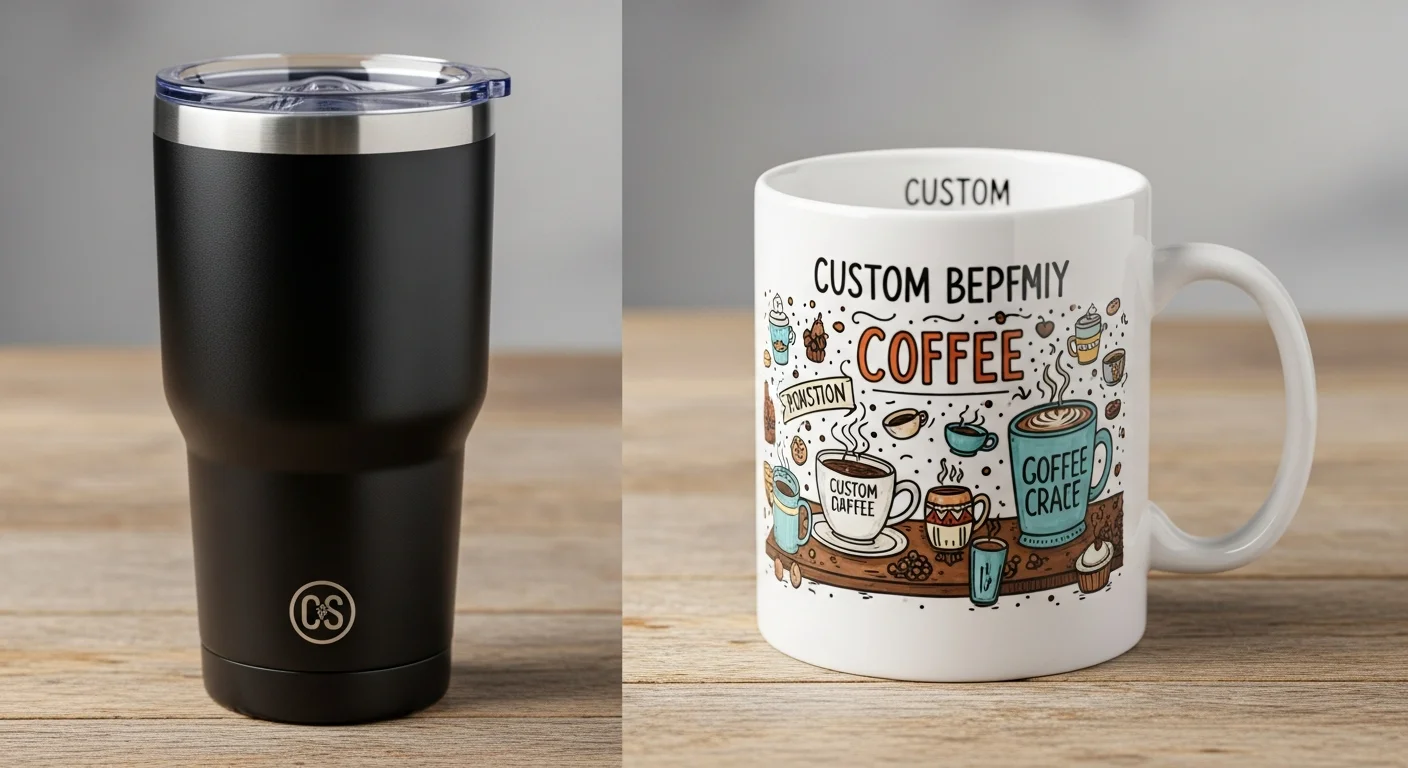
The choice between a custom tumbler and a custom mug is one of the most common decisions in the custom drinkware space, and the right answer depends entirely on how the product will be used, who will receive it, and what design goals the project needs to achieve. Tumblers and mugs serve the same fundamental purpose — holding beverages — but they differ dramatically in insulation performance, portability, design surface, decoration options, pricing, and perceived value. This tumbler vs mug comparison guide provides a data-driven framework for making the right choice, whether the project is a corporate gift program, an event favor, a personal gift, or a promotional giveaway.
Both product categories have devoted followings and legitimate advantages. A ceramic mug delivers warmth, nostalgia, and a generous flat print area that reproduces photographic detail beautifully. An insulated tumbler vs ceramic mug comparison reveals superior temperature retention, spill-proof portability, and an active lifestyle fit that mugs simply cannot match. The goal of this drinkware comparison guide is not to declare a universal winner but to map each product's strengths to the use cases where they matter most. For detailed specifications on tumbler materials, see the tumbler materials guide. For mug material options, read the mug materials comparison.
Tumblers and Mugs at a Glance
Before diving into the detailed comparison, a high-level overview establishes the key differences between the two drinkware categories. Custom tumblers are insulated cylindrical vessels with lids, designed for portability and temperature retention. Custom mugs are open-top vessels with handles, designed primarily for stationary use at a desk or table. The table below summarizes the core differences across the most important comparison criteria.
- Insulation: Tumblers — double-wall vacuum (hot 6–8 hrs, cold 12–24 hrs) | Mugs — none to minimal (hot 20–45 min)
- Portability: Tumblers — designed for travel, fits cupholders, spill-proof | Mugs — stationary, open top, spill risk
- Design surface: Tumblers — 360° cylindrical wrap | Mugs — primarily front and back flat panels
- Decoration: Tumblers — sublimation, laser engraving, UV print | Mugs — sublimation, screen printing, direct print
- Price range: Tumblers — $8 to $25 per unit (bulk) | Mugs — $4 to $15 per unit (bulk)
- Perceived value: Tumblers — higher (premium, modern) | Mugs — moderate (classic, familiar)
Insulation and Temperature Performance
Temperature performance is the most significant functional difference between tumblers and mugs. A standard stainless tumbler vs coffee mug comparison reveals a dramatic gap: a double-wall vacuum insulated tumbler keeps coffee hot for 6 to 8 hours and iced drinks cold for 12 to 24 hours, while a ceramic mug loses most of its heat within 20 to 45 minutes at room temperature. For users who sip slowly, work outdoors, or need their beverage to maintain temperature during a long commute, this difference alone often decides the category.

The insulation advantage extends to condensation. An iced drink in a ceramic mug or glass produces a puddle of condensation on the desk within minutes, potentially damaging papers, electronics, or wooden surfaces. A vacuum insulated tumbler eliminates condensation entirely because the outer wall stays at room temperature regardless of the beverage temperature inside. This makes tumblers the default choice for office-safe drinkware and environments where spill-proof drinkware is valued.
That said, mugs have their own thermal advantage in a specific context: hot drink drinkware for immediate consumption. Many coffee and tea enthusiasts prefer the experience of a warm ceramic mug in their hands — the tactile warmth is part of the ritual. A tumbler's insulation prevents this sensation, which some users find less satisfying for a quick morning coffee at the kitchen table. For these users, the mug's lack of insulation is actually a feature, not a flaw.
Portability and Lifestyle Fit
Tumbler portability is one of its defining advantages. With a secure lid, slim profile, and cupholder-compatible dimensions, a tumbler travels anywhere — commutes, gym sessions, hikes, road trips, and office meetings. The spill-proof lid with either a sip opening or straw makes tumblers the only practical choice for on-the-go beverages and environments where an open container would be risky (cars, backpacks, gym bags, strollers).
Mugs, by contrast, are inherently stationary. The open top and handle design work perfectly at a desk drinkware station, kitchen counter, or dining table, but they are impractical for transport. Travel mugs with lids exist as a hybrid solution, but they sacrifice the classic mug aesthetic and handle ergonomics that make mugs appealing in the first place. For projects where the drinkware will primarily be used in a fixed location — an office desk, a home kitchen, a cafe — a mug's stationary design is perfectly suited to the use case.
The lifestyle question becomes: does the target audience spend more time at a desk or on the move? Corporate employees who commute and attend meetings throughout the day benefit from travel drinkware (tumblers). Creative professionals who work from a single studio or home office may prefer the familiar comfort of a desk mug. Understanding the audience's daily pattern is the key to choosing the right category.
Weight is another portability factor worth considering. A 20oz stainless steel tumbler weighs approximately 11 to 13 ounces empty, while an 11oz ceramic mug weighs roughly 12 to 14 ounces. The difference is minimal until liquid is added — a full 20oz tumbler weighs over 30 ounces total, while a full 11oz mug weighs about 25 ounces. For bag or purse carry, the tumbler's secure lid and slimmer profile make it the clear winner despite the slight weight increase. For a detailed breakdown of tumbler dimensions by size, see the tumbler size guide.
Decoration Options Compared
Both tumblers and mugs support high-quality custom decoration, but the available methods and their results differ in ways that affect design decisions. Custom tumblers can be decorated via sublimation (full-color wraps on coated surfaces), laser engraving (metallic reveal on powder-coated stainless steel), and UV printing (direct-to-substrate on any surface). Custom mugs are typically decorated via sublimation (full-color on white ceramic), screen printing (1–4 colors on any surface), and direct ceramic printing (kiln-fired for maximum durability).
The design surface comparison reveals that tumblers offer a continuous 360-degree cylindrical canvas, while mugs offer two primary flat panels (front and back) separated by the handle. Tumblers excel at full-wrap panoramic designs, continuous patterns, and all-over artwork. Mugs excel at front-and-back compositions — a logo on the front, a message on the back — that take advantage of the natural "two-sided" presentation created by the handle orientation.
For detailed decoration method comparisons, see the tumbler decoration methods guide and the mug printing methods comparison.
Design Surface and Print Area
The mug print area vs tumbler print area comparison shows that tumblers generally offer more total printable surface but mugs offer a flatter, more distortion-free canvas. A standard 11oz ceramic mug provides approximately 8.5 inches wide by 3.5 inches tall of printable space on the front panel — a flat rectangle that reproduces text, photos, and logos without the curvature distortion that tumblers introduce.

A 20oz skinny tumbler provides approximately 9.3 inches wide by 5.5 inches tall of total printable surface — more total area but distributed across a curved cylinder. This curvature means that elements at the edges of a full-wrap design are viewed at an angle, which can distort proportions and make text harder to read. Single-side tumbler designs avoid this issue by concentrating the artwork on the front face, but they sacrifice the full-wrap capability that makes tumblers unique.
For projects where photographic accuracy and text clarity are paramount — detailed family portraits, small text quotes, or intricate illustrations — mugs may produce a more faithful reproduction. For bold graphics, patterns, and designs that benefit from a panoramic canvas, tumblers offer a more dynamic presentation. The tumbler size guide provides print area dimensions for every standard size.
Pricing Comparison
On a straight tumbler price vs mug price comparison, mugs are typically 30 to 50 percent less expensive per unit. A standard 11oz white ceramic mug with full-color sublimation starts at $4 to $7 in bulk, while a comparable 20oz stainless steel tumbler with sublimation starts at $9 to $14 in bulk. The price gap narrows at higher quantities and widens with premium tumbler features (copper insulation, handles, textured coatings).

However, the cost per unit comparison tells only part of the story. When factoring in perceived value, daily usage frequency, and useful lifespan, the economics shift. A tumbler used 3 to 5 times daily for 3 or more years generates significantly more brand impressions than a mug used once or twice daily and eventually chipped or broken. The tumbler perceived value — the amount a recipient believes the item is worth — is consistently 40 to 60 percent higher than a mug at equivalent price points, according to promotional products industry surveys. This perception gap means a $12 tumbler feels like a more generous and thoughtful gift than a $12 mug, which influences recipient satisfaction and brand goodwill.
For a detailed breakdown of tumbler pricing by material, method, and quantity, see the tumbler pricing guide. For mug pricing details, read the mug pricing breakdown.
Best Use Cases for Tumblers
Tumblers outperform mugs in use cases that involve mobility, outdoor environments, temperature sensitivity, or a desire to project a modern, premium aesthetic. The following scenarios strongly favor choosing a tumbler over a mug.

- Corporate gifts for active employees: Sales teams, field workers, and commuters benefit from corporate gift tumbler vs mug scenarios where portability and spill-proof design matter. A tumbler travels to meetings, client sites, and vehicles.
- Event favors for outdoor celebrations: Weddings, barbecues, pool parties, and sporting events need drinkware that handles temperature extremes and resists breakage. Stainless steel tumblers are virtually indestructible.
- Cold drink drinkware: Iced coffee, smoothies, and water stay cold for hours in an insulated tumbler. Mugs offer no cold retention and produce condensation.
- Health and fitness audiences: Gym-goers, hikers, and wellness enthusiasts value the large capacity and temperature retention of 30oz and 40oz tumblers as hydration tools.
- Premium branding: When the gift psychology of the promotion matters — employee retention gifts, executive client gifts, VIP event favors — a tumbler's higher perceived value delivers stronger emotional impact.
Best Use Cases for Mugs
Mugs remain the superior choice for use cases centered on nostalgia, desk-based routines, budget-conscious large orders, and designs that require a flat, distortion-free canvas. The mug nostalgia factor is a genuine emotional advantage: a warm ceramic mug evokes comfort, home, and routine in a way that a sleek stainless tumbler does not.
- Office desk companions: Employees who work from a fixed desk all day and enjoy the ritual of a warm mug beside their keyboard. The handle ergonomics and open-top design feel natural for stationary sipping.
- Hot drink drinkware: Tea and coffee purists who want to feel the warmth of the mug in their hands and appreciate the way ceramic interacts with beverage temperature.
- Budget-friendly bulk orders: When the budget is $5 per unit or less, ceramic mugs provide a quality custom product at a price point that tumblers cannot match.
- Photo-heavy designs: Family portraits, pet photos, and detailed illustrations reproduce more faithfully on the flat surface of a mug than on the curved surface of a tumbler.
- Fundraising and cause marketing: Schools, nonprofits, and community organizations benefit from mugs' lower per-unit cost when profit margins on each sale are critical.
- Kitchen and home décor: A mug displayed on a shelf, in a cabinet, or on a mug tree serves as both functional drinkware and decorative item — a dual-purpose appeal that tumblers lack in home settings.
The mug nostalgia factor should not be underestimated, especially for gift-giving contexts. There is a deeply embedded cultural association between a personalized mug and a thoughtful, personal gift. Phrases like "World's Best Dad" and "Keep Calm and Carry On" have been mug staples for decades, and that familiarity creates an emotional shortcut that tumblers have not yet fully replicated. For gifts where sentimental resonance matters more than practical functionality — a grandparent's birthday, a teacher appreciation gift, a "thinking of you" surprise — a mug often delivers a stronger emotional response than a tumbler, even if the tumbler is objectively more useful.
When to Offer Both
The most strategic approach for many projects is offering both drinkware types rather than choosing one over the other. Corporate gift programs, for example, can offer a tumbler for commuters and a mug for desk workers, allowing each recipient to choose the format that fits their daily routine. This dual-option approach increases gift satisfaction because recipients self-select the product that matches their lifestyle rather than receiving a one-size-fits-all item they may not use.
Event planners can also benefit from a mixed approach. Wedding couples might choose 12oz wine tumblers as the general guest favor and 20oz branded tumblers for the bridal party, while also offering custom mugs as a secondary favor option for guests who prefer desk drinkware. E-commerce brands selling custom drinkware should list both categories to capture the full spectrum of customer intent — some shoppers arrive specifically seeking a versatile beverage container (tumbler), while others want a classic ceramic coffee mug.
When offering both, maintain visual consistency by using the same color palette, typography, and brand elements across both product types. This creates a cohesive drinkware collection that looks intentional rather than fragmented. Coordinated tumbler and mug sets also make excellent gift bundles with a higher perceived value than either product alone.
From a bulk ordering comparison perspective, ordering both tumblers and mugs in a single purchase often qualifies for higher volume discount tiers than ordering each separately. If the combined quantity crosses a discount threshold (for example, 100 total units across both products), the per-unit savings on each item improves. This approach works particularly well for corporate gift programs that want to offer recipients a choice: "Pick your preferred drinkware" creates a more personalized experience while still maintaining brand consistency across the collection. For detailed pricing across both categories, see the tumbler pricing guide.
Choose Your Custom Drinkware
The tumbler vs mug decision ultimately comes down to three questions: Where will it be used? Who will use it? What impression should it make? For portability, insulation, and premium perception, choose a custom tumbler. For desk comfort, nostalgia, and budget efficiency, choose a custom mug. For maximum flexibility and recipient satisfaction, consider offering both.
Start designing your ideal custom drinkware today with our free design tool. Upload your artwork, preview it on any tumbler or mug, and see real-time pricing that updates as you customize. No minimums on either product category, free digital proofs, and quality you can trust — because whether it holds a morning espresso or an afternoon iced coffee, the drinkware should be as good as the design on it.
Related Articles
- Sublimation vs Laser Engraving vs UV Printing for Tumblers
- Stainless Steel vs Plastic vs Glass: Choosing the Right Tumbler
- Custom Tumbler Size Guide: From 12oz to 40oz
- Custom Tumbler Pricing Guide: Complete Cost Breakdown
- Sublimation vs Screen Printing vs Vinyl for Mugs (Mugs Cluster)
- Custom Mug Pricing Breakdown (Mugs Cluster)
- Ceramic vs Glass vs Stainless Steel Mugs (Mugs Cluster)
Share this article
Written by
Priya Shankar
Customer Success Lead at RareCustom. Priya helps customers choose between tumblers and mugs based on their specific needs and occasions.